Featured Post

SIX KEYS TO A LITERARY GENETIC CODE

In essays on the subject of centricity, I've most often used the image of a geometrical circle, which, as I explained here,  owes someth...

Showing posts with label robert kanigher. Show all posts

Tuesday, October 14, 2025

MYTHCOMICS: "THE LAST DAY OF THE AMAZONS" (WONDER WOMAN #149, 1964)


In my overview of Robert Kanigher's WONDER WOMAN comics of the 1960s, I asserted that the writer hardly ever made much use of the mythical elements present in the mythos bequeathed to DC by creator William Marston. In contrast to Kanigher's contemporaneous METAL MEN, wherein the author sometimes managed to imbed his juvenile formulas with the substance of epistemological myths, Kanigher wrote as if he thought his readers too simple-minded to care about consistency or elucidation of fantasy-concepts. However, at the end of the essay I added that I found one story that achieved mythopoeic concrescence. True, it's flawed. A lot of time is wasted with a side-plot showing Wonder Woman in her Diana Prince ID, where she has to rescue a rocket crew from disaster without revealing her identity to Steve Trevor. However, one of the corniest elements found in many WW stories of the time actually works to the advantage of LAST DAY OF THE AMAZONS. 

I noted in the overview that I was no fan of Kanigher's "Wonder Woman family." a sterile emulation of the Weisinger "Superman family." Back in the Golden Age Wonder Woman was always an adult. Her only family member was Hippolyta, the immortal queen of Paradise Isle, who created her daughter Diana from clay with the help of the Amazons' patron deities Athena and Aphrodite. In the late 1950s and early 1960s, though, Kanigher added to Hippolyta's brood two time-tossed incarnations of Diana, one the teenaged Wonder Girl, the other the toddler Wonder Tot. By 1964, the time of DAY, Hippolyta has evidently grown contemptuous of the perils of time-paradoxes, for all three versions of Diana co-exist on Paradise Isle and have adventures together. They begin DAY with all four Amazons asleep, though all the later scenes are in daytime, so apparently the catastrophe waits until dawn to strike. A massive earthquake strikes the island, and the Amazons have to form a "human chain"-- a favorite Kanigher trope-- to keep Wonder Tot from falling into a chasm.


The Amazonian quartet goes outside. Their two patron deities materialize and tell them that Paradise Island is falling apart due to Hippolyta's transgression against Athena's law, that no man may be allowed to tread upon a sanctuary meant only for the immortal Amazons. The presence of a man in Greek armor, "The Prince," is at the root of the trouble, but since Hippolyta insists on explaining how things came to this pass, even juvenile readers would have figured out that DAY is a tale beginning "in media res," which gives Kanigher the chance to start things off with a bang before settling in for a big explanation.


Hippolyta briefly mentions that her unnamed Prince was her consort, if not husband, back in the days before she was granted immortality. However, he was lost at sea and presumed dead. However, because Kanigher also wants to acquaint his readers with the lives of Hippolyta's daughters, the exegesis is delayed so that the reader can see a lot of incidents in the lives of the three Wonders. Eleven pages go by before Kanigher tips his hand. In contrast to all the other stories in which Hippolyta sends her children off to have heady adventures, this time she's haunted by the memory of her lost love. In a nice bit of irony, Wonder Tot swears to stay with her lonely old mother, but then in a short time the child ventures forth to have a one-page exploit with her wacky buddy Mister Genie. 


While Hippolyta's lost prince was never mentioned before this story or afterward, at this time the amazon queen feels her lovelorn state exacerbated by the fact that all of her daughters have interesting, vital lives. So to anneal her sorrow, Hippolyta creates a stone statue of her beloved. But as she goes to sleep-- presumably the night immediately before the earthquake-- she makes the mistake of praising only the sculpting skill lent her by Athena for giving her a semblance of her lost love. By doing this, Hippolyta emulates the act by which she brought her child Diana to life from clay, though without any intention of making the stone come to life.


According to Kanigher's cosmos, though, Aphrodite was responsible for imbuing the clay statue of Diana with life. The love-goddess is affronted that her worshipper Hippolyta would credit Athena with anything concerning love. There's some justice in this. Athena, the virgin war-goddess, is the image on which all of the Amazons have modeled their (presumably celibate) lives. They seem to evoke Aphrodite not with respect to forging romantic alliances-- although both Wonder Woman and Wonder Girl are pursued by attentive males-- but with respect to invoking Aphrodite in a vague spirit of beneficence, one that Marston tended to call "lovingkindness." This arrangement seems to have been okay with Aphrodite until Hippolyta credits Athena with anything pertaining to the exigencies of romantic love. This is probably the only time in Kanigher's career that he portrays the Greek gods of the WONDER WOMAN cosmos as being as fractious and petty as they often are in traditional stories.


A massive fire-creature sticks his head out of a crevasse, and wonder of wonders, Kanigher actually explains that this is "the God of Earthquakes," whom Athena presumably summoned to devastate Paradise Island. All of the Wonder Family members try to sacrifice themselves to save the other (barely seen) Amazons, and once again they form a human chain to support one another. Aphrodite is not impressed by acts of heroism; she only wants to see a sacrifice rooted in romantic love. The animated statue-- which for all we know might incorporate the long-dead spirit of the Prince-- then gives the love-goddess the sacrifice she wants. Once his intrusive male presence has vanished from the island, Athena is free to cancel the execution, and the goddess leave.

Given that almost every bit of characterization in Kanigher's WONDER WOMAN is annoyingly flat, the conclusion proves eyebrow-raising. The three daughters realize that their mother has lost her only love a second time, and they try to soothe Hippolyta by telling her that they'll devote more time to her. But Hippolyta's last words are those of an aging (and not immortal) parent ceding power to the younger generation, giving them permission to live their own lives, no matter how it isolates her. Perhaps Kanigher allowed himself this isolated moment of sensitivity because mortal men, as much as mortal women, feel time's winged chariot hurrying near. And even an immortal queen, devoted to the battle-ethos of Athena, must satisfy all forms of erotic romance, even in the form of memories, to the exclusive claims of the Goddess of Love.                

Friday, October 10, 2025

AMAZON ATROPHY

 Yesterday I decided to do a deep dive into a section of the shallow pool known as "Robert Kanigher's WONDER WOMAN." I didn't want to try reading everything that he might have written since he (almost exclusively) took over writing the DC feature following the passing of William Marston in 1947. But since I think Kanigher was a guy who had real talent, I wanted to get as much info as possible about why he didn't seem to show any of that creative ability during the decade of the sixties. He was doing some good scripts in that decade for BATMAN, METAL MEN, and the war books, but as far as WONDER WOMAN was concerned, a Kanigher script from the 1960s reads just like anything he did in the 1950s. I don't fault him so much for being dull in the 1950s, because the majority of the stories from DC Comics were dull then, as the company sought to keep its squeaky-clean image amid industry controversies. But why couldn't he seem to craft a decent story for the Amazing Amazon?

In this essay I suggested one reason:  

"[Kanigher's] use of myth-ideas was both derivative and desultory, giving one the impression that he could barely summon any enthusiasm for the series, even when dealing with characters he himself created, or at least substantially re-worked, like the idea of “Wonder Woman as a girl.” Another reason may have related to his insider knowledge that DC wanted to keep control of the franchise in those days, before the company bought the character from the Marston estate outright. His knowing that the company wanted to keep their hold on the character, and that they didn't seem to have any concept of what to do with the Amazon except to emulate Marston (but without as much bondage), probably contributed to Kanigher's sense that he could do anything he wanted, as long as he kept turning in scripts on time.   

I started collecting superhero comics after the debut of the Batman teleseries, so Kanigher's WONDER WOMAN was my first experience with the heroine. I remember thinking at some point that I didn't initially like the Andru-Esposito art or the romantic aspect of the Amazon's ongoing romance with Steve Trevor. Was any of that just the usual antipathy of a pre-teen toward matters of sex? Possibly, but if so, the phase didn't last, as I welcomed the change to "Mod Wonder Woman" with the new editorship of Mike Sekowsky, and even bought those issues off the stands new-- and there was a fair amount of romance appeared in those stories.


I didn't confine my study only to issues in the 1960s but rather extended it from issue 105 (April 1959) through issue #176 (May-June 1968). I did so because #105 introduced the aforementioned "Wonder Woman as a girl." Since these stories usually took place before the juvenile Wonder Woman became a superhero, a lot of them took place in the fantasy-domain of Paradise Island and various vague fantasy-domains. But here, as described, Kanigher just tossed out his concepts willy-nilly, with no attempt to ground them in any knowledge-system, as one could find in titles of the time like FLASH and SUPERMAN. Thus even though Wonder Girl might have been introduced to give the title "teen appeal," both her character and her adventures were superficial. As time went on, Kanigher devised ways for all three members of the Wonder Family -- Wonder Girl, her adult self, and Wonder Tot, a baby-wonder-- to appear in the same adventures. But this merely made Kanigher's attempt to imitate the "Superman Family" of the more popular SUPERMAN titles more forced and therefore pathetic. In both sets of stories, the authors were attempting to get readers invested in the recursive nature of the SUPERMAN and WONDER WOMAN worlds; worlds in which repetition of motifs was intended to be reassuring. But though there were a lot of dull 1950s SUPERMAN stories too, there were also tales that sustained a sense of juvenile charm, particularly in the late 1950s, when editor Mort Weisinger became somewhat more venturesome in his choice of story-subjects.    


The Marston feminist message was given no more than lip service during the sixties decade, even in the brief period when Kanigher and his artists emulated the general look of Golden Age WONDER WOMAN. However, there was an aspect of the Superman books that both Marston and Kanigher imitated: the hero's use of incredible powers to perform unique feats. Kanigher's concoctions of bizarre tasks were no better or worse than those of Marston, but generally speaking Marston usually provided some rationale for the menaces WW faced. In the above excerpt from WW #154, Kanigher wastes no energy figuring out why a giant flaming humanoid happens to be dwelling right under Paradise Island. Is the Boiling Man a member of a subterranean race? An ancient Greek Titan confined to the underworld by the Olympians? 
It's astounding that Kanigher worked in comic books for so long but had so little insight into what his audience wanted. Yes, the flashy super-feats might be the primary concern of kid-audiences. But Marston sold well in part because he challenged his audience, while Kanigher seemed to have had a low opinion of kids' capacities.


Yet there was one type of super-feat Kanigher avoided in the six years of my survey: the hand-to-hand fight-scene. Marston's Amazon was a jock; she liked not only entering athletic contests but challenging opponents, particularly conceited males, to fights. Kanigher didn't show any reluctance to show his Golden Age creation Black Canary duking it out with male crooks, so he wasn't personally repelled by "tough females." Even his female robot Tina of the contemporaneous METAL MEN was a spitfire. So it's possible that the low incidence of fight-scenes in the five-plus years from #105 to #155 (July 1965) was a dictate from DC editorial not to make the heroine seem too masculine, since that had been a major complaint about the character from the fanatic Frederic Wertham, the man whose fulminations made the 1955 Comics Code necessary for the comics-industry. However, evidently by 1965 sales on WW had declined enough for Kanigher to attempt impressing readers with his Marston-imitation, beginning in issue #156. Sales probably did not appreciably improve, but this new direction resulted in much more physical violence between the Amazon and her opponents for the remaining three-or-so years of Kanigher's tenure. Here are a few examples from that period:


This development certainly allowed artists Andru and Esposito to make the art more dynamic. Another possible factor is that even though the Marston-emulation took place before the debut of BATMAN in January 1966, by 1965 many DC superheroes began getting more "punchy," possibly in recognition that Marvel Comics was cutting into DC's action with the hyperkinetic fight-scenes of Kirby, Ditko and others. But apparently, even once the Marston-schtick ran its course in about eight issues, Wonder Woman's sales did not improve despite more fight-scenes either. This resulted in the aforementioned phase of "Mod Wonder Woman," which seemed to do a little better for the first year before its sales also declined.

Of all the stories I studied, only one merited the designation of a myth-comic, and I'll devote a separate essay to Kanigher's only exceptional WW story of the 1960s.   

Saturday, May 31, 2025

NEAR-MYTHS: "SEALED IN BLOOD" (SGT. ROCK ANNUAL #2, 1982)

For the last Memorial Day, I decided to read some random war comics from DC, few of which I ever sampled previously. I was aware that in the late 1950s, DC's war titles, generally under the editorship of Robert Kanigher, began to evolve a regular lineup of featured characters, some of whom then began to cross over frequently in the sixties, seventies and eighties. The particular 1980s crossover I encountered was not surprising for its crossover of heroes, but for the way that Kanigher-- who certainly was not given to the Stan Lee method of endlessly recycling even the most obscure antagonists-- decided to exhume a "bad guy" so obscure, she isn't even indexed in Grand Comics Database.

So far as I can tell, the one and only time Nazi officer Helga Voss appeared in a comic was SGT. ROCK #422 (1978.)


 Lieutenant Helga Voss introduces herself to the redoubtable Rock by machine-gunning a small squad of Brit soldiers, fighting with the sergeant, and then trying to get him killed by a patrol of her countrymen, all of whom Rock kills. All the backstory we get is that Helga's father and brothers died in the field, so she took their place. Rock takes Helga prisoner and returns with her to his unit.


Once Helga encounters Easy Company, she finds it "easy" to make all the grunts drool over her, except for Rock-- and according to Kanigher's hints and Frank Redondo's art, even Rock is not insensible to her charms. Despite his refusal to let her cozy up, she still takes him by surprise, steals a gun and kills one of Rock's men. (Not one of the well-known ones, of course.) She leads the "feldwebel," as she repeatedly calls him, into a German ambush, but Rock triumphs even though Helga escapes. Though she swears to make another run at Rock, Kanigher apparently dropped her as a potential menace.


     Four years later, Kanigher and artist Dan Speigle launched SGT ROCK ANNUAL #2-- which I assume had a #1 under some other title. In the story proper, a flashforward scene shows Rock in the same situation seen on the cover-- Rock hanging from a cable-car while being menaced by a man with a gun-- but now we learn that that the would-be killer is Frank Rock's only brother Larry, who's fighting in the same war, but in the Philippines.


A montage, apparently in Rock's mind, rehearses how Larry, despite grievous wounds, saves the famed General MacArthur from an assassination attempt. Larry later saves MacArthur from a second attempt, and the creator of "Enemy Ace" gets into heavy poetry, using fraternal imagery to describe  Larry and the pilot of a zero plane as "murderous twins," until their bond is severed by the breaking of an "umbilical cord of madness."

Back in Rock's terrain, he gets two sets of orders (one open, one sealed) from fellow warcomics-star Lieutenant JEB Stuart and his "Haunted Tank," complete with the tank's resident Civil War ghost.  
   
When a battle temporarily incapacitates the Haunted Tank, Easy Company proceeds to follow the already opened orders, to seek out a German castle and to liberate a prisoner there. They encounter a ten-foot-tall Kraut robot whom the soldiers nickname "Goliath" before eventually taking him out with their guns. 


After the robot's demise, another pitched battle erupts, but this time Easy gets help from frequent guest-star Mademoiselle Marie, as well as returning evildoer Helga Voss. Given that Kanigher and others had already established an ongoing relationship between Rock and Marie, it's tempting to think that the only reason Kanigher revived Helga for just a few pages was to portray a machine-gun "catfight" between the French brunette and the ice-blonde Nazi.


    In order to justify the third hero-crossover, Rock gets an air-lift to the German castle by "Navajo air ace Johnny Cloud," while the rest of Easy keeps footing it overland. Somehow Marie and Cloud both know that Rock carries sealed orders that he can't open till he reaches the castle. Once Rock infiltrates the castle, he makes two discoveries. One is that Rock's frequent sparring partner The Iron Major is present in the schloss. The other is that the orders tell him to kill the prisoner if he can't rescue him. A page or so later, Rock makes a third discovery-- the identity of the prisoner-- but the more astute readers will probably have figured that Kanigher didn't keep bringing up Larry Rock for no reason.


As a minor twist, Kanigher reveals that the Iron Major is of an older German echelon and so doesn't approve of Nazi depravity. The depraved Nazi colonel orders the Major executed, so Rock has to save his enemy from his other enemies, and then clobber the Major when the more cultured villain gets in the hero's way. Surprisingly, Kanigher rushes past the revelation that the prisoner is Larry Rock-- maybe he thought it was so obvious, everyone would have seen the handwriting on the wall. The two Rocks escape the Germans by cable-car, but Larry's old wound makes him irrational. He demands his brother kill him to keep Larry from falling into enemy hands and being tortured to reveal vital information.  


For the big dramatic finish, Larry vanishes into the icy mountain wastes, sparing Brother Frank from having to execute the prisoner as his orders demanded. So even if the orders were "sealed in blood"-- that of fraternal blood, blood-ties that couldn't be allowed to trump the needs of the military-- Frank Rock actually defies those orders for sake of brotherly love. Larry actually has no good reason to tell Frank to kill him-- once they're on the cable-car, they're no longer in danger of recapture-- but I guess Kanigher used Larry's head-wound to justify the big sacrificial moment. Yet though it's a very contrived tale, there's just a few myth-tropes here worth preserving. And from what I've heard, I believe Larry Rock comes back later, so the big sacrifice gets overturned for the sake of another story in the Rock mythos. 
 

Wednesday, December 11, 2024

CURIOSITIES #41: WONDER WOMAN'S "NEW GOLDEN AGE"


In WONDER WOMAN #156 (1965), editor/writer Robert Kanigher endeavored to goose sales by announcing a "New Golden Age" for the heroine. This brief reboot of the low-rated WW series only lasted about eight more issues, in which the words "Golden Age" would often be used on covers or splash pages. Kanigher revived a smattering of villains introduced by William Moulton Marston in the 1940s, and he even had his regular artists, Ross Andru and Mike Esposito, emulate the drawing-style of the feature's original artist H.G. Peter. Once sales came in, probably indicating little if any improvement, Kanigher and the artists largely went back to what they'd been doing on the title in years previous.

One might think that Kanigher, who was himself a graduate of the Golden Age hard-knocks school, might have been able to capture something of the resonance of the Marston series. Indeed, for some years after Marston's passing, Kanigher even wrote scripts for Peter before DC gave the older artist his walking-papers. Since I haven't read every Kanigher WW script from his run of twenty-plus years, I can't make a decisive statement about why the feature began to lose readers over time, and I can't even say when the decline began. But my considered opinion is that Kanigher generally imitated the daffier aspects of Marston's scripts-- things like having Amazons riding kangaroos-- but he couldn't deliver on the heartfelt meaning that Moulton conveyed in his scripts. I'm not saying that any of Moulton's 1940s readers were necessarily converted to his unique feminist philosophy, or even that those readers understood what Moulton was talking about. But young readers are often attracted by the sense of an author's conviction in his principles, as long as he makes those principles into good stories. That's something Moulton was often able to do, in contrast to the modern generation of Progressive political comics-writers.

In summation, I think Kanigher looked around at the sales success of other DC revivals of Golden Age characters-- one of whom, THE FLASH, Kanigher had written at the dawn of the Silver Age, circa 1956. But the FLASH stories produced by dominant writer John Broome did possess a strong conviction in the types of science fiction and fantasy appropriate to juvenile audiences. In contrast, Kanigher writing a WW script in 1965 wasn't much different than a WW script in 1956: almost non-stop wackiness with a small moral sop tossed in. Kanigher looked at the success of some (though not all) of the Julius Schwartz line of DC magazines, and he thought all one had to do was mindlessly emulate the outward form of Golden Age stories-- which was exactly what the Schwartz line did NOT do. It's at least of passing interest that 1965 was the same year as the first full comic-book convention in New York, which is probably why Kanigher worked in a lot of references to the comic-collecting hobby in #156.

BTW, the fact that I have no comments on the featured "novel," "Brain Pirate of the Inner World," should be enough to signify my opinion of it.


Monday, November 11, 2024

NEAR-MYTHS: THE CAPTAIN HUNTER CHRONICLE (OUR FIGHTING FORCES #99-105, 1966-67)


I had not planned to honor Veterans' Day with a post on an old war comic-- assuming "honor" is the proper word-- but it just so happened that a few days before Vets' Day, I came across a comics-essay mentioned that one of the first, if not the first, comics titles to take place during the Vietnam War was this very short-lived feature. So, after I read all seven appearances of this feature, I decided to devote a post to DC Comics' first Vietnam-based feature.

I don't think the Vietnam conflict had become hugely unpopular with the American public in 1966. Nevertheless, this feature seems to have taken an odd path compared to DC's other war-books featuring continuing characters. For one thing, the hero, Green Beret Phil Hunter, is almost entirely a loner, one who comes to the aid of other American soldiers but is no longer a member of the armed forces. Though Hunter's tour of duty is up and he has refused to re-enlist, he declines to return to the U.S. Captain Hunter has a Rambo-like mission: to find his lost twin brother Nick, a serviceman who went missing in Vietnam. The U.S. government seems totally okay with Hunter not only retaining custody of his uniform and combat gear, but with pursuing his lone-wolf mission with no oversight. Inevitably he ends up fighting endless supplies of hostile Vietnamese, generally termed "Charlies."


Some war comics have reflected on the ethics and politics of wartime encounters, but even if HUNTER had lasted three times its seven issues, I don't think its creators would have had anything to say about Vietnam. Robert Kanigher, who's credited with scripting all but two stories, probably conceived the basic setup, since it's marked with his over-the-top sentimentality and formulaic tendencies. Hunter is largely a superman, more often seen wading into a half-dozen opponents and thrashing them with his fists, rather than simply shooing them down. Kanigher was sometimes capable of conjuring up some decent pulp poetry, but HUNTER is one of his hack-serials, driven by the very mediocre gimmick that Phil Hunter believes that he has a psychic link with his twin, guiding him to his lost brother. I don't get the sense that Kanigher was very invested in the narrative, which may be the reason why he wrapped up the series in issue #105, wherein Phil does find and rescue his brother Nick. But just in case Hunter's adventures grabbed a few readers, the last story also promotes the exploits of the twins' WWII-serving father Lieutenant Hunter-- and this Hunter's Nazi-busting activities with his team, "Hunter's Hellcats," enjoyed a much longer run than HUNTER.


While Kanigher had no interest in engaging with the politics or culture of Vietnam, he did include one support-character who qualifies as a near-myth. This was Lu Lin, a curvaceous Vietnamese femme who volunteered to lead Hunter wherever he wished to go in Vietnam, to repay him for having saved her life. For most of the narrative, Hunter is suspicious of this inscrutable Oriental, and constantly wonders if she's an agent of the Vietcong, planning to lead him into a fatal trap. Hunter also forms the annoying habit of referring to Lu Lin as a "kewpie doll," and I suspect that this was his deflection from the expression "china doll"-- which even Kanigher may've realized would not track with an Asian who was not Chinese.

Lu Lin's lack of emotion and fatalism really bug Hunter, and a few times he kisses her just to see if he'll get a reaction-- which he does not. Lu Lin is thus of a piece with many pop-cultural depictions of Asians, at once half-condescending and half-admiring, and I would not be surprised if Kanigher modeled the character on figures like Milt Caniff's Dragon Lady. There's also a slight vibe of the conqueror-trope-- kill the male soldiers and then sleep with their women-- though neither romance nor genuine sexual actions are even implied. Indeed, in the final story, Lu Lin-- though she proves herself loyal to Hunter in every tale-- simply disappears from the story with no farewell, remaining as unknowable as in her first appearance. Because I think Kanigher liked the trope of "the woman whose nature is her mystery," I think Lu Lin taps ever so slightly into that myth-trope, and gives the HUNTER strip a slight distinction beyond being DC's first serial venture into the Vietnam Conflict. 

Friday, November 8, 2024

PHASED AND INTERFUSED PT. 5

In the second part of PHASED AND INTERFUSED, in which I discussed how the icon of "Dick Grayson Robin" phase shifted his way into the separate identity of Nightwing. Here I'll deal with the retconned origins of the "First Wonder Girl," who was declared to have had a substantial existence in the annals of the WONDER WOMAN continuity, starting in WONDER WOMAN #105 (1959).


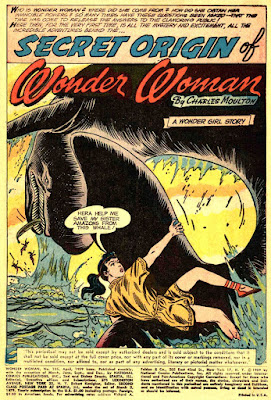
(Side note: was this the first time a DC story used the exact words "Secret Origin" in a title?)

Writer Robert Kanigher then continued to alternate between grown Wonder Woman and her teen self in the comic, and some fans have speculated that even in 1959, Kanigher might've been trying to reach kids who were tantalized by all the emphasis on "teens" in pop culture, in order to give WONDER WOMAN's sales a boost.


At first Kanigher kept the teen and adult Wonder Women separate, though issue #120 (1961), he found a way to cross over the respective icons by having each of them encounter the same peril, "the Mercurian Menace," but at different times in the Amazon's heroic career. Then in #122 he began to play with time, showing Princess Diana getting de-aged to her younger selves, including not just "Wonder Girl" but also "Wonder Tot."


Then in WW #124 Kanigher introduced the idea that through Amazon technology all three versions of the heroine could co-exist and participate in mutual adventures. Thus, for roughly the next three years, Wonder Woman and her teenaged self both existed in what I've termed a "semi-bonded ensemble" in these stories, though both icons continued to enjoy independent stories. Wonder Tot occasionally got her own stories as well, though there were so few of these that it would fair to call her "charisma-dominant," since her main function was to appear as part of the ensemble. In contrast, the Kanigher version of Wonder Girl did sustain a minor mythology of her own, however derivative, just as Superboy did in his starring feature. Given that both Wonder Woman and Wonder Girl were designed to generate their own separate cosmoses, every story with both characters after WW #124 would constitute a stature-crossover, just as much Thor and Iron Man are in every co-starring appearance in THE AVENGERS, which is also a semi-bonded ensemble, but only for those characters whose own features reached a certain level of escalation (as opposed to the earlier example of Giant-Man and the Wasp, explained here).

Sunday, February 6, 2022

NULL-MYTHS: “WONDER GIRL’S STOLEN FACE” (WONDER WOMAN #153, 1965)


Despite Robert Kanigher’s considerable creativity, I’ve yet to see anything he wrote for the WONDER WOMAN feature—which he wrote and edited for over fifteen years—that qualified as a mythcomic. His use of myth-ideas was both derivative and desultory, giving one the impression that he could barely summon any enthusiasm for the series, even when dealing with characters he himself created, or at least substantially re-worked, like the idea of “Wonder Woman as a girl,” as I discussed here.


All that said, Kanigher gets a little closer to the mythic mark with the 1965 story “Wonder Girl’s Stolen Face,” though it’s such a jumbled mess that it only qualifies as a “null-myth.” Strangely, in other venues Kanigher seemed to be a fan of “strong women,” since he had created such DC Comics characters as Black Canary, Poison Ivy and Mademoiselle Marie. But the closest he comes to expatiating on a feminine theme in a WONDER WOMAN comic is the old saw about women being ruled by their vanity.


“Face” begins by showing Wonder Girl (a teenaged version of Wonder Woman, who could co-exist with her older self via a complicated time-trick) being celebrated by both her immediate family on Paradise Island, and by two young swains pursuing her: Mer-Boy, a half-fish merman who dwells in the ocean with his kindred, and Bird-Boy, who lives in the sky with his fellow bird-folk. But the teen Amazon’s good cheer is sabotaged by a longtime WONDER WOMAN villain, the alien Duke of Deception, who wants the entire Wonder-family eliminated so that he can invade Earth with his flying saucers. He decides to sow the seeds of dissension by depriving Wonder Girl of her normal good looks and making her into a monster embittered against society and her family.


Sure enough, the first part of the Duke’s plan works fine. At the very moment when Wonder Girl’s two beaus are singing praises for her Cleopatra-like beauty, the ray literally steals the heroine’s face—we know this because we see the disembodied face later on-- and replaces it with a half-human, half-gargoyle physiognomy. Upon finding herself transformed, does the teenager rush off to Paradise Island, to have her mother and the Amazon scientists examine her? No, she raves at her boyfriends for being taken aback by her face-lift, even though neither of them forswears her for her sudden hideousness. In fact, each in turn invites the gargoyle girl to attend functions in their respective domains, trying to buoy up her spirits. However, at both functions the mer-people and the bird-people both think Wonder Girl is putting them on with her horrific visage, and they laugh at her. In both domains the angry Amazon tears up a lot of real estate and flees back to her family’s island. However, the other members of the WW family-- Wonder Woman herself, her mother Hippolyta and Wonder Tot (don’t ask!) -- make the exact same mistake, with the result that once again the tormented teen tears things up and fights with her family.


This of course is just what the Duke wanted. However, the other members of the family refuse to strike Wonder Girl. This bit of charity clears some of the rage from the heroine’s mind, and instead of attacking further, she flies off, intending to exile herself (still with no reason to know that the transformation is permanent). The frustrated alien traps Wonder Girl, planning to draw the other Wonders into an ambush. The teen’s innate heroism asserts itself, and she wins free in time to give warning—after which the four fighting females demolish the Duke’s invasion force. From one of the destroyed saucers Wonder Woman saves her younger self’s stolen face—it really does look like just a disembodied face, of course—and later Amazon science manage to get rid of the gargoyle-visage and restore to Wonder Girl her normal cuteness, as well as returning everything to the status quo.


The best part of this story is not the villain’s predictable plot, but the wacky lengths to which Kanigher goes to justify the Duke’s face-swapping technology. In a monologue spoken for the reader’s benefit, the deceptive demon claims that he performed this perfidious act twice before on two famous icons: mythology’s Medusa and Robert Louis Stevenson’s Doctor Jekyll. I feel reasonably sure that the original story of Medusa—a beautiful mortal woman, whom a god transformed into a snake-haired horror—was probably the main inspiration for “Face,” and aside from the Duke’s participation, the Medusa story hews close to the original story’s outlines. However, the revision of Stevenson’s Doctor Jekyll narrative is a classic example of an author playing the part of Procrustes, the manic innkeeper of myth who cut off his victims’ limbs so that they would fit on a bed. According to Kanigher, Jekyll wasn’t transformed into Hyde by his experimental potion as Stevenson claimed, but by the Duke replacing Jekyll’s normal face with a monstrous physiognomy. It’s of minor interest that the transformed Wonder Girl acts more like Hyde than like Medusa, which may be the only reason that Kanigher bothered to rewrite Stevenson. Further, it may be revealing that the Duke says he struck at Medusa and Jekyll out of envy for their accolades. Maybe the real reason Kanigher rewrote those classic stories was also out of envy, albeit of the authorial kind…

A SERIES OF UN-UDDERABLE EVENTS


The “events” to which my title refers are all the 1959-1966 appearances of DC Comics’ original “Wonder Girl” character, whose name I will henceforth abbreviate to “WG1.” Prior to 1959, the WONDER WOMAN continuity had made loose references to the idea that the heroine had passed from childhood to adulthood on Paradise Island before taking on her costumed mantle. However, in no previous period was a younger version of Wonder Woman a frequent element of the series. But in WONDER WOMAN #105, dated April 1959, writer/editor Robert Kanigher and artist Ross Andru began making repeated use of a teenaged version of the heroine, much as the feature SUPERBOY told stories of Superman when he was a youth. WG1’s adventures were sometimes featured on WONDER WOMAN covers, while at other times the teen Amazon was just a backup to her better-established older self. Not a lot of fans, even back in The Day, were especially fond of the character, though ironically WG1 indirectly spawned DC’s second Wonder Girl iteration, and that character enjoyed considerable cachet in the TEEN TITANS series-- more on which later.
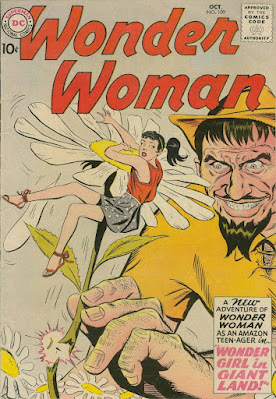


Many fans, then, would have deemed WG1 an unfortunate result of editor Kanigher’s tendency to write down to the readers of WONDER WOMAN. But it only recently dawned on me that WG1 was also “un-udderable,” in a way I can only express in song:


No boobs at all,

No boobs at all,

Double-U Gee-One

Had no boobs at all!


(Approximate melody based on a song about Fawcett’s Captain Marvel, who was said to have no “balls” at all.)


While looking through one of the WG1 stories, a question occurred to me. If one presumes that Kanigher began writing stories of a teenaged Amazon, logic would dictate that he was doing so to improve sales. Movies about the new breed of American called the “teenager” had proliferated in the middle 1950s. Such films varied between stories about “clean teens” or about adolescents with somewhat raunchier proclivities. But all teen movies dealt with youths over fifteen, meaning that the female teenagers no longer looked like kids. However, WG1, despite being called a teen, always looked significantly undeveloped.
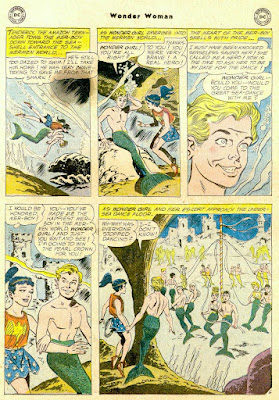


The WG1 stories do not explicitly state how old the young Amazon is. Yet in all the character’s appearances, she goes around clothed in a very loose tunic, whether it’s some Graeco-Roman garment or a version of the famous Wonder Woman costume. Since the mature Wonder Woman was reasonably well endowed, the logical conclusion is that the creators of WG1 meant to imply that the character was too young to have significant breastitude. If Kanigher was at all consistent about deeming WG1 a teenager, the youngest she could be would be thirteen, and for some individuals this can be too young for full development.
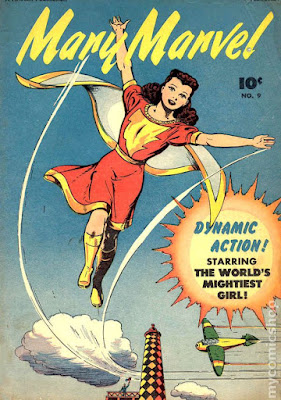


Of course, though WG1 was not technically a kid sidekick, I believe most if not all “young allies” of older superheroes were supposed to be in this same age-range. Michael Fleischer’s ENCYCLOPEDIA OF BATMAN offers evidence that Robin the Boy Wonder was supposed to be a perpetual thirteen or fourteen before he finally started aging in the late 1960s, and most boy sidekicks looked no older than Robin. Prior to WG1, there were few teenaged superheroines in comics, and the only long-lived one was Fawcett Comics’ Mary Marvel, sister of the aforementioned Captain Marvel. Mary’s age probably wasn’t stated either, but on the whole, her figure also suggested the appearance of a girl who had just recently passed into adolescence. All this circumstantial evidence suggests that the raconteurs who worked on Golden Age superheroes were convinced, probably not without merit, that most of their readers were pre-teens, and that the only ages they wanted to see represented were either (1) kids of middle school age or (2) adults, the latter embodying the fantasy of attaining temporal power. That’s also probably one reason that Kanigher decided to devote space to stories of a thirteen-year-old Amazon. The baggy clothing may have been calculated to dodge any question of the not-yet-budding youth being exploited, since a reader couldn’t even tell if she had breasts.
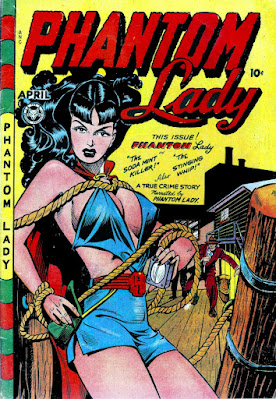


Of course, if you lived back in the 1950s and listened to the Abominable Doctor Wertham, all comics in all genres were replete with what the psycho psychiatrist called “headlights.” There can be little doubt that a few superheroines were especially well endowed, particularly some versions of the Phantom Lady. But most of the genres that accentuated the positive power of cleavage were those of crime, jungle-adventure, and teen-humor—the last being the only genre in which developed female teens regularly put their goods on display.
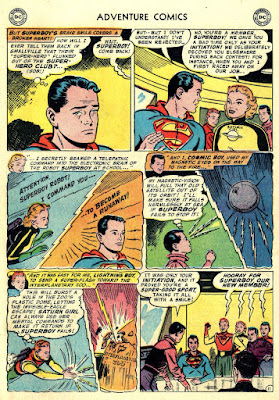


I doubt that during the middle 1950s the very conservative DC company had to clean up very much in the boobage department. Before the Code, the potential lubricity of Wonder Woman’s costume was restrained by the quasi-Classical art of H.G. Peter. After the Code, Andru and others tended to draw her as being a bit on the slender side. Most regular female characters—Lois Lane and Lana Lang (in the SUPERBOY feature) -- sported modest cleavage, while Catwoman, one of the few well-endowed DC femmes, found herself placed in exile for having drawn the wrath of Wertham. One character, Saturn Girl of the Legion of Super-Heroes, made her first appearance as a supporting character in a 1958 SUPERBOY story, and in that story she barely appears to have any tits at all. However, once the idea of the Legion earned some plaudits from the readers, Saturn Girl’s second appearance gave her a better costume and cleavage about the same as that of Lois and Lana. But then, she, unlike WG1, was supposed to be at least fifteen. On a side-note, though the lady Legionnaire’s first appearance predates that of Kanigher’s WG1, neither Saturn Girl nor any of her compatriots appeared in a regular feature until 1962.
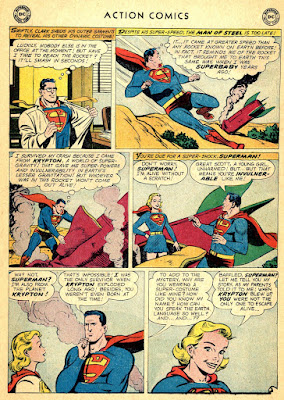


In any case, there’s some irony in the fact that WG1 was the first teen heroine of the 1950s to appear on a semi-regular basis, for she only appeared on newsstands about a month ahead of ACTION COMICS #252, dated May 1959. The first version of Supergirl is explicitly said to be fifteen, a topic which comes up when she auditions to join the Legion of Super-Heroes. (In a twist typical of the period, the heroine washes out when she temporarily becomes an adult and violates the group’s “no one over 18” rule.) More relevantly, from the first Supergirl, unlike WG1, did have fully developed knockers, and though they probably weren’t any bigger than Lois Lane’s, the girl’s girls got a little more emphasis because of the “S” emblem she wore on her chest.
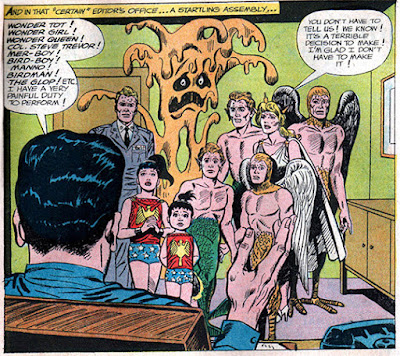


As for WG1, Kanigher had her making references to teenaged pursuits like dancing, dating, and listening to “platters.” But she was always a pale shadow of her older self, in contrast to Superboy, whose small-town background gave him a little distinction from his mature persona. So, in 1966, fading sales on WONDER WOMAN impelled Kanigher to make a show of dumping WG1 and many other wacky creations out of the comic. The gesture didn’t prevent the writer-editor from losing his access to the venerable Amazon property. Yet just as WG1 was being knocked off, her sort-of doppelganger, Wonder Girl II, debuted in TEEN TITANS.
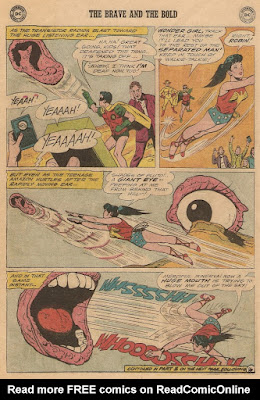


In the first appearance of the TITANS, three kid sidekicks—Robin, Kid Flash, and Aqualad—assembled to fight a menace. Writer Bob Haney and artist Bruno Premiani made them all look like they were in the thirteen-year range, but this didn’t last long. In the group’s second appearance, WG2—who was never decisively stated to share the complicated origins of WG1—joined the group, and remained a member for the series’ initial run, and later revivals as well. Yet from WG2’s debut in the TITANS title, the artist did not follow Kanigher’s lead in terms of putting WG2 in a baggy toga. Instead she wore a version of Wonder Woman’s costume that conformed to the contours of her body. Naturally, the new character began with the same modest breasts of other DC heroines. But unlike her predecessor, her costume was tight enough to demonstrate that at least she HAD boobs.


By the end of the sixties, WG2, like both Wonder Woman and Supergirl, became better endowed. Further, Catwoman returned to the comics, and some new characters were breast-monsters from the first, like the Barbara Gordon Batgirl and the vampy Legionnaire Dream Girl. All of which just proves the non-existent adage, “You can’t keep a good--” …no, I just can’t say it. I invite my few readers to write their own bad pun.