Hit Me With Your Best Shot: The Night of the Hunter
Not only am I apparently over-challenged to join Nathaniel's Hit Me With Your Best Shot series by the posted deadlines, but most of us who participate continually moan about how hard it is to winnow down to just one shot, even though this is the whole point of the exercise. At least with Showgirls I knew right where to go, but I kept sneaking in runners-up for Angels in America and Requiem for a Dream. At least I committed to a favorite in each case.
This time I'm cheating a little more, because the more deadline-savvy participants have already revealed their choices, and I couldn't help looking at their entries before I skimmed back through the movie. I love the peekaboo lighting trick that director Charles Laughton and legendary d.p. Stanley Cortez pull off with the candle and the window screen, while feisty Lillian Gish is keeping vigil with her shotgun, guarding her new wards from burly, devilish, implacable Robert Mitchum:


Jose likes this shot, too, so even if I would have picked it as my favorite (and I might have), I'll leave it aside for now.
I'm pretty sure my choice would actually have been "Not Quite Still Life, With Frog," one of several storybook tableaux featuring uncanny animal bystanders, during the kids' spooky flight down the river:
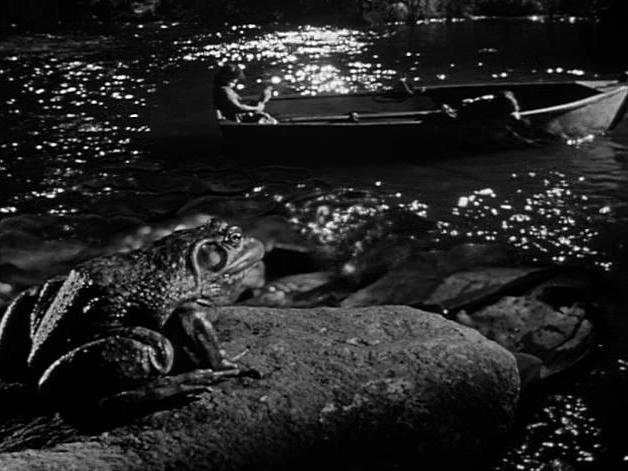
I just adore the cryptic, animist flavor of this sequence, which is shimmery and beautiful, but with the lenses pushing the frogs and the bunnies and the spiderwebs so insistently into the foreground that the overall effect is not entirely reassuring. Laughton and Cortez avoid telegraphing in any obvious way that the kids are absconding to a safer haven, or that having (barely) evaded the mad preacher's grasp has necessarily made life easy. To confess fully, however, I partly love the image because without it, and without the whole river-flight sequence, I don't know if Michel Gondry and Björk would have dreamt up her "Human Behaviour" video, and that would have been a great loss to humanity.

I also don't see how Martin Scorsese would have arrived at many of the images he burned into my brain in Cape Fear without Harry Powell to serve as Max Cady's stauncher, more barrel-chested grandpappy, always surreally lurking around the perimeter of the house he is haunting:

And I'm grateful for so many images that other Hit Me With Your Best Shot commentators singled out:


I'm especially fond of the top left image because I find it so breathtaking that Laughton and Cortez can orchestrate such an unbelievably strong, remarkably sustained, concertedly unrealistic look for their movie, and still accommodate so complete a departure from their template as these quick inserts of the (perpetually) drowned Shelley Winters. The light gray palette and minimal chromatic contrast, the diagonal angles, the unsettling motion of the formidably static camera, the flowing undulations of the seaweeds: Shelley hasn't just died, she's sunk to the bottom of a completely different filmic universe. From whose perspective—psychic or imaginative, rather than literal—could this shot possibly derive? I can't imagine the kids having this particular vision of their late Mom, though I'm not sure the rest of the movie exemplifies the kids' vision, either. Of all the times Shelley obligingly drowned on screen, this one's my favorite.
I also love the top-right image because even though the house towers over Mitchum's Harry, a fact that is only accentuated by the low angle of the camera, and even though the domicile all but crowds the human menace out of the frame, the compressed depth of field and the minimal shadowing everywhere except the front door area makes that house look awfully flimsy. Whereas, introducing a man-shaped black hole into the shot, resting with arrogant, Hud-like indolence against that crooked little tree, Harry seems as though he could raze the whole edifice in the time it takes to say "Leaning on the everlasting arms."
A few more favorites, since this is the end of the series' first season, and it's such a visually rich film:

Adore this opening aerial shot. Nothing's even happened yet, and already the kids of the world are sprinting for cover as though this is Cloverfield.

Like a re-write of the final shot of Shane, except this isn't about watching a boy's hero riding off toward the horizon, but watching a boy watch his father be apprehended by police, as though he's witnessing this awful trauma but also experiencing it as a sort of out-of-body experience. Again, the lensing and the bare minimum of shadow make it look as though Billy is standing before a screen painting of his father's arrest rather than implicating him spatially in the scene, though the advance of all those cops is undisguisably harrowing, and the implied sightline is devastatingly direct. Poor kid. His dad already feels so close and yet so far away.

Bless Laughton and Mitchum for allowing Harry some wit, and the film its own occasional, obsidian sense of humor. The actor popping his head down from the top bunk when we aren't necessarily expecting him to be a presence in the scene is even more chuckle-worthy as a graphic impression than it is unsettling as a certain pretext for nefarious behavior. This shot, too, gets a pointed reprise in Scorsese's Cape Fear. (Remember that Mitchum played the original Max Cady, too.)

One of the few close-ups I've ever seen of Mitchum where he almost looks conventionally handsome, and frankly pretty sexy. Screening Out of the Past and Crossfire yesterday, I was thinking of how carnally charismatic Mitchum succeeds in being without quite qualifying as handsome. He's shaped like a keg of ale, with an inverted pyramid or a funnel for a head, his brow much wider in circumference than his jaw, and his facial features stretched in a strange, triangular way like a drawing on a balloon, cinched with a knot at the bottom. It's a great face for movies, but an odd one, and only great because Mitchum makes it work as brilliantly as he does. But in this shot, he's much more straightforwardly attractive, and it makes Shelley Winters's Willa Harper make a little more sense in the way she breathlessly flings herself at him. Which, speaking of...

...is there a more devastating shot of spousal alienation in movies, especially on a wedding night, especially when we're expecting, as Willa obviously is, that Harry will be a force to be reckoned with in bed? Poor gal, even before she winds up in the drink, having handed her kids over to the monster.

And is there a more pitiable irony in movies than the fact that Billy can't help but react to the pitiful spectacle of terrible, terrorizing Harry being taken down like some petty vagrant, as though it's a replay of his Dad's demise—that he instinctively reaches out to his most fiendishly devoted antagonist, even permitting himself the emotional release that he did not allow at the moment of the initial wound?

How dear and how insightful, then, of Lillian Gish's Rachel to help Billy get over his father by allowing him to feel just a little bit like the man of her house, afforded the privilege of sleeping at her feet while the rest of the kids are locked up behind them. Is there a bit of the overzealous warden, though, in the way Rachel "protects" her charges? Is it odd that she sometimes looks more like ranch-hand of the kids than their den-mother caretaker, with her chickens penned inside her little coop, and with her trusty dog, subservient and silent, sleeping at her feet? She's a more than obvious Force of Good, but even Good can look a little strange, especially when you're dreaming. Sort of. Maybe.
(Note that all of these shots will luster even more once the Criterion DVD bows in the U.S. on November 16, in the 1.66:1 aspect that Laughton intended, and which the MGM disc compresses into Academy ratio.)
This time I'm cheating a little more, because the more deadline-savvy participants have already revealed their choices, and I couldn't help looking at their entries before I skimmed back through the movie. I love the peekaboo lighting trick that director Charles Laughton and legendary d.p. Stanley Cortez pull off with the candle and the window screen, while feisty Lillian Gish is keeping vigil with her shotgun, guarding her new wards from burly, devilish, implacable Robert Mitchum:
Jose likes this shot, too, so even if I would have picked it as my favorite (and I might have), I'll leave it aside for now.
I'm pretty sure my choice would actually have been "Not Quite Still Life, With Frog," one of several storybook tableaux featuring uncanny animal bystanders, during the kids' spooky flight down the river:
I just adore the cryptic, animist flavor of this sequence, which is shimmery and beautiful, but with the lenses pushing the frogs and the bunnies and the spiderwebs so insistently into the foreground that the overall effect is not entirely reassuring. Laughton and Cortez avoid telegraphing in any obvious way that the kids are absconding to a safer haven, or that having (barely) evaded the mad preacher's grasp has necessarily made life easy. To confess fully, however, I partly love the image because without it, and without the whole river-flight sequence, I don't know if Michel Gondry and Björk would have dreamt up her "Human Behaviour" video, and that would have been a great loss to humanity.
I also don't see how Martin Scorsese would have arrived at many of the images he burned into my brain in Cape Fear without Harry Powell to serve as Max Cady's stauncher, more barrel-chested grandpappy, always surreally lurking around the perimeter of the house he is haunting:
And I'm grateful for so many images that other Hit Me With Your Best Shot commentators singled out:
I'm especially fond of the top left image because I find it so breathtaking that Laughton and Cortez can orchestrate such an unbelievably strong, remarkably sustained, concertedly unrealistic look for their movie, and still accommodate so complete a departure from their template as these quick inserts of the (perpetually) drowned Shelley Winters. The light gray palette and minimal chromatic contrast, the diagonal angles, the unsettling motion of the formidably static camera, the flowing undulations of the seaweeds: Shelley hasn't just died, she's sunk to the bottom of a completely different filmic universe. From whose perspective—psychic or imaginative, rather than literal—could this shot possibly derive? I can't imagine the kids having this particular vision of their late Mom, though I'm not sure the rest of the movie exemplifies the kids' vision, either. Of all the times Shelley obligingly drowned on screen, this one's my favorite.
I also love the top-right image because even though the house towers over Mitchum's Harry, a fact that is only accentuated by the low angle of the camera, and even though the domicile all but crowds the human menace out of the frame, the compressed depth of field and the minimal shadowing everywhere except the front door area makes that house look awfully flimsy. Whereas, introducing a man-shaped black hole into the shot, resting with arrogant, Hud-like indolence against that crooked little tree, Harry seems as though he could raze the whole edifice in the time it takes to say "Leaning on the everlasting arms."
A few more favorites, since this is the end of the series' first season, and it's such a visually rich film:
Adore this opening aerial shot. Nothing's even happened yet, and already the kids of the world are sprinting for cover as though this is Cloverfield.
Like a re-write of the final shot of Shane, except this isn't about watching a boy's hero riding off toward the horizon, but watching a boy watch his father be apprehended by police, as though he's witnessing this awful trauma but also experiencing it as a sort of out-of-body experience. Again, the lensing and the bare minimum of shadow make it look as though Billy is standing before a screen painting of his father's arrest rather than implicating him spatially in the scene, though the advance of all those cops is undisguisably harrowing, and the implied sightline is devastatingly direct. Poor kid. His dad already feels so close and yet so far away.
Bless Laughton and Mitchum for allowing Harry some wit, and the film its own occasional, obsidian sense of humor. The actor popping his head down from the top bunk when we aren't necessarily expecting him to be a presence in the scene is even more chuckle-worthy as a graphic impression than it is unsettling as a certain pretext for nefarious behavior. This shot, too, gets a pointed reprise in Scorsese's Cape Fear. (Remember that Mitchum played the original Max Cady, too.)
One of the few close-ups I've ever seen of Mitchum where he almost looks conventionally handsome, and frankly pretty sexy. Screening Out of the Past and Crossfire yesterday, I was thinking of how carnally charismatic Mitchum succeeds in being without quite qualifying as handsome. He's shaped like a keg of ale, with an inverted pyramid or a funnel for a head, his brow much wider in circumference than his jaw, and his facial features stretched in a strange, triangular way like a drawing on a balloon, cinched with a knot at the bottom. It's a great face for movies, but an odd one, and only great because Mitchum makes it work as brilliantly as he does. But in this shot, he's much more straightforwardly attractive, and it makes Shelley Winters's Willa Harper make a little more sense in the way she breathlessly flings herself at him. Which, speaking of...
...is there a more devastating shot of spousal alienation in movies, especially on a wedding night, especially when we're expecting, as Willa obviously is, that Harry will be a force to be reckoned with in bed? Poor gal, even before she winds up in the drink, having handed her kids over to the monster.
And is there a more pitiable irony in movies than the fact that Billy can't help but react to the pitiful spectacle of terrible, terrorizing Harry being taken down like some petty vagrant, as though it's a replay of his Dad's demise—that he instinctively reaches out to his most fiendishly devoted antagonist, even permitting himself the emotional release that he did not allow at the moment of the initial wound?
How dear and how insightful, then, of Lillian Gish's Rachel to help Billy get over his father by allowing him to feel just a little bit like the man of her house, afforded the privilege of sleeping at her feet while the rest of the kids are locked up behind them. Is there a bit of the overzealous warden, though, in the way Rachel "protects" her charges? Is it odd that she sometimes looks more like ranch-hand of the kids than their den-mother caretaker, with her chickens penned inside her little coop, and with her trusty dog, subservient and silent, sleeping at her feet? She's a more than obvious Force of Good, but even Good can look a little strange, especially when you're dreaming. Sort of. Maybe.
(Note that all of these shots will luster even more once the Criterion DVD bows in the U.S. on November 16, in the 1.66:1 aspect that Laughton intended, and which the MGM disc compresses into Academy ratio.)
Labels: 1950s, Blog Buddies, Charles Laughton, Cinematography, Lillian Gish, Robert Mitchum
posted by NicksFlickPicks at 12:00 AM
3 comments