Nathaniel has just posted this month's
Supporting Actress Smackdown, dedicated to the
nominated ladies of 1964. I'm not going to say this is Oscar's worst lineup in this category, but it's the only one I could think of where I don't like any of the five movies and don't love any of the five performances. I had one heck of a grouchy ballot, though I have to say, even more than usual, reading my fellow panelists' comments and participating in the first-ever
post-Smackdown podcast gave me so many new ideas about the films, the nominated turns, and entire ways to think about acting. So, huzzah to
Joe Reid,
StinkyLulu, beloved actress
Melanie Lynskey, and hat-wearing, chalk-gardening, iguana-taming, beach-dancing, Charlotte-hushing hostess
Nathaniel Rogers, whom I love not only for his website and his insights into actressing but for the scrupulous eight-point agendas he sends before these conversations. (Just like he loves me for writing five 64-word capsules about these performances. I am amazing.)
Still, this doesn't change my opinion that AMPAS needed help picking better Supporting Actress alternatives in 1964. Given that the year's big hits and nomination leaders included
Becket,
Dr. Strangelove,
The Best Man,
Fail-Safe,
Seven Days in May,
Zulu, and
A Hard Day's Night, I understand why they didn't feel surfeited with distaff contenders. But look—they didn't need to abandon the eligibility list or even move out of their favored genres and character types to produce a richer field:

 Nominated: Gladys Cooper
, as Henry Higgins's acerbic high-society mother in
My Fair Lady
What I Thought: On the evidence of this film, Cooper's aged more gracefully than Cukor. She seems to be giving a tart but unostentatious reading of Mrs. Higgins, but like many of the actors, she is stymied by her director's distant, stagebound camera. We don't spend much time with her and barely see her when we do, making a capable if unchallenging performance seem even more minor.
Why Not Instead: Glynis Johns's dizzy suffragette in
Mary Poppins, if Oscar insisted on short-listing a vivid peripheral player in one of the year’s big musical juggernauts, rendered by an irresistible character actress whose previous nominations had yielded no wins?

 Nominated: Edith Evans
, as the haughty, intractable guardian of a tiny pyromaniac in
The Chalk Garden
What I Thought: If more people knew this movie, I would say, "Ask about
me, Olivia, ask about
me!" to narcissists at parties, and my intimates could all chortle. So GIF-able, Edith! Otherwise, this feels like a Dench-in-
Chocolat nod. I know she's a Dame but it's hardly a peak role, and her emphasis on imperiousness clogs other possibilities in it. Moment to moment, her choices feel obvious.
Why Not Instead: Future Dame
Maggie Smith, who's so saucy and insouciant as Anne Bancroft's torpid yet chatty frenemy in
The Pumpkin Eater, the kind of movie that pedigreed English actresses should be making instead of odd Disney-Du Maurier mashups like
The Chalk Garden. The many, gangly ways Smith finds of disrespectfully inhabiting Bancroft's kitchen are nod-worthy enough. Yootha Joyce is also pretty remarkable as a psychotic in normal-woman's clothing in the scene at the hair salon.

 Nominated: Grayson Hall
, as the self-hating Sapphic chaperone and geyser of anger in
The Night of the Iguana
What I Thought: Hall is even more transfixing than the iguana, and almost more than Ava Gardner caressing shirtless houseboys in the moonlit surf. She's the first coming of Grace Zabriskie. I'm impressed her presence didn't get staler, given how the script keeps on forcing her through the same scene: approach neurotically, throw tantrum, swear revenge, repeat. Sadly, she short-changes the semi-repressed cravings that define the character.
Why Not Instead: Louise Latham in
Marnie, who gives a master class in how to telegraph asphyxiated desires and make an instantly perverse impression while still flipping nimbly through every page of the character's highly compromised biography. She's as drily, tensely, indelibly quasi-maternal as Hall is, only she actually
is the mother in question. Bonus points: equally bad hair!
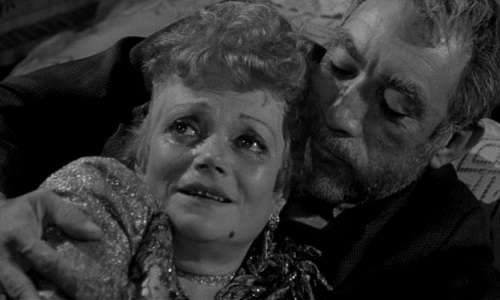
 Nominated: Lila Kedrova
, the deserving winner, as the nostalgic hotelier, voluptuous but tremulous, in
Zorba the Greek
What I Thought: I object to the role, which forces its interpreter through serial stereotypes: the delusional coquette, the gaudy epicurean, the whimpering toddler in an aging courtesan's body. Kedrova leans into some of these clichés, mugging with her face and body, limiting the impact of her sorry fate when it (inevitably) comes. But she works with what she's got, livening up this weirdly self-serious travelogue picture.
Why Not Instead: Irina Demick in
The Visit, who's got a tough row to hoe in this allegory of mercenary money-hunger and human brutishness, another European movie with a motley cast. She anchors her own B–plot as a somewhat self-deceiving adulteress while busily crossing and re-crossing the film's vision of Moral Lines. She, too, has a funny ak-sahnt but she acts with greater candor and less forcing of effect.

 Nominated:
 National treasure
Agnes Moorehead, entering the Kitsch Hall of Fame as the servant in
Hush...Hush, Sweet Charlotte
What I Thought: Charlotte should be delicious but instead it tars everyone involved, giving them too little (Astor) or goading them to vandalize their talents (Davis). De Havilland proves you can enjoy yourself without sacrificing dignity. Hopefully Moorehead at least had fun. She’s a kick to watch, appears to recognize what claptrap she's in, and overacts as only a great actor could. But an Oscar, for cartooning?
Why Not Instead: Anna Ciepielewska, that household name, who keeps the audience guessing throughout the classic demon-possession drama
Mother Joan of the Angels, a 1961 film that appeared on Oscar's eligibility list for 1964. Is Sister Małgorzata, forever running errands for the convent, the only nun who has resisted Satan's call? Or is she baiting the locals into trusting her, all the better to seduce and snare them? It's a carefully balanced turn even in an equally gonzo but more earnest high-Gothic environment than
Charlotte's.
What's that, Oscar? Still not biting? That's weird, but I'll give you one more shot to mend your ways. With less pressure to ape your own wonky template, what about this ballot?
 Julie Christie
, who's not exactly breaking the mold of the opaque, bewitching Mystery Girl in
Billy Liar (another film belatedly eligible for Oscar in 1964) but who makes a remarkable impression given the limits of the role, suggesting for the first time in her
glorious career how gifted she'll be at implying a lot but specifying little beneath her characters' pearlescent surfaces. She even manages to imply that Liz is just eccentric enough, or maybe just sympathetic enough, to be an appealing partner for Tom Courtenay's Billy, without implying they're likely to wind up together. Certainly, Supporting Actress nods have gone to bigger ciphers, less deftly and appealingly etched than this one.
 Gloria Foster
, future Oracle of the first
Matrix movie, who blows pretty much everyone on this page out of the water in a few sequences of the groundbreaking African-American drama
Nothing But a Man, playing the steel-spined wife of the protagonist's distant and morbidly alcoholic father. Is Lee an enabler, or a voice of hard truth to both father and son? In Foster's wizardly hands, with incredible, unfussy directness, the answer is both. What are her feelings, exactly, for Ivan Dixon's Duff? Everything Foster does, every way she is, seems to inform Duff's revised approach to his own bond with Abbey Lincoln's Josie (wondeful), but the actress is enigmatic enough that we're not quite sure
what Duff is learning from Lee. I craved a sequel, though in truth I would have followed any of these characters into their own movie. Rent it.
 Ava Gardner
, who twice over seemed within striking distance of her
second career nomination in 1964. She's a famously relaxed and effectively sensual presence in
The Night of the Iguana, where she might have confused voters by straddling the lead-supporting line. Hall got nominated instead, as did Edmond O'Brien for John Frankenheimer's paranoid military thriller
Seven Days in May, where Gardner effectively has the Kim Basinger part: the serene but plot-crucial female role in a big manly ensemble. She aces it, particularly in an extended rencontre with Kirk Douglas. He's in her apartment on false pretenses, but Gardner adds so much poignancy and layering to the sequence beyond its narrative import. What a year.

Speaking of people who barely missed,
Irene Papas, who's at least as striking a presence as Kedrova in
Zorba the Greek and figured importantly in several films AMPAS and critics' groups recognized across a decade, from
Electra to
Z to
The Trojan Women, without ever scoring an Oscar nod for herself. I tend to dislike parts like the Widow in
Zorba, a sort of unexplored placard for The Suffering of Women in Foreign Cultures, but Papas individualizes this nameless character. Cacoyannis and Lassally often get lured into filming Papas's face, dress, and body for graphic impact rather than character-revealing detail, but she still cuts through their aestheticizing visual schemes. (And if we're fishing around for international talents, borderline-lead Gunnel Lindblom in Bergman's
The Silence was also eligible in 1964.)
 Ann Sothern
, who scored a Golden Globe mention for her busybody lobbyist in Gore Vidal's political pressure-cooker
The Best Man. Sothern mostly recedes after making a big early impression, and maybe she goes with the slightly misogynist vein of the part, which understands women and women's investments in politics in a pretty narrow way. But Sothern gives Sue Ellen Gamadge potency, ferocity, and a gift for turn-on-a-dime public pretense, which is more than was asked of her in her belated nomination for 1987's
The Whales of August. Note: this part was assayed recently on Broadway by Supporting Actress perennial Angela Lansbury and in an earlier Broadway production by Elizabeth Ashley. Along with Sothern, Ashley was the other 1964 Golden Globe nominee dropped for Oscar's ballot. She's not one of
The Carpetbaggers's many, many problems, but I think my work here is done... beyond exhorting you to contribute your own suggestions below!
Labels: 1960s, Agnes Moorehead, Alfred Hitchcock, Ava Gardner, Best Supporting Actress, Black Cinema, Edith Evans, International, Julie Christie, Maggie Smith, Oscars, Tennessee Williams