Sunday, August 03, 2014

The Fifties 2014: Actor, Actress, Director, Picture


ACTOR

NICK'S PICKS:

Macon Blair, Blue Ruin: Communicates the everyman quality of the character without condescending to him. Never turns into a killing machine.

Jim Broadbent, Le Week-end: Just as he was nearing Maggie Smith levels of typecasting, he plays someone angrier, sadder, hornier, more fun.

Pierre Deladonchamps, Stranger by the Lake: Not a wallflower or an idiot but shows us the character's nerves and his unreliable conscience.

Ralph Fiennes, The Grand Budapest Hotel: Distinctive enough he isn't just doing "a Wes Anderson character," and he's dapper, funny, and sad.

Sergio Hernández, Gloria: We sense his desire for Gloria and the certainty that he will disappoint her. You resent him but still sympathize.

Runners Up: Tom Cruise, Edge of Tomorrow; Jake Gyllenhaal, Enemy; Archie Alemania, Norte, the End of History
On the Radar: Tom Hiddleston, Only Lovers Left Alive

Read more »

Labels: , , , , , , , , , , ,

Friday, July 24, 2009

Mrs. Miniver and Mr. Schindler: Best Pictures 1942 and 1993


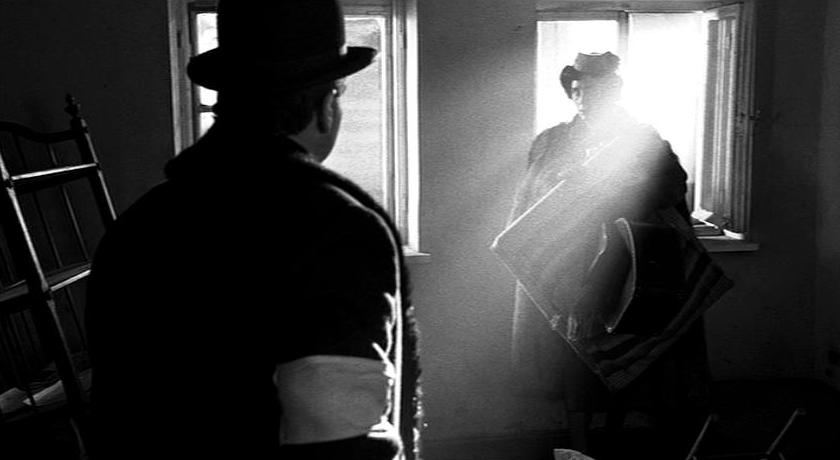
NICK: Having watched my conspirators in pleasure show such effort and ingenuity in our last two installments to put our disparate films in dialogue with each other, I get to enjoy a ready-made Oscar juxtaposition of World War II dramas: Mrs. Miniver, the first entrant from this AMPAS-beloved genre to swipe the top prize, and Schindler's List, frequently hailed as a highpoint in the Best Picture heritage. Neither film is a battlefield picture; instead, they each focalize the magnitude of the war through the expanding consciousness of the titular character and the subversion of her or his habits of thought and action. Both were the first movies by their pedigreed, Oscar-friendly auteurs to cop the Best Picture and Best Director trophies after multiple winless nods.

Of course there are also clear markers of dissimilarity between these films and the stories they tell. Mrs. Miniver presents the war only semi-directly as a blend of farewells, alarms, thrift, social disruption, and local casualties; Schindler's List boldly reconstructs and scrutinizes the supremacist and genocidal ethics and terrible, sometimes enforced complicities that both inspired and drew force from the Nazi war machine. Kay Miniver is a radiant paragon of noble citizenship and domestic steadfastness; Oskar Schindler is a rake and a profiteer whose unlikely emergence as an objector and protector arrives with all kinds of vagaries and caveats attached. Mrs. Miniver was not in every respect a picture that Wyler cherished; Schindler's List was self-consciously conceived, produced, and received as the technical, cultural, and moral apotheosis of Spielberg's career, even if some audiences were more skeptical than others of its structural existence as a studio-produced Holocaust diorama in wide commercial release, in venues where the floors are inevitably dotted with trodden Goobers and the popcorn odors waft in from the next-door screenings of Beethoven's 2nd.


In fact, Schindler's List is so patently the mightier text and social artifact that those modest, resilient, upper-middle-class Minivers may have a hard time getting out from under Spielberg's shadow—so let's start with them first. I think it's the case that we've all seen Mrs. Miniver twice. What do you guys think about it, and did your feelings change at all from the first to the second viewing?

MIKE: I don't like Mrs. Miniver. I like Kay Miniver at times, but I don't like very much about the film she's in. It's a serviceable propaganda piece, but it's nothing more than that aside from a series of ugly hats perched on stiff upper lips. I don't completely agree with Wyler's longtime collaborator Lillian Hellman that "it's such a piece of junk, and it's below [him]," because there are a couple good scenes in there that have resonance beyond the film's very utilitarian purpose, but I do agree that it is beneath Wyler.

The two scenes I like most take place in the bedroom (a mostly sexless place, because Walter Pidgeon is in it). First is Garson's cautious, teasing reveal of that terrible hat, the one that looks like a sparrow crashed into a beaver; both Garson and Pidgeon seem at ease around each other, and you can believe that this relationship once generated enough passion to produce three kids. The second, and the best scene in the film, is the aftermath of Dunkirk, when Pidgeon, puffed up with pigeonly pride at his accomplishments, is aghast to discover that his pretty li'l wife had some adventures of her own. Pidgeon is looser than he's ever been in his entire screen career, and Garson shows a sexy playfulness that unfortunately few directors let her use.

NATHANIEL: I cherish both the scenes of which you speak but I'd disagree about this particular bedroom being a sexless place, despite the separate beds. The second time through I kept expecting Pidgeon and Garson to make a fourth baby at any minute. This is not to say that they struck me as in lust with each other but that the "old marrieds" feel rang true. That ease of which you spoke is evident in the silences, the way they touched (loved the spank), the way the actors sometimes don't even look at each other but you can see that they're fully aware of the other's presences. And I especially like those sequences you mentioned because they show this comfortable couple creating drama where none really exists—initially hiding things that they totally plan to share—merely for the flirty diversion it provides. My whole life I've been hearing that Mrs. Miniver is nothing but a propaganda piece but I happen to quite like it.

It's not exactly a great movie, I'll give you that. But as war films go, I like that it's light on its feet and sustains its energy well despite nearly being a one set film. (Was it my imagination or was the editing here much busier—more cuts—than in most early '40s movies?) You really do get the sense of war intruding on otherwise peaceful and happy existences. Most war films tend to err on the side of the dully sober. I admire that this one makes no judgments about the frivolity of flower shows, joy rides, college "phases," and expensive hats but instead posits that people should be able to enjoy these things. Freedom is worth fighting for! Yeah yeah yeah. You hear that all the time in war movies, including this one. Frivolity is worth fighting for, damnit! That's something you don't hear as often.

One nagging question though: Shouldn't that "Mrs. Miniver" rose have wilted long before the flower show? You see it in the first scene, already in a vase, and it survives a summer break, a whirlwind courtship and honeymoon and the first months of The Blitz?

Damn.

MIKE: Neither time nor war nor ugly hats can wilt the Miniver Rose, Nathaniel. Not even Nazis can remove its bloom.

THE BENING Well, I'll tell you, Nathaniel—eggshells and Miracle-Gro!

NICK: You pretty much take her everywhere these days, don't you, Nathaniel? Has she introduced you to Juli yet?

To the matter at hand: I feel like I come down somewhere between the two of you, a snug and lovely place to be. I appreciate Mrs. Miniver's sincere-feeling investment in domestic rituals and in personalizing the homefront. Having been a homefront kid while my dad was gone commanding a unit in a war, I am probably well-disposed to the blend of dogged optimism, worried fright, and the odd layer of "business in usual" that Mrs. Miniver showcases. I think the film is better, though—and this is where I see Wyler's gift—at capturing those frictions in specific images and textured performance choices than in the blocky, overstated ways in which the script aims to tackle this stuff. I mean, the whole flower competition eats an awful lot of time on its way toward a fairly certain outcome, but Wyler and Whitty pull out some comic and even some poignant tension in it as she debates with herself. The movie never convinces, or should I say never pretends, that there's much at stake in dime-a-dozen conflict scenes like Teresa Wright lobbying for her grandmother's victory or Garson and Whitty going to toe-to-toe about the engagement, and even the famous scene of the German pilot skulking into chez Miniver is so baldly telegraphed and unsubtly conceived.

But even in these scenes, and in many others, I do admire the layered characterization: headstrong Wright nervously stroking the upholstery when meeting Vin for the third time, the slightly harrowing way in which Vin's little brother likes to play-act being a dive bomber, Garson relentlessly sewing in her fake but admirable cool inside the air-raid shelter. I admire that Wyler punches up the German-intruder scene by starting it off in such incongruously bright light and wide-open space, and having the superficially intrepid Garson so awkwardly handling the gun by its barrel, upside-down, when she's retrieving it for the police. Like you guys have said, the actors are often really great with spontaneity, ensemble playing, and crisply humanizing detail, which are pleasures in themselves. But then, they sometimes backfire into making me wish the whole movie were firing on more cylinders to really get the most from this team, and they can't always compensate for all the obnoxiously haloed lighting and the pathetic miniature-models in the river patrol scene, or the dialogue teetering from chunky bits of "patriotism" to little dime-novel ejaculations ("Good old, Vin!").

And if Mike hates the hats, I don't like that Greer Garson—to me, one of the most beautiful women in Hollywood's past—has to make her big entrance in a scalloped-doily hat and a dress that has spaghetti stitched to the neckline. But then she heads right into that delicious, charming convo with the guy who feels as guilty about buying cigars as she does about her beaver-sparrow hat. Again! You're always getting the good with the bad in this pic.


"I survived the London Blitz, and all I got was this hideous ensemble."

NATHANIEL: Funny you should say that, for "the good with the bad" is how I'd describe quite a few of Steven Spielberg's hugely beloved pictures. But it's hard to describe the magnificently controlled Schindler's List that way. Unless you're referencing the pink coat but I'd rather not start off with the one blemish. That's not just spaghetti on an otherwise beautiful dress, it's the tomato sauce, too.

MIKE: The red-coated girl was part of what displaced Schindler's List from its position at the top of my top 100 list. (New list forthcoming!) I think it's one of few places where Spielberg underestimated his audience's ability to comprehend the extent of the ghetto liquidation. I know he used it to show Schindler himself finally understanding, but surely this man didn't need such a specific reminder.

The other reasons stem from how even in the middle of its undeniably horrific events, it backpedals at times, as if Spielberg were too wedded to Hollywood tropes to carry through. To start out, I don't think it downplays the extent of the Holocaust to tell about the lucky survivors, so I'm not in the Claude Lanzmann camp that views this film as a misguided attempt to dramatize an event that cannot be dramatized. But there's a line in there somewhere, and Spielberg crosses it in two major scenes. First is the old man whom Goeth chooses to execute, but every German pistol within a stone's throw somehow jams, saving his life and stretching believability too far. Second, and much more egregious, is the scene where the women are led into the shower rooms at Auschwitz but are greeted with water instead of poison gas. This, for me, is unforgivable: if there's a single image that sums up the Holocaust's mechanized, efficient destruction of humanity, it's the gas chamber, and the cheap "gotcha!" when that water comes down is among Spielberg's most cowardly mistakes as a director.

And I'm not sure what I'd think if it turned out to be true. This feels like melodrama, not reality. The film is certainly melodramatic at times, especially the scene on the train tracks where Schindler weeps about how many more people he could have saved, but that scene tears me up every time. I don't mind being manipulated if it's done so well.

NICK: Wow! And I so often feel like the carpy one. Admittedly, I agree with a lot of this: the shower scene at Auschwitz and the failed execution of the rabbi are highly dubious and feel like Spielberg devices. Then again, that brutal kick that Goeth gives the old rabbi at the end of that scene registers very strongly. Even stronger to me is the haunting shot of the naked women running into that cavernous shower; the enormity of everything the scene and the film have conjured up to that point is so profound that I don't think the sequence or the film escapes paying tribute to what we all know about the gas chambers. But yes, it's a major stretch, on very thin ethical and narrative ice, and I can see taking major exception. Whereas the girl in the red coat has never really bothered me. Neither of her appearances goes as far into sentimentality as they could have, and seeing her dead—especially in the fairly offhanded way that the moving camera frames her, in the barrow with several others—makes her a somewhat important ballast against the film's decisions elsewhere to focalize so many characters who don't die.

I have my own caveats, but given that this feels like one of the most considerable films ever to win the prize, I get to play the annoying do-gooder who says, Surely we want to foreground the positives. And I know you both hold the movie in very high esteem. I'll start with some of the peaks and strengths that really stood out to me this time. The production design is uncommonly persuasive and detailed, from apartments to camps to cellars to exteriors to cabarets to trains to the extraordinary range of palette, even within the monochrome scale. The mournful Itzhak Perlman theme is as powerful as it always was, but I was almost as struck this time by Spielberg's and Williams' astonishing and risky irony of using hard, dogged piano in the cross-cutting between the establishment of the factory and the assemblage of the ghetto, as though both grow out of the same grinding, mercilessly bureaucratic urge. I saw a much more rounded, bullish, many-sided character coming from Liam Neeson than I had remembered in the past—to include that, rather like the Minivers, he rarely stops believing in the value and defensibility of casual, "frivolous" pleasures, though he's obviously an epicurean and a spendthrift in ways they aren't.

The liquidation of the ghetto is so indelibly shot, edited, mixed, choreographed, and performed that I don't even know what to say about it. While I'm feeling speechless for a moment (it never lasts), rattle off some more high points.

NATHANIEL: You've barely scratched the surface of its many triumphs. I hadn't seen it since December 1993 and the things I most loved about it then were just as impressive: the harrowing liquidation sequence you've mentioned, the harsh beauty of the cinematography surveying all that ugliness, the framing device (which was so moving and earned here but unfortunately regurgitated without inspiration for Saving Private Ryan), and that astonishingly cruel performance by Ralph Fiennes. He seems to have swallowed whole the too-often-abstracted concept of evil. It can't be fully digested—who can ever fully digest the enormity of man's inhumanity to man that the Holocaust represent?—so it seems to have just settled in his lazy gut, completely rotting him from the inside.

The thing that most struck me on this second viewing that I know I didn't appreciate or fully grasp in 1993, before I had any real experience of the corporate world, was how the film is in many ways as much of a business thriller as it is a war drama. And a hugely successful one at that: you're tense with fear at Schindler's political missteps (the kiss at the party), you're gripped by the intricacies of his game plan and game face, and you're caught up in the power struggles. I love that Amon Goeth seems so untouchably powerful at first only to be understood, gradually, as something as banal and impotent as a middle manager. Mostly importantly to this war drama's parallel business thriller is that you're rooting for Schindler to succeed but this makes you so complicit in all of his awful compromises and the dehumanizing deals he's continually making. He grasps the humanity of the "enemy" more than the other men sporting swastikas, but he won't let that get in his way. At least at first. I feel certain that a third viewing would reveal yet more intricacies about the dehumanizing business of war.

NICK: Genius! I love this take on the movie. I totally agree, and it opens so many things to think about. Related to your great point: in this last viewing (my third), I seized on that moment when they've just banged out the list, and Stern can't figure out how Schindler is going to secure all of these "indispensable workers," and he looks at Schindler and suddenly says, "You're not buying them." Kingsley's ambiguous reading of this line is so artful, because you can't tell just then whether he's appalled at the obscenity of purchasing these people, or whether he's thunderstruck at the moral gesture to which this profligate hedonist is actually committing himself. Obviously the movie and even the scene wind up tilting toward (b), but the implications of (a) are never completely removed.

Couldn't help interjecting. Mike, what do you love?

MIKE: Did I mention that it's still in my Top 10? I agree with everything positive you guys have said; it's almost easier to enumerate the few flaws than to get a handle on how amazing this film is. Foremost for me are Ralph Fiennes's performance as Amon Goeth and Janusz Kaminski's impeccable cinematography. Fiennes is the most-ripped-off supporting actor in the history of the category, not because Tommy Lee Jones wasn't great, but because Fiennes gave one of the two or three best supporting performances ever.

And I, too, am in awe of your "business of war" take on the film, Nathaniel. Bravo! It really nails something that I hadn't thought about—Schindler's complicity, for most of the film, with the Nazis, and our complicity with him. But I can't quite accept Goeth as a banal middle manager. There's a fervor there, whether it's mental illness or genuine belief in the cause, that you'd never get at ConHugeCo. He's not just putting in his time.

I know we try to stick to the films and avoid what went on outside them (Oscar campaigns, etc.), but with both these films, it struck me how much their internal self-importance translated to their public reception. Judges sentenced hate crime perpetrators to watch Schindler's List, and Spielberg released a teacher's guide to be distributed with free copies of the film to high schools; for Miniver, BBC Radio played the vicar's closing speech to British troops, and Roosevelt and Churchill requested special screenings of the film to increase support for the war effort. It's pretty convenient for this series that we have two films that took on such political importance; what do you guys think about that?

NATHANIEL: Doesn't "internal self-importance" often translate to public reception? Or rather, isn't it always aiming to do so? I guess the difference here—with your well-chosen but, I assume, not isolated examples—is that both films were bulls-eyes in their respective eras.

People don't talk about Mrs. Miniver much anymore but it was a huge success in its time. The IMDb even references this tagline for the film: "Voted the Greatest Movie Ever Made!" Now, I'm not sure who was voting (Greer Garson?) but the picture was beloved and respected. And we all know how quickly Schindler's List started to show up on "greatest movies of all time" lists.

I've often groused about the "Subject Matter = Quality" equation with Oscar (and with critics and audiences to some extent, too). Subject matter never automatically equals quality. Subject matter is just wallpaper. It's how you decorate the rest of the room that counts. So in the cases when artistic ambition lives up to the grandness of certain subjects or themes, which excite people even when the artistry isn't much to rave about, it's easy to see why the public reception borders on ecstasy.

NICK: I know exactly what you're both getting at: it's totally weird that Schindler's List beat The Piano, one of the greatest films of all time, perhaps the greatest, for Oscar's top prize. I couldn't agree more. And without that sense of Schindler's internal self-importance? Never woulda happened. I appreciate the tact you both showed in hinting at this point without wanting to hurt me by spelling it out, but I think transparency is important.

[THE BENING murmurs inaudibly to NICK]

NICK:: So it turns out that it's not that weird, and that a lot of people think Schindler's List is also one of the greatest movies of all time. And apparently – wait – [one more whisper from THE BENING] – apparently miscarriages of justice are pretty frequent in Oscar history, especially recently. Very interesting, Annette.

Given that AMPAS was so swept up in patriotic fervor in 1943 that it was giving plaster statuettes so as not to waste the country's valuable metals, it's even less surprising that internal self-importance + Oscar's frequent Anglophilia pushed Mrs. Miniver over the victory line. If you scatter-plot that year's ten nominees, it makes sense as a consensus pick, sharing the propagandistic fervor of 49th Parallel and Wake Island but with healthy doses of the sentimentality you see in Random Harvest, The Pride of the Yankees, and The Pied Piper (which is sort of Mrs. Miniver starring an old codger instead of Greer Garson). Schindler's win needs no more contextual explaining than you guys have already provided, and there's every reason for Oscar to feel proud about that one. Since you both confessed to your reservations, I'll say that the story does feel weirdly disproportioned to me; Spielberg and Zaillian start wrapping things up just when Schindler has published his list, short-changing our curiosities about how he got away with his factory being a "model of non-production" and how their lives as Schindlerjüden actually looked and felt, to include their relations with him. The movie suddenly races to its own finish line: marital reunion, European cease-fire, big farewell, and we're done! But in and of itself, and especially by comparison to many other Best Picture winners, the selection of Schindler's List comes close to being an absolute good.


As always, readers, we want to know your thoughts: are you more of a Nathaniel or a Mike in response to Mrs. Miniver? If you're a Lillian Hellman, let it all out. What do you think of Schindler's List? Which of its virtues have we still not begun to evoke, and what reservations do you feel compelled to express?

Also don't forget the Best Pictures Tournament that's an ongoing accessory to this series. We last voted five installments ago, which means it's now time to vote on your favorite winner from 1938-1942 and from 1993-1997. The collective favorites and rankings among the three of us are already posted, but you've got 90 days to change our minds!

Tags:
This Week: Nathaniel's post

Previously: ep.1: Wings & No Country; ep.2: Broadway Melody & Departed; ep.3: All Quiet & Crash; ep.4: Cimarron & Million Dollar Baby; ep.5: Grand Hotel & LOTR:ROTK; ep.6: Cavalcade & Chicago; ep.7: It Happened One Night & A Beautiful Mind; ep.8: Mutiny on the Bounty & Gladiator; ep.9: Ziegfeld & American Beauty; ep.10: Zola & Shakespeare; ep.11: You Can't Take It with You & Titanic; ep.12: Gone with the Wind & The English Patient; ep.13: Rebecca & Braveheart; ep.14: How Green Was My Valley & Forrest Gump

Compendium: My ongoing "Best Pictures" Special Section, with reviews, rankings, polls, and links to all of our discussions

Labels: , , , , , , ,

Sunday, November 16, 2008

Gone with the Ghibli: Best Pictures 1939 and 1996


An odd Moroccan wind rains blood on the state of Georgia...

NICK: If you've had seven spare hours lately - and who hasn't? - you'll have joined us in revisiting two of Oscar's grandest, prosiest, most impassioned historical epics. There had never been a movie quite like Gone with the Wind (1939), and in many respects, there's hasn't been one since: a cultural lodestone from the eve of the book's publication through the deliriously publicized build-up to the picture to its relentless, Sherman-style takeover of the box-office, where it still reigns handily as the all-time champ if you adjust for inflation. Gone with the Wind had more authors than you could shake your last carrot at, and it shows: directorial styles, camera distances, rhythms of dialogue, lighting regimens, and story emphases shift frequently over the course of its 238 minutes. For some viewers, this mars the movie and for some it deepens and enriches its interest; some critics are tempted to overlook the film's oscillations and inconsistencies, where others marvel at its overall coherence despite all the cooks in the kitchen. Some viewers don't even notice. So frankly, dears, do we give a damn?

And how about all the competing tones and authorial signatures in The English Patient, Miramax's first Oscar win after several years as the chic, funky, and dangerous bridesmaid? Anthony Minghella's glossy and story-driven direction sometimes matches Michael Ondaatje's spindly, image-driven mosaic. Harvey Weinstein's obsession with mainstreaming the arthouse and producer Saul Zaentz's fondness for European and literary pedigrees certainly worked out with AMPAS, to the tune of nine wins: one more than GWTW, unless you count the latter's technical and honorary citations. But is the movie they made all of a piece, or is it a pile of glittery, unreconciled fragments? Do the plot strands blend together or do some get lost within this romantic braid?

NATHANIEL: I think unreconciled fragments are the point, frankly (my dears), since The English Patient is such a memory tone poem. Not that I love all the fragments. The English Patient loses me whenever Willem Dafoe holds up his thumbless hands and the political intrigues bore me. But I lost the thread of your question as soon as you said "romantic braid"—anything referencing hair entangles me immediately in visual flashes of Kristin Scott Thomas's miracle bangs, Ralph Fiennes at his sandy prettiest, Naveen Andrews wringing out his massive locks, and especially the scene where Hana (Juliette Binoche) chops hers off in a moment of rushed practicality. She looks fabulous afterwards—I'm sure she's a good nurse but I think she missed her calling.


Hana as Coiffeuse > Scarlett as Couturier

This brings me to a major point in the movie's favor, which is its tactile quality. I often feel like if I touch the screen I'll feel the heat of skin, the smoothness of the sand, the texture of hair, and even the cold outer shell of bombs and worn book covers. Good movies always work sight and sound but how many evoke any of the other senses?

NICK: A great point, and a great one to get in early. I'm nosing in before Mike even gets to talk, but I remember being surprised (sort of) when Peter Greenaway took such strong public exception to The English Patient, since among narrative films it's the only contemporary of The Pillow Book I could think of that had a similar knack for that tactile, synesthesiac vibrancy that you're talking about. All those plums and paper maps and dust storms and shampoos.

MIKE: I can't help but think of The English Patient in terms of halves: the half driven by divine coincidence versus the half driven by contrivance; the half made of unapologetically melodramatic moments and huge emotional swells versus the half where everything is so polite, even despite the various explosions and romances; the half that's so three-dimensional, sensual, and sensory that I want to put it in my mouth and/or rub it all over my body (and it sounds like you guys agree with me) versus the flat whodunit (or whoisit, or isithim).

I'm talking about the good half and the not so good half, the pre-war and the post-war, the Ralph-as-gawky-god and the Ralph-as-whispery-pudding, the "Kristin Scott Thomas is a love goddess who seems uncomfortable in her own body, which makes her even more attractive" half, and the "Juliette Binoche is vague and cold beyond the requirements of her character" half. I don't know how this relates back to Nick's original question, since I haven't read the novel and can't say whether what works is Minghella channeling a 1930s epic weepie or Minghella trying to shove some Ondaatje into the film. Oh, yeah: what I'm saying is, "What Nathaniel managed to say in one sentence."

The film's best moments feel like they're from another era, say, the era of Gone with the Wind (woo, segue). A weeping Ralph carrying Kristin's body out of the cave, the incredibly hot prelude to their first assignation ("You still have sand in your hair"): huge, unabashedly romantic moments that compelled me to watch them again before I could finish this paragraph. These moments reminded me of similarly huge moments in GWTW that I had seen and heard so many times that, when I finally got around to watching it for the first time, I thought would be sapped of their power, but they weren't. They're so much a part of the epic fabric of the film that anything muted or attenuated would have seemed out of place. I was so swept away that I really didn't notice all the oscillations and inconsistencies you mentioned in your opening, Nick. Maybe on second viewing I'll be able to see some of them.

NATHANIEL: I don't notice the tonal or visual schizophrenia of Gone with the Wind that much, either. I blame that almost entirely on Vivien Leigh. I like to think of GWTW's entire cast, numerous setpieces, and multiple acts in exactly the way that Scarlett herself seems to think of them: as either annoyances, obsessions, crushes, flatteries, inconveniences, backdrop, excuses for bad behavior, frenemies, threats, or... other. It's ALWAYS about her. Even when it's not.


Scarlett/Vivien throwing Georgia shade at the mention of Melanie/Olivia

Vivien Leigh is the top. When you hear about someone carrying a film, this is what they mean. That she carried it for four hours with an 18-inch waist as a virtual unknown in the midst of that veritable hurricane of apocrypha which surrounds this production—I'm sorry! This is supposed to be about what's on the screen. Not what happened behind the scenes or the legend accumulated. I get distracted. But maybe Oscar does, too. If you'll allow me an obscene exaggeration: I sometimes forget (mostly when I'm not watching it, which is often... it's four hours long!) that Gone With the Wind is a movie at all. It's a historical and cultural event that happened, rather than a story on celluloid. When that happens, isn't Oscar almost a given? See also: Titanic, The Sound of Music, et cetera...

I'm suddenly curious about which of those huge unstoppably effective moments Mike was referencing and which of Gone With the Wind's disparate personalities Nick likes most and least.

MIKE: The big one for me was Viv's "As God is my witness, I will never go hungry again!" soliloquy. I felt it coming a mile off—it might as well have been heralded by a troupe of trumpeters. Chills ran up and down my legs and arms: here it comes. And then it was so shattering, so strong, so desperate—and so contrived. But it blew me away, even though I was expecting to giggle through it. See also: "Frankly, my dear, I don't give a damn."

You bring up a good point, Nathaniel, about how hard it is to separate what's on screen from what went into it, and what came after it. Part of what makes it work is the fact that it was such a miracle that it worked at all, and there's a danger that its ubiquitousness will ruin the experience for first-time viewers (although it didn't for me).

NATHANIEL: "Never go hungry again"—the crazy thing about that pre-intermission curtain call is how "The End" and "Stay Tuned!" it is at once. If this movie were made now they would just chop it in half and demand your ticket dollars all over again for part two the following year.

A moment I love that I rarely hear discussed is the eruption of the news of war at the Wilkes plantation. The choreography is just thrilling. All those people running, colorful dresses swirling across the screen at various angles down towards the doors as Scarlett O'Hara alone zig-zags through them upstream, lost in a very different moment than the larger one. Movies today, outside of some action movies or auteur flicks, don't often have this kind of emotionally attuned and narrative revealing choreography—it's all closeups and reaction shots now—and I think the movies are worse for it.

That said, for as much as I can get swept up in the movie there is the nagging reminder that this lush world, built on the backs of slaves, deserved to be blown away. The slaves talking about beating the Yankees are particularly disturbing to me—Stockholm Syndrome anyone? It's always been a little odd to me that Hollywood romanticized the South so much. Are Civil War era movies ever about the North?

NICK: Sorry to duck out for so long from my own party. I was busy upstairs making a dress from my own drapes. I'm not even going to delve into the complicated waters of whether this movie actually waxes nostalgic about slavery or whether it has an appropriately harsh view of the Peculiar Institution. Though I will note that we see black slaves picking cotton in a field before we see anything else, and slave labor is often what's depicted beneath the occasional "That was the South, gone forever!"-type intertitles. Make of that what you will.

What I was getting at about the changing aesthetics, though I'm not the first to notice this, is that the first third or so of the movie (let's call it the Cukor part) has so many more close-ups, such gentler lighting, and so many more expressive movements of the camera or of choreographed bodies within the frame: that shot you mention, Nathaniel, of Scarlett floating up the steps while the men of Twelve Oaks are all racing downward is a perfect example. By contrast to this, Melanie's pregnancy and (even more so) the escape from Atlanta are rendered almost completely (and mostly by William Cameron Menzies, I think) through old-fashioned cross-cuts, like when Rhett worries out loud about explosives and we cut to a pile of boxes that say "Explosives."


Cukor's GWTW is lovely! Menzies' GWTW is...so literal!

And then as the film continues, under the hands of mad Victor Fleming and staid Sam Wood, the lighting and color choices get much harsher, there's a lot more black and weighty diagonals, and the camera stays further away for lots of group scenes. At moments, the movie looks like Fritz Lang shot it (check out Barbara O'Neil as the dead Mrs. O'Hara on her Caligari-ish catafalque), and some of the Technicolor has a kind of violent, Red Shoes intensity to it, as when Bonnie takes her final horse ride or when Scarlett's accosted by her own husband on those huge, nightmare stairs.


It makes sense that the prevailing mood changes over the course of these particular events, but the early emphasis on personality-driven characterization and elegant movement in the early scenes turns into a broody, sometimes very tense, occasionally clunky pile-up of narrative scenes about running a sawmill or duping the police or pond-hopping to London or semi-hating your own spouse. It's partly great acting but partly the totally different photography that sometimes makes Leigh look like a totally different woman in the first half of GWTW vs. the second. I'm mostly cool with that—this movie gives you SO MUCH, and so much to chew on—but I miss the verve and lightness of the magnificent first half when I have to flip the disc over and press onward through the sudsier, stiffer second.

But with all this talk of GWTW's iconic imagery, you can feel that The English Patient is often aspiring to the same kind of iconicity: the bi-plane crash, Hana's flight through the church, Almásy toting Katharine out of the cave. Do these images resonate for you, or are they instances of the movie trying too hard?


NATHANIEL: I like it when movies try too hard ("...sometimes", he quickly adds). At least I do if what they're trying for is heightened. It's one reason I am counting down the days impatiently until Australia hits... But back on topic: I love Hana's flight through the church—it's the image that always pops into my brain if i hear the three words "The English Patient"—but in other instances I feel how self-conscious the movie is, even as I'm a little bit swept up in it (i.e. Almásy & Katharine's affair). I guess I wish that The English Patient was either more heightened (more of the real through unreal filters please: like those odd birds-eye flights over sand, all foldy like bedsheets) or a little more focused.

I've never been in love with it though it didn't make me as crazy the second time through as it made Elaine:

Oh. No. I can't do this any more.
I can't. It's too long.
(to the screen) Quit telling your stupid story,
about the stupid desert, and just die already!
(louder) Die!!

Mike?

MIKE: "What I want to know is, did they shrink them down, or is that a really big sack?"

Huh? Oh, right, we're talking Oscars. Yeah, The English Patient works best for me when it's going for the big score: I still cry like a baby when Ralph's crying like a baby toting Kristin out of the cave, I get a little steamed up during their assignation in the alcove, and I feel dizzy during Hana's flight in the church—incidentally, the only thing that really works for me about the postwar storyline. I want more grand gestures, doomed romances, tragic sacrifices, and Ralph looking like a tormented Muppet (sorry, Nick, I stole that from you). The past is veiled with smoke and dust and gauzy curtains, lit with reddish fiery sunsets and sunrises, and it's a much better place for both the main characters and us, the viewers, at least when it comes to The English Patient.

And it's not even trying to bite off as much as Gone with the Wind, which does want to be all things to all people (and its reputation and box office might indicate that it succeeds). Nick, having you spell out the pre- and post-intermission differences makes them completely obvious, and while I'm not going to say I subconsciously noticed all of them, I am going to say that even absent the too-many-cooks explanation for them, all those tonal, compositional, and narrative changes serve the story pretty well. One could probably exhaustively explain why each one of them works, but someone else has probably already done that in book-length form, and besides, I wouldn't always agree with the reasoning: there's a definite change once you have to flip that disc, and it's a change from something I absolutely love to something I heartily like and respect. From certain off-board grumblings, it sounds like "like" and "respect" might be in short supply during our next installment...


As God as my witness, readers, I'll never watch Braveheart again! Actually, I have to, but to ease my suffering in advance, please tell us what you think about Gone with the Wind's rose-colored plantations, the fierceness of Vivien Leigh, the sensuality of The English Patient, and the relative merits of its duelling plotlines. And we didn't even start on Clark Gable, on Max Steiner's score, on Gabriel Yared's score and Walter Murch's sound bridges, on those political intrigues that bore Nathaniel, on birthin' no babies, on whatever happened to the size of Kip's role (he has arguably the biggest part in the novel), on that gorgeous notch in a woman's neck, on Kristin Scott Thomas bumping her head on those bleachers, on that poor horse who drops dead on the way back to Tara (best acting ever by an animal, or a snuff film straight outta PETA's collective nightmare?), or on the surreal strain of pretending for four hours that Leslie Howard is a sexpot. What do you remember, from the amnesiac haze of your hospital gurney, and from beneath your Muppet makeup? What do you give a damn about?

Tags:
This Week: Nathaniel's screen shots
Previously: ep.1: Wings & No Country; ep.2: Broadway Melody & Departed; ep.3: All Quiet & Crash; ep.4: Cimarron & Million Dollar Baby; ep.5: Grand Hotel & LOTR:ROTK; ep.6: Cavalcade & Chicago; ep.7: It Happened One Night & A Beautiful Mind; ep.8: Mutiny on the Bounty & Gladiator; ep.9: Ziegfeld & American Beauty; ep.10: Zola & Shakespeare; ep.11: You Can't Take It with You & Titanic
Compendium: My ongoing "Best Pictures" Special Section, with reviews, rankings, polls, and links to all of our discussions

Labels: , , , , , , , , ,

Monday, April 23, 2007

Update to the DVD Spotlight

This week's selection for the DVD Spotlight is Martha Fiennes' Onegin, a gorgeous and beautifully judged rendering of Pushkin's classic novel in verse. Sadly, Onegin suffered the same inglorious fate of several other Ralph Fiennes films that bowed so close to the end of December that Stateside audiences barely noticed them: the same was true of the exemplary Oscar and Lucinda, the terrific-until-it-collapses The End of the Affair, the intriguing but annoyingly hermetic Spider, and last year's wildly uneven but nonetheless worthwhile The White Countess, notable mostly for a strong score and creative sound design. Ralph has really gotta get on the phone with his distributors and ask them what exactly it is about his aquiline beauty and finely-etched acting that makes them think "let's bury this film after Christmas."

Anyway: Onegin is on my mind because I recently enjoyed a high-definition broadcast of the Metropolitan Opera's terrific production of Tchaikovsky's opera, beamed right into the AMC Rivers East 21 in Chicago, Illinois. The opera production was superb; in fact, the acting as well as the singing by Dmitri Hvorostovsky, Renée Fleming, Ramón Vargas, and Elena Zaremba was all so strong, the stylized lighting and sets were so gorgeous, and the conducting of Valery Gergyev was so luscious that Eugene Onegin ranks easily as the richest experience I've had in a movie theater in 2007. Liv Tyler plays a much more remote Tatyana in the movie than Fleming does onstage, and Fiennes is a less domineering Onegin than Hvorostovsky is, but the film is still a pristine and affecting piece of work, lit to chilly perfection by the superb cinematographer Remi Adefarasin (The House of Mirth, Elizabeth). If you missed Onegin in theaters—and Samuel Goldwyn virtually guaranteed that you did—check it out on DVD, and follow up with my review!

Labels: ,

Sunday, June 18, 2006

Picked Flicks #50: The English Patient & The Talented Mr. Ripley

Anthony Minghella's The English Patient is a waning moon of a movie, full of terrible torture and recurrent explosions, but more powerful still in depicting the low sputtering of a candle, the dimming of a flashlight, the erosion of love, the wearing away of borders. The film's fundamental attitude, notwithstanding its multiple cataclysms and its memorable howls of bereavement, is of poignant, downcast serenity. Proceeding along a gossamer thread of slow fades and lingering dissolves, The English Patient doesn't plumb the horrors of war—the deaths, the displacements—so much as it radiates a pearly, sometimes choking sadness that is the plausible aftermath of war, but also of love, and even of life itself: a mournful tranquility with which we, like the world, absorb our shocks and weather our storms. Experiences, the terrible as well as the transcendent, disperse and ripple outward into the mundane and unknown. They melt each other's boundaries, even when we're working hard to distinguish them. Beauty and memory and knowledge recede even as they are awakened or unearthed. The morbid eventfulness of the opening scenes, full of rasping soldiers and felled planes and exploding landmines, sets up only a few of the maze-like inroads into the movie's concatenated narrative; more importantly, these scenes rush to provide a context for that mood of bruised, wistful grief that defines Michael Ondaatje's novel as well as Minghella's adaptation. The heart of the film, then, lies not in major story points but in seemingly ornamental shots like that of Juliette Binoche trimming her hair in the window of an abandoned monastery, or another in which she uses piles of books to fill the gaps in a decimated staircase. Later—though actually much earlier, in the film's serpentine temporal logic—when Ralph Fiennes' leonine Count Almásy and Kristin Scott Thomas' patrician adventurer Katharine Clifton are stranded inside a jeep during a terrible sandstorm, the emotional core of the scene is not the deep desperation of their circumstances, nor the lusty attraction blooming between them, nor even the inevitable chaos that will afflict their cohort once their affair begins. What that scene is really about is stealing a moment of unclaimed time, so that Almásy can tell this gilded beauty about the names of North African winds, and so she can hear him and be moved by what moves him. It is a rare, fleeting moment away from warmaking and mapmaking, away from worldly consequence, and it is precious for that very reason.

Granted, the film does not always benefit from Minghella's taste for romantic projections or his fervently literary emotionalism. His best visual and tonal ideas arise in that opalescent monastery where Binoche takes care of Fiennes, but not so his most rigorous concentration on plot or character; in fact, Minghella quite defies the emphases in Ondaatje's novel and inflates the Almásy-Katharine liaison into an erotic reckoning so potent it's almost embarrassing. Other problems emerge from the clash of impulses between aestheticism and political anatomy, and from Minghella's vague, uneven management of key characters like Willem Dafoe's Caravaggio and Naveen Andrews' Kip. But if all of this makes The English Patient a film of moments more than a sturdy whole, the moments are often glorious, and even as I confess my awareness of the movie's limitations, I maintain that its blend of bathos, adventure, contemplation, and cosmetic luster remains hard to beat. Kristin Scott Thomas fuses sexiness and intelligence in such layered, fascinating ways that she almost single-handedly validates the film's entire project of eroticizing ideas (or is it of intellectualizing eros?). Binoche finds an ideal film and character for her translucent style of acting; her early reading of the line "I don't know anything" tells you all you need to know about the character. The sound design is dense and often pristine, doing just as much as Stuart Craig's excellent production design and Ann Roth's typically subtle costumes to mask the film's low budget and, better, to foster its ambitions.

Three years later, Minghella returned with another prestige literary adaptation, and this time he had more money to throw around. But beyond being even more plushly outfitted than its predecessor, The Talented Mr. Ripley is in nearly every respect the more impressive, surprising film. Minghella tinkers with Highsmith even more than he did with Ondaatje, but rather than bend the material in more conventional directions as he did in The English Patient, he warps and weaves Ripley into an object of even more sidewinding, epicurean perversity than the novel is. Where The English Patient is suffused with death and immersed in the impermanence of things, The Talented Mr. Ripley has the guts as well as the chops to turn a story about killing into a parable of invention, of production, illuminating not just how Tom Ripley turns himself into someone else, but how each new imposture and each new murder actually creates something new—a new sense of who and what Tom is, of who and what he craves, of where he is going, of what he has been up to all along, of what the world must be, at essence, if Tom and his story are possible. Even though we, unlike any of the characters, know what Tom is doing and how he's managing it (often barely), we still end the film with an uncanny sense of several Toms existing, of not knowing where or how to fix him, of not quite believing there is only one Tom. And unlike The English Patient, the film takes perfect measure of every character and performance. Cate Blanchett's heartbreakingly gauche heiress and Jude Law's apollonian narcissist are the crowning glories, though Gwyneth Paltrow's seething anger at being so constantly abandoned, underestimated, and ungratified is a more impressive acting achievement than most reviewers admitted. I saw The English Patient four times in the theater, besotted by its conception and by the pure beauty of how it looked and sounded; Ripley, though, is the film I now dip into more often, and the one from which I learn more. Both films offer enticing signs that all is not lost in the territory of the upscale period drama, and that even within our illiterate age, ardent booklovers can both make and enjoy spectacular films. (Click here for the full list of Nick's Picked Flicks.)

Images © 1996 Miramax Films and © 1999 Paramount Pictures/Miramax Films.

Labels: , , , , , , , , ,

Monday, April 17, 2006

Picked Flicks #60: The Baby of Mâcon & The Pillow Book

I wouldn't be surprised at all to learn that Peter Greenaway is not the child of two humans, but the offspring of a building and a painting, born on the hottest day of the year in some very, very chilly place. His cinema might be the most immediately identifiable of any English-language director, and maybe of any director, period: he doesn't seem to have seen or cared about the work of other filmmakers so much as he has traveled the world to behold giant plinths and catafalques, leafed through Da Vinci's notebooks and Euclidean proofs, and made the best of a poor situation, committing his imaginary worlds to film because it's the only form that anyone is willing to subsidize. Effectively, he's been making CD-ROMs since the days when people still bought music on cassette tapes. His images dissolve into and hyperlink to each other, massive as all creation when they aren't cropped and subdivided into defiantly atypical aspect ratios. Art, math, money, and frank sexuality intersect in his movies, just like on the internet—just like everywhere, really—except that with Greenaway at the helm, this collision of humanity's great passions winds up looking like nothing any other person would ever conceive, and perhaps not like anything that any other person would ever want to see. Greenaway leaves a lot of moviegoers cold, and conversely, some of his most ardent supporters are curators, academics, and high-cultural separatists who are rarely caught in any screening venue where popcorn has ever been sold. I almost walked out of the impeccably mounted and ferociously acted The Cook, the Thief, His Wife, and Her Lover, whose sour misanthropy seems aimed not just against people but against movies themselves. The Belly of an Architect might have been a better intro, 8½ Women might have been better consigned to the dustbin of stunted ideas, and as for Prospero's Books, though I'm now quite taken with its multimedia collage of Elizabethan idioms, it didn't really impress me until my third or fourth try.

Despite this spotty track record, Greenaway is a director who interests me tremendously; I'm not easily put off by someone who will work this hard to make such exquisitely eccentric objects, alternately impenetrable and rife with insinuations. Twice, his epic blends of the epicurean and the rectilinear have produced something that really floored me. Go figure, then, that my favorite of Greenaway's movies, The Baby of Mâcon, is the one that's still illegal in the United States, presumably because it's the one that comes close in its esoteric way to saying something that the United States needs to hear. Julia Ormond, happening upon a director even frostier than she is, comes wickedly alive as a hot-blooded French woman in a 17th-century village beset by famine, plague, and fallow fields. The only sign of new life in Mâcon is the pristinely beautiful baby that springs, incongruously, from Ormond's obese and haggard mother; boldly braiding her own self-interest into the town's thirst for a positive omen, she claims the flaxen-haired infant as her own virgin birth, and then seduces the local bishop's icily skeptical son (Ralph Fiennes) with the brazen magnificence of her lie and the voluptuous offering of her body. Every main character is paradoxically addicted to the ideal of holiness and the spark of carnality, leading to the sorts of perverse hypocrisies and self-gratifications that, in Greenaway's films, always get you killed in an especially macabre way. If anything, The Baby of Mâcon is even more lavishly mounted than most Greenaway pageants, and even more Artaudian in its sickening climax of violence. By staging the film as a Jacobean revenge drama—Sacha Vierny's camera glides fluidly but anxiously through the tense action, the offstage grumblings, and the murmuring audience of puffy aristocrats and smudgy commoners—Greenaway poses questions about voyeurism and cruelty that encompass both his viewers and himself, further layering the implications of this scary horror-melodrama about fundamentalism, superstition, jealousy, and prurience.

After the international PR disaster of The Baby of Mâcon, Greenaway's next film was the luxuriously synesthaesiac The Pillow Book, an absolute corker of a 90-minute movie that unfortunately continues for 45 more minutes, working hard in the process to numb and obliterate everything that is almost impossibly gorgeous in the preceding material. Vivian Wu plays Nagiko, a haughty Japanese model with an insatiable yearning for having calligraphy painted on her skin. Wu is a shrilly maladroit presence, and the premise wouldn't work at all if it weren't realized in such sinuous detail, but so it is. The Pillow Book lists two directors of photography, three production designers, four costume designers, and two calligraphers in the opening credits, and indeed, the movie comes closer than any other to constituting its own elaborate, absorbing museum—one where you're encouraged to sniff and caress the artwork, to strip the clothes off the models, to run the paint along your tongue like it's a spice. This unparalleled mise-en-scène, the creatively embedded frames, and the arresting sonic mix of Japanese pop, monastic chants, and avant-garde rock together yield a new kind of movie, a three- and almost four-dimensional environment. Customary film grammar hardly accounts for how the movie works, either when it's scoring or when it's flailing, and if its structural repetitions ultimately grow a bit tedious, its fearless peculiarity and almost aphrodisiac blend of skin, music, and curvaceous lettering make it worth digesting in multiple doses, even if they're small ones. (Click here for the full list of Nick's Picked Flicks.)

Labels: , , , ,