Ken Burns: “Disney Stole ‘Sons of Liberty’ Melody From The Iroquois!”

To the best of my recollection Walt Disney and Robert Stevenson‘s Johnny Tremain (6.19.57) is the only mainstream film that ever depicted the Boston Tea Party. Am I wrong? Oh, and the Sons of Liberty were violent rowdies.

Despite the purported semblance of historical realism, Tremain fulfilled the Disney law of the 1950s about always featuring a happy sing-along scene.

Titular player Hal Stalmaster is now 85 years old. Luana Patten was definitely a looker, but she sadly passed at age 58. 19 year-old Richard Beymer (West Side Story) played Johnny’s best friend, Rab Silsbee.

Okay, That’s It — Panahi’s “Just An Accident” Will Take Best Int’l Feature Oscar

When this happens inside Hollywood’s Dolby Theatre on Sunday, 3.15.26, it will be the second time that a political/cultural sympathy vote has bestowed a major honor upon Jafar Panahi’s latest film, the first time occuring at the close of last May’s Cannes Film Festival when it won the Palme d’Or.

Joachim Trier‘s Sentimental Value, obviously the best film of the 2025 festival, therefore lost to It Was Just An Accident and had to settle for a Grand Prix award (i.e., second prize). If I know anything about the Academy, Value will once again get elbowed aside because of Panahi’s just-announced one-year jail sentence.

Was William Shakespeare a London Tomcat? Was He a Kirk Douglas Kinda Guy?

As a successful playwright, producer and director of many respected plays, Mr. S was surely regarded by young women as an opportunity waiting to happen. In this respect he surely had the pick of the litter. “Will” was married with kids, of course, but those obligations were 100 miles away in Stratford-upon-Avon. Out of sight, out of mind. How could he have abstained, given his relative youth and all? How could he not have been Joseph Fiennes?

Does Anyone Even Remember “42”?

“Critics have a duty to be clear with readers,” Marshall Fine has written in a 4.12 essay. “Not to warn them, per se, because that implies something about relative merit. But to be clear or honest [when the case applies]: This is a movie in which nothing much happens. Or this is a movie in which what does happen doesn’t make a lot of sense. Or is deliberately off-putting or upsetting.”

I am one of the few critic-columnists who actually says stuff like this from time to time. But I disagree with Fine siding with the virtues of audience-friendly films, particularly when he uses Brian Helgeland‘s 42 as a sterling example.

“You know what an audience-friendly film is,” Fine writes. “It tells a story that engages you about characters you can like and root for. {And] yet movies that seek to tell a story that uplifts or inspires often get short shrift from critics. 42 is being slagged by some critics for being manipulative, [but it] happens to be a well-made and extremely involving story about an important moment in history.”

Wells response: 42 is okay if you like your movies to be tidy and primary-colored and unfettered to a fault, but it’s a very simplistic film in which every narrative or emotional point is served with the chops and stylings that I associate with 1950s Disney films. The actors conspicuously “act” every line, every emotional moment. It’s one slice of cake after another. Sugar, icing, familiar, sanctified.

One exception: that scene in which Jackie Robinson is taunted by a Philadelphia Phillies manager with racial epithets. I’m not likely to forget this scene ever. It’s extremely ugly.

Back to Fine: “The fact that 42 works on the viewer emotionally, however, is often seen as a negative by critics who aren’t comfortable with movies that deal with feelings, rather than ideas or theories.” There’s an audience, Fine allows, for nervy, brainy and complex films like To the Wonder, Upstream Color, Room 237, Holy Motors and The Master. But “all of those are not audience-friendly,” he states. “Most of them were barely watchable.

But if you read the reviews, you would find little that’s descriptive of what the movie actually looks or feels like while you’re watching it. Which, for a lot of people, was a negative experience in the case of those particular titles. “How many people saw them because of positive reviews that were misleading? How many might have thought twice if the review mentioned that, oh, well, this film is all but incomprehensible, even if you’ve read a director’s statement on what it means? Or, well, this movie has very little dialogue and takes a 20-minute break for a flashback to the beginning of time? Or this movie is about an inarticulate movie star caught in moments by himself during a movie junket?”

Wells response: I also think that critics should just say what it’s like to watch certain films. If a film is great or legendary or well worth seeing they need to say that, of course, but they also have to admit how it plays in Average-Joe terms and how it feels to actually sit through it. I’m not saying “nobody does this except me,” but who does do this? New Yorker critic David Denby strives to convey this, I think. Andy Klein does this. I’m sure there are others. But I know that it’s a clear violation of the monk-dweeb code to speak candidly about how this or that monk-worshipped, Film Society of Lincoln Center-approved film actually plays for non-dweebs or your no-account brother-in-law or the guy who works at the neighborhood pizza parlor.

Guys like Dennis Lim will never cop to this. It also needs to be said that “audience-friendly” is a somewhat flattering term. The more accurate term is audience-pandering. Pandering to the banal default emotions that the less hip, more simple-minded and certainly less adventurous portions of the paying public like to take a bath in. Because these emotions are comforting, reassuring, and above all familiar. That is what 42 does, in spades.

Possibly The Most Repulsive Human Trait

It is my considered opinion that emotionally performative people of an insincere bent — i.e., phonies who instinctively laugh their ass off or otherwise show monkey-like obeisance before power whenever there’s an opportunity to back-pat or express any sort of emotional mood support — are among the worst people in the world.

All “performative” people are, by nature, insincere. They’re basically jacking you off.

I understand the basic pleasing impulse as I’ve expressed insincere approval thousands of times throughout my life, but I’ve always tried to avoid bending over or slapping my thighs when laughing uproariously at some shitty joke.

Posted 11 months ago: Nothing uncorks my rage more than people laughing too hard, too demonstratively, giggling like idiots, rocking back and forth, slapping their thighs, covering their mouths with their right hand, going “hoo-hoo-hoo” and “yee-hee-hee”…all of this is truly horrible.

Have you ever seen any serious, heavy-cat comedians laugh like this? Woody Allen will crack an occasional grin or smirk, but never, ever has he yee-hawed in some over-the-top way. People who know what goes never laugh like this. Only shallow gladhanders do. Only the worst people.

12.30.22: “I wear my gracious alpha face all the time in social situations. It’s the only way to be. 99% of people who work in social congregation situations turn on the placid vibes. So much so that it’s fairly freaky, in fact, when certain people (submentals, addicts, sociopaths) don’t turn it on. There’s no earthly reason not to be warm and kind and gracious with people, and I mean especially in Hollywood realms.

“I’m saying this because I wish below-the-liners and set visitors and others who work with above-the-liners would stop saying ‘wow…he/she is so nice!’? How else are they gonna behave? They’re probably nice people anyway, yes, but first and foremost they’re top-level professionals and talented smoothies, and this is how the movie business operates.

“Do you ever hear polar bears saying, “Wow, the snow is so white and powdery, and the seals bark so vigorously when I catch and eat them!” I’m just sick of hearing how nice this and that famous person turned out to be. Turn that shit down a bit.”

By the way: Of all the millions upon millions of faces out there, there’s one that immediately makes me flinch and recoil:

Movie Endings That Say “This Marriage Is Obviously Poisoned With Deceit, and Will Probably Get Worse”

The greatest “holy shit, this marriage is so totally fucked” finale is delivered by Francis Coppola‘s The Godfather (’72), but what are some of the strongest runner-ups?

In the same vein, what are some of the most dishonest upbeat finales in the history of movies about marriages and families? Upbeat endings that you’d like to believe and invest in, but you can’t possibly do so because of all the emotional corn syrup and forced fakery?

It’s A Wonderful Life is surely the fakest of them all, although I’ve always melted (and will continue to melt) when James Stewart cries out “Clarence!…I want to live again!” That’s always moved me, but the happy-schmappy stuff at the Bailey home with all the community joy and donated money…that has always felt to me like happy crap.

A Guy Who Knew From Cricket Bats

The sublimely gifted Tom Stoppard, the Czech-born, British-seasoned author of Rosencrantz and Guildenstern Are Dead (’66), Jumpers (’72), Travesties (’74), Night and Day (’78), The Real Thing (’82), Hapgood (’88), Arcadia (’93), The Invention of Love (’97), The Coast of Utopia (saw it at the Vivian Beaumont in ’07), Rock ‘n’ Roll (’06) and Leopoldstadt (’20)….one of the greatest fellows I’ve ever “known”, so to speak, has passed at age 88.

Posted on 10.16.22: The Reagan-era play that lifted me up and melted me down like none before or since was Tom Stoppard‘s The Real Thing (’84).

“Sappy as this sounds, it made me swoon. Okay, not ‘swoon’ but it struck some kind of deep, profound chord. Partly because I saw it at a time when I believed that the right relationship with the right woman could really make a difference. That was then and this is now, but I was in the tank for this stuff in ’84. The play used the Monkees’ “I’m A Believer” as mood music, and I pretty much was one at the time.

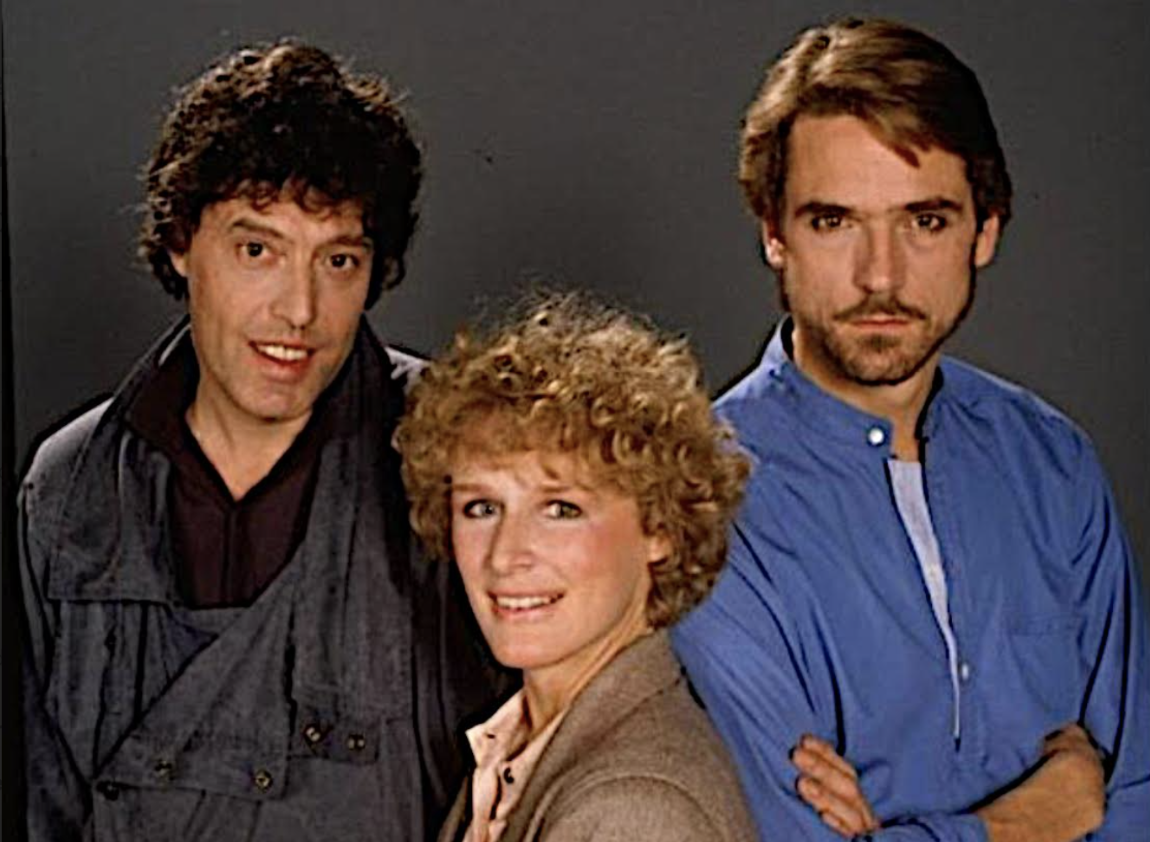
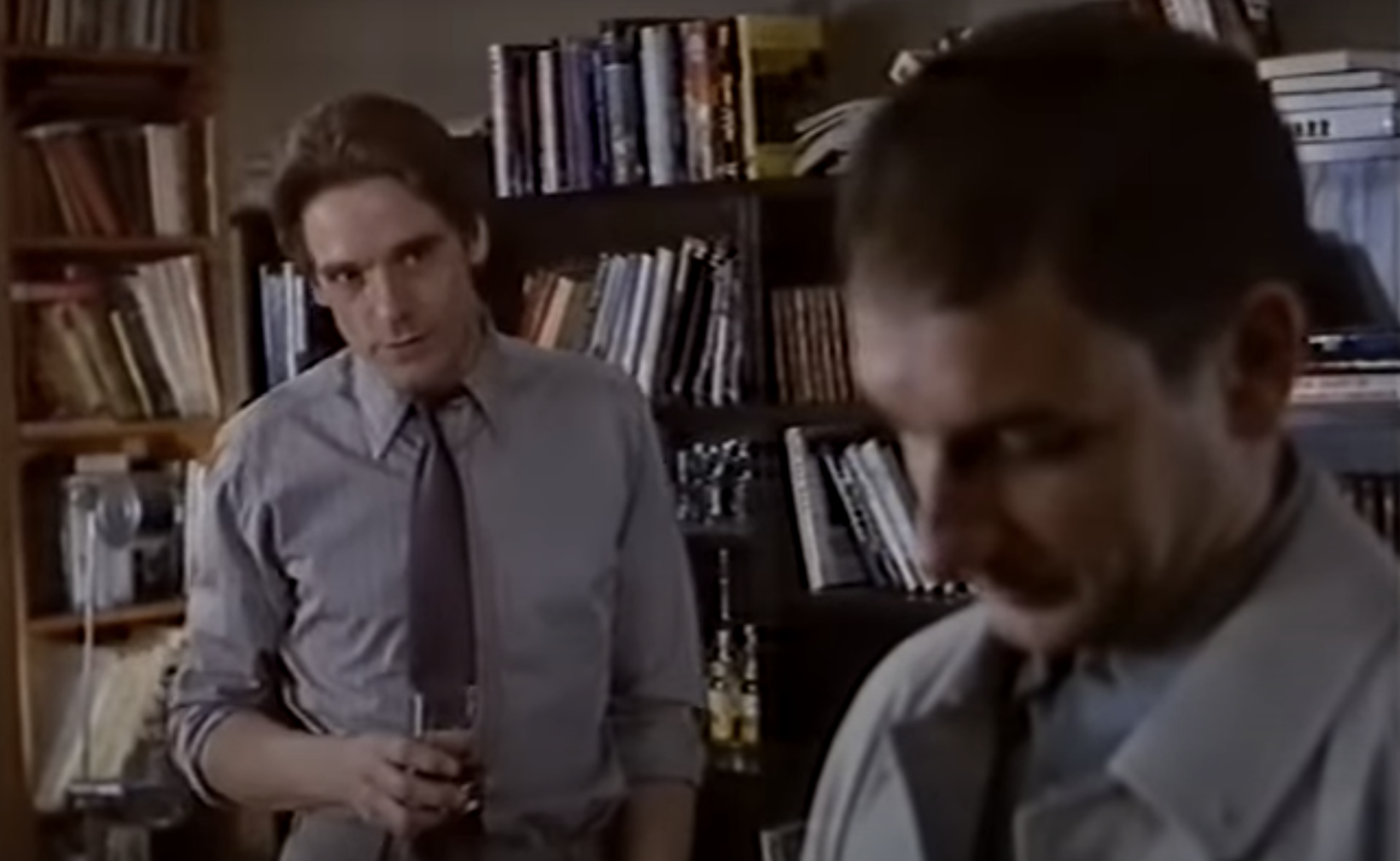
“I’m speaking of the original B’way production, of course, directed by Mike Nichols and costarring Jeremy Irons and Glenn Close. My admiration for Irons’ performance as Henry, a witty London playwright who resembled Stoppard in various ways, was boundless. Close, whom I was just getting to know back then, was truly magnificent as Annie.”

N.Y. Times critic Frank Rich called it “not only Mr. Stoppard’s most moving play, but also the most bracing play that anyone has written about love and marriage in years.”

“Love has to do with knowing and being known. I remember how it stopped seeming odd that in biblical Greek, knowing was used for making love. Whosit knew so-and-so. Carnal knowledge. It’s what lovers trust each other with. Knowledge of each other, not of the flesh but through the flesh, knowledge of self, the real him, the real her, in extremis, the mask slipped from the face.

“Every other version of oneself is on offer to the public. We share our vivacity, grief, sulks, anger, joy…we hand it out to anybody who happens to be standing around, to friends and family with a momentary sense of indecency perhaps, to strangers without hesitation. Our lovers share us with the passing trade. But in pairs we insist that we give ourselves to each other. What selves? What’s left? What else is there that hasn’t been dealt out like a pack of cards?

“[The answer is] carnal knowledge. Personal, final, uncompromised. Knowing, being known. I revere that. Having that is being rich, [so] you can be generous about what’s shared — she walks, she talks, she laughs, she lends a sympathetic ear, she kicks off her shoes and dances on the tables, she’s everybody’s and it don’t mean a thing, let them eat cake.

“Knowledge is something else, the undealt card, and while it’s held it makes you free-and-easy and nice to know, and when it’s gone EVERYTHING IS PAIN. Every single thing. Every object that meets the eye, a pencil, a tangerine, a travel poster. As if the physical world has been wired up to pass a current back to the part of your brain where imagination glows like a filament in a lobe no bigger than a torch bulb. Pain.”

— from Tom Stoppard‘s The Real Thing, directed by Mike Nichols and costarring Jeremy Irons and Glenn Close. It opened at the former Plymouth Theatre (now the Gerald Schoenfeld Theatre) on 1.5.84.

Frank Rich’s N.Y. Times review, 1.6.84.

When “The Indian Fighter” Opened at Mayfair in 1955…

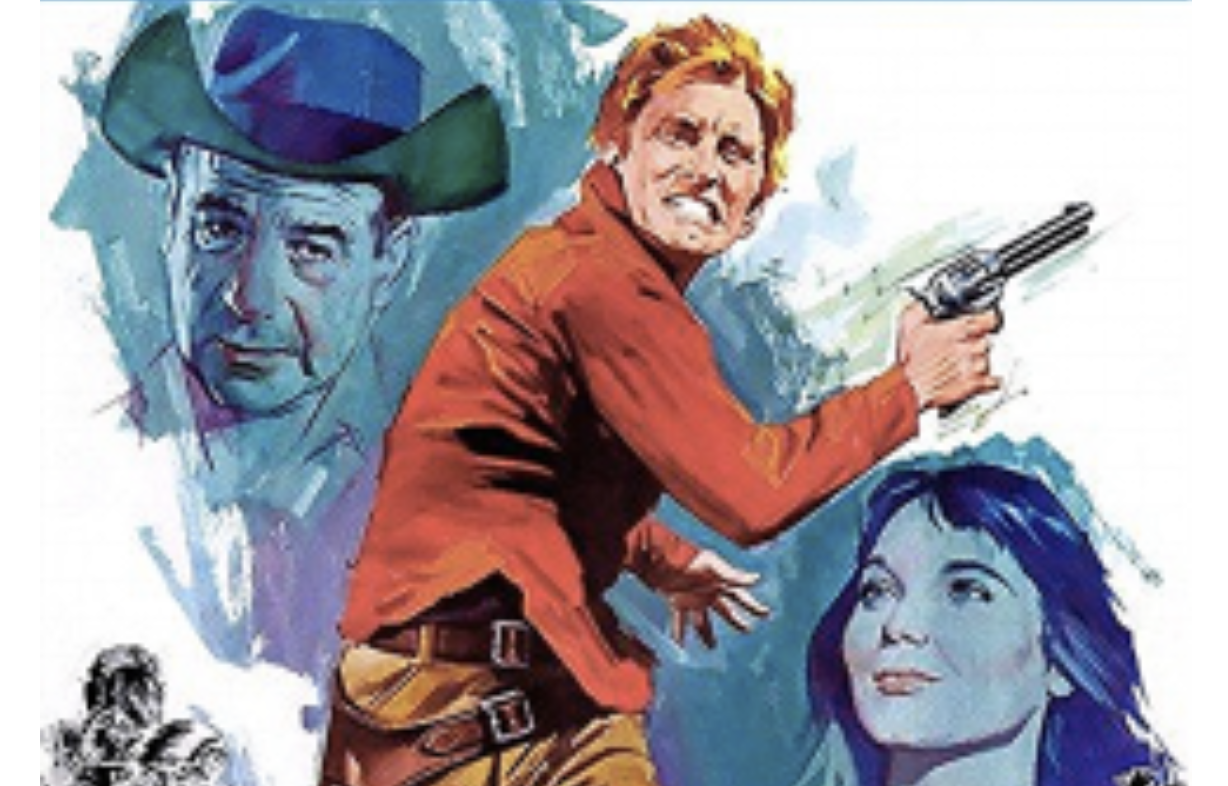
The Indian Fighter (United Artists, 12.21.55) was a passable-but-no-great-shakes western, starring Kirk Douglas and directed by Andre de Toth. It served the usual brawny action stuff in eye-filling CinemaScope, but the main hook was the sexual rapport between the 39-year-old Douglas and the 20 year-old Elsa Martinelli, a native of Tuscany and a fashion model, playing a willing Sioux squaw.

Douglas was a legendary hound, of course, and given the fact that (a) he hired Martinelli after seeing her photo on a European magazine cover, and (b) his company, Bryna Productions, produced The Indian Fighter, you can guess what happened off-screen.

12.22.55 N.Y. Times review excerpt: “Douglas’s Johnny Hawks, a free soul, thinks nothing of detouring a wagon train he is leading towards Oregon in order to keep a nocturnal tryst with the chief’s comely daughter; and only one reel before he nearly had succumbed to the blandishments of an equally beauteous widow.

“It must be noted of course, that the script by Ben Hecht and Frank Davis has a fair sense of humor, and that the forests and mountains of Oregon, where this fiction was filmed, are sweeping and picturesque in color and CinemaScope.

“In the brunette Elsa Martinelli, who plays the Indian lass with a minimum of words and a maximum of feline grace, Mr. Douglas has come up with a pretty photogenic newcomer.

Eduard Franz as Chief Red Cloud, Walter Matthau and Lon Chaney as the bad men of this escapade, Diana Douglas as the marriage-minded widow and cavalry officer Walter Abel do not contribute spectacular performances.

“But Mr. Douglas’ characterization is properly muscular. As a hard though not faultless gent, he sits a horse well, looks great in buckskins and sometimes gives the impression that he could take over a pioneer’s chores. Mr. Douglas has not blazed a cinema trail with The Indian Fighter, but he has come up with a sturdy entertainment that should please the action fans.”

But what would Ken Burns say?

Wee Bit Bored by Ken Burns’ Revolutionary War Series, And Yet…

I was watching Ken Burns The American Revolution, his epic-length PBS series about the Revolutionary War, and I don’t know if it was me or the series but something felt vaguely off. After a half-hour or so I began saying to myself, “This feels staid…Burns’ Civil War series (35 years ago) felt more alive and engaging on some level…this doesn’t seem to have much in the way of primal forward thrust.”

That said, I don’t see what’s so woke or twisted or threatening about Burns suggesting that the Iroquois Confederacy, a union of six Indian tribes or nations in New York state, influenced the structural thinking behind the U.S. Constitution.

Narrator Peter Coyote: “Long before 13 British colonies made themselves into the United States,” the Iroquois had “a union of their own that they called the Haudenosaunee — a democracy that had flourished for centuries.”

The legend is that Benjamin Franklin was so taken with the Iroquois Confederacy that in 1754, he suggested that the 13 colonies should form a similar union, which became known as The Albany Plan. The plan was rejected but was a forerunner for the Articles of Confederation and the United States Constitution.

Canassatego, a leader and spokesman of the Iroquois Confederacy in the 1740s. In 1744 he urged that the British colonies emulate the Iroquois by forming a confederacy.

What’s so terrible about passing this verified history along?

Iroquois Wiki excerpthttps://en.wikipedia.org/wiki/Iroquois#Confederacy: “When Europeans first arrived in North America, the Haudenosaunee (Iroquois League to the French, Five Nations to the British) were based in what is now central and west New York State including the Finger Lakes region, occupying large areas north to the St. Lawrence River, east to Montreal and the Hudson River, and south into what is today northwestern Pennsylvania.

“At its peak around 1700, Iroquois power extended from what is today New York State, north into present-day Ontario and Quebec along the lower Great Lakes–upper St. Lawrence, and south on both sides of the Allegheny Mountains into present-day Virginia and Kentucky and into the Ohio Valley. From east to west, the League was composed of the Mohawk, Oneida, Onondaga, Cayuga and Seneca nations.

“In 1722, the Iroquoian-speaking Tuscarora joined the League, and thereafter the Iroquois League become known as the Six Nations.”

Read more