Showing posts with label Yukio Mishima. Show all posts

Friday, August 22, 2025

Yukio Mishima / The strange tale of Japan novelist


Getty Images Yukio MishimaGetty Images

The theatrical life and death 50 years ago of one of Japan’s most celebrated and controversial authors created an enduring – but troubling myth, writes Thomas Graham.

Yukio Mishima: The strange tale of Japan novelist

Thomas Graham


Standing on a balcony, as if on stage, the small, immaculate figure appeals to the army assembled below. The figure is Yukio Mishima, real name Kimitake Hiraoka. He was Japan’s most famous living novelist when, on 25 November 1970, he went to an army base in Tokyo, kidnapped the commander, had him assemble the garrison, then tried to start a coup. He railed against the US-backed state and constitution, berated the soldiers for their submissiveness and challenged them to return the Emperor to his pre-war position as living god and national leader. The audience, at first politely quiet, or just stunned into silence, soon drowned him out with jeers. Mishima stepped back inside and said: “I don’t think they heard me.” Then he knelt down and killed himself by seppuku, the Samurai’s ritual suicide.

Saturday, November 23, 2024

Thirst for Love by Yukio Mishima / Review


Thirst for Love by Yukio Mishima

Reviewed: 
by Kristopher Cook

Synopsis: 

Etsuko struggles to come to terms with the death of her husband. Moving in with her father-in-law only raises more concerns for what it means to find true happiness.

Thursday, November 21, 2024

The Importance of Being Mishima Yukio


The Importance of Being Mishima Yukio

Damian Flanagan

24 November 2017


On November 25, 1970, the celebrated author Mishima Yukio shocked Japan with his ritual suicide. Damian Flanagan argues that his death went beyond a nationalistic call to arms or the final act of a madman, carrying real literary significance and shedding light on Mishima’s final artistic aims.


The Shocking End of an Author

November 25 this year marks the forty-seventh anniversary of the so-called Mishima Incident—one of the most shocking happenings of postwar Japanese history. What happened in the space of 80 extraordinary minutes that bright morning in 1970 has been minutely chronicled, yet still resounds in controversy and enigma.

The events, at least, are clear: Mishima Yukio, Japan’s greatest postwar literary talent, led four young cadets of his private army, the Shield Society, into a pre-arranged meeting with a general at a Self-Defense Forces facility in Ichigaya, Tokyo. Expecting nothing more than some pleasantries, the general was stunned when Mishima’s men suddenly seized, gagged, and threatened to kill him unless all the personnel on the base were immediately summoned to hear the author speak. After repeated scuffles with officers attempting to break into the hostage room, Mishima eventually strutted out onto a large balcony outside the room and addressed up to 1,000 military staff on the parade ground below.

Mishima hectored them about the need for constitutional reform and fulminated that the “Peace Constitution” did not even recognize their existence. Intending to speak for a half-hour, he was immediately confronted with a barrage of abuse (“Madman!” “Idiot!” “Japan is at peace!”) and gave up after only seven minutes. He retired to the general’s room, where he began his meticulously prepared ritual suicide. He plunged a short sword deeply into his abdomen and excruciatingly pulled it across his stomach before his attendant and probable lover Morita Masakatsu attempted to perform kaishaku, beheading Mishima with a long sword to end his agony.

Unfortunately, Morita’s swordsmanship was hopeless, and he repeatedly missed Mishima’s head, striking him agonizingly on the shoulders instead. Another of the cadets—an experienced kendō practitioner—then stepped in and expertly performed the kaishaku. Morita himself then performed ritual suicide and was in turn decapitated. When the police entered the room shortly afterwards, the heads of Mishima and Morita were resting side by side on the carpet.

An Electrifying Tragedy

News of the incident spread like wildfire across the mass media in waves of miscomprehension and misreports. Some people, when they heard the name “Mishima” constantly repeated on the radio and television, assumed that he had won the Nobel Prize for Literature. Instead, that evening’s edition of the Asahi Shimbun—the paper’s top-selling edition ever—carried a photograph of Mishima’s severed head.

An explosive outpouring of frantic analysis followed, offering diverse opinions: Mishima had died in the noblest of political protests. No, he had simply gone insane. The writer’s desire to die a heroic samurai death at the peak of his powers and to indulge his lifelong sadomasochistic impulses were also inevitably mentioned.

In his later years Mishima dove deeply into Japan’s military past and the samurai ethos underpinning it. (© Jiji)

The ostensible reasons for Mishima’s dramatic suicide—a demand for the legal recognition of the Japanese military and a reform of the American-imposed “Peace Constitution”—are today policy objectives of the conservative Abe Shinzō and his Liberal Democratic Party, which has just won an overwhelming electoral victory. Indeed, in a grim irony showing how things have come full circle, three years ago a protestor set himself on fire, objecting to just the constitutional reform Mishima was calling for.

Although he only became interested in the idea in the last years of his life, Mishima took constitutional reform seriously and set up a study group on Japan’s Constitution within the Shield Society. Yet many have seen his posturing on this issue as a charade to effect his own spectacular samurai-style death. Mishima had written in works like the 1969 Wakaki samurai no tame ni (For Young Samurai) of reviving samurai ideals in modern Japan and had died with a hachimaki band around his head proclaiming shichishō hōkoku, or “seven lives to give for the emperor.”

Whatever your perspective on the incident, the one thing that seemed clear was that it was a grim, terrifying moment of high tragedy. Mishima was known in life for his great sense of humor and his infectious laugh, but it seemed as if in this final event all humor deserted him. As the writer Yoshida Ken’ichi memorably said of Mishima, he might be laughing with his voice, but his eyes were always serious.

Looking for the Comedic Side

That is one way of understanding Mishima, but it is not the only one. In fact, it makes just as much sense to turn that equation around and see things the other way—whenever Mishima was staring at you in deadly seriousness, he was also laughing. Like Friedrich Nietzsche, a favorite author—Mishima’s mother left a copy of Nietzsche on her son’s altar so he could read him for all eternity—Mishima understood that the most profound ideas could not just be fused with comedy, but that comedy is intrinsic to the highest forms of philosophy, as it is to the human condition itself.

Where, then, was the comedy in the Mishima Incident? Actually, everywhere, if you knew where to look.

Mishima had a long-standing interest in ritual suicide, a subject he described in detail in his 1961 short story “Yūkoku” (Patriotism), which he turned into a film in 1965 with himself in the lead performing the suicide. In preparation for the Mishima Incident he read up on historical acts of seppuku. His editor at Shinchōsha, Kojima Chikako—for whom he was serializing his “life work,” the Sea of Fertility tetralogy—recalls how when she called to collect his monthly manuscript he would regale her with comic stories of seppuku that had gone bizarrely wrong.

There was the samurai who had started to insert a sword into his stomach, but had discovered it to be blunt and so decided to have it sharpened, putting off his death for another day. Or the samurai who had committed seppuku without kaishaku and had lain there for hours. When his body was discovered by junior samurai, they began talking about him, only for the seemingly dead corpse to bark out, “Don’t dare speak about me in that way!” This type of thing would send Mishima into hysterics.

Still, it’s hardly Oscar Wilde, is it? But in fact Wilde, along with the Japanese writer’s lifelong devotion to the Irish playwright who lived from 1854 to 1900, was a key part of the 1970 suicide. Mishima’s obsession with Wilde’s 1891 play Salomé—the story of the beheading of John the Baptist at the request of King Herod’s stepdaughter Salomé and its alluring depiction of sadomasochistic eroticism—positions the entire Mishima Incident in an entirely new light.

The Mishima-Wilde Connection

Mishima first encountered Oscar Wilde and his play Salomé, illustrated by Aubrey Beardsley for its 1894 English translation, in his preteen years. He would later recall the enormous impact it made on his imagination.

“I was probably eleven or twelve and saw an Iwanami pocketbook edition of Wilde’s Salomé. Beardsley’s illustrations intensely attracted me. Taking it home and reading it, I felt as though I had been struck by lightning . . . Evil had been unleashed; sensuality and beauty had been liberated; moralizing was nowhere to be seen.”

Later, Mishima had the opportunity of going to see Richard Strauss’s Salomé at the Metropolitan Opera House in New York when he made his first overseas trip to America in 1952.

As well as being an outstanding novelist and short story writer, Mishima was also a prolific dramatist, writing more than 80 pieces for the stage, in a variety of genres including Western plays as well as nō and kabuki works. He also adapted and directed plays and occasionally appeared in them himself in bit parts. Yet when in 1960 he realized his lifelong dream of putting Wilde’s Salomé on stage in Tokyo, he declared:

“It has been my dream for the last twenty years to direct Salomé. I would only be slightly exaggerating to say that I joined the theater just so I could direct Salomé one day.”

Wilde himself selected the young artist Aubrey Beardsley to create the images for his play’s first English-language edition.

Immediately before the Mishima Incident, he was preparing another production of Salomé to open in Tokyo in the spring of 1971. When on stage, only a few months after Mishima’s death, the severed head of John the Baptist was lifted up and kissed by Salomé, the audience could not fail to link its significance to the incident that had just rocked Japan.

The eyes were deadly serious, but the voice rang out in high laughter. It was a pattern throughout Mishima’s life that he wished to act out in person the arresting visual stimuli—from the Martyrdom of St. Sebastian to samurai seppuku deaths—that had beguiled his imagination as a child. But perhaps no image mattered more to him that the severed head of John the Baptist in Wilde’s Salomé.

Rather than seeing that shocking image of Mishima’s severed head on the carpet as the appalling conclusion to his call for constitutional reform or his desire to die like a samurai, we can view it as Mishima’s longstanding ultimate objective, the moment when he himself was transformed by the stroke of a lover’s blade into a real-life John the Baptist.

It’s not funny, most would say; it’s deeply disturbed. But this was Mishima’s ultimate joke on life and the power of imagination itself, profoundly informed by his love of Oscar Wilde. It was a comedic representation of the importance of being Mishima Yukio.

(Originally written in English. Banner photo: Mishima Yukio gives a speech from the second-floor balcony of the Ground Self-Defense Force’s Eastern Corps Headquarters in Ichigaya, Tokyo, shortly before committing suicide on November 25, 1970. © Jiji.)

Damian Flanagan

Writer and literary critic. After graduating from Cambridge University with a degree in English literature, came to Japan and earned his MA and PhD in Japanese literature at Kobe University. An author of numerous books on Japanese literature, he also writes widely on Japanese politics and culture for Japanese and Western publications. His website is www.damianflanagan.com.

NIPPON


Watching the Skies in Japan / Mishima Yukio and Other UFO Enthusiasts


Watching the Skies in Japan: Mishima Yukio and Other UFO Enthusiasts

24 JUNE 2020


Mishima Yukio was among the famous members of the Japan Flying Saucer Research Association, founded by Arai Kin’ichi in 1955 to research and discuss UFOs.


Mishima and the Flying Saucers

“Summer, the season of flying saucers, is almost here. Last summer, I took my binoculars to Atami Hotel and watched the skies every single night in the hope of seeing so-called UFOs coming in to land. Yet in the end, I was not fortunate enough to witness such an event.”

This is the opening of an essay that author Mishima Yukio wrote in 1957 for Uchūki (Spacecraft), the official publication of the Japan Flying Saucer Research Association (JFSA). Mishima, who yearned to see an alien spaceship, joined the organization the year after it was founded in 1955 by Arai Kin’ichi, a UFO trailblazer in Japan. The JFSA had more than 1,000 members at one point, and Mishima was not its only famous face. Others included the writers Hoshi Shin’ichi, Ishihara Shintarō, and Nitta Jirō; the rocketry pioneer Itokawa Hideo; and the composer Mayuzumi Toshirō. In June 1957, Mishima took part in an observation event in Hibiya, Tokyo, and later that summer he searched for UFOs during a trip to the United States. Arai wrote in an article that Mishima was an enthusiastic member of the association and always showed up to events with a huge telescope.

Mishima Yukio (left) at an observation event in Hibiya, Tokyo, in June 1957. (Courtesy UFO Fureaikan)

Mishima wrote an article for the magazine Fujin kurabu (Women’s Club) about a cigar-shaped UFO-like object he witnessed with his wife from the top of his home in Ōta, Tokyo, on May 23, 1960. In his novel Utsukushii hoshi (A Beautiful Star), published two years later, the members of a family of four who each witness a flying saucer discover that they are all from different planets: Mars, Jupiter, Mercury, and Venus. They strive to build up the peace movement to save humanity from annihilation and nuclear war, while facing an antagonistic group of aliens seeking to wipe people out. This uncharacteristic work reflects Mishima’s fascination with UFOs and aliens.

However, Mishima was never convinced he had actually seen a UFO. In a tribute in the Asahi Shimbun to the playwright and fellow flying saucer enthusiast Kitamura Komatsu after his death in 1964, Mishima wrote, “While I wasn’t able to see a flying saucer in the end, I enjoyed the more valuable experience of pure friendship.”

UFOs for Peace

Even so, Mishima believed that UFOs existed. Arai, the JFSA head, was similarly certain that they were real, despite not having seen them himself, and toiled steadily to gather information about them. Arai was born in Tokyo in 1923 and worked with airborne radar in the Army Air Service during World War II. He had a longstanding interest in weather and astronomical observation, as well as aircraft. After a postwar spell in the Ministry of Finance, he ran a bookshop in Shinagawa, Tokyo, and read widely in his fields of interest. He came across the Japanese translation of Flying Saucers Have Landed by George Adamski, which was published in 1954. Adamski claimed to have gone on board a flying saucer that came to land and talked with aliens from Venus. The UFO boom had begun some years earlier with media reports that US businessman Kenneth Arnold had seen nine shining objects flying through the sky while traveling in his plane on June 24, 1947. Arai was immediately interested, although skeptical whether Adamski’s claims could stand up to scientific scrutiny. As these kinds of personal stories and witness accounts steadily continued to emerge, Arai felt there should be a venue for serious discussions of UFOs, which led him to found the JFSA.

The inaugural edition of its official publication included the following passage. “As Japan still has no serious research body for UFOs, they are currently seen as the products of daydreams or hallucinations. Yet it cannot be called absurdly unscientific to investigate whether such objects exist in our vast universe. For even now we, the residents of Earth, are forming plans to journey through the cosmos in the distant future. Thus, our possession of all manner of materials relating to flying saucer reports around the world and debate on their veracity based on today’s superlative space science is, although we are an amateur organization, surely a significant first page in the history of space travel.”

Arai Kin’ichi’s 2000 autobiography UFO koso waga roman (My UFO Romance). (Courtesy UFO Fureaikan)
Arai Kin’ichi’s 2000 autobiography UFO koso waga roman (My UFO Romance). (Courtesy UFO Fureaikan)

Arai’s ultimate goal was world peace and the protection of humanity’s future. He feared that the Cold War between the Western and Eastern Blocs would lead to another global conflict. In a 1978 interview with the magazine UFO to uchū (UFOs and Space), he commented, “If we knew for certain that there were UFOs watching Earth, like a third party, wouldn’t that bring war to an immediate end?” In 1957, the JFSA marked two years since its founding with a joint statement of “universal peace” with other research groups. It sounded a warning over how the nuclear arms race threatened the future of humanity, while calling for differences between states and races to be overcome in order to make preparations for the coming of flying saucers. The same year, a report in foreign dispatches came that the Soviet Union was planning to launch a rocket to the moon armed with a nuclear weapon. The JFSA handed a document urging the cancelation of its launch to the Soviet ambassador. Mishima’s novel Utsukushii hoshi depicts the writing of a letter calling on the Soviet leader Nikita Khrushchev to stop nuclear testing, which was clearly influenced by the JFSA action. 

A UFO Center in Japan

Around 3,000 items from Arai Kin’ichi’s collection are kept in the UFO Fureaikan. (Courtesy UFO Fureaikan)

Arai established a UFO library in his company building in Shinagawa, where he displayed the materials he had assembled and made them available for reading. Shortly before his death in April 2002, he donated most of the materials to a museum, the UFO Fureaikan in Fukushima, Fukushima Prefecture. He knew and trusted Kinoshita Tsugio, then the museum director. Kinoshita recalled, “While he was still alive, Arai wanted the materials to be properly organized and looked after. He was a good-natured and serious man. He told me, ‘I’ve never seen a UFO. You’re so lucky to have witnessed them several times.'”

The UFO Fureaikan opened in 1992, funded by one of the ¥100 million grants paid out to municipalities throughout Japan in a government bid to revitalize the regions. It is located on a hill called Senganmori, known for the many sightings of luminous objects in the skies. Kinoshita, a local UFO researcher, was director of the museum from 1993 to 2010.

Senganmori (left) and the view from its 462.5-meter summit. (Courtesy UFO Fureaikan)

The pyramid-shaped Senganmori is said to have a strong magnetic field, and has rocks resembling a whale, an Easter Island moai, and other curious forms. These have led it to be seen as a “power spot.” Kinoshita says there are many witness reports of UFOs within a radius of 30 or 40 kilometers around Senganmori and the city of Fukushima. He says he first encountered one in the summer of 1972, when he was 25, while climbing Minowayama to the west of Senganmori with three friends. 

“We were 10 or 15 minutes from the summit. As I took a step forward, I suddenly looked up at the skies and saw a helmet-shaped object floating as if it had been stuck there. It was the oxidized silver color of a one-yen coin and looked around 30 centimeters long. The four of us were dumbfounded for 30 seconds or so. We hurriedly climbed to the summit to view it from a greater height, but when we looked up again it had vanished.”

Kinoshita soon became engrossed in UFO research. He says he has now seen UFOs at least six times. Since retiring from his post as museum director, he has established a place for study next to his home, a short car journey from the Fureaikan. Sometimes visitors come and talk about UFOs or share their own witness accounts. While there are many people who do not believe at all, Kinoshita says it is important to recognize UFOs as potential gateways to advancement. “We don’t know if people really saw UFOs or not. But simply deciding that they must have been mistaken doesn’t allow for them to broaden their interest. If they say they’ve witnessed a UFO, we have to listen carefully. A sighting might inspire someone’s future research in astronomy or energy systems. These are gateways for expanding our world. There are skeptics who ask why they’ve never seen a UFO, but people today rarely look at the sky. If you don’t look up at the sky, you’ll never spot a UFO!”

(Originally written by Kimie Itakura of Nippon.com and published in Japanese. Banner photo © KTSimage/Pixta. With thanks for the cooperation of UFO Fureaikan.)

NIPPON


Mishima Yukio / Historical Visionary


Shapers of Japanese History

Mishima Yukio: Historical Visionary

Inoue Takashi 

2 October 2020

Mishima Yukio’s literary creations, imbued with his individualistic aesthetic sense, have enthralled readers around the world. In the year that marks the fiftieth anniversary of his suicide, Mishima expert Inoue Takashi looks back on the writer’s life.

Fifty years ago, Mishima Yukio died dramatically, killing himself by seppuku after his calls to reform Japan’s postwar Constitution failed to inspire Self-Defense Forces to rise up at a base in Tokyo. The death of the renowned author, nominated five times for the Nobel prize in literature, caused shock in Japan and around the world, but his motives were hard to fathom. Half a century later the mysteries remain, and critics continue to investigate the meaning of his literature and suicide.

Mishima was born Hiraoka Kimitake in 1925. As the Shōwa era (1926–89) began the following year, the author’s age remained in step with the numbering of the era; he was 20 in 1945 (Shōwa 20) and 45 when he died in 1970 (Shōwa 45). Divide the period into three, and there are the first 20 years of Shōwa that were dominated by years of warfare culminating in unprecedented collapse, the next 25 of rapid economic growth that lifted the country up from its burnt-out ruins, and the 20 or so that followed. Mishima’s life overlapped with the first two of these parts, which could be seen as most representative of the period as a whole. Although the curtain finally came down on the Shōwa era in 1989, as the economic bubble burst, he could be said to have already followed its spirit to the grave.

Mishima believed that literary works represented their age, while at times expressing disagreement and offering new historical visions. This was particularly the case from his 1956 work Kinkakuji (trans. The Temple of the Golden Pavilion) onward. The main genre of modern Japanese literature was the I-novel, in which authors sincerely recorded their own experiences and incidents around them; writers with the same sense of creativity as Mishima were extremely rare. On the international stage, however, authors celebrated for their contributions to the novel like Balzac, Flaubert, Thomas Mann, Tolstoy, and Dostoyevsky all transcended their era, criticizing society and thrusting their artistic vision on the world. Mishima was a writer in this tradition.

Debut at 16

Mishima was born in Yotsuya, Tokyo. This was technically in the prestigious Yamanote district on the west side of the city center, but in fact it was a poor locality, left behind in the reconstruction that followed the Great Kantō Earthquake of 1923. His grandmother Natsuko, from a distinguished samurai family, was dissatisfied with the living environment there. Mishima’s grandfather was formerly the governor of the southern half of the island known as Karafuto in Japan (now wholly administered by Russia as Sakhalin). However, he was forced out of office after a bribery scandal, and Natsuko compensated for her lost dreams and shattered self-esteem through devotion to her grandson.

As Natsuko suffered from sciatica and Mishima had a weak constitution, they often spent their days together in the sickroom. Mishima, who loved fairy tales and picture books, later let his own imagination fly, drawing and writing stories. In “Sekai no kyōi” (The Wonder of the World), a story he wrote when he was 10, autumn comes to an island paradise and with the extinguishing of a candle, it is plunged into darkness.

Although Mishima was not himself from an aristocratic family, he attended Gakushūin, a school for children of the upper classes. His poor health played a part in his undistinguished performance in elementary school. From junior high school, however, his teachers helped lift him to become one of the institution’s outstanding students. At 16, he made his literary debut with his first story to be published outside school magazines. In “Hanazakari no mori” (The Forest in Full Flower; 1941), the narrator enters the flow of time before he was born, and rediscovers the origin of life. This was when Mishima adopted his pen name. It was also the year Japan attacked Pearl Harbor, initiating the Pacific War.

Mishima graduated from Gakushūin High School at the top of his class in 1944 and enrolled in the Faculty of Law at Tokyo Imperial University (now the University of Tokyo). Although poor health exempted him from military service, Mishima’s first collection that year, bringing together “The Forest in Full Flower” with four other stories, had been intended as a posthumous publication. The end of the war the following year left him facing a dilemma. Older authors forced into silence during the war years and up-and-coming writers back from the battlefields let forth a flood of fiction, while Mishima, who despite his youth had been creatively active during this time, found he had lost his place in the literary world. Half deciding to abandon his idea of becoming a novelist, he joined the Ministry of Finance after graduating from university, and began on the bureaucratic career path.

Instead of giving up fiction, however, Mishima quit his job at the ministry after nine months to work on a new novel. Kamen no kokuhaku (trans. Confessions of a Mask), published in 1949, had a narrator based on the author himself, who looks back on the circumstances that led him to accept his homosexuality. In one notable scene, the narrator first becomes sexually excited on seeing a picture of the martyrdom of Saint Sebastian, who was bound to a tree and shot with arrows. The novel did not represent Mishima’s own coming out as gay, though. Rather, with an insistence that everyone is wearing masks, it poured cold water on the kind of sensibility that believes unquestioningly in the identity of the self. This irony resounded with the psychologically troubled young people who had to live through the chaos of wartime and the immediate postwar period, making Confessions of a Mask a bestseller.
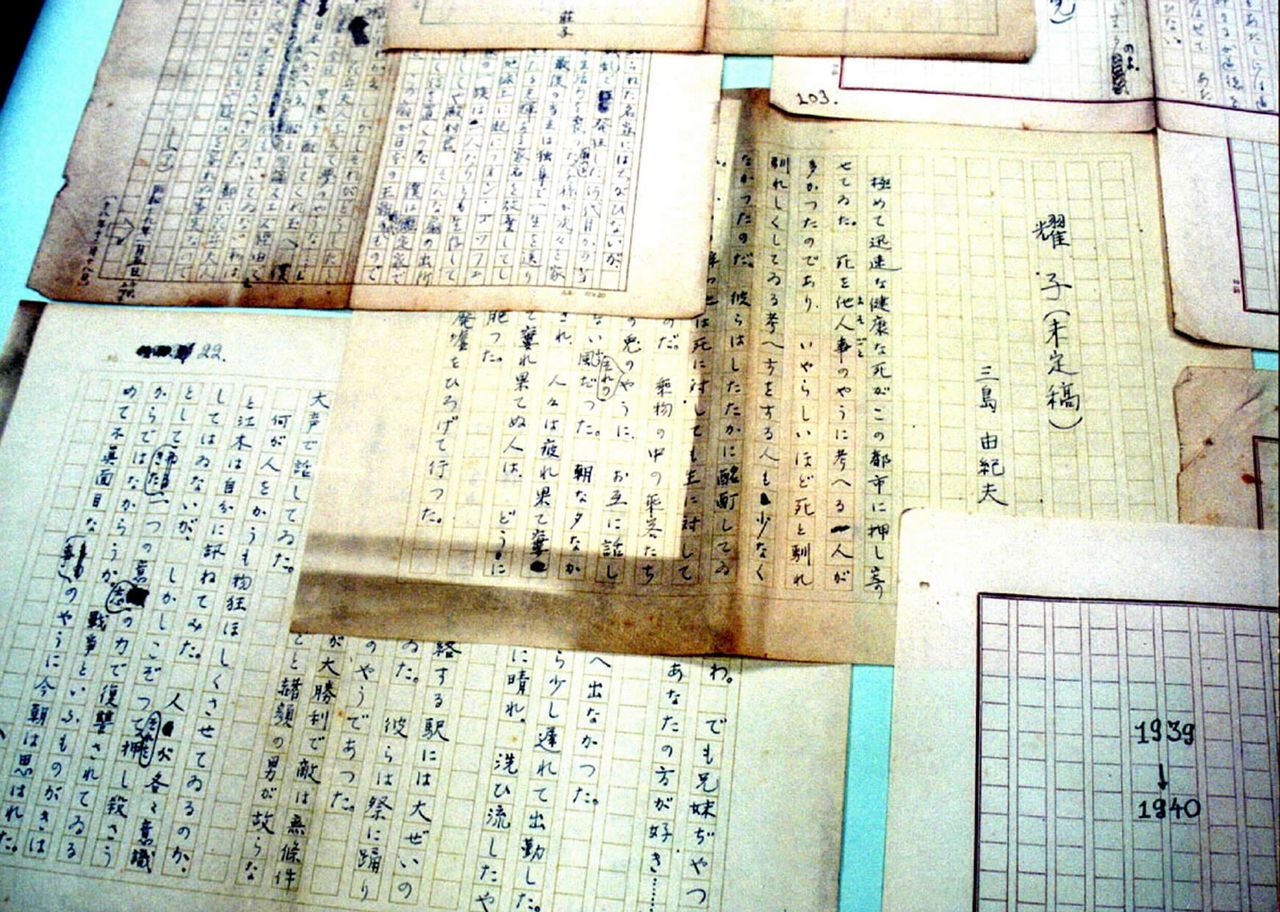
Unpublished manuscripts by Mishima Yukio. In 2000, 183 works of fiction and criticism written by Mishima in his late teens and early twenties were discovered. These are at the Mishima Yukio Literary Museum in Yamanakako, Yamanashi Prefecture. (© Jiji)

Success and Miscalculation

Having returned to the literary scene, Mishima drew a lively picture of the gay community in occupied Japan in Kinjiki (trans. Forbidden Colors), published from 1951 to 1953, and presented an innocent story of first love in his 1954 Shiosai (trans. The Sound of Waves). He also ventured into drama with the 1956 collection Kindai nōgakushū (trans. Five Modern Nō Plays) and the 1954 kabuki play Iwashiuri koi no hikiami (trans. The Sardine Seller’s Net of Love). In 1956, at the age of 31 he published The Temple of the Golden Pavilion, based on the real-life arson of Kinkakuji, the titular Kyoto temple, by one of its acolytes in 1950. It became one of his best received works and was translated into many languages.

By the time it was published, Japan’s economic boom years had begun. What drew so many readers to this novel about the arson incident of six years before? Reborn after the tribulations of war, the country was rising toward prosperity. Even so, it was only a decade or so since the war ended, and the dark memories of that time were slow to fade. They remained deeply rooted in people’s minds as an inner threat to the bright dreams of postwar democracy, progress, and affluence. The Temple of the Golden Pavilion spoke for the internal unease many in the new society felt.

From the inner perspective, democracy and economic growth were nothing other than masks. Continuing to wear them meant losing sight of the roots of existence, and falling into nihilism. Mishima made nihilism the subject of his 1959 work Kyōko no ie (Kyōko’s House), which tells the story of four young people leading lonely lives in Tokyo and New York around 1955.

(From left to right) Authors Mishima Yukio, Abe Kōbō, Ishikawa Jun, and Kawabata Yasunari come together to read a joint statement in Tokyo on February 28, 1967, protesting against the Cultural Revolution in China. (© Jiji)

Here he made a great miscalculation. The generation of readers who embraced The Temple of the Golden Pavilion were lukewarm about Kyōko’s House. By 1959, the people bustling through a new and bigger economic boom were no longer interested in the question of nihilism. For Mishima, who had tried to depict some of the darker aspects of the age in his novel, this was a grave shock.

The Final Manuscript

Mishima went on to seek new ways of being outside the literary sphere, acting in the 1960 gangster movie Karakkaze yarō (Afraid to Die) and becoming the subject of the 1963 photography collection Barakei (Ordeal by Roses) by Hosoe Eikō. With their success, he became a media favorite. 

This meant, however, catering to the postwar society that made no attempt to understand Kyōko’s House. The greater the media reaction he stirred up, the greater his sense of self-denial. To counter this situation, he could only take on the challenge of creating a literary work that captured the age and offered a new vision of history on a greater scale than ever before. This was the tetralogy Hōjō no umi (trans. The Sea of Fertility).
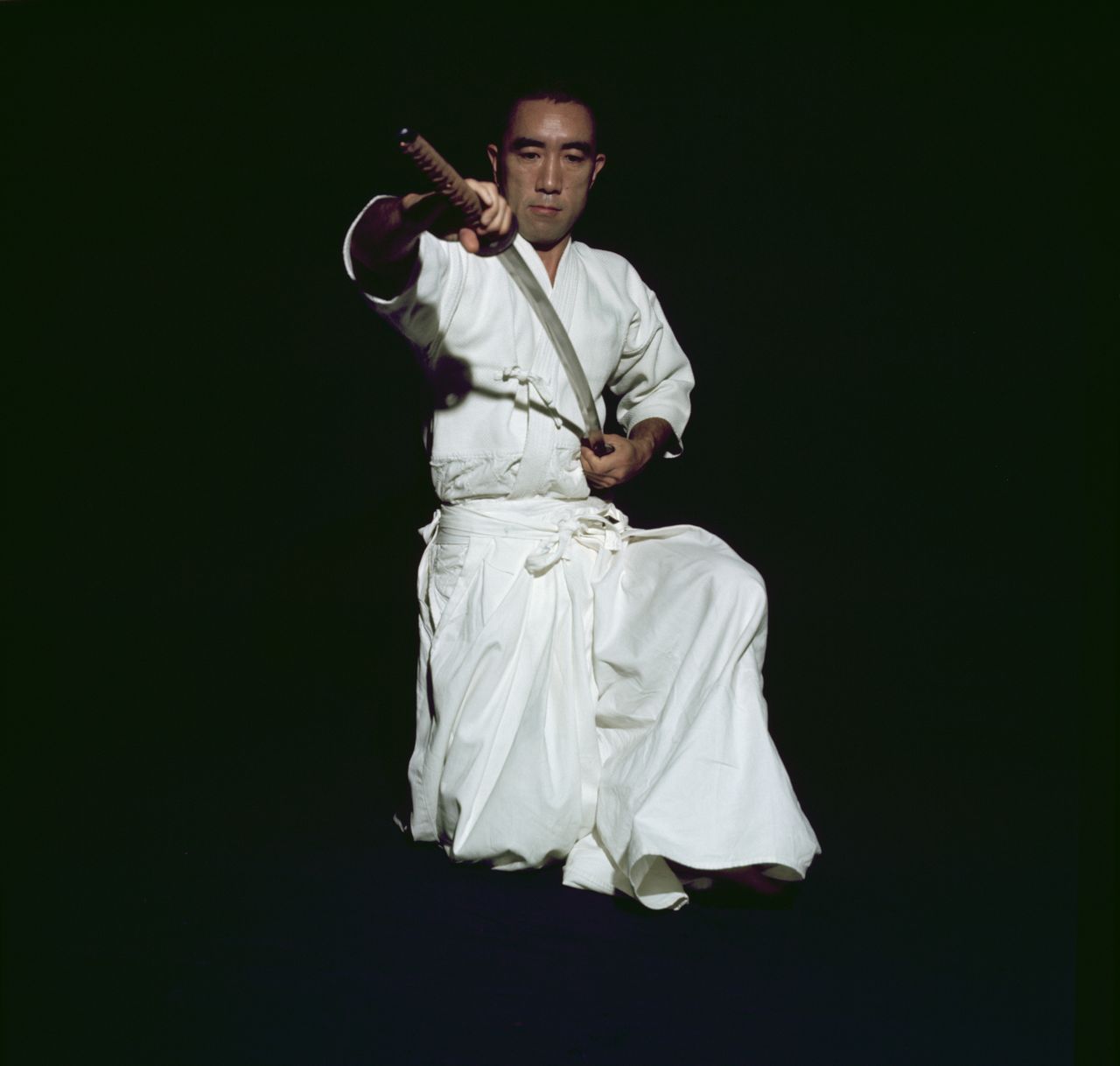
Mishima Yukio practicing the martial art of iaidō on July 3, 1970. (© Jiji)

In the four books, its protagonist apparently reincarnates through the twentieth century. The opening depicts a memorial ceremony for those who died in the Russo-Japanese War of 1904–5. Its bleak atmosphere lingers in the background throughout The Sea of Fertility, demonstrating that the roots of postwar nihilism were already present in the Meiji era (1868–1912). As the successive reincarnations fight against this rejection of principles in their pursuit of life, a joyful enlightenment seems certain in the final part.

However, while this was the ending in the original concept, the fourth book actually finishes with the twist that the stories of reincarnation were no more than an illusion. After handing the final manuscript in to be edited on November 25, 1970, Mishima caused a sensation with his suicide. The truth behind the act is still unknown. One thing I can say is that Mishima vividly portrayed the nihilism the age was moving toward in his ending to The Sea of Fertility. I take his death by his own hand as having been an act aimed at encouraging each one of us to discover how to overcome that nihilism.

(Originally published in Japanese on August 26, 2020. Banner photo: Mishima Yukio in 1970. © Jiji.)

***

Inoue Takashi

Professor at Shirayuri University. Specializes in Mishima Yukio and other modern Japanese literature. Born in Yokohama in 1963. Graduated from Tokyo University, where he also conducted graduated work. Was a lecturer and associate professor at Shirayuri University before taking on his current position in 2008. Works include Mō hitotsu no Nihon o motomete: Mishima Yukio Hōjō no umi o yominaosu (Seeking Another Japan: A Reassessment of Mishima Yukio’s The Sea of Fertility) and Mishima Yukio Hōjo no umi vs. Noma Hiroshi Seinen no wa: Sengo bungaku to zentai shōsetsu (Mishima Yukio’s The Sea of Fertility vs. Noma Hiroshi’s Ring of Youth: Postwar Literature and the Total Novel).


NIPPON


Saturday, August 31, 2024

Mishima Yukio’s Suicide and “The Sea of Fertility”

Shapers of Japanese History

Mishima Yukio’s Suicide and “The Sea of Fertility”

Inoue Takashi 

25 November 2020

Half a century after Mishima Yukio’s suicide, literary specialist Inoue Takashi considers the connections between his death and his final work, Hōjō no umi (trans. The Sea of Fertility).

Mishima in the World / 50 Years Later


Japan’s Literary Treasures

Mishima in the World: 50 Years Later

Irmela Hijiya-Kirschnereit 

2 November 2020

Half a century has passed since the demise of Mishima Yukio, for many decades the world’s best-known Japanese literary author. By number of translated book titles, he is far ahead of Kawabata Yasunari and Ōe Kenzaburō, Japan’s two literary Nobel Prize winners to date. But being widely known and read in the fast-paced world of the twenty-first century would be no mean feat, given the enormous changes in the media landscape and the changed significance of highbrow literature. What is left of his legacy as a writer?

Ordeal by Roses / The Astonishing Artistic Collaboration Between Mishima Yukio and Photographer Hosoe Eikō


Shapers of Japanese History

Ordeal by Roses: The Astonishing Artistic Collaboration Between Mishima Yukio and Photographer Hosoe Eikō

Iizawa Kōtarō

10 November 2020

In 1963, one of Japan’s most promising young photographers collaborated with renowned author Mishima Yukio on Barakei (Ordeal by Roses) a remarkable collection of artistically creative photographs that used the author’s bodybuilder’s physique to stunning effect, creating an international sensation.