Showing posts sorted by relevance for query rufus king. Sort by date Show all posts

Sunday, August 26, 2012

John Dillinger, Cole Porter and Rufus King Walk Into a Bar....

What connects John Dillinger, renowned gangster, and Cole Porter, renowned songwriter, to Rufus King, once highly esteemed but now mostly forgotten mystery writer?  The Cole Porter connection is not altogether startling (Mike Grost also mentions this on  his website). However, the John Dillinger connection was totally unexpected.

Both Cole Porter, born on June 9, 1891 and Rufus King, born on January 3, 1893, were only children of wealthy parents and attended Yale University in overlapping years.  The families of both men intended that their Yalies become respectable lawyers, but it didn't quite pan out that way.

Both Porter and King took to the musical in a big way while at Yale and they became key members--and in their respective senior years, presidents--of the Yale Dramatic Association (King also was a member of the Elizabethan Club, dedicated to conversation, tea and literature, and the Pundits, the senior prank society).

When King came to Yale the precocious Porter already was writing musical plays for the YDA.  "Rufe" King, who was adept among the all-male membership at playing women's parts, became one of the YDA's star attractions (about King, another member of the YDA, Arnold Whitridge, wrote the following--no doubt envious!--couplet: "Little Rufe King couldn't teach me a thing/I'm the Queen of the Yale Dramat").

Perhaps the best known Porter play in which King starred was And Still the Villain Pursued Her (1912), a send-up of Uncle Tom's Cabin and nineteenth-century melodramas.  King's friend, the future Oscar-nominated actor Monty Woolley played the villain, while King, age nineteen, took the heroine's part.
 
Here's an except from Porter's song (sung by King) "The Lovely Heroine":

Oh gee! It's heaven to be the lovely heroine.
All the men woo me
And try to undo me
But that's not my line.
I live so far from New York
I faint dead away at the smell of a cork.
Why! I'm such a child I believe in the stork!
For I'm the heroine.

Wooley's lyric from "I'm the Villain" naturally was a mite more pugnacious:


Cole Porter at Yale
Oh, I'm the villain,
The dirty little villain;
I leave a pool of blood where e'er I tread,
I take delight 
In looking for a fight
And pressing little babies on the head
Till they're dead.

(see The Complete Lyrics of Cole Porter, p. 13-14).

Little Rufe King was much in demand for women's parts.  In other Porter musicals King sang the numbers "Oh What a Lovely Princess" (Years have I waited for someone adorable/So far my luck is deplorable) and "The Prep School Widow" (I find that school boys offer more/than many a college sophomore).

In 1914, King was planning to enroll in Columbia Law School (surely a loss to musical comedy), but instead he steered another, more unexpected, course.

Rufus King, author
King spent a couple years at sea as a shipboard wireless operator, enjoying a "romantic life of rolling ships and strange ports" (and obviously picking up a lot of maritime knowledge that would figure in many of his later novels).  He also worked a year in a Paterson, New Jersey silk mill, before serving as an artillery lieutenant in World War One.

After the war King was employed for a time in the maritime division of the New York police, before achieving success in late thirties as a mystery novelist.  All in all, surely one of your most interesting mystery author backgrounds!

Now what, oh what, does John Dillinger have to do with any of this (admittedly it's a little hard to see the notorious public enemy performing star turns in musical comedy)?

Well, in April 1934, Dillinger and his gang were holed-up at the Little Bohemia Lodge in the upstate Wisconsin village of Manitowish Waters.  The lodge owner's wife managed to get a letter to the FBI, which launched a badly botched assault on the building, in the process killing a bystanding Civilian Conservation Corps worker, but failing to capture or kill Dillinger or any members of the gang.

Little Bohemia Lodge, site of a 1934 FBI-Dillinger altercation

Evidently a good businessman, the owner of the lodge, Emil Wanatka, sought to get as much publicity out of the bloody shoot 'em up as he could.

Besides selling his story to Startling Detective Adventures ("I Was Held Captive by Dillinger and Saw Him Blast His Way to Freedom"), Wanatka proudly pointed out to visitors the bullet holes in the walls and windows of his lodge and displayed Dillinger possessions that he said he had found in the small cottage adjacent to the lodge where Dillinger had stayed during his brief but memorable visit (Wanatka also faked a photo of him and Dillinger together; see below).

Proud members of the Rufus King fan club?
These Dillinger possessions included, besides the odd gun or two, two books: John Fox. Jr.'s The Little Shepherd of Kingdom Come (originally published in 1903), a popular Civil War novel, and, yes--you've surely guessed it by now--a Rufus King mystery, Murder on the Yacht (1932).

So was our man Dillinger a fan of Rufus King, an author who "to millions of people" had made-- according to the enthusiastic publicity people at King's publisher Doubleday, Doran--his detective "Lieutenant Valcour a symbol of danger and excitement" (obviously Dillinger didn't get enough danger and excitement in his life already)?

It may well be so--though surely a true crime fiction addict would have dashed back to that cottage and grabbed the book before eluding the clutches of the FBI. Surely one just can't go and leave a Rufus King novel unfinished!

Dillinger must have finished reading Murder on the Yacht before the boys from the bureau started shooting.  Or maybe he waited to make his escape until he finished the last page ("Just one more page, Floyd!").

Note: Pictures One and Four are courtesy of Bill Pronzini.  Dillinger and his gang also attacked a state police arsenal in Peru, Indiana, birthplace and boyhood home of Cole Porter, oddly enough.  Did Rufus King ever visit Peru, Indiana?  I'm on the case!

Meanwhile, see my recent review of King's classic Murder by Latitude (1930) here.  A review of King's Murder on the Yacht is coming, along with reviews of Ellery Queen, Rex Stout and Max Alan Collins. TPT

Monday, June 27, 2022

Rufus King: American Crime Queen

This photo was taken in 1920 when Rufus King
was 27 and serving as senior wireless operator
on the steamship Annetta, licensed to the
Atlantic Fruit Company. 

Blonde, blue-eyed and fair-complexioned,
"Rufe" stood five feet six and a half inches. 
His relatively diminutive stature and 
delicate, fair features made him a natural for 
"drag" roles in the Drama Association at Yale,
where he was a student between 1910 and 1914,
despite a strong chin with an evident cleft in
some photos.  His serious expression above
belies his penchant for wit and drollery in his 
days with the Dramat and later, among a select
group of friends that included Yale classmate
and Oscar-nominated actor Monty Wooley.

If Ellery Queen was the King of Golden Age American detective fiction, was Rufus King its Queen?  I will be looking at this question over several blog posts.

Rufus King was born in New York City on January 3, 1893 to Thomas Armstrong King, a doctor, and his wife Amelia Sarony Lambert, a daughter of photographer Theodore Sarony Lambert and great niece of Napoleon Sarony, the most renowned photographer in late nineteenth century America.  

Thomas King was one of two sons of dry goods merchant Washington King and his wife Maria Louisa Hill, of the small town off Mooers in northeastern New York, near the Canadian border.  They were a couple whose roots ran deep in the rocky soil of New England.  Both of their their sons, however, were exceptional young men who would end up denizens of the cosmopolitan big city. 

Their elder son, Charles Francis King, was a full decade older than Thomas (who was born in 1866) and he turned out to have rather a strange and interesting history, but more on that later. 

In the immediate term Charles graduated in 1880 from Lehigh University of Bethlehem, Pennsylvania and became a prominent mining engineer, said to have been associated in several ventures with iron and steel tycoon and philanthropist Andrew Carnegie.  He likely was the same Charles Francis King who was once employed as a chemist with the Pennsylvania Steel company.

Thomas King graduated from Lehigh University and later, in 1888, the University of Vermont College of Medicine at Burlington.  He practiced medicine in New York City and on November 24, 1890 married Amelia Sarony Lambert at St. Stephen's Roman Catholic Church.  After the marriage the young couple resided with Amelia's widowed mother Margaret at her home at 141 Lexington Avenue, along with Amelia's brother and sister Thomas and Nora, both artists and actors.  (There were a couple of other Lambert daughters as well, but apparently they married.)

Thomas King's own mother and father had passed away in 1883 and 1885 respectively and he was, well, estranged from his brother.  It appears that he basically was adopted by the Lamberts, or Sarony-Lamberts as they were sometimes called.  Or perhaps one should say they adopted him.

the King house at Rouses Point, overlooking Lake Champlain

In Rouses Point, a small New York town located on Lake Champlain, a couple of miles south of the Canadian border and but a short distance from his home town of Mooers, Thomas King bought the old Ezra Thurber house, a lovely porticoed brick Georgian home built in 1818 that was said once to have been a stop on the Underground Railroad that American slaves traveled to freedom in Canada before the Civil War.  It is also claimed President James Monroe stayed there, though I don't believe he was running away form anything.

Amelia and her and Thomas' only child Rufus, born about two years after their marriage, spent quite a bit of the year at the house at Rouses Point, along with Amelia's mother Maggie and her siblings Thomas and Nora.  Thomas King, a successful New York doctor, presumably spent much of his time making money in the City by ministering to the medical needs of well-off patients.  All of them, barring Rufus himself, are interred in the family vault at Rouses Point.  King must have been a successful physician to support all this; interestingly the great American playwright Eugene O'Neill mentions consulting Dr. King about his nerve pain in 1920, the year that saw the premiere of his hit play The Emperor Jones.  

Rufus King's aunt
Nora Sarony Lambert (1885-1934),
seventeen years younger than his
mother Amelia Sarony Lambert

Evidently King converted to Catholicism when he married into the Sarony-Lambert clan, Amelia's parents both being of the Catholic faith, her father Theodore being a French Canadian and her mother Margaret, or Maggie, Irish. Theodore followed in the footsteps of his famous uncle, Napoleon Sarony, taking up photography; but at one point earlier in his life he owned a wax museum in Montreal, filled with "life-size models of celebrities."  (This might well have given Rufus King the notion of the "murder rooms" in his suspense thriller Museum Piece No. 13; see my review here.)

However, Theodore Lambert died in 1888 at the age of 45 and his widow Maggie does not appear to have come from a well-off background.  (She may have been employed as a housekeeper in 1860.)  Marriage for her eldest daughter to promising young Dr. King may have been a godsend.  

Neither Thomas nor Nora appear ever to have married and to have lived rather dilettante existences, falling back on their wealthy brother-in-law when "resting."  Thomas died in 1920 and Nora 14 years later in 1935; both, oddly, were the same age, only 49, at their deaths.

It's not surprising that the Sarony-Lamberts emphasized for all it was worth their connection to Napoleon Sarony, who died at the age of 75 in 1896 when Amelia was 28 years old and Rufus but 3, for Sarony was, according to the New York Metropolitan Museum, "an acknowledged master of celebrity photographs" who "succeeded Matthew Brady as the best-known portrait photographer in New York."  Indeed, says the Broadway Photographs website, doing the Met one (or more) better: "From 1870 until his death in 1896, Napoleon Sarony was deemed the premier portrait photographer of the United States, and one of the greatest in the world."

He photographed oodles and oodles of celebrities, including, in some of their most iconic photos, Oscar Wilde and Nikola Tesla, and others like Mark Twain, William Tecumseh Sherman, actress Sarah Bernhardt and actor Joseph Jefferson (grandfather of mystery writer Jefferson Farjeon) and bodybuilder Eugen Sandow.  I'll pause to show some of these immediately below.

Oscar Wilde

Eugen Sandow

Joseph Jefferson

Napoleon Sarony selfie

Nikola Tesla

Thomas and Amelia King sent their privileged son Rufus to Yale University, where he, a true Renaissance man, excelled on the rowing team (coxswain), in creative writing and as the female lead for several years in plays staged by the all-male Yale Dramatic Association, including both serious dramatic works and campy musical farces scripted by a notably talented classmate, the future popular songwriter Cole Porter.  I've written more about King's drag performances in this Crimereads article.  Below are some more photos of King from his Yale days, some of which weren't used at Crimereads.

Rufus King's Yale senior photo, 1914

Rufus as scheming maidservant 
Tanya  in Leo Tolstoy's play
The Fruits of Culture (1889).
Tolstoy died the previous year to the Yale
Dramat's performance of the play in 1911.

Rufus (left) and a classmate on the Yale Dramat

Rufus King at the Yale Dramat, lower right corner (second row).  To his left is the student
he sat next to in the above photo.  In the upper left corner is Cole Porter.
When he graduated from Yale in 1914, Rufus was supposed to matriculate at Columbia University Law School, but Rufus, as we shall see in part two, had other inclinations.  The straight and narrow path would not be for him.

Friday, August 24, 2012

Maneaters: Murder by Latitude (1930), by Rufus King

Valcour sat beside Captain Sohme at the forward end of the small lounge.  The leaden sky and air made of it a cubicle of murk which the ceiling lights, that had been turned on, scarcely affected at all, and the sea was a woman's glass with the ship a tense, unhappy atom creeping, turn by turn, along its flat insensate floor.... (Murder by Latitude, 1930)

For a short period in the early to mid 1930s there were, in the eyes of a number of mystery critics and readers of the time, two reigning monarchs of American classical detective fiction, Ellery Queen and Rufus King.  If Ellery Queen's reputation has faded (most unjustly) among the mystery masses, Rufus King's has vanished into air. I have only read a few novels by Rufus King, but in my view on the strength of his fifth mystery novel, Murder by Latitude, his name should be not merely recollected but lauded.

Certainly Murder by Latitude at least should be in print!  It's one of the major American works within the detective fiction genre from the period between the two World Wars.

a novel as stylish as its dust jacket

Murder by Latitude is one of those novels with a plot so suspenseful that one really must be careful in the name of aesthetic justice of writing too much about it.  Broadly speaking, Murder by Latitude, as the title indicates, is an ocean liner mystery, one of early vintage.  There is a very early yacht mystery, The After House (1914), by Mary Roberts Rinehart and I know Carolyn Wells did one typically mediocre effort in the 1920s called The Bronze Hand that takes place on an ocean liner. There also are a number of later examples, including several others by King himself.  One of the best known of these is John Dickson Carr's The Blind Barber (1934).  However, King's maiden effort in this sub-genre made a great splash at the time--and deservedly so.

On the ship in Murder by Latitude is a remarkably ruthless murderer.  He--or she?--has killed once already and kills again on board the liner Eastern Bay as it makes its tortured way from Bermuda to Halifax.  Indeed, the novel opens in quite an attention grabbing manner with a description of the strangling of the ship's wireless man.  This savage slaying has the effect of preventing the ship from getting messages from the New York police, who now have a description of the murderer for Lieutenant Valcour, King's series detective, who is also on board the ship, trying to catch the culprit.  Now Valcour is left groping in the dark, and the murderer has not yet completed his (her?) work....

the English edition of King's novel

Murder by Latitude is something one doesn't come across every day: a real page turner.  I read over 200 pages in one sitting, something I very rarely do these days.  It's superbly suspenseful (why are those objects disappearing?), evocatively written (you really get the sense of a ship at sea), modern in tone and well-characterized (more below) and, best of all for a 'tec fiction fiend, it boasts a really clever solution, masterfully twisted by the hand of a storytelling virtuoso. 

in the book it's the stiff that's deshabille
--though the dame indeed is a blonde
Mike Grost, who has written rather extensively on the internet about Rufus King (Grost and other bloggers who have written about King are linked below), argues that Latitude is also notable for its "gay sensibility."  I have to say I agree with Grost's assessment.

For example, the middle-aged, much married Mrs. Poole is a maneater who harpoons (Valcour's word) much younger men as husbands.  She is on board with husband number five, Ted Poole, who is constantly portrayed in an objectified manner by the author. "It was a pity he had his clothes on," thinks Mrs. Poole, as she looks over at her much younger husband "wriggling" on a deck chair.

There is also a movingly portrayed relationship between two crewmen on the ship that is, as Mike Grost has written, rather Melvilleian in tone.  Then there's that queer Frenchman, Mr. Dumarque, a remarkable epigram-tossing aesthete.  Latitude is not a "gay mystery," but it does seem as though it might have been written by a gay man.

Currently very little is known about Rufus King, even though he was a popular and prolific writer within the mystery genre for many years, publishing twenty-three mystery novels and short story collections between 1927 and 1951 and three more genre books between 1958 and 1964.  He died two years late in 1966, at the age of 73.
 
King graduated from Yale in 1914, then spent a few years at sea, enjoying "a romantic life of rolling ships and strange ports."  He also spent some time as a workman in a Paterson, New Jersey silk mill.  When the United States entered the Great War he served in it as an artillery lieutenant. King's first mystery novel did not appear until ten years later, when King was 34, but he quickly made a name for himself in the field.  His breakthrough detective novel, Murder by the Clock (1929), was adapted into a well-regarded film in 1931 (the other best-known Rufus King film is the Fritz Lang directed The Secret Beyond the Door, 1947).

the derelict Delaware and Hudson Railway Station at Rouse's Point, New York
where Rufus King regularly would have stopped off


During his life King annually resided part of the year at Rouse's Point, New York, located on Lake Champlain a mile south of the United States-Canada border.  He was a good friend of the Oscar-nominated gay actor Monty Wooley, a fellow New Yorker and Yalie.  I believe both his life and his books are worth exploring.

Links to other bloggers on Rufus King:

Mike Grost (detail on plots)

John Norris (Murder by the Clock)

TomCat (The Case of the Constant God)

Pietro De Palma (Murder by Latitude--SPOILERS!!) Pietro calls it a "masterpiece" and I agree!

Wednesday, June 29, 2022

The Adventures of Rufus King: The Making of a Major Vintage Mystery Writer

What to do after college is a perennial question for graduates.  Some gets jobs.  Some go to grad school.  Some take a gap year.  

The "Rainbow Division" 
had its inception in the New York
National Guard, but took units
from across the country, 
"like a rainbow" as Major
Douglas MacArthur put it

Future mystery writer Rufus Franklin King, the only child of successful New York doctor Thomas Armstrong King, was supposed to enroll in law school in the fall at Columbia University when he graduated from Yale in 1914 at the age of 21, but things didn't work out that way.  

When Rufus balked at the prospect of "taking silk," speaking loosely, his father "put him to work in a silk mill" (Rufus' words) at Paterson, New Jersey.  (Dad had his hand on the purse string, don't you know.)  This was just a year after the famous general strike at Paterson in 1913, which was a great progressive celebrity cause of its day.

Rufus stuck it out in the grim wilds of New Jersey, 20 miles from his native Manhattan, for just two years, until 1916, when he joined Squadron A Calvary, a unit of the New York State National Guard composed of "many of the foremost young society men of New York," to serve adventurously in the Mexican expedition against the forces of Mexican revolutionary leader Francisco "Pancho" Villa.  

When, with American entry into the Great War in 1917, Squadron A was reorganized the following year as the 105th Field Artillery, King served overseas in Europe in Battery A from June 5, 1918 through March 13, 1919. 

During this time King performed with great valor and was awarded the Silver Star Medal for his heroism during the Meuse-Argonne Offensive, which was conducted over seven weeks in the fall, culminating in the German armistice on November 11, 1918, after over 26,000 Americans had been killed, along with a like number of Germans.  It remains the deadliest battle in US Army history.

battery of the 105th Field Artillery, France
At the large wood known as the Bois de Sachet, Lieutenant King stepped into the breach with his pair of guns after the wounding of his Captain, "displaying great initiative, energy and unusual military ability."  As Rufus later put it in a publicity blurb, he "was cited for holding the front line in the Bois de Sachet with two French .75s."  

After leaving the US Army in 1919, Rufus bloody well wasn't going back to a prosaic life in Paterson, New Jersey.  

Instead of going back to the silk mills, he became the senior wireless operator aboard the steamship Annetta, which was leased to a fruit company, and spent much of his time in Latin American ports, enjoying many adventures.  

Off Pernambuco, Brazil he "salvaged a ship...and hauled it into port" and "he beachcombed along the waterfront of Buenos Aires."  An attractive and charismatic blond American still in his twenties, "Rufe" doubtlessly collected some fetching objects on his waterfront wanderings.

Canon de 75 modele 1897

It was in Panama that Rufus completed a manly adventure story and sent it on to the pulp magazine Argosy.  On his next return to Panama, so the story goes, he found an acceptance letter from the magazine along with a check; and he thereupon resolved to return to the US and make his living from fiction writing.  (Of course being the only child of a wealthy doctor didn't hurt, but the publicity material never mentioned that little detail.)  

Presumably this career-altering tale was the serial "Dirty Weather," which appeared in Argosy in three parts in October 1922.  Still, on returning to the US he worked for a time in the maritime division of the New York City police (boats again), so he hadn't exactly bet the farm, so to speak, on writing.  

I have a feeling boats are involved again!

"Dirty Weather" was followed in Argosy by the serials "Dirty Work" in May 1924, "Tuned Out" in September 1924 and "North Star" in February 1925.  "Tuned Out" was later repackaged as a mystery (which is isn't) and published as The Fatal Kiss Mystery in 1928, as a follow-up to Rufus' first mystery novel, a very Roaring twenties affair entitled Murder De Luxe (1927).

"North Star," a "dog tale" about a heroic German shepherd who rescues his dumb master from disaster, became Rufus' first published novel in 1925.  It was a substantial success and was adapted as a fifty minute silent film, released on Christmas Day of the same year and starring Strongheart, a doggy rival to Rin Tin Tin, and, in a sixth-billed part, a 24-year-old Clark Gable.  

Rufus is said to have based his canine hero on his own German shepherd police dog.  I wish I had a picture of them!

The next year Rufus published another dog novel, Whelps of the Wind (this time the dog democratically is a "mongrel," as they used to say, i.e., a pooch made of mixed breeds).  This book was well-received too, although no film was made from it.  Perhaps Strongheart held out for more dough--dog biscuit dough, that is.


The first actual film based on a Rufus King story was an espionage film set in the Panama Canal, called The Silent Command.  The film, which starred none other than Hungarian actor Bela Lugosi in his first American film role (the lead villain, natch), opened in August 1923 and was quite well-received.  Was this one of the early Argosy serials originally?

It was not until 1927 Rufus published his first actual crime novel, the aforementioned Murder De Luxe, having torn up his third dog novel after reading Gladys Bronwyn Stern's novel The Dark Gentleman, which the deemed the last word in dog tales.  He followed Murder De Luxe in 1928 with The Fatal Kiss Mystery, which was really a Wellsian light sci-fi story masquerading as crime fiction.

Bela Lugosi as a wicked wireless operator out to blow up the Panama Canal in
Rufus King's The Silent Command (1923)

Finally in 1929, a year after the death of his father from pneumonia at the age of 62, Rufus, whom the will of his father had hedged in with a trust fund and trustee, published his first Lieutenant Valcour detective novel, Murder by the Clock.  It was a huge success and set his career firmly on the course of mystery fiction.  The leap in sophistication from his previous books is indeed remarkable.  

What critics liked so much about Murder by the Clock was not its puzzle plot per se but the characters with which Rufus peopled it.  Unbeknownst to critics, they had discovered a crime novel, a serious story about people impacted by a crime.  In my view Murder by the Clock stands as one of the great American mystery debuts of that year, alongside Dashiell Hammett's Red Harvest and Ellery Queen's The Roman Hat Mystery, and is something of a compromise between them.  

It's too bad Rufus King was one of the mystery writers whom Julian Symons reread, when writing the first edition of Bloody Murder in the early Seventies, and damningly deemed to be not "anything like as good as I remembered" from adolescent days. In truth it's exactly the sort of thing that Symons should have liked: a dark story of warped personalities, morbid psychology and aggressively presented sexuality, with the rapid narrative pace of Red Harvest, one of Symons' favorite crime novels (and rightly so).

This was the first Rufus King novel which I ever read, about twenty years ago, and I'll admit at the time I didn't like it, being in my full "Humdrum" phase in those days.  It seemed too thinly plotted to me.  

On recently reading the novel, however, I thought it simply superb.  John Norris at Pretty Sinister Blog reviewed it over a decade ago, back in January 2012, which seems like practically ancient history now.  My first Rufus King rave, of Rufe's third Valcour crime novel Murder by Latitudecame later that year, and Mike Grost at his mystery fiction website also posted a good deal about Rufus King around that time.  I think all that led to Rufus getting republished in 2014, although unfortunately I was never involved with that particular publisher.

I quote the conclusion of John's review below, because he really nails it to the masthead, as it were:

Murder by the Clock is unlike any other American mystery I have read from this era.  Ture, there is detection and the policeman hero is doggedly determined to being in the villain of the piece, but the emphasis here seems to be less on the mechanics of the criminal investigation and more on the after effects of the crime as it alters the lives of the Endicott household.  In this respect King's novel is far more modern than one would expect from his era.  He may have been one of the earliest writers to explore the real drama inherent in crime and its aftermath rather than exploiting a fictional murder as a mere puzzle entertainment.  

 a natty Rude King in the 1930s
bronzed and burnished by many an idle
summer spent in Florida and Bermuda

There's a great deal of truth here, a'though I always recoil from the term "mere puzzle/s."  Indeed, that's one of the chapter titles, ironically used, in my books Masters of the Humdrum Mystery, a defense of the classic, puzzle-oriented mystery, which was published in 2012 as well.  

I love me a murder puzzle with meticulously detailed detection and I truly believe a good puzzle is never "mere," but there's something truly thrilling with Murder by the Clock in seeing such a mature embodiment of the crime novel way back in 1929, one that doesn't have to resort to thuggish brutal violence like Red Harvest (good as it is) to score its points about human nature.  Rufus King is writing about a much more sophisticated New York milieu than Hammett's Wild West extravaganza, but his perception of the horrid darkness often found at the core of the human heart is just as acute as Hammett's.

Rufus King reminds me a great deal of another handsome and sophisticated gay vintage mystery writer, one who will be very familiar to readers of this blog: Hugh Callingham Wheeler (1912-1987), who over three decades wrote crime fiction, both with his partner Richard Wilson Webb and, after the two men broke up, solo.  

Although he was a full generation removed from Rufus, Hugh Wheeler and Rufe are rather similar writers.  Both men were precocious college students possessed of copious amounts of personal charisma, both were extensive travelers and lovers of the life aquatic, and both took writing seriously as an art form and were desirous in their mystery fiction of doing something more than mystifying their readers.  Both men had multiple films adapted from their works too.

Hugh Wheeler ultimately abandoned crime writing for theater and film writing, publishing his last crime novel in 1965, although Seventies works like the stage musical Sweeney Todd and the black comedy film Something for Everyone certainly have criminality in them.  Rufus King first abandoned his series sleuth Lieutenant Valcour after eleven books in 1939 and then left long form crime writing altogether in 1951, although he continued publishing short crime stories, primarily in Ellery Queen's Mystery Magazine, throughout the Fifties and Sixties, up to his death in 1966.  But they both left sizeable and important mid-century crime fiction legacies and there's no doubt in my mind that they were two of the genre's most significant and distinctive authors.

Sunday, April 5, 2015

Murder Farce: The Deadly Dove (1945), by Rufus King

"I will tell you more," Joe said, "about the Dove.  He is a gentlemanly, mild-mannered old guy, and for looks you would think that a sneeze would blow him away. With him you never have to worry. Just give him a  job and you can forget about it."

--The Deadly Dove (1945), Rufus King

In The Deadly Dove, Rufus King's assassin, the mild-mannered murderer known as the Dove, is, course, ironically named.  Rather than a man of peace he is a professional hit man, one highly-regarded within the slay racket.  His professional services are called upon in The Deadly Dove.

In New York actor Alan Admont has married the widow Christine Belder. Christine is wealthy and imperious while Alan is handsome and impecunious. Also, Christine is sixty and Alan is twenty-five.

Alan owes a very substantial sum of money to gangster Joe Inbrun, who concludes that the best way for Alan to be in a position to pay him back would be if Alan were to inherit a chunk of change from a rich, dead wife.  Joe tells Alan he has hired the Dove to eliminate Christine at her crumbling Gothic pile of a mansion in the Catskills, where the couple is staying, surrounded by a very odd coterie of retainers.  However, the best-laid plans....

Christine returns from a trip to New York having been persuaded by her conservative, perpetually suspicious attorney, Stuyvesant Swain (a loyal friend of her dead first husband and bemused observer of her own affairs), to create an immediate lifetime annuity. This means that upon Christine's demise gold-digging Alan will get nothing but her jewels, which are enough to cover his debt to Indrun and Indrun's debt to the Dove, with precisely nothing left over for him.  Suddenly Alan has every reason to keep his wife alive. But the deadly Dove already has set flight for the Catskills! What to do now....


The Deadly Dove is a short, farcical murder novel that, as others have commented before me, reads very much like a novel adapted from a play. Like The Case of the Dowager's Etchings and Museum Piece No. 13, both reviewed on this blog, it was originally lucratively serialized in a "slick"; however, I have seen no evidence that it actually was a play, although Rufus King in the 1930s enjoyed some success with play writing, as John Norris has documented.

The Dove is very much the sort of villain one might have expected to see on stage, during the between-the-wars years, in an Edgar Wallace crime thriller; yet in his novel King plays the criminous situation more for laughs than for thrills. I enjoyed the proceedings, but then I enjoy murder farces.

another Belarski pb cover,
clearly adapted from the pulps
(this scene doesn't actually quite
happen in the novel--the Dove
is not so crude a killer)
Rufus King's wealthy father, who died when Rufus was 35, appointed the King family lawyer as Rufus's trustee; and the relationship between headstrong Christine Belder and cautious Stuyvesant Swain may bear some resemblance to that between Rufus and his trustee (a family friend wryly commented on John Norris's blog, "Rufus needed his money looked after").

A relationship between an older wealthy women and a younger attractive man is a familiar motif in King's writing and I think one that reflects the likelihood that King was almost certainly gay. That King's fiction has certain gay aspects to it seems obvious to me, as well as John Norris and Mike Grost; yet this is something that had never been alluded to within the mystery community, as far as I know, before we three began blogging about his books.

King portrays Christine Belder as an eccentric, no question; but ultimately he seems impressed with her determination to live life as she pleases, with little concern for conventional opinion of the day. Can Christine be seen as a female "gay icon" archetype? I think so.

Tuesday, March 31, 2015

The Case of the Dowager's Etchings (1944), aka Never Walk Alone (1951), by Rufus King

Mrs. Carter Giles, for decades the dowager of Bridgehaven, decided that her contribution to the war effort would be opening her house to the war workers who were overcrowding her little city.  She expected to be able to pick her lodgers with the discrimination for which she herself had always been noted.  But Fate and the lodgers decreed otherwise, and a few hours after the invasion of her motley crew, Mrs. Giles found a body under the bushes next to the house....

--from the front jacket flap of The Case of The Dowager's Etchings (Doubleday Doran, 1944)

River Rest was a JUNGLE--And he would be king of this jungle.  He moved down the carpeted hall, his animal senses alert and quivering....Only an old woman stood between him and his dream of wealth....Without realizing it, Carrie Giles had become a stranger in her own home.  Four roomers had moved in.  Three were cold-eyed men.  The fourth was a predatory female whose every word and gesture was a wanton invitation.  All four were interested in Carrie's etchings.  But she never knew why--until a silent killer walked into her room!--from the back cover of Never Walk Alone (formerly The Case of the Dowager's Etchings) (Popular Library, 1951)

Going stag: the hardcover edition
Surely nothing in crime fiction illustrates the calculatedly salacious marketing of fiction in the early years of the paperback revolution than the startling transformation of Rufus King's The Case of the Dowager's Etchings (a 1944 hardcover) to Never Walk Alone (a 1951 paperback).

This remarkable publishing alchemy is a process that academia now metaphorically designates "pulping," i.e., making books more available to readers as cheap paperbacks with vivid, sexualized covers--often adapted by artists from original pulps art--guaranteed to catch the eye, titillating many, while outraging others (in the 1950s Congressional pressure would encourage publishers to tone down the covers).

In 1944, The Case of the Dowager's Etchings was published by that great warhorse of American crime fiction publishing, Doubleday Doran's Crime Club. By this time the Crime Club had a visual categorization system with an array of symbols meant to immediately signify to Crime Club members and potential buyers what kind of mystery they were getting with each title.  The Case of the Dowager's Etchings was denoted with a clutching hand, signifying "character and atmosphere."

Rufus King in the 1930s
This is a fair classification.  Although in the 1930s Rufus King, like John Dickson Carr, opted in his mysteries for fleeter, more thrilling fictional narratives than those of the so-called "Humdrum" school of Freeman Wills Crofts, John Street and others, he nevertheless fashioned these narratives in the form of classical detective fiction. By the 1940s, however, King was moving away from the traditional detective fiction form to something more on the order of the suspense thriller. Perhaps the best known of this group of King crime novels is Museum Piece No. 13, a modern Bluebeard fable that was filmed, with significant differences from the novel, as The Secret Beyond the Door (1947) (see my review of the novel here).

The Case of the Dowager's Etchings is a fine example of suspense fiction, but where Museum Piece No. 13 is predominantly Gothic and gloomy, Etchings conforms much more to the novel of manners style most associated today with the British Crime Queens Dorothy L. Sayers, Margery Allingham and Ngaio Marsh, with some good character studies, witty writing and minute social observation.

The protagonist of Etchings, the blue-blooded Carrie Giles (Mrs. Carter Giles), is a skillfully-delineated character, one of a long line of memorable wealthy matrons in Rufus King's fiction. King, who grew up in New York City in privileged circumstances--prep school and Yale; summers in Rouses Point, a town at the northern tip of Lake Champlain just below Canada; winters in Florida) no doubt knew such people well (I suspect he drew partly on his own mother).

Although it is unquestionably a slighter novel, Etchings reminds me to some degree of Elisabeth Sanxay Holding's brilliant crime novel The Blank Wall, which it preceded by three years. Holding's novel, also set during the Second World war, offers a fascinating look at social changes wrought by the conflict, particularly in the roles of women, including, in the case of the protagonist of that novel, wealthy, sheltered white matrons.

King skillfully navigates this same process of personal growth with Carrie Giles, who feels, in an increasingly democratic age, obsolete and resented by the local hoi polloi, some of whom make their feelings vocal when they see her being driven about town, to their disgust, in a Victorian carriage, pulled by a "roached black mare" (Mrs. Giles brought out the carriage again because of wartime gasoline rationing).

Rooms to let: all just as Papa left it
Her dashing grandson is a war hero, but Mrs. Giles wants to do more personally for the patriotic cause; so she decides to open her mansion to take in a quartet of war factory workers, having learned that housing for these people is inadequate and overcrowded. Regrettably for Mrs. Giles, trouble soon flows from this noble resolution.  As the hardcover edition explains, not long after she takes in her new boarders, she finds a dead body in the bushes. Soon Mrs. Giles is tangling with mysterious forces that seem to have criminal designs centering on her house.  Who can she trust?  And will the killer feel compelled to kill again?

Mrs. Giles does some investigating in her own right and King offers readers one splendid clue, so there is genuine detective interest in Etchings, but I think readers may enjoy the novel most, like I did, for its "manners."

One of my favorite aspects of the novel is how King has Mrs. Giles, a woman in her seventies, constantly reflecting on the things her Papa did or said. It seems like practically everything in the mansion, River Rest, was purchased by Papa or chosen by Papa.  It's a wonderful portrait of a masterful Victorian father, sublimely confident even when utterly mistaken and though long dead still a great influence on his daughter (however there are signs his grip finally may be slackening).

In its blurb the hardcover edition of Etchings doesn't mention, oddly, the Victorian-era etching, a pastoral scene with stag done by Mrs. Giles, that figures significantly in the plot, though it is depicted in the somewhat stodgy front cover illustration.  On the whole, however, the plot description details the novel's doings dutifully, if a bit dully.

Cinematic: ready for their closeups
With the 1951 Popular Library paperback edition, The Dowager's Etchings got  a major makeover. On the cover we have quite a dramatic moment, courtesy of Rudolph Belarski (one of his best pieces of work I think). A character in the book explicitly is compared to Humphrey Bogart, and certainly that man on the cover bears resemblance to the actor.

In the novel there also is a sexy, brassy woman factory worker (Rosie the Ravisher one might say, or, as the back cover blurb rather overheatedly puts it, "the predatory female whose every word and gesture was a wanton invitation").  I assume this is meant to be the woman on the cover who resembles Rita Hayworth (it's certainly not Mrs. Giles).

The problem is this scene never quite occurs in the book! Nor does the new title seem very particular to the novel. Perhaps it's meant to reflect how Mrs. Giles has to rely, amid great danger, on her own devices in the crisis she faces, with her beloved grandson frequently sidelined? Was the publisher drawing on "You'll Never Walk Alone," the Rodgers and Hammerstein hit from Carousel (1945)? (The song is vastly more familiar to my British readers, I suspect, in this version by Gerry and the Pacemakers.)

Don't let any misleading cover art or blurbs spoil your enjoyment of the actual text of the book.  The Case of the Dowager's Etchings is another great novel from an American Golden Age Crime King, whatever one puts on its covers.

Other Rufus King novels reviewed at The Passing Tramp:

Maneaters: Murder by Latitude (1930)
Tempests: Murder on the Yacht (1932)
Reefs: The Lesser Antilles Case (1934)

Good news too for fans: All the Rufus king novels are being reprinted, by Wildside Press. I wish I could say I has something to do with it (I had been trying for years), but at least it's finally happening.

Monday, September 3, 2012

Reefs: The Lesser Antilles Case (1934), by Rufus King

I've been enjoying reading Rufus King very much, so expect to see more of his stuff here the rest of the year.  But, bear with me, I won't turn this into the Rufus King blog.  After this one will come books by Ian Rankin and George Bellairs (both police procedurals, I would say, no matter how much the term "Tartan Noir" is thrown out concerning Rankin).

However, back to the matter at hand, Mr. King!


The Lesser Antilles Case is the third of three maritime mysteries starring King's series detective Lieutenant Valcour that appeared between 1930 to 1934 (Valcour also solved two non-maritime mysteries in this period).   

Chart your course for death!
 Antilles has a different structure from the earlier two, Murder by Latitude (1930) and Murder on the Yacht (1932).  Instead of starting with Valcour joining the passengers on a maritime craft to try to catch a murderer on board, Antilles begins with survivors of a maritime disaster--the foundering of a yacht, Helsinor, on a reef in the Lesser Antilles--returning to New York unhappily to face the bright, invasive flashes of press cameras.

We learn that while on a lifeboat the survivors may have been drugged with chloral and two of their number--the New York millionaire and owner of the yacht, Lawrence Thacker, and yacht third mate Leighton Klein--pitched by some malign individual off the boat into the shark-infested sea.  A publicity-seeking numerologist, Lillian Ash, is doing all she can to trumpet the word "murder" to the press and Valcour is asking questions of the survivors informally.

Curses! The old hydrocyanic acid
in the highball trick!
For a (non-lethal!)
whiskey highball recipe
see the great cocktails website
 When one of the heirs to the Thacker millions himself dies unnaturally (hydrocyanic acid in his highball), Valcour's investigation becomes official.  This being a Rufus King novel, the only thing to do is to gather Valcour and the survivors of the disaster on board another yacht, Helsinor II, to go back to the scene of the disaster.  Valcour plans to stage a diving expedition to recover clues from the sunken Helsinor.

This part of the book recovers some of the high tension of the earlier pair of maritime mysteries, particularly during the nail-biting diving expedition.  However, the first half of the book is compelling as well, a fast-paced, smoothly-written investigation in New York City locales both high and low of events in the near past.

There are several interesting women characters in the novel, particularly the aforementioned Lillian Ash (though she rather resembles Carlotta Balfe from Murder on the Yacht); Erika Land, the young heiress; and Land's society matron aunt, Helen Whitestone.  Often an exaggerated target of lampoonists, the 1930s society matron in Rufus King's hands becomes a character of surprising depth.

beautiful but deadly
King also does the "lower orders" (the servants and the sailors) well, never stooping to attempts to extract cheap laughs from the reader at their expense.  All in all, King's facility with characterization, I think, matches that of the British Crime Queens.

Neither Antilles nor Murder on the Yacht really has what Mike Grost and I both found in Murder by Latitude to be notable gay subtext.

However, King does include this circumspect though suggestive exchange between Valcour and Mr. Pritchett, butler to the poisoned Edmund Gateshead:

"I wonder whether I'm right about Mr. Gateshead."
"In what way, sir?"
"In seeing him as a man who possessed an intense desire for beauty, a man of strong, few, and perhaps curious friendships.  His life with women confined itself almost exclusively to those of an age with or older than himself."
Pritchett said carefully: "That is about correct, sir."

King has a nice way with words all round.

With that almost terrifying facility of the very rich, to think, with Miss Whitestone, was to act....

She did not think, and never had thought, that sunken bathtubs (possibly from some early Roman connotation) were quite nice.

The word murderer hit her with a sickening physical blow.  It was useless to argue with herself that well-bred people didn't do such things.  She thought irrelevantly that Cain must have been, for his time, well bred.

She did something strange with her lips, under the curious delusion that she was managing a smile.

And to top the whole thing off, the plot is classical, clever and fair play!  What more can a mystery fan ask for, really?

Tuesday, July 5, 2022

The Mystery of Mother Love: Cornell Woolrich, Milton Propper, Todd Downing, Hugh Wheeler, Richard Webb and Rufus King

"[Woolrich] had an unnatural relationship with his mother....the true picture of a homosexual's relationship with his mother....A combination of dependence, adoration, hatred.  All the things you'd expect."--Mystery editor Lee Wright in a 1979 interview with author Francis Nevins

"He is a good, a nice young man but badly controlled by his mother.  You have the expression--a mama's boy?"--Miss Fernandez in "Let Her Kill Herself" (1956), by mystery writer Rufus King

The consensus on gay men--whose "abnormality" in their eyes was a condition that had to be explained and pathologized--used to be that they were unable to develop "normal" relationships with women due to an imbalance in their own parents' relationships, the mothers being "strong" and the fathers "weak" or "distant" and the mothers dominating their sons to an unhealthy degree.  

Angel of Death
Katherine Hepburn in
Suddenly Last Summer (1959)

Gay men were "mama's boys," in other words, who, if not actual "sissies" and "inverts" altogether more effeminate than masculine, were so under the ball-crushing weight of their mother's thumbs that for them relationships with other women become impossible.  In this context I always think of Katherine Hepburn as genteel iron lady Mrs. Venable in Suddenly Last Summer, the 1959 film adaptation of Tennessee Williams' 1958 one-act play, and her dead gay son, never actually seen in the play or film, Sebastian.  That's a codependent relationship which leads to some dire results indeed!  On stage there have been a long line of distinguished Mrs. Venables, including Patricia Neal, Maggie Smith, Elizabeth Ashley and the recently deceased Diana Rigg.  

Of course straight men can be mama's boys just like gay men--hence the trope of the wife having to deal with her meddlesome mother-in-law.  Back in the Fifties Hugh Wheeler wrote a superb short story, adapted as an episode of Alfred Hitchcock Presents starring William Shatner, about this phenomenon, called "Mother, May I Go Out to Swim?"  However, it is true that if you look at certain famous gay, or reputedly gay, male vintage mystery writers, you do often find that the men had very close--and sometimes personally disabling--relationships with their mothers.

Probably the most famous "queer" male American mystery writer was Cornell Woolrich (1903-1968), except for the needling fact that we don't really know whether he actually was gay.  A queer, very queer fellow, yes indeed, but, gay?  Well, we just don't know, as I pointed out in my Crimereads article on him from last January.  
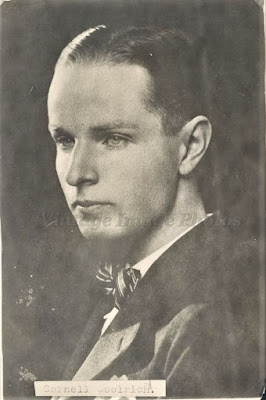
Cornell Woolrich in 1925
He was in his early twenties
and writing his first novel

Cornell's relationship with his mother seems almost like the textbook case of a smothering mama (at least later in life; when he was a child she seems to have been rather neglectful),  Yet frustratingly we almost never hear from his mother, Claire, at first hand, and get her side of the story.  She likely would have responded that her boy was a mess and needed a mother's steady hand.  And it's true that Cornell was one messed up dude, physically as well as psychically.  

If Cornell was gay in a repressive era, that was the least of his problems, in my view.  Right now I lean to his having been more likely asexual.  Cornell actually was married, briefly, but his wife annulled the union on account of his having been unable to consummate it.  It seems unlikely that he had any other serious intimate relationships, although a couple of hearsay accounts claim that he cruised men.

"Dependence, adoration, hatred," Lee Thayer called it, when discussing Cornell Woolrich's attitude to Claire with Francis Nevins.  "All the thing's you'd expect" with "a homosexual's relationship with his mother."  How does this Thayer's sweeping generalization stand up with some other gay male American/Anglo-American vintage mystery writers?
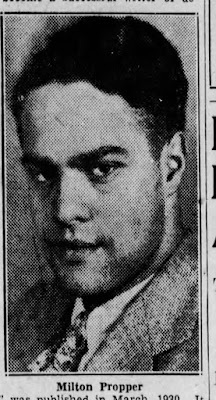
Milton Propper 
in his early twenties
after he had published
his first novel

Mystery writer Milton Propper (1906-1962), a brilliant young Jew from Philadelphia--people joked that he was still wearing short pants when he enrolled in college at the age of 16--was said to have had a very close relationship with his beautiful and charming mother Helen, to whom he dedicated his first detective novel.  He also dedicated a detective novel to his smart sister Madelyn, but, even though he published 14 of them between 1929 and 1943, he never got around to dedicating one either to his father Jake or his brother Walter, neither of whom, according to a cousin, was that bright a bulb in the family chandelier.  

Milton's mother died in 1944 and, coincidentally or not, Milton's life went decidedly downhill after that and he committed suicide in 1962, having never published another book.  While he was known to have been gay and to have picked up men, whether he had any stable intimate same-sex relationships is unknown.  

Todd Downing (1902-1974), who authored nine detective novels between 1933 and 1941, lived most of his life in the town of Atoka, Oklahoma and was one-eighth Choctaw (through his father) and half-Yankee (through his mother).  Although his father was an important man in local politics and a tribal leader, the Downing household was decidedly gynocentric, dominated by his outspoken, long-lived maternal northern-born grandmother, Awilda, and his mother Maud.  

His elder brother Gordon having died as an infant, Todd's only sibling was his lesbian sister Ruth, who graduated from Columbia University with a degree in social work and long lived with a female companion.  The family was, quite frankly, better educated and more cultured than most of the town of Atoka, and they always stood somewhat apart from it, leading to a certain insularity on their part.
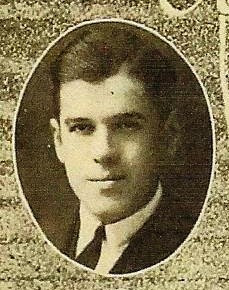
Todd Downing in his early twenties 
when he was a college instructor

I've never actually received any confirmation that Todd was gay, but his writing and his personal collection of books are hugely suggestive in this context.  Todd never married or, indeed, had any intimate physical relationships of which we know. During the Forties, after he gave up writing and college teaching as a profession, Todd, now himself in his forties, moved from his parents' home in Atoka to Philadelphia and worked with an advertising firm.  In the early Fifties he taught at some private schools before moving back to Atoka after the death of his father to live, yes, with his mother until her death a decade later.  He lived alone at the family house and taught at Atoka High School until his own death, another decade after his mother's passing.

Now we come to some gay writers who had--like Cornell Woolrich, who was active as a crime writer from 1934 to 1968 (although his greatest years were in the Thirties and Forties)--far greater longevity within the mystery genre: Anglo-American partners Richard Wilson Webb and Hugh Callingham Wheeler, who wrote as Q. Patrick, Patrick Quentin and Jonathan Stagge.

Hugh Wheeler
in his early twenties, when
he began writing crime fiction
with his partner Richard Webb

Handsome Hugh Wheeler (1912-1987)--who floated through life, seemingly, on a cloud of serene self-confidence--is the only one of these men who seems not to have been arguably mother-dominated in any sense.  His closest family relationship was with his only sibling Jack, his elder brother.  

He and Richard Wilson Webb (1901-1966) are also the only men among this group, apparently, who ever were able to maintain long-term sexual relationships.  They themselves lived together  as partners between 1933 and 1951, although the relationship became "open," at least on Hugh's part, when they were parted during World War Two.  Hugh lived with another man, whom he met during the war, from 1951 (after Rickie moved out) until his death in 1987, although he had additional, more transitory relationships as well.  

Richard Wilson Webb's health severely declined after the war, but he too seems to have lived with another man in France, a Frenchman named Jean, in the fifteen years that lay between his breakup with Hugh and his own death in 1966.  Webb seems to have been much closer to his mother (he compared Hugh's face to hers, a great compliment in his eyes) and even to have disliked his father.  There's a highly suggestive short story by him in this context.  

Richard Wilson Webb
in his twenties around the time 
of the publication of his first
detective novel

Rickie also grew up in the youngest in his family, with a bunch of sisters and one significantly elder brother.  I tried to communicate a few years ago with the son of this brother, Rickie's only nephew as far as I know, a retired law professor who is now in his nineties; but he pointedly refused, via email, to talk with me.

Now we come to Rufus King (1893-1966), the elder of the lot and the only one old enough to fight in the Great War, which he did, most heroically.  Courtesy of a recent interview which I conducted, I now have more information on the author concerning this subject.  

I've written a bit now about Rufus' interesting family background, but I will recap here briefly.  He was the only child of a New York doctor, Thomas Armstrong King, and Amelia Sarony Lambert, a great-niece of once-famed celebrity photographer Napoleon Sarony.  

The family maintained two residences, one the Lambert family home at 141 Lexington Avenue in Kip's Bay, described in a 2017 New York Times article as the "least fashionable neighborhood of Manhattan," and the other an 1818 Georgian home at the small upstate New York town of Rouses Point, two miles from the Canadian border on Lake Champlain.  It's a lovely home but no one was exactly beating down the doors to live in Rouses Point.

Rufus' father's family was New England Yankee of undistinguished lineage as far as I can tell, (Thomas' father, Washington King, was a dry goods merchant of Mooers, another small upstate New York town), while Amelia, through her father's French Canadian Catholic relations, could regard her own family as "artistic."  Among her siblings she had a younger brother and sister, Thomas and Nora, who were actors and artists, although they enjoyed no great success and, indeed, lived with (and off?) Amelia and Thomas, along with their mother, Maggie, for much of their lives.  

Did Amelia regard herself as culturally superior to her husband, like playwright Tennessee Williams' mother Edwina Dakin, and pulp writer Robert E. Howard's mother Hester Ervin?  This sort of thing crops up frequently with the parents of artistically creative men, who often were closer to and fostered in their artistic inclinations by their mothers.  (On the other hand, author Georges Simenon hated his mother.)

Rufus King age 27
when he was working as a 
steamship wireless operator

Thomas King seems to have tried to keep Rufus' nose to a practical grindstone.  After Rufus graduated from Yale in 1914 and declined to enroll in law school at Columbia University, his father put him to work in a silk mill in Paterson, New Jersey.  Two years later, "Rufe," looking for a more adventurous life, heroically rebelled by joining the New York National Guard and serving in the Mexican expedition against Pancho Villa and later the First World War, where he was awarded the Silver Star Medal.  He then became a wireless operator on a steamship, returning to the States in 1920, at the age of 27, only after selling a pulp adventure story to Argosy and determining to make his living from fiction writing.

But where did he live?  Why, with his parents!  We talk about adult children living in their parents' basements today, but of course this was a common enough phenomenon back then too (though you can be sure Rufe was not living in any basement).  

All through the Twenties, as he established himself as a successful pulps writer and novelist (two of his works had been adapted as films by 1925), Rufus lived with his parents in Manhattan and Rouses Point, often wintering with his mother in Florida.  I get the impression much time was spent apart from his busy father, one of whose patients was playwright Eugene O'Neill, but in any event, Thomas King contracted pneumonia from a patient in 1927 and the next year at the age of 62 he died a lingering death from the wasting disease.  He had taken more than ten months to expire.

Amelia herself was 60 at the time and she proceeded to live as before, only she now had control over much of her dead husband's money.  A trust fund had been set up for Rufus by the terms of his father will, giving him no control over the capital, though by this time Rufus was 35 years old.  It seems Rufe was considered too improvident to be trusted with money.

Rufus remained living with his mother at Rouses Point, wintering with her in Florida, even though in 1929 he published a very successful mystery novel, Murder by the Clock, which was successfully filmed in 1931.  He was a very popular mystery writer throughout the Thirties and Forties, with his books reprinted in paperback, and he wrote three Broadway plays, including the book for the mystery-musical hybrid Murder at the Vanities (1933), a big stage hit, adapted successfully as a film in 1934.  

Carl Brisson and Kitty Carlisle in 
Murder at the Vanities (1934)
Liberace would have added some glitter.

Like Cornell Woolrich, Rufus King must have been making a great deal of money by this time (even with his inheritance from his father tied up in a trust), although evidently money went through his hands like water.  (He once bought a Rolls Royce in cash.)  

Like Cornell Woolrich, once again, Rufus chose, despite his success, to continue cohabiting with his mother.  He apparently never left her side, except for short periods. (He seems to have made a trip to England by himself in 1931 and they were necessarily separate, for example, when his plays were going through rehearsal.)  

People at the time seemed bemused by Rufus King maintaining his distant fastness in Rouses Point, seemingly about as far removed from New York City civilization as Manhattan, Kansas.  The situation  is reminiscent of Todd Downing, whom local newspapers dubbed "the hermit of Atoka."

"Anything for a quiet life," quizzically observed one New York newspaper article of Rufus' sticking it out at Rouses Point.  To a newspaper interviewer in 1932 Rufus himself put it this way, typically drolly, of life at his "sheltered nook":

You've got to lead a quiet life to write about crime, says King, whose books are beginning to rival in popularity those by the late Edgar Wallace.  And what he means by quiet is lake, wood, roadhouses, bootleggers, boarder jams, army posts, French-Canadian taverns, baseball, customs jambles, in the summer--hunting, sadness, chills, log fires and peace, in the fall--snow, ice, Belasco winds, drifts, snowshoeing, skiing, mulled ale and a passion for spring, in the winter--with a substrata of auction and contract, dogs, scandal, gossip--and that's all.

The granddaughter and daughter of Rufe's successive trustees suggested that Rufus was a charming profligate, beloved by women and children, who needed looking after by his male trustees and his Mama:

The author was a family friend.  His father, Dr., King, was a friend and client of my grandfather, who was a lawyer and Rufus' trustee.  (Dr. King somehow knew that Rufus needed his money looked after.)  My father, also a lawyer, inherited this position.  As a child and young person, I adored Rufus; he was an enchanting person.  We had an obligatory weekend chez Rufus every summer, at his home in Rouses Point, NY.  My father found Rufus alarming, but my mother and Rufus laughed gaily and understood each other.  When asked, he presented her with a copy of his [mystery novel] Museum Piece No. 13, inscribed.  Knowing him, my mother said, "Now Rufus, please writing something I can show to my dignified friends."  Upon which he wrote, "For Jane, to show to her dignified friends.  With love to her. and nuts to them."

....Rufus said that his "reader" was his widowed mother.  She was given the manuscript halfway through.  If she could guess who the murderer was, he rewrote.

Cornell Woolrich alienated people, Rufus King captivated them.  Woolrich was perpetually unhappy with his lot in life, Rufus King was--well, what, exactly?  The above account paints a picture of a man loving life and even getting along swimmingly with his widowed mother and his trustee's wife and daughter, even if the staid trustee himself found Rufus' gay antics "alarming."  For three years Rufus to much acclaim performed women's parts in drag in productions of the Yale Dramatic Society, while with much valor he commanded field artillery during the Great War.  For several years afterward he was the wireless officer on a steamship and traveled around Latin America.  It's impossible to imagine the neurasthenic Cornell Woolrich, who fearfully lived out his life in a series of New York hotel rooms, doing such things.

Yet there was, it seems, one crippling fear which possessed Rufus: fear of his mother.  

I'll look more at this next blog post, when I go over what happened to Rufus during the last 15 years of his life (1951-1966), after his mother died in 1950 and he left Rouses Point for good the next year.  How much did Rufus' last, motherless years resemble or differ from those of Cornell Woolrich--ten years (1958 to 1968) which were for Woolrich, sad to day, even more dismal than all of his previous ones.
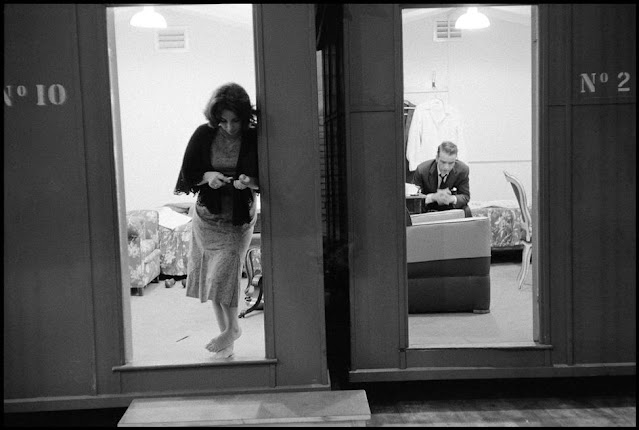
Just Friends
Elizabeth Taylor and Montgomery Clift in their rooms during the shooting of 
Suddenly Last Summer (1959)