IMDb-BEWERTUNG
7,0/10
8548
IHRE BEWERTUNG


Füge eine Handlung in deiner Sprache hinzuA woman risks losing her chance of happiness with the only man she has ever loved.A woman risks losing her chance of happiness with the only man she has ever loved.A woman risks losing her chance of happiness with the only man she has ever loved.
- Regisseur/-in
- Autoren
- Stars
- Nominiert für 2 BAFTA Awards
- 6 Gewinne & 29 Nominierungen insgesamt





Anthony LaPaglia
- Sim Rosedale
- (as Anthony Lapaglia)


Mary MacLeod
- Mrs. Haffen
- (as Mary Macleod)


7,08.5K
1
2
3
4
5
6
7
8
9
10
Empfohlene Bewertungen
A richly painted tapestry of early New York society, Anderson is terrific.
House of Mirth is a richly painted tapestry of a piece of early American Society all but unrecognizable to most Americans. It's a great story and great looking, but the real surprise in Terence Davies' adaptation of Edith Wharton's novel is how deftly Gillian Anderson among others manages to gracefully convey the stilted rigors of the period language. The film is largely about the traps and deceits verbal gamesmanship and class one-upsmanship. It is a deadly and vicious internal warfare that goes on with the upper class bourgeois in New York City in the early 20th century. The price one pays particularly that a woman pays for straying too far from the unwritten laws of that society can be severe. Lillie Bart's flaw is not really in her indiscretions, but in her inability to compromise at the right time. Her timing is fatally flawed. That the film is so relentlessly tragic, really takes the viewer by surprise, partly because Anderson gives her character such spunk and vivaciousness that you find yourself surprised by the endless bad luck that she brings on herself. Anderson's remarkable beauty, poise as an actress, facility with the dialogue, in my mind, bring her to a whole new level as an actress.
It is also wonderfully cinematic. There are rich colors and textures, beautifully framed scenes, marvellous costumes. Though steeped in tragedy and melodrama, you'll find yourself so swept away in this world that it will seem centuries and not merely decades removed from our time. Perhaps this is why the titles at the beginning and at the end are `New York 1914' you need this reminder by the end.
With a host of good performances and a rich sense of place you will get emotionally and imaginatively swept up in this world. Just be prepared for the landing.
It is also wonderfully cinematic. There are rich colors and textures, beautifully framed scenes, marvellous costumes. Though steeped in tragedy and melodrama, you'll find yourself so swept away in this world that it will seem centuries and not merely decades removed from our time. Perhaps this is why the titles at the beginning and at the end are `New York 1914' you need this reminder by the end.
With a host of good performances and a rich sense of place you will get emotionally and imaginatively swept up in this world. Just be prepared for the landing.
Stunning in every way
Wow. Terence Davies' "House of Mirth" is a film that is just brilliant.
Essentially, the plot focuses on Lily Bart (Gillian Anderson) a socialite in the early 1900s in New York who, through a series of tragic circumstances, goes from being popular and admired to being a social outcast. Anderson is perfect in the role, and we feel all of her emotions. The superb cast includes Dan Aykroyd and Eric Stolz as two of her suitors, and Anthony LaPaglia, great as always, as a man who tries to help Lily out despite her pride winning over.
Davies' direction is incredible, one scene is simply of an empty house as it rains and it is just mind-blowing. The script, also, feels real all of the time which is a credit to the actors also.
I definitely recommend this movie, but don't expect it to zoom straight by and then be forgotten!
Essentially, the plot focuses on Lily Bart (Gillian Anderson) a socialite in the early 1900s in New York who, through a series of tragic circumstances, goes from being popular and admired to being a social outcast. Anderson is perfect in the role, and we feel all of her emotions. The superb cast includes Dan Aykroyd and Eric Stolz as two of her suitors, and Anthony LaPaglia, great as always, as a man who tries to help Lily out despite her pride winning over.
Davies' direction is incredible, one scene is simply of an empty house as it rains and it is just mind-blowing. The script, also, feels real all of the time which is a credit to the actors also.
I definitely recommend this movie, but don't expect it to zoom straight by and then be forgotten!
The heart of fools is in the house of mirth
"The House of Mirth" is that rare thing, a British film about America. Officially it is an international co-production, but it was not only made by a British director, Terence Davies, but also shot on location in Britain, even though most of the action is supposed to take place in and around New York. (As a keen birdwatcher I have to say that I could tell that it had been shot on this side of the Atlantic from some of the typically European birdsong in the background). It is, in fact, a good example of the sort of costume drama at which the British film industry has traditionally excelled, although there have been some notable American examples such as Scorsese's "The Age of Innocence", also based upon a novel by Edith Wharton.
The action takes place in 1905. At the opening of the film its heroine, the socialite Lily Bart, appears to be living a charmed life. She is young, beautiful and the niece of the wealthy Mrs Julia Peniston. Yet her position is more precarious than she realises and the film traces her downfall from wealth into poverty and from respectability into social disgrace. The title is deeply ironic; this is a tragedy, not a comedy, and there is nothing about Lily's position that might arouse mirth. Wharton took her title from the Biblical book of Ecclesiastes: "The heart of the wise is in the house of mourning; but the heart of fools is in the house of mirth".
The implication of this title is that those who live merely for mirth or pleasure are foolish, and certainly Lily's downfall is partly the result of her own folly; she incurs, for example, large gambling debts which she is unable to meet. Yet it is also partly the result of the hypocrisy of American high society in the early years of the twentieth century. Although some Americans tried to pretend that theirs was a classless society, the ultra-rich of New York could be just as ruthlessly snobbish as their counterparts in London, Paris or Berlin, and just as ruthlessly unforgiving of those who fell foul of society's unwritten rules. Lily's reputation is damaged not only by her gambling habit, which alienates her puritanically religious aunt, but also by an untrue allegation of an affair with a married man. (The allegation is made by the man's wife, who wants to distract attention from her own adultery). At times Lily's own good nature works against her; she has the opportunity to revenge herself on the woman who has unjustly accused her, but refuses to take it because to do so would also compromise Lawrence Selden, the man she loves.
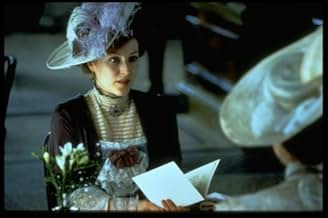
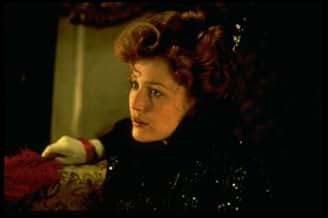
The star of the film is Gillian Anderson, which surprised me when I first saw it in the cinema as I had previously only though of her as "that bird from the X-Files" or the girl who, a few years earlier, had been voted "Most Beautiful Woman in the World" by the readers of FHM magazine. (This aroused some ungallant comments from members of the anti-redhead brigade, who opined that Gillian had only won the title because readers had confused her with her namesake Pamela). "The House of Mirth", however, proved two things. Firstly, it proved that Gillian was a much more versatile actress than I had hitherto supposed. Secondly, it proved (to my satisfaction at least) that she was far more ravishingly beautiful than Pamela Anderson ever knew how to be. Her Lily Bart is one of the great tragic heroines of modern cinema; I was reminded of Nastassia Kinski's performance in "Tess", another period drama about a beautiful young woman who struggles vainly to escape a cruel and inexorable fate.
There are other good performances from Laura Linney as Lily's accuser, the spiteful Bertha Dorset, from Dan Aykroyd (an actor I more normally associate with comedy) as the financier Gus Trenor who unsuccessfully attempts to seduce Lily, Jodhi May as Lily's quiet but scheming and hypocritical cousin Grace Stepney, who eventually inherits Mrs Penistone's fortune and Eric Stoltz as Selden.
Like many British period dramas, the film is beautifully photographed and makes use of some sumptuous sets and costumes. My one criticism would be that, in the early scenes it moves too slowly, but the pace gradually quickens as Lily's tragic drama is played out to its climax; the ending is particularly moving. This is one of the finest period dramas of recent years. A film to savour. 9/10
The action takes place in 1905. At the opening of the film its heroine, the socialite Lily Bart, appears to be living a charmed life. She is young, beautiful and the niece of the wealthy Mrs Julia Peniston. Yet her position is more precarious than she realises and the film traces her downfall from wealth into poverty and from respectability into social disgrace. The title is deeply ironic; this is a tragedy, not a comedy, and there is nothing about Lily's position that might arouse mirth. Wharton took her title from the Biblical book of Ecclesiastes: "The heart of the wise is in the house of mourning; but the heart of fools is in the house of mirth".
The implication of this title is that those who live merely for mirth or pleasure are foolish, and certainly Lily's downfall is partly the result of her own folly; she incurs, for example, large gambling debts which she is unable to meet. Yet it is also partly the result of the hypocrisy of American high society in the early years of the twentieth century. Although some Americans tried to pretend that theirs was a classless society, the ultra-rich of New York could be just as ruthlessly snobbish as their counterparts in London, Paris or Berlin, and just as ruthlessly unforgiving of those who fell foul of society's unwritten rules. Lily's reputation is damaged not only by her gambling habit, which alienates her puritanically religious aunt, but also by an untrue allegation of an affair with a married man. (The allegation is made by the man's wife, who wants to distract attention from her own adultery). At times Lily's own good nature works against her; she has the opportunity to revenge herself on the woman who has unjustly accused her, but refuses to take it because to do so would also compromise Lawrence Selden, the man she loves.
The star of the film is Gillian Anderson, which surprised me when I first saw it in the cinema as I had previously only though of her as "that bird from the X-Files" or the girl who, a few years earlier, had been voted "Most Beautiful Woman in the World" by the readers of FHM magazine. (This aroused some ungallant comments from members of the anti-redhead brigade, who opined that Gillian had only won the title because readers had confused her with her namesake Pamela). "The House of Mirth", however, proved two things. Firstly, it proved that Gillian was a much more versatile actress than I had hitherto supposed. Secondly, it proved (to my satisfaction at least) that she was far more ravishingly beautiful than Pamela Anderson ever knew how to be. Her Lily Bart is one of the great tragic heroines of modern cinema; I was reminded of Nastassia Kinski's performance in "Tess", another period drama about a beautiful young woman who struggles vainly to escape a cruel and inexorable fate.
There are other good performances from Laura Linney as Lily's accuser, the spiteful Bertha Dorset, from Dan Aykroyd (an actor I more normally associate with comedy) as the financier Gus Trenor who unsuccessfully attempts to seduce Lily, Jodhi May as Lily's quiet but scheming and hypocritical cousin Grace Stepney, who eventually inherits Mrs Penistone's fortune and Eric Stoltz as Selden.
Like many British period dramas, the film is beautifully photographed and makes use of some sumptuous sets and costumes. My one criticism would be that, in the early scenes it moves too slowly, but the pace gradually quickens as Lily's tragic drama is played out to its climax; the ending is particularly moving. This is one of the finest period dramas of recent years. A film to savour. 9/10
interesting casting and opulent production
Director Terence Davies has done a magnificent job of recreating the turn of the century in "The House of Mirth," a 2000 film starring Gillian Anderson, Eric Stoltz, Dan Ackroyd, Laura Linney, Anthony LaPaglia, and Terry Kinney.
Anderson is Lily Bart, a beautiful young woman of good social standing, traveling in the best circles, who throws away her opportunities for a good marriage because she wants something more meaningful. However, her reputation begins to suffer due to her circle's misreading of an innocent situation, and things go from bad to worse for her as she descends down the social strata. She has it in her power to win back everything she has lost but refuses to stoop that low due to her love for one man.
It's obvious that Davies took a great deal of care with this film. It is not infused with modern sensibilities, the period look is authentic, as is the look of the cast. By that I mean, Gillian Anderson's sumptuous red hair, full beautiful face, and lovely figure are much more period than, say, Gwyneth Paltrow's -- and yet films are rarely cast with an eye toward capturing the period in that way. The casting of Dan Ackroyd as Trenor is unusual but very right - he's not truly of the class he travels in and a real glad-hander. Eric Stoltz is Selden - handsome without being drop dead gorgeous, gentile without being effeminate, who has good chemistry with Anderson.
The villainess of the piece is Laura Linney as the awful Bertha Dorset, a cunning witch, and as usual, Linney is perfection -- smiling, subtle, and you can just see the knife going in. In the book she is more responsible for Lily's troubles than in the film. In the film, we see her making initial trouble for Lily; in the book, she continues to work on destroying her with a whisper here and word there.
What makes the story of Lily so frustrating is that she can ruin Bertha in five minutes but refuses, suffering instead, which drove me crazy. That's not the film's fault.
This was an era where no one expressed emotions, so when someone says, thank you or I understand, there is a world of meaning to be read in the eyes. It's a world of artifice, and Davies obviously worked at getting this from his actors. Everything is in what lies beneath.
The acting is uniformly excellent; only Gillian Anderson falls a little short of the mark. Lily is an extremely difficult role, and Anderson at least in 2000 did not have all the necessary skill to completely pull it off. She has the look, the bearing, and the intelligence. What she lacks is the ability to actually become someone of that era, rather than putting it on like an overcoat. She does much better in the latter part of the film, which calls for a different set of acting muscles than in the beginning.
Reminiscent a bit of "Sister Carrie," "The House of Mirth" points up the difficulties of women in that time period to make their way, of the boundaries of class, and the rigidity of the upper class. Highly recommended, but not an easy, cheerful film by any means.
Anderson is Lily Bart, a beautiful young woman of good social standing, traveling in the best circles, who throws away her opportunities for a good marriage because she wants something more meaningful. However, her reputation begins to suffer due to her circle's misreading of an innocent situation, and things go from bad to worse for her as she descends down the social strata. She has it in her power to win back everything she has lost but refuses to stoop that low due to her love for one man.
It's obvious that Davies took a great deal of care with this film. It is not infused with modern sensibilities, the period look is authentic, as is the look of the cast. By that I mean, Gillian Anderson's sumptuous red hair, full beautiful face, and lovely figure are much more period than, say, Gwyneth Paltrow's -- and yet films are rarely cast with an eye toward capturing the period in that way. The casting of Dan Ackroyd as Trenor is unusual but very right - he's not truly of the class he travels in and a real glad-hander. Eric Stoltz is Selden - handsome without being drop dead gorgeous, gentile without being effeminate, who has good chemistry with Anderson.
The villainess of the piece is Laura Linney as the awful Bertha Dorset, a cunning witch, and as usual, Linney is perfection -- smiling, subtle, and you can just see the knife going in. In the book she is more responsible for Lily's troubles than in the film. In the film, we see her making initial trouble for Lily; in the book, she continues to work on destroying her with a whisper here and word there.
What makes the story of Lily so frustrating is that she can ruin Bertha in five minutes but refuses, suffering instead, which drove me crazy. That's not the film's fault.
This was an era where no one expressed emotions, so when someone says, thank you or I understand, there is a world of meaning to be read in the eyes. It's a world of artifice, and Davies obviously worked at getting this from his actors. Everything is in what lies beneath.
The acting is uniformly excellent; only Gillian Anderson falls a little short of the mark. Lily is an extremely difficult role, and Anderson at least in 2000 did not have all the necessary skill to completely pull it off. She has the look, the bearing, and the intelligence. What she lacks is the ability to actually become someone of that era, rather than putting it on like an overcoat. She does much better in the latter part of the film, which calls for a different set of acting muscles than in the beginning.
Reminiscent a bit of "Sister Carrie," "The House of Mirth" points up the difficulties of women in that time period to make their way, of the boundaries of class, and the rigidity of the upper class. Highly recommended, but not an easy, cheerful film by any means.
Mesmerising film
This is a slow paced mesmerising film. If your only knowledge of Gillian Anderson is as Dana Scully in the X-Files then you are in for a big surprise. Firstly the lady can act, and secondly with great subtlety. If you have read the book then clearly the writer/director Terence Davies has taken a few liberties. But so much script has been lifted word for word from the novel that I think he can be forgiven any eccentricities. This is a story of manners in early twentieth century New York and environs. Everyone seems so decent and 'proper', but each plays their own manipulative game. No-one (with the exception of Sim Rosedale) tells the truth. As a morality tale it seems as relevant today as when Edith Wharton wrote it. Davies has succeeded in losing none of its mood or punch by transferring it to screen. Unfortunately I think this is a film that requires watching more than once as some explanatory scenes appear to have ended up on the cutting room floor. Generally the acting is excellent throughout though I felt that at times Davies's enthusiasm for detail hamstrung some actors where others appeared to have relished the close direction. This is a film to add to your personal collection.


Wusstest du schon
- WissenswertesEdith Wharton named the source novel after a passage from Ecclesiastes 7:4, "The heart of the wise is in the house of mourning; but the heart of fools is in the house of mirth."
- PatzerThe film, which takes place during 1905-07, depicts several characters attending a performance of the opera "Cosi fan tutte" -- but that opera was first performed in New York in 1922.
- Crazy CreditsThanks to the staff of Kelvingrove Museum, the Lord Provost and staff at Glasgow City Chambers, residents of Kersland Street, all the staff at the Arthouse Hotel, Glasgow, and the Earls of Wemyss and March and Lady Wemyss.
- SoundtracksOboe Concerto in D Minor: Slow Movement
Composed by Alessandro Marcello
Performed by Ferenc Erkel Chamber Orchestra
Courtesy of Naxos Recordings
Top-Auswahl
Melde dich zum Bewerten an und greife auf die Watchlist für personalisierte Empfehlungen zu.
- How long is The House of Mirth?Powered by Alexa
Details
- Erscheinungsdatum
- Herkunftsländer
- Sprachen
- Auch bekannt als
- La casa de la alegría
- Drehorte
- Produktionsfirmen
- Weitere beteiligte Unternehmen bei IMDbPro anzeigen
Box Office
- Budget
- 10.000.000 $ (geschätzt)
- Bruttoertrag in den USA und Kanada
- 3.043.284 $
- Eröffnungswochenende in den USA und in Kanada
- 48.770 $
- 25. Dez. 2000
- Weltweiter Bruttoertrag
- 5.186.458 $
- Laufzeit
- 2 Std. 15 Min.(135 min)
- Farbe
- Sound-Mix
- Seitenverhältnis
- 2.35 : 1
Zu dieser Seite beitragen
Bearbeitung vorschlagen oder fehlenden Inhalt hinzufügen