

Füge eine Handlung in deiner Sprache hinzuIs American foreign policy dominated by the idea of military supremacy? Has the military become too important in American life? Jarecki's shrewd and intelligent polemic would seem to give an... Alles lesenIs American foreign policy dominated by the idea of military supremacy? Has the military become too important in American life? Jarecki's shrewd and intelligent polemic would seem to give an affirmative answer to each of these questions.Is American foreign policy dominated by the idea of military supremacy? Has the military become too important in American life? Jarecki's shrewd and intelligent polemic would seem to give an affirmative answer to each of these questions.
- Regisseur/-in
- Autor/-in
- Stars
- Auszeichnungen
- 4 Gewinne & 3 Nominierungen insgesamt



- Self
- (Archivfilmmaterial)

- Self
- (Archivfilmmaterial)

- Self
- (Archivfilmmaterial)

- Self
- (Archivfilmmaterial)

- Self
- (Archivfilmmaterial)

- Self
- (Archivfilmmaterial)

- Self
- (Archivfilmmaterial)


- Self
- (Archivfilmmaterial)

- Self
- (Archivfilmmaterial)
Empfohlene Bewertungen
A documentary all Americans should watch
Fair and Balanced
And what answers do we find? We find that Eisenhower, a military man of all people, was very scared that having this much power and money invested in a standing army and a huge profit driven industry supporting it, would haunt future Americans.
The film then sets out to show, very convincingly, that we have indeed been involved in conflicts we should not been involved in, and did so for all the wrong reasons. One of the films most important moments is when it shows Bush on tape stating that we did not go into Iraq for reasons related to 9/11. Most American citizens, completely buffaloed by Fox News Channel (when they can be pulled away from watching sports), are completely oblivious to this fact.
A framework of understanding: Why We Fight compared to Fahrenheit 9/11
Why We Fight is everything that F9/11 is not. Where F911 told, WWF explains. Where F911 ridicules, WWF allows items of fact speak for themselves. Why We Fight makes the assumption that its audience is educated and capable of examining multiple facets of an issue without resorting to unnecessarily polar characterizations of people or ideas. Just to be clear: WWF's take on these issues is unmistakable, but if F911 is a declaration, WWF is fundamentally a question.
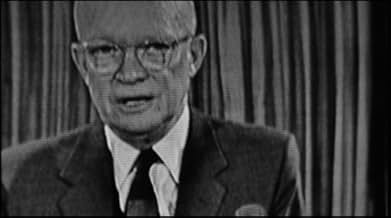
Why We Fight asks its audience to consider Eisenhower's presidential farewell address, and amount of it he devoted to warning against the rise of the "military-industrial complex," coining a new phrase.
"This conjunction of an immense military establishment and a large arms industry is new in the American experience. The total influence -- economic, political, even spiritual -- is felt in every city, every State house, every office of the Federal government. We recognize the imperative need for this development. Yet we must not fail to comprehend its grave implications. Our toil, resources and livelihood are all involved; so is the very structure of our society." (1961)
Viewers of Why We Fight are consistently returned to this warning as they are reminded of the last fifty years of American military conflicts.
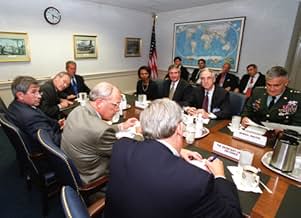
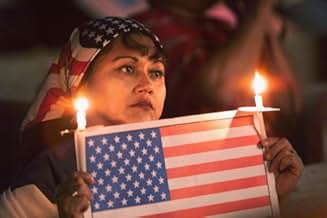
We are introduced to an ex-NYPD cop, Vietnam vet and father of a 9/11 victim who wants revenge on the bastards who killed his son. We meet an Air Force Lt. Colonel who resigned her post in intelligence at the Pentagon when political urgencies began to warp and distort her work of 20 years. The pilots who dropped the first bombs on Baghdad in 2003 talk about their mission. We hear commentary from think-tankers Bill Kristol and Richard Perle, and candid reservations about American military power from Senator John McCain. All have something valuable to say about the conflict in which the United States is engaged.
Fundamentally Why We Fight asks questions of involvement and influence: who are the players, what are their interests, and what are the stakes? It's not about one man, a group of men, or a political party. There are no conspiracy theories; merely a serious question. How much military might is necessary? Given the amount of money spent on defense, the number of jobs the industry provides, the numbers of congressmen in office due to contracts being brought home to their constituents, should we be concerned how the business of war drives the politics for war? Are the needs of a defense corporation different than those of humans? Who is in control, and how much power should they have?
On the surface, the movie is about how we got into Iraq. Deeper, it is asking what the future holds: American military supremacy? For how long? How long did the English or the French or the Soviets hold on to their hegemonies? Just how did we get from Iranians, Jordanians and Frenchmen proclaiming "we are all Americans" in the days following 9/11, to being seen around the globe as the single biggest threat to peace in the world? Can we ever get back?
Richard Perle makes a statement I found chilling largely because I find it hard to disagree. He says something to the effect of, "people think that you can just elect a new man to office, and everything will change. It's already a different world. We have already changed." The degree of truth of that statement is worthy of debate, and that's why I wholeheartedly recommend this movie.
thought provoking
Why We Fight is a superb complement to Errol Morris' Oscar-winning Fog of War. Morris took indirect shots at George Bush II by showing a Lyndon Johnson speech referring to Vietnam as "a war against tyranny and aggression." In that speech, Johnson also reiterated, "We won't leave until the job is finished." Sound familiar?
Jarecki picks up where Morris left off, more directly highlighting the similarities between Vietnam and the present conflict in Iraq. There are most certainly differences, but the parallels cannot and MUST NOT be ignored if the American people are to have any hope of learning from our government's past and present missteps. Most significantly, Jarecki shows how each conflict was escalated through a lie (Gulf of Tonkin/WMD) and nonsensical pro-freedom rhetoric from the government and the media.
Unlike Michael Moore's poorly constructed Farenheit 9/11, Jarecki does not limit the scope of the film to simplistic Bush team bashing. That's not to say this is absent from the film; Jarecki is obviously anti-Bush and left-leaning. However, he successfully illustrates how all of our elected representatives, Republicans and Democrats, are influenced by the Industrial-Military Complex.
You cannot fight a war against an abstraction (i.e. War on Terror, War on Communism, War on Drugs, War on Crime, et al). People are the true targets of wars. Declaring war without officially declaring it and abusing words like freedom and liberty are just ways of dehumanizing the conflict, and if we dehumanize war, we will never stop fighting.
This is a film that everyone in America should see, and if it is truly so enraging to the right-wingers, I would challenge them to make a comparable documentary defending the Iraq War. I would gladly watch it to see their side of the coin.
"We will bankrupt ourselves in the vain search for absolute security." - Dwight D. Eisenhower
"If tyranny and oppression come to this land, it will be in the guise of fighting a foreign enemy." - James Madison
"The Department of Defense is a behemoth...With an annual budget larger than the gross domestic product of Russia, it is an empire." - The 9/11 Commission Report
More successful than Fahrenheit 911
Why we Fight presents a lyrical and devastatingly haunting portrait of a system that has failed the west - specifically America - time and time again in a repeating cycle. The narrative carefully builds an historical context for the present administration's actions, and unfolds a story of how Americans, even the most staunch supporters of Bush's policies, have gradually learnt that they've been lied to, lied about and then lied to again as the administration is called on to answer for their lies.
With extraordinary research, and some incredible interview contributors, the facts are again repeated - indeed, they gain, perhaps even greater impact because of the historical context - and the warnings of past leaders.
It is above all a film which at once makes you terribly sad - and frustrated. But the surprise - for me at least - was that my anger became levelled not so much at the arrogance of our governments, and those in the positions of power - but at the stupefying inaction of the voting public.
I need only direct you to another of the 'reviews' of this film to underline just how poisoned the populous is, and just how stupid people have allowed themselves to become.
-------- The director spoke at Sundance about how he consciously prevented this breathtaking documentary from being screened before the election in 04 - largely because he felt the message of the film is not partisan, and not about a particular administration - but it is about the system. My only frustration about this is that I can only imagine what the snowballing effects of this film might have been had it been allowed to swiftly follow 'Fahrenheit 911'.


Wusstest du schon
- Zitate
Joseph Cirincione: In some ways, the military-industrial complex may become so pervasive that it is now invisible. This is about, you know, ideas and influence and what's safe for your career. Being seen in opposition to strong defense policies is a liability. Not just for a politician who wants to run for president, but for an expert who wants to make a name in town, or a journalist who wants to get his or her story on the front page of the paper. In this way, restricting the level of discussion to this rush for war.
- VerbindungenFeatured in The Daily Show: Eugene Jarecki (2006)
Top-Auswahl
- How long is Why We Fight?Powered by Alexa
Details
- Erscheinungsdatum
- Herkunftsländer
- Offizieller Standort
- Sprachen
- Auch bekannt als
- Why We Fight
- Produktionsfirmen
- Weitere beteiligte Unternehmen bei IMDbPro anzeigen
Box Office
- Bruttoertrag in den USA und Kanada
- 1.439.972 $
- Eröffnungswochenende in den USA und in Kanada
- 53.571 $
- 22. Jan. 2006
- Weltweiter Bruttoertrag
- 1.439.972 $
- Laufzeit
- 1 Std. 38 Min.(98 min)
- Farbe
- Sound-Mix
- Seitenverhältnis
- 1.85 : 1