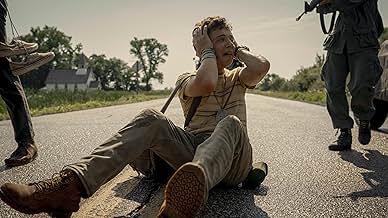
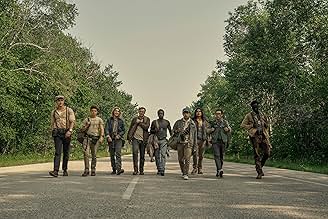
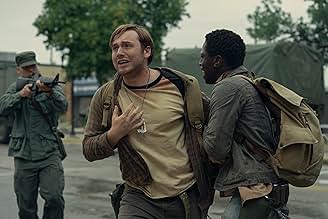
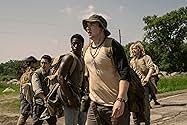
In einem dystopischen Amerika veranstaltet ein repressives Regime tödliche Wettkämpfe, bei denen 100 Jugendliche 6+ km/h gehen müssen. Ray Garraty macht mit, um ein sorgenfreies Leben zu gew... Alles lesenIn einem dystopischen Amerika veranstaltet ein repressives Regime tödliche Wettkämpfe, bei denen 100 Jugendliche 6+ km/h gehen müssen. Ray Garraty macht mit, um ein sorgenfreies Leben zu gewinnen.In einem dystopischen Amerika veranstaltet ein repressives Regime tödliche Wettkämpfe, bei denen 100 Jugendliche 6+ km/h gehen müssen. Ray Garraty macht mit, um ein sorgenfreies Leben zu gewinnen.
- Regisseur/-in
- Autoren
- Stars
- Auszeichnungen
- 1 Gewinn & 5 Nominierungen insgesamt
6,874.3K
1
2
3
4
5
6
7
8
9
10
Empfohlene Bewertungen
Too many changes
In the book the horror of watching young men get shot is highlighted by the unfeeling, voracious crowds lining the street, the betting rings encouraging people to gamble their savings on their favourite, the desperation of some ghouls for a ticket where they sit. This is left out of the movie and, given the lack of action in the conventional sense, I don't see why. What we get instead is a long chat.
The ending is also rewritten and is unsatisfactory in my opinion. It is an ultimately disappointing movie despite the strong cast.
A Step Ahead
By 1977, Stephen King was rapidly becoming a household name, with the best sellers 'Carrie', 'Salem's Lot' and 'The Shining' making him one of the horror genre's rising stars. Success, however, brought limitations. At the time, publishers believed the public wouldn't accept more than one book a year from a single author, and King's output far outpaced that rule. To sidestep it- and to see whether his popularity came from genuine talent or just luck- he adopted the pseudonym, Richard Bachman. Bachman became both an experiment and an outlet, a shadow identity that allowed King to publish more freely without diluting the value of his established brand.
Bachman's second novel, 'The Long Walk,' was first published in 1979, though written years earlier while King was a freshman at the University of Maine. Set in a near-future America, it follows a group of young men competing in a brutal annual contest where they must keep walking above a set pace- or face execution.
A kind of science-fiction allegory for the Vietnam War draft, it resists being pinned down to a single reading, and has long tempted filmmakers. George A. Romero was first attached to direct in the late 1980s, but the project never materialized. Years later, Frank Darabont- who successfully adapted King's 'The Shawshank Redemption,' 'The Green Mile' and 'The Mist'- also took a crack at developing it, though his version likewise stalled in development. Finally, in late 2023, it was announced that Francis Lawrence had assumed directorial duties, working from a screenplay by JT Mollner.
Lawrence's film is a strong, faithful adaptation of the source material, capturing both its relentless tension and thematic depth. Although somewhat mischaracterized as a horror, the film is consistently unsettling, immersing viewers in a dystopian world where brutality and violence are commonplace. Much like the novel, it aims to explore themes of conscription, authoritarian control and the expendability of youth, while also serving as a pointed critique of capitalism and the societal pressures that pit individuals against one another.
However, while 'The Long Walk' gestures toward these themes, Lawrence rarely probes them with the depth they deserve, presenting them more as background texture than as active philosophical inquiry. For instance, the spectacle of the Walk itself is ripe for commentary on media voyeurism and desensitization, yet the film stops short of interrogating the audience's complicity or the system's mechanisms of control. It's evocative, but not especially reflective.
Moreover, Mollner's dialogue is occasionally clunky, leaning heavily on overwrought emotional beats. Characters speak less as people and more as thematic signposts, particularly in moments of tension where nuance is sacrificed to reiterate stakes we already understand. Further, the characters themselves are largely archetypal. While this mirrors King's tendency to populate his stories with familiar types, the film does little to complicate or humanize them. Motivations are thinly sketched, emotional arcs predictable. As a result, the titular walk feels less like a descent into psychological horror and more like a grim endurance test with interchangeable figures.
Beyond its narrative strengths and weaknesses, 'The Long Walk' excels in its technical execution, helping to sustain tension and immerse viewers in its dystopian world. Director of photography Jo Willems captures the relentless monotony and oppressive heat of the journey with a stark, unflinching eye. He utilises a muted colour palette- dominated by greys, browns, and washed-out greens- reinforcing the bleakness and brutality of the film's world.
Complementing the cinematography is Nicolas Lepage's minimalist, atmospheric production design. Rather than overbuilding the dystopia, he and his team suggest decay through subtle cues: crumbling buildings, cracked sidewalks, rusted metalwork. The roadside becomes a purgatory, with sparse signage and empty towns evoking both Americana and abandonment. It's not flashy, but its restraint serves the story- though some might wish for a more vivid sense of the society watching from the sidelines.
In addition, Mark Yoshikawa's editing is tight and purposeful, maintaining a steady rhythm mirroring the walk's relentless pace. Most of the film unfolds in linear fashion, enhancing the narrative's sense of inevitability- an endless march toward a conclusion that can only be grim. Jeremiah Fraites' score is subtly atmospheric, simmering beneath the surface like a pulse.
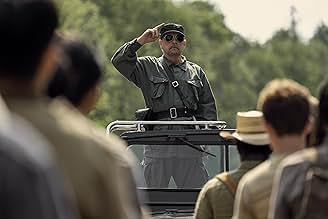
Although saddled with somewhat one-note characters, most of the cast perform admirably. Cooper Hoffman and David Jonsson, as the leading lads Ray Garraty and Peter McVries, carry the weight of the story with impressive intensity, conveying the physical strain and psychological tension of the walk with nuance. Ben Wang steals every scene he's in, while Charlie Plummer makes for an effective young psychopath. Further, Mark Hamill is a gruff delight as the constant-sunglass-sporting Major, who runs the show; someone you'll really love to hate.
In conclusion, while Francis Lawrence's 'The Long Walk' doesn't fully capitalize on the philosophical weight of its premise, it remains a gripping adaptation of one of Stephen King's most haunting early works. Lawrence's direction, paired with strong technical craftsmanship and committed performances, ensures the film leaves a lasting impression- even if it strolls past some of its deeper questions. It's a bleak, relentless journey that, despite its flaws, is a step ahead of many other King adaptations.
Bachman's second novel, 'The Long Walk,' was first published in 1979, though written years earlier while King was a freshman at the University of Maine. Set in a near-future America, it follows a group of young men competing in a brutal annual contest where they must keep walking above a set pace- or face execution.
A kind of science-fiction allegory for the Vietnam War draft, it resists being pinned down to a single reading, and has long tempted filmmakers. George A. Romero was first attached to direct in the late 1980s, but the project never materialized. Years later, Frank Darabont- who successfully adapted King's 'The Shawshank Redemption,' 'The Green Mile' and 'The Mist'- also took a crack at developing it, though his version likewise stalled in development. Finally, in late 2023, it was announced that Francis Lawrence had assumed directorial duties, working from a screenplay by JT Mollner.
Lawrence's film is a strong, faithful adaptation of the source material, capturing both its relentless tension and thematic depth. Although somewhat mischaracterized as a horror, the film is consistently unsettling, immersing viewers in a dystopian world where brutality and violence are commonplace. Much like the novel, it aims to explore themes of conscription, authoritarian control and the expendability of youth, while also serving as a pointed critique of capitalism and the societal pressures that pit individuals against one another.
However, while 'The Long Walk' gestures toward these themes, Lawrence rarely probes them with the depth they deserve, presenting them more as background texture than as active philosophical inquiry. For instance, the spectacle of the Walk itself is ripe for commentary on media voyeurism and desensitization, yet the film stops short of interrogating the audience's complicity or the system's mechanisms of control. It's evocative, but not especially reflective.
Moreover, Mollner's dialogue is occasionally clunky, leaning heavily on overwrought emotional beats. Characters speak less as people and more as thematic signposts, particularly in moments of tension where nuance is sacrificed to reiterate stakes we already understand. Further, the characters themselves are largely archetypal. While this mirrors King's tendency to populate his stories with familiar types, the film does little to complicate or humanize them. Motivations are thinly sketched, emotional arcs predictable. As a result, the titular walk feels less like a descent into psychological horror and more like a grim endurance test with interchangeable figures.
Beyond its narrative strengths and weaknesses, 'The Long Walk' excels in its technical execution, helping to sustain tension and immerse viewers in its dystopian world. Director of photography Jo Willems captures the relentless monotony and oppressive heat of the journey with a stark, unflinching eye. He utilises a muted colour palette- dominated by greys, browns, and washed-out greens- reinforcing the bleakness and brutality of the film's world.
Complementing the cinematography is Nicolas Lepage's minimalist, atmospheric production design. Rather than overbuilding the dystopia, he and his team suggest decay through subtle cues: crumbling buildings, cracked sidewalks, rusted metalwork. The roadside becomes a purgatory, with sparse signage and empty towns evoking both Americana and abandonment. It's not flashy, but its restraint serves the story- though some might wish for a more vivid sense of the society watching from the sidelines.
In addition, Mark Yoshikawa's editing is tight and purposeful, maintaining a steady rhythm mirroring the walk's relentless pace. Most of the film unfolds in linear fashion, enhancing the narrative's sense of inevitability- an endless march toward a conclusion that can only be grim. Jeremiah Fraites' score is subtly atmospheric, simmering beneath the surface like a pulse.
Although saddled with somewhat one-note characters, most of the cast perform admirably. Cooper Hoffman and David Jonsson, as the leading lads Ray Garraty and Peter McVries, carry the weight of the story with impressive intensity, conveying the physical strain and psychological tension of the walk with nuance. Ben Wang steals every scene he's in, while Charlie Plummer makes for an effective young psychopath. Further, Mark Hamill is a gruff delight as the constant-sunglass-sporting Major, who runs the show; someone you'll really love to hate.
In conclusion, while Francis Lawrence's 'The Long Walk' doesn't fully capitalize on the philosophical weight of its premise, it remains a gripping adaptation of one of Stephen King's most haunting early works. Lawrence's direction, paired with strong technical craftsmanship and committed performances, ensures the film leaves a lasting impression- even if it strolls past some of its deeper questions. It's a bleak, relentless journey that, despite its flaws, is a step ahead of many other King adaptations.
A change too far
If you film a much loved book, say Lord of the Rings for this example, and, at the council of Elrond, Gandalf says "Oh, you want to take the ring to Gondor Boromir? OK then", fans of the book are going to be disappointed. And that's how I feel right now. Unlike LOTR, The Long Walk does not have a great deal of action in the traditional sense, so why remove what important moments there are: an adolescent who's never had sex risking everything for a kiss? The barbaric nature of huge crowds gathered to cheer on boys about to die? Or to gamble what small funds they have on who will survive? Why remove all the things that made a novel so special and decide your scriptwriter knows best?
The ending is changed and not convincing and while I can imagine Hollywood require more resolution than the original text, I don't think this was the way to go personally.
Apart from the changes, I thought most of the cast did well but were a bit too well fed and healthy for the supposed economic misery this US faced.
The ending is changed and not convincing and while I can imagine Hollywood require more resolution than the original text, I don't think this was the way to go personally.
Apart from the changes, I thought most of the cast did well but were a bit too well fed and healthy for the supposed economic misery this US faced.
Disappointed
The Long Walk is one of my favorite books and I have been dreaming of a movie adaptation. I felt it was promising for the first 30 minutes, mostly due to wonderfully brutal cinematography. However, as soon as the drama ramped up, actors started to overact and the whole script all of a sudden derailed into Hollywood cliche land. I felt like the movie pretty much cut out all the parts of the book I loved the most and butchered the final scenes into something completely different than the subtle but powerful book ending intended to convey.
Too unbelievable
The long walk, you see them walking all the time, but it doesn't show that the distance weighs. The longest distances walked are nowhere near 300 plus miles. That's impossible. And yet they talk, look just out of bed. It's the lack of seeing accomplishment at a great physical cost, is what put me off. Walking without shoes is totally impossible, yes he does it laughing. Maybe I'm biased as a long distance walker myself. For me there was not enough happening of worth. The end is devoid of all logic.
New and Upcoming Book-to-Screen Adaptations
From literary classics to graphic novels and more, see what books have recently made, or will be making the leap to the big (and small) screen in 2025 and beyond.
Soundtrack
Hier kannst du dir den Soundtrack anhören und dann auf Amazon Music weiterschalten.
Wusstest du schon
- WissenswertesOn August 30, 2025, Lionsgate held a special screening where the invited audience was required to walk on treadmills at the regulation 3 mph for the duration of the film, under threat of being thrown out if they slowed down.
- PatzerPeter's large facial scar changes intensity throughout the film, even completely disappearing in some scenes.
- Zitate
Hank Olson #46: I DID IT ALL WRONG!
- VerbindungenFeatured in The Big Thing: THE LONG WALK (2025) | NON-SPOILER REVIEW! (2025)
Top-Auswahl
Melde dich zum Bewerten an und greife auf die Watchlist für personalisierte Empfehlungen zu.
- How long is The Long Walk?Powered by Alexa
Details
- Erscheinungsdatum
- Herkunftsländer
- Offizieller Standort
- Sprache
- Auch bekannt als
- Todesmarsch
- Drehorte
- Produktionsfirmen
- Weitere beteiligte Unternehmen bei IMDbPro anzeigen
Box Office
- Budget
- 20.000.000 $ (geschätzt)
- Bruttoertrag in den USA und Kanada
- 35.163.573 $
- Eröffnungswochenende in den USA und in Kanada
- 11.703.621 $
- 14. Sept. 2025
- Weltweiter Bruttoertrag
- 63.117.958 $
- Laufzeit
- 1 Std. 48 Min.(108 min)
- Farbe
- Sound-Mix
- Seitenverhältnis
- 2.39 : 1
Zu dieser Seite beitragen
Bearbeitung vorschlagen oder fehlenden Inhalt hinzufügen