

Ein spannungsgeladener Thriller, der auf realen Ereignissen basiert und über die Mission erzählt, Verschleierungsaktionen und Machtmissbrauch aufzudecken, die einen Internet-Shootingstar in ... Alles lesenEin spannungsgeladener Thriller, der auf realen Ereignissen basiert und über die Mission erzählt, Verschleierungsaktionen und Machtmissbrauch aufzudecken, die einen Internet-Shootingstar in eine der umstrittensten Organisationen des 21. Jahrhunderts verwandelt hat.Ein spannungsgeladener Thriller, der auf realen Ereignissen basiert und über die Mission erzählt, Verschleierungsaktionen und Machtmissbrauch aufzudecken, die einen Internet-Shootingstar in eine der umstrittensten Organisationen des 21. Jahrhunderts verwandelt hat.
- Auszeichnungen
- 2 Gewinne & 3 Nominierungen insgesamt




Empfohlene Bewertungen
The Confused State
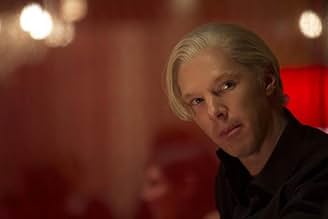
Anyways, let's focus on my reaction to the feature in general with as much honesty as possible. I won't lecture you on how much you should hate the NSA and the government's surveillance activities nor should I protest such anarchists' decisions. I'll judge the film as it should be judged, but of course, the level of its accuracy should absolutely be considered. Concentrating on the strengths at first, right off the bat, it's quite obvious just how exceptional the lead performances from Benedict Cumberbatch and Daniel Bruhl are, and as usual, Cumberbatch carries that impressive volume of charisma with him where you simply can't take your eyes off his mannerisms and speech (I believe I already noted this in my Star Trek review); in short, his portrayal of Julian Assange is terrifically veracious. Daniel Bruhl, coming off of his memorable performance in Rush, makes his mark yet again, playing a foil to Julian in a way. Furthermore, The Fifth Estate unquestionably works as a full-fledged thriller with the several twists and turns throughout. The story, itself, is compelling and though it's abundantly filled with journalistic terminology and complicated concepts, you're forced to dedicate twice the attention to the screen.
On that note, The Fifth Estate suffers from a highly noticeable and detrimental flaw: its messy execution. What fundamentally follows persistently throughout the narrative are perplexing scenes that leave the audience scratching their head- and not in a good way in case you're asking. The movie's editing style and script will doubtlessly leave you confused in numerous instances. While you're attempting to understand how exactly a specific action or trade works, the film casts you into another situation that leaves you baffled yet again, and this really stems from- as previously mentioned- its wide array of terminology and the fast pace with which it irresponsibly deals with its explanation to the moviegoers. This is precisely why The Social Network shone in its brilliance: it was perfectly comprehensible and continued with remarkable execution- the pure opposite of The Fifth Estate. By the time the story comes to a conclusion, you will have likely properly sorted the film's ideas but to have a thriller work is to avoid placing your interested crowd into a muddled and jumbled predicament as it lessens the satisfaction and surprise that comes with a thrilling experience.
At the end of the day, The Fifth Estate is great in that it sparks a mixed reaction and requires both extreme sides of the table to continuously argue over the rightfulness or criminality of Wikileaks' existence and the path that Julian Assange took to see it to success. There are too many factors to just definitively point out if you should or shouldn't view it. However, if you're not one for complicated, fast- paced political thrillers, this probably won't be an enjoyable time at the movies. Otherwise, there might be something here that'll get you thinking about the whole debacle of our privacy vs. the so-called "evil government."
Should Be about the Truth
Title (Brazil): "O Quinto Poder" ("O Quinto Poder")
I actually liked it
I come at this film from a slightly different point of view because I still don't know what was so fabulous about "The Social Network." I understand the comparisons due to the similar stories. People seemed to find "The Social Network" incredibly compelling, but I guess it's a generational thing - I just didn't.
I attended this film with a friend who had only a vague knowledge of Wikileaks, and he absolutely loved it and found the "redaction" scenes toward the end of the film tense and suspenseful, as I did.
I realize that some of the film may be fictional, and that Wikileaks is a controversial subject. I can't pretend to know the truth. Cumberbatch portrays Assange as an egomaniacal, protective, arrogant man who refuses to compromise, even when information may hurt people. His right hand, Daniel (Daniel Bruhl) begins to see that Assange's dictatorial attitude and paranoia has gone too far and is actually in the long run going to hurt what could have been an important organization.
What should we know, and when should we know it? Assange wants to release unedited documents onto the World Wide Web. Yet in the beginning of the film, he wants at all costs to protect sources. He seems to forget that later on. That's all in the film, based on two books that we're told are biased.
Still, The Fifth Estate raises some interesting questions and also talks about the challenges we face now with news going out onto the Internet. I think some transparency is healthy; I don't think banks should help customers cheat the U.S. out of $30 billion in taxes; but I don't believe military strategy should be leaked, and I believe that sources should be protected. It seems like so much of what we hear today, from politicians and celebrities and publicists is "spin." And most of us are aware that there's more than they're telling us.
As far as the acting, Laura Linney and Stanley Tucci are marvelous in small roles; Cumberbatch gets excellent support from Bruhl, Alicia Vikander, Jamie Blackley, and the rest of the cast.
In short, Cumberbatch's performance should be seen and appreciated. I think this film has gotten a bad rap. It's certainly not an awful film.
The truth may be in there somewhere.
But Bill Condon's (Gods and Monsters, The Twilight Saga: Breaking Dawn) film about Wikileaks founder and hero/pariah (delete according to your political stance) Julian Assange really isn't that bad. Take that as you will.
Not really a biopic, The Fifth Estate takes a similar approach to Assange as The Social Network did with Mark Zuckerberg, looking more at the product of the man than the man himself. It consumes 8 minutes more of your time than The Social Network, feels twice as long, is far more arduous and will require just a single viewing, compared to repeat visits for the Facebook flick.
Trudging through the meeting of the ultimate whistleblower Assange (Benedict Cumberbatch) and Daniel Berg (Daniel Brühl), the explosion of Wikileaks in the public's perception, the shadowy deals with The Guardian and the fall out from countless exposés about underhand dealings from governments and corporations, The Fifth Estate spews out a huge amount of information but never quite manages to get down to the gritty truth.
It feels cluttered and more of a lecture than a movie and I'm not sure I know a great deal more about Assange now than I did yesterday. Too much has been shoehorned into its 128 minute running time but it still only glances over some of the highest profile matters surrounding Assange: the Bradley/Chelsea Manning revelations and the sexual misconduct allegation against Assange that have led to his exile in the Ecuadorian embassy in London.
Cumberbatch succeeds admirably in portraying Assange as an obsessive with a serious case of egotism and a lack of social graces or personal care. It's a fine performance and will be a revelation to those who know Cumberbatch only from BBC's Sherlock or Star Trek Into Darkness. He is eminently watchable and succeeds in making an unpleasant man fascinating to watch. Assange wrote an open letter to Cumberbatch hoping to dissuade him from portraying him on film in The Fifth Estate, a "wretched" film, a work of fiction "based on a deceitful book", and one imagines that, should a copy of the film reach him inside his 'prison' he'll be dismayed by the way he is portrayed. Perhaps he'll be magnanimous to concede that, nevertheless, it is a fine performance from Cumberbatch.
Many of the other prominent actors don't fare quite as well. Brühl follows up his superb performance in Rush with a more downbeat character that he never really sinks his teeth into. Like Brühl, Alicia Vikander, Berg's love interest and just one of many thorns in Assange's side, has little to play with and her performance is smothered by the presence of Assange.
Bucking the trend, David Thewlis gives a pastiche of a Guardian journalist, more given to flouncing noisily into meetings and huffing in exasperation than acting. But Thewlis' performance is evened out by able turns from the new Doctor Who, Peter Capaldi, Laura Linney and Stanley Tucci, though with so many characters vying for screen time and Condon battling to squeeze in as much information as possible alongside some outdated 80s techniques (text across faces, anyone?), they, too are lost in the mêlée.
The Fifth Estate isn't a great film and it may not be terribly truthful (the jury's still out on that one) but, despite it's flaws, I still enjoyed it. Once! And maybe truthful representations aren't important. As Cumberbatch wrote in his response to Assange, " the film should provoke debate and not consensus."
And in that, at least, The Fifth Estate succeeds admirably.
For more reviews from The Squiss, subscribe to my blog and like the Facebook page.
Not what I expected
The movie starts out by convincing you of the genius and passion of Julian Assange where you feel compelled to see him as a champion for justice but about half way through you start to see him as a real A**hole (this is as the movie portrays him, not my personal view), as it proceeds his character gets worse... almost villainous (not that he surrounded by angels; mind you).
I think it worth a look especially if you were not aware of the WikiLeaks phenomena as it was occurring, I for one found much of it informative and I believe it will raise some awareness about censorship in the media and the plight of genius (if not bordering on madness but isn't that always the way?).


Wusstest du schon
- WissenswertesJulian Assange emailed Benedict Cumberbatch to ask him to not to participate in the film.
- PatzerAfter Julian and Daniel fight and finally split up there is a shot of the streets outside Daniel's apartment by night. Two cars drive past backwards, revealing the film has been played in reverse.
- Zitate
Julian Assange: If you want the truth, no one is going to tell you the truth, they're going to tell you their version. So if you want the truth, you have to seek it out for yourself. In fact that's where power lies, in your willingness to look beyond this story, any story. And as long as you keep searching, you are dangerous to them. That's what they're afraid of: you. It's all about you. And a little bit about me too.
- VerbindungenFeatured in The Agenda with Tom Bradby: Folge #4.1 (2013)
- SoundtracksStompbox (Spor Remix)
Written by Liam Black, Leon Harris and Daniel Arnold
Performed by The Qemists
Courtesy of Ninja Tune
Top-Auswahl
Details
- Erscheinungsdatum
- Herkunftsländer
- Sprachen
- Auch bekannt als
- El quinto poder
- Drehorte
- Domaine provincial d'Hélécine, 2 rue Armand Dewolf, Hélécine, Walloon Brabant, Belgien(White House interior scenes)
- Produktionsfirmen
- Weitere beteiligte Unternehmen bei IMDbPro anzeigen
Box Office
- Budget
- 28.000.000 $ (geschätzt)
- Bruttoertrag in den USA und Kanada
- 3.255.008 $
- Eröffnungswochenende in den USA und in Kanada
- 1.673.351 $
- 20. Okt. 2013
- Weltweiter Bruttoertrag
- 9.058.564 $
- Laufzeit
- 2 Std. 8 Min.(128 min)
- Farbe
- Sound-Mix
- Seitenverhältnis
- 2.35 : 1