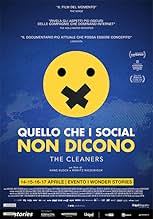
Im Schatten der Netzwelt
- 2018
- 1h 28min
PUNTUACIÓN EN IMDb
7,1/10
1,9 mil
TU PUNTUACIÓN
Una mirada al tenebroso inframundo de Internet donde se elimina el contenido cuestionable.Una mirada al tenebroso inframundo de Internet donde se elimina el contenido cuestionable.Una mirada al tenebroso inframundo de Internet donde se elimina el contenido cuestionable.
- Directores/as
- Guionistas
- Estrellas
- Premios
- 8 premios y 10 nominaciones en total
Mark Zuckerberg
- Self
- (metraje de archivo)
Donald Trump
- Self
- (metraje de archivo)
- Directores/as
- Guionistas
- Todo el reparto y equipo
- Producción, taquilla y más en IMDbPro
7,11.9K
1
2
3
4
5
6
7
8
9
10
Reseñas destacadas
Probably failing to reach intended audience for this information. Pertinent issues demonstrated very well. May leave impression on social media users open for these topics
Being an IT-consultant myself, having worked in information security for many years already, the movie did not offer many new insights, for me that is. Nevertheless, I'm always interested in any serious attempt to get the negative aspects of Internet across. Yet it may shoot above the heads of the average end user, thus failing to reach the intended audience and probably also won't effectively work as an eye-opener.
An interesting approach is to revolve the story line around the so-called content moderators, to consistently return to one of them to delineate the respective sections of the documentary. Their jobs are not easy, for example 3% of their decisions are checked by their supervisor, and they can make only a few mistakes per month. On the other hand, they are paid very well relatively in terms of the usual salaries in that part of the world.
A continuous stream of violence and other hefty photos or video's, all bordering on what is tolerable, will have ultimate effects on these moderators, something that is rightly touched by the movie. Their jobs will have nasty side effects on their minds. Despite the short exposure times per photo (20 seconds??), the sheer volume and the high percentage of disturbing images is bound to leave long lasting effects. I assume some sort of PTSS, despite the moderator not being physically involved in the situations at hand. As a form of self-defense, he may maintain the position that what he sees is happening far away and not affecting him dangerously in a physical sense. Conversely, it may broaden their horizon and make them aware of things not common in their own country. For example, one of the moderators told she developed an interest in sex toys as a side effect of her job, being something completely new to her before.
There were a few relatively short scenes wherein general counsels of the most-involved companies (Google, Facebook and Twitter) were questioned in the US House/Senate. What we got to see seemed devoid of any real content, possibly merely added to demonstrate that these companies are closely watched by politicians. The trivial questions we saw put to them and their prepared responses, did not contribute to my feeling that they are really scrutinized by politicians. (Side note: In April 2018 Facebook's Mark Zuckerberg made an appearance in the US House/Senate, in the aftermath of the Cambridge Analytica revelations. His questioning left a similar impression of triviality.). We cannot blame the politicians, as their inability is inevitable due to a lack of understanding how Internet works. However, in a way it was still relevant to add these sessions, if only to let the companies quote some numbers about people involved in the "cleaning" process. One of them mentioned even 10,000 employees, leaving unclear whether this also included contractors outside the US, like the ones in Manilla who were the main topic of this documentary.
The documentary provided also for some insight in the mistakes these moderators can make, for example because of little knowledge of (slang) vocabulary, missing cultural context, different norms in other parts of the world, and so on. Best example is the iconic picture that had an important influential role in showing the US people the truth about the Vietnam war, but it contained a frontal nude minor, hence had to be removed according to the written rules. My personal fear is that the deletion process tends to err on the side of caution and thus become too careful, thereby removing important documents about e.g. political conflicts (some examples were mentioned, but this topic got too little attention). Also pointed out were contemporary trends that some countries put pressure on the "platforms" to remove content that is not friendly towards the acting government, thereby suppressing the opposition and disconnecting them from their audience. These platforms prove to be lenient, just to prevent being blocked altogether which would render their business (e.g. advertising) impossible, with a negative influence on their profit/loss figures and their stakeholder value.
Though one of the reviewers complained that a beheading was shown on screen that took too long and was too painful to watch, I did not see his/her issue (maybe that scene was deleted afterwards). What they showed instead was an already beheaded body with the severed head on top, thereby explaining some details about the way this victim was beheaded, given the marks on the skin (apparently a kitchen knife was used, which is far from painless).
An interesting approach is to revolve the story line around the so-called content moderators, to consistently return to one of them to delineate the respective sections of the documentary. Their jobs are not easy, for example 3% of their decisions are checked by their supervisor, and they can make only a few mistakes per month. On the other hand, they are paid very well relatively in terms of the usual salaries in that part of the world.
A continuous stream of violence and other hefty photos or video's, all bordering on what is tolerable, will have ultimate effects on these moderators, something that is rightly touched by the movie. Their jobs will have nasty side effects on their minds. Despite the short exposure times per photo (20 seconds??), the sheer volume and the high percentage of disturbing images is bound to leave long lasting effects. I assume some sort of PTSS, despite the moderator not being physically involved in the situations at hand. As a form of self-defense, he may maintain the position that what he sees is happening far away and not affecting him dangerously in a physical sense. Conversely, it may broaden their horizon and make them aware of things not common in their own country. For example, one of the moderators told she developed an interest in sex toys as a side effect of her job, being something completely new to her before.
There were a few relatively short scenes wherein general counsels of the most-involved companies (Google, Facebook and Twitter) were questioned in the US House/Senate. What we got to see seemed devoid of any real content, possibly merely added to demonstrate that these companies are closely watched by politicians. The trivial questions we saw put to them and their prepared responses, did not contribute to my feeling that they are really scrutinized by politicians. (Side note: In April 2018 Facebook's Mark Zuckerberg made an appearance in the US House/Senate, in the aftermath of the Cambridge Analytica revelations. His questioning left a similar impression of triviality.). We cannot blame the politicians, as their inability is inevitable due to a lack of understanding how Internet works. However, in a way it was still relevant to add these sessions, if only to let the companies quote some numbers about people involved in the "cleaning" process. One of them mentioned even 10,000 employees, leaving unclear whether this also included contractors outside the US, like the ones in Manilla who were the main topic of this documentary.
The documentary provided also for some insight in the mistakes these moderators can make, for example because of little knowledge of (slang) vocabulary, missing cultural context, different norms in other parts of the world, and so on. Best example is the iconic picture that had an important influential role in showing the US people the truth about the Vietnam war, but it contained a frontal nude minor, hence had to be removed according to the written rules. My personal fear is that the deletion process tends to err on the side of caution and thus become too careful, thereby removing important documents about e.g. political conflicts (some examples were mentioned, but this topic got too little attention). Also pointed out were contemporary trends that some countries put pressure on the "platforms" to remove content that is not friendly towards the acting government, thereby suppressing the opposition and disconnecting them from their audience. These platforms prove to be lenient, just to prevent being blocked altogether which would render their business (e.g. advertising) impossible, with a negative influence on their profit/loss figures and their stakeholder value.
Though one of the reviewers complained that a beheading was shown on screen that took too long and was too painful to watch, I did not see his/her issue (maybe that scene was deleted afterwards). What they showed instead was an already beheaded body with the severed head on top, thereby explaining some details about the way this victim was beheaded, given the marks on the skin (apparently a kitchen knife was used, which is far from painless).
Extremely. On. Point. Screened in DC days aferry Zuckerberg I'm Congress.
A bald, revealing dive into the belly of the beast - Manilla, where ill-trained and more, dirt-level-paid sub-contract toilers attempt to curate 25,000 wildly sourced and morally divergent posts/images a day for a pittance. The implications for what passes for fact and news on the major social network platforms, and for the demographics that access this information, and often do not access more credible and valid sources, is enormous. Disturbing images are shown, You need to see this hard-hitting, shocking, film. It rates an 11. Disclaimer:after using Facebook from 2008, I happened to have closed my account weeks before. Karma.
some but not all
Well made movie with an interesting topic. While i brought am insight in extremistic and violent content censorship it left out how US standars in erotic are applied to the rest of the world.
10marbez
A duty for all Internet & "Social Media User
It is terrible how internet companies and so called "social media" control our minds and ignore all the elected governments...
Widespread Impact
Looks at the people and companies in the Philippines contracted to moderate Internet content on social media platforms and the effect it has on the employees - you cant undo what you have seen. Raises ethical and moral questions - has caused some employees to commit suicide. Ridiculous productivity goals given to employees - a disturbing view of what happens behind the scenes. Should be mandatory viewing for all media platform users.
¿Sabías que...?
- Citas
Donald Trump: If I wouldn't have social media, I couldn't get the word out. I probably wouldn't be standing here, right?
Selecciones populares
Inicia sesión para calificar y añadir a tu lista para recibir recomendaciones personalizadas
- How long is The Cleaners?Con tecnología de Alexa
Detalles
- Fecha de lanzamiento
- Países de origen
- Sitios oficiales
- Idioma
- Títulos en diferentes países
- The Cleaners
- Localizaciones del rodaje
- Empresas productoras
- Ver más compañías en los créditos en IMDbPro
Taquilla
- Recaudación en todo el mundo
- 43.670 US$
- Duración
- 1h 28min(88 min)
- Color
Contribuir a esta página
Sugerir un cambio o añadir el contenido que falta