

Cuando la policía de una ciudad alemana no es capaz de atrapar a un asesino de niños, otros criminales deciden participar en la búsqueda.Cuando la policía de una ciudad alemana no es capaz de atrapar a un asesino de niños, otros criminales deciden participar en la búsqueda.Cuando la policía de una ciudad alemana no es capaz de atrapar a un asesino de niños, otros criminales deciden participar en la búsqueda.
- Director/a
- Guionistas
- Estrellas
- Premios
- 2 premios en total




- Director/a
- Guionistas
- Todo el reparto y equipo
- Producción, taquilla y más en IMDbPro
Resumen
Reseñas destacadas
A masterful take on compulsive immorality
It is a film devoid of typical humanitarian propaganda, yet it is not the case that we immediately feel the need to relate to the child murderer Hans Beckert ( Peter Lorre ) since Fritz Lang also shows us the effects his gruesome crimes have in the form of the police constantly raiding establishments, the grieving parents & random people accusing eachother of the murders. It is not a movie that forces its opinion on you, but causes you to think about what is truly right and wrong. Hans later claims he cannot help himself because he has an irresistible compulsive urge to kill which cannot be stopped, much to the dismay of other career crooks who claim they only commit crimes to survive and take no pleasure or feel no compulsion towards it. It is a psychological kind of movie that is still as relevant as ever today as it was in 1931.
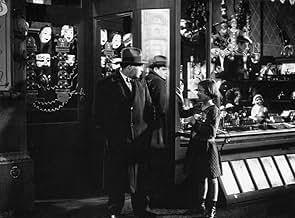
Peter Lorre is ofcourse the perfect fit for the psychopathic child murderer, he has the perfect innocent wide eyed look for a psychopath, who seems to even be likeable when he is not murdering children. His signature whistle by Edvard Grieg - In the Hall of the Mountain King is a nice creepy addition to his character which he uses to lure kids to their doom. Ofcourse the incredible shot at the start which focuses on Hans's shadow on the poster that lists his crimes and reward for capture while talking to a little girl before killing her is a great ironic symbolism to announce his character.
It was Lang's first sound picture, yet only two third of the movie was shot with actual sound while everything else was shot silent. This was primarily to keep the costs down since sound equipment was very expensive at the time. It creates a weird mix in constant transitioning from silent to sound. Yet as Lang has stated it adds another layer to the eeriness the movie has, so it only enhances the experience instead of unimmersing you out of the film.
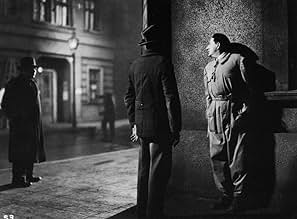
The cinematography is revolutionary in its use of low key lightning, which is a technique that was used many times after in the classic Film Noir era in Hollywood. The result is many Film Noirs share a visual resemblance with M due to their dark tone. Not only visually, but psychologically many themes of M have been repeated throughout the years in cinema. It was one of the first instances of a semi-sympathetic look on a pure psychopathic murderer, which has been repeated countless times in later years.
Some might feel sorry for Beckert for having this affliction of which he cannot be helped while others would prefer to see him hang, the movie doesn't shove the right answer down our throats, and it's possible to look at it from either way without having a right answer. It is a sociological thinking man's picture that is as relevant now as it ever was.
Fritz Lang's Finest Film
The story of M concerns a serial killer who preys on children & presents an underworld society whose usual business is disrupted due to the everyday raids carried out by the police to apprehend the killer-on-loose. Driven by police's continued failure & increasing losses in their business, the criminal bosses ultimately decide to take matters in their own hands & try to capture the killer all by themselves.
Directed by Fritz Lang, this is the film that the esteemed director called his finest & it's not really difficult to see why. The screenplay & direction brims with creativity, the suspense is wonderfully created & utilized, black-n-white photography is crisp & inventive, editing never lets the story settle down, score & sound effects work in seamless harmony, and Peter Lorre steals the show with a highly compelling performance.
On an overall scale, M is a cinematic treasure that has innovation written all over it. Whether it's the narrative style, leitmotifs, camera angles, sound mixing, symbolism or expressions, the contribution this German classic has made in the world of filmmaking is groundbreaking. A thought-provoking & well-researched study into the mind of a disturbed character, M is a strong meditation on the morals of right & wrong, that has a lot to say about our very own society.
Thoroughly recommended.
Fritz Lang's (sound) masterpiece- a taut and quintessentially suspenseful story, and Lorre
On the first viewing I just went straight for the story, which is able to suck one in enough to make you feel dizzy. But on the multiple viewings it becomes even more interesting as one can study the intricacy, and indeed full-on artistry, of Lang's camera. He puts it in unusual places at times, and adds for good measure shades of dark and gray in many of the night scene (this is, by the way, a precursor to 'film-noir', which Lang later became an important director in the 40's and 50's). On top of this, there is a very modern sense of style in the editing- I remember a couple of scenes that surprised me editing wise. One is where the cops (I think it was the cops) have an argument about the investigation- two of them get into a shouting match, and we get medium close-ups of them going back and forth. This is done quickly, with a kind of intensity that isn't even captured in today's thrillers. There is also the hunt for Lorre in the digging of the house, where Lang cuts around constantly, heightening the tension between the predators (the criminals) and the prey (Lorre), until it's almost too much to take.
The disturbing aspects of the story, of child abduction and murder, have become benchmarks of a number of today's thrillers, where the cop is usually the subject and the killer left more in the shadows, in cat & mouse style. This doesn't happen here, and because of it by the time we get to the final scene, with Lorre being interrogated and giving his "I can't help it" speech, it becomes something poetic, tragic, frightening. Lang doesn't leave his "message" so simplistically, he makes sure we know Lorre's side too, however twisted it has become, and the antagonist is shown as human as opposed to these present-day thriller where the killers are barely given one dimension let alone two. There were reports that during filming Lang put Lorre through torture, ultimately causing the two to never work together again. But nevertheless, out of this comes a towering performance of a small, wild-eyed criminal in the midst of an extremely well-told and unpredictable mystery story. In short, if you don't know what you're in for when you hear that whistle, those several infamous notes, you may not at all.
Far Ahead Of Its Time And May Always Will Be
The film is lead by Peter Lorre in a transcending performance who plays the serial killer and rapist in which the film is centered around. In this performance Lorre is successful in something that at the very least is rare to see in any kind of film, compassion for a child killer and rapist. Lorre makes the viewer see, that he is not a criminal by choice but by a sickness of compulsion. Too often then not is our perception of a psychotic killer having that look that puts fear into his or hers victims' eyes. Lorre doesn't do that but rather displays a frightened man, a scared man. One in which his desperation leads to his hazardous behavior. His portrayal of a killer is not of a fearless one but of one consumed by fear. Something that even today we as a people cannot understand, let alone in 1931.
The direction and writing of Fritz Lang is beyond comprehensible as he taps into the mind of a serial killer and his complexities. He does so in such that we get an empathetic and compassionate illustration of all sides of the story. This in which by then end of the film all points of view are more then well delivered to the audience. Fritz Lang here, has simply created here a timeless masterpiece. One that excels in its technical aspects and enlightens the audience on a topic that other films still have not yet to match M in.
I highly recommend this film for many obvious reasons and conclusions. This film was created by one of the all time great directors in Fritz Lang, Lang's command for the screen is mesmerizing and a joy to witness and so on and so forth. Yet much of this is mostly superficial and a waste of time to continuously state. M, as I mentioned before takes a strong and original stance on an issue that we as a society yet have not fully resolved. This film may not give you THE answer on this issue but it may sway that moral compass of yours that lies inside of all of us.
A masterpiece of visual drama; brilliantly acted by Peter Lorre. **** out of ****.
"M" is a cinematic masterpiece of visual drama. The stunning performances define the careers of exceptional actors such as Peter Lorre and Gustaf Grundgens. Director Fritz Lang gives depth and dimension to his production by distinctly capturing the ecstasy of the film's many characters and focusing accurately on individual situations. This is an intriguing journey into the mind of a psychotic child murderer, blending terror, complexity, and malignity in one amazing motion picture.
Screenwriters Paul Falkenburg and Adlof Jansen construct the characters of "M" with distinctive personalities and three dimensional emotions. Many lesser filmmakers give their characters no creativity outside the confines of the script. In this movie each individual character has a mind of their own; they are free to roam the landscape of a inviting atmosphere.
Fabricating such an impressive atmosphere is some of the best cinematography and lighting effects that I can remember watching. This resplendent component creates the film's terrific moody ambiance. Suspense is one thing "M" contains in full context. The movie's third act is sheer peak-high tension.
Shot in black and white, "M" stars Peter Lorre as Peter-Hans Beckert, an extremely disturbed child murderer in the process of wreaking havoc on a neighborhood. Parents everywhere are living in fear of their children being kidnapped and abruptly annihilated.
This picture contains a brilliantly crafted setup. The visual setting creates a strongly developed opening. Every scene works to either complicate the initial problem or propels the story through a firm narrative through line.
The film captures the chaos of the town in terror perfectly. "M" is more about the results of a serial killer than an actual serial killer. Never do we directly witness a murder; the violent encounters are implied. This method of film making perhaps makes the movie's impact even greater. With an creative perspective through a third person point of view, the filmmakers repeatedly give us examples of a solid structure through characters and occurrences.
"M" offers a unforgettable, challenging performance by Peter Lorre. This extraordinary actor is tormenting and disturbing without embracing in extreme violent conduct. He perspires with momentum and rapture. This productions closing scenes are so deeply penetrating they entirely captivate the viewer. Isn't this what movies are supposed to do?


¿Sabías que...?
- CuriosidadesContrary to popular belief, Fritz Lang did not change the title from "The Murderers are Among Us" to "M" due to fear of persecution by the Nazis. He changed the title during filming, influenced by the scene where one of the criminals writes the letter on his hand. Lang thought "M" was a more interesting title.
- PifiasWhen the gangsters find M in the attic and turn on the light, the clock behind M moves back five minutes from 11:55 to 11:50.
- Citas
Hans Beckert: I can't help what I do! I can't help it, I can't...
Criminal: The old story! We never can help it in court!
Hans Beckert: What do you know about it? Who are you anyway? Who are you? Criminals? Are you proud of yourselves? Proud of breaking safes or cheating at cards? Things you could just as well keep your fingers off. You wouldn't need to do all that if you'd learn a proper trade or if you'd work. If you weren't a bunch of lazy bastards. But I... I can't help myself! I have no control over this, this evil thing inside of me, the fire, the voices, the torment!
Schraenker: Do you mean to say that you have to murder?
Hans Beckert: It's there all the time, driving me out to wander the streets, following me, silently, but I can feel it there. It's me, pursuing myself! I want to escape, to escape from myself! But it's impossible. I can't escape, I have to obey it. I have to run, run... endless streets. I want to escape, to get away! And I'm pursued by ghosts. Ghosts of mothers and of those children... they never leave me. They are always there... always, always, always!, except when I do it, when I... Then I can't remember anything. And afterwards I see those posters and read what I've done, and read, and read... did I do that? But I can't remember anything about it! But who will believe me? Who knows what it's like to be me? How I'm forced to act... how I must, must... don't want to, must! Don't want to, but must! And then a voice screams! I can't bear to hear it! I can't go on! I can't... I can't...
- Créditos adicionalesAll of the original credits appear only in the beginning with no music.
- Versiones alternativasIn the English and French language versions, in addition to having been dubbed, had some footage re shot. These scenes include the telephone conversation between the minister and the police commissioner, and the ending of the film. Peter Lorre's performance in the trial was re shot, however this time he spoke his lines in English or French, depending upon the version. The shots of him are lit and photographed much differently than Fritz Lang's original footage. Additionally, a shot of the police arriving was inserted, taken from an earlier part of the film (whereas in the original German version no police forces are shown at all). The court scenes have been eliminated and replaced with happy endings where young children play a game similar to the one seen in the opening (English) or a smiling couple watching their children play in the street (French).
- ConexionesEdited into Juden ohne Maske (1937)
Selecciones populares
- How long is M?Con tecnología de Alexa
Detalles
Taquilla
- Recaudación en Estados Unidos y Canadá
- 35.566 US$
- Fin de semana de estreno en EE. UU. y Canadá
- 6123 US$
- 17 mar 2013
- Recaudación en todo el mundo
- 35.566 US$
- Duración
- 1h 57min(117 min)
- Color
- Mezcla de sonido
- Relación de aspecto
- 1.19 : 1
- 1.20 : 1