

Un vendedor de seguros de Los Ángeles se deja seducir por un ama de casa para participar en un plan de fraude y asesinato que despierta las sospechas de su colega, un investigador.Un vendedor de seguros de Los Ángeles se deja seducir por un ama de casa para participar en un plan de fraude y asesinato que despierta las sospechas de su colega, un investigador.Un vendedor de seguros de Los Ángeles se deja seducir por un ama de casa para participar en un plan de fraude y asesinato que despierta las sospechas de su colega, un investigador.
- Director/a
- Guionistas
- Estrellas
- Nominado para 7 premios Óscar
- 5 premios y 9 nominaciones en total




- Stage Hand
- (sin acreditar)
- Pullman Porter
- (sin acreditar)
- Bit Part
- (sin acreditar)

- Man Reading Magazine Outside Keyes' Office
- (sin acreditar)

- Train Conductor
- (sin acreditar)

- Conductor
- (sin acreditar)

- Nettie - Dietrichsons' Maid
- (sin acreditar)

- Norton's Secretary
- (sin acreditar)
- Director/a
- Guionistas
- Todo el reparto y equipo
- Producción, taquilla y más en IMDbPro
Resumen
Reseñas destacadas
Movie Heaven, Baby
The Not-So-Perfect Crime
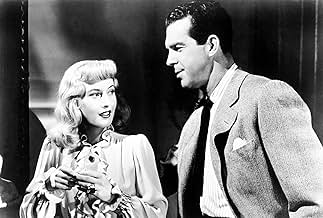
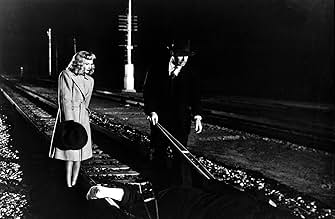
The film begins in present day giving insight into Walter's current plight. Walter Neff gives the voice over as the plot unfolds. It starts in the present time allowing the audience to know what crime has happened without the interesting details to support it. This is an interesting twist to the common film noir plot. Knowing the crime at hand keeps the audience hungry for those details. Walter is the victim of the beautiful woman who manipulates him into pulling off a murderous insurance fraud scam. Walter is an impeccable insurance salesman and Phyllis, in some ways, forces him into providing her with what she needs. Phyllis is the typical femme fatale' who has no problem in using others to get what she wants.
Throughout the film Walter is completely enamored by Phyllis. Walter could have coined the pet name baby' with his fondness towards Phyllis by calling her that throughout the film. He is easily distracted by her beauty and evil charm. He seems to be entranced by Phyllis's ankle bracelet, so much that he mentions it numerous times. This allows the audience to feel the sexual tension between the two. Phyllis, on the other hand, shows the audience that she can use and abuse anyone who gets in her way. While believably attracted to Walter, Phyllis keeps him hopping to fulfill her needs. She pulls him in and handles him like a puppet. She is the epitome of the film noir genre's femme fatale'.
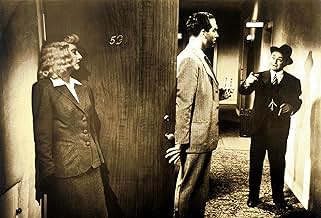
Barton Keyes, played by Edward G. Robinson, is Walter's co-worker and friend at the insurance company where he works. Barton closely investigates all insurance claims that come across his desk. While at one time Walter assuredly agreed with this practice, once Barton starts to unravel the mystery behind Mrs. Dietrichson's insurance claim, we begin to see just how nervous and paranoid Walter is. Walter then begins to see Phyllis in a whole new light. Barton plays the integral part by piecing together details that are thrown around throughout the film. This keeps the tension high for the filmgoer. These details are pieced together perfectly through to the end.
Double Indemnity has the perfect plot with the perfect cast. Walter and Phyllis' attraction are tasty and the crime is wonderfully puzzling. Double Indemnity is the true film noir giant.
One of the best films noir ever, Double Indemnity communicates with amazing effectiveness the depths of depravity, greed, lust, and betrayal of the seemingly innocent and beautiful.
Barbara Stanwyck, in one of the most remembered performances of her extensive career, represents (with nearly flawless ease) the cold and ruthless manipulator who has no difficulty in ruining other people's lives in various ways (including death, if necessary) in order to get what she wants. Known in the film community as the `femme fatale,' this is someone who uses her sexual prowess, seductiveness, and emotional detachment to drag an unsuspecting person (generally an interested man) into a scheme from which she is expected to benefit heavily and he is most likely headed for destruction. In these types of films, the man often either finds his life in ruins or ends up dead, as is often (but not always) also the case with the fate of the femme fatale.
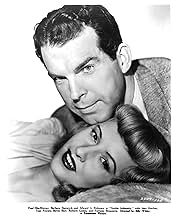
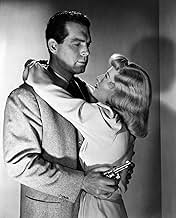
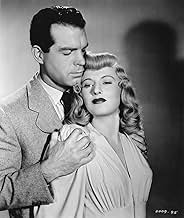
Barbara Stanwyck (as Phyllis Dietrichson, the murderous femme fatale in Double Indemnity) and Fred MacMurray (as Walter Neff, her victim'), have amazing chemistry on screen. Their attraction is incredibly well portrayed, and the development of their relationship with each other is so convincing that what happens between them almost seems normal. Besides that, their mutually calculated interaction, although it seems at first like it has been rehearsed endlessly and ultimately brought unconvincingly to the screen, is exactly as it was meant to be, because it represents each character's intentions, even very subtly foreshadowing their future betrayals against each other. Phyllis has gone through every word she ever says to Walter in her head. She has practiced what she wants to say when she brings up the idea of life insurance to Walter in the beginning and she knows what she wants to say whenever they interact with each other because she has been planning for quite some time the prospect of murdering her husband in order to collect his fortune. Walter, conversely, methodically makes amorous advances as though this is something that he does regularly, and then ultimately he also plans out his conversations with Phyllis because he begins to suspect her and is sure to tell her only what he wants her to hear. This seemingly stiff dialogue brilliantly represents Phyllis and Walter's precise (and sinister) intentions, and it's quick pace creates a feeling of urgency and restlessness.
Probably the most fascinating and entertaining actor in the film, Edward G. Robinson, plays Barton Keyes, Walter's friend and employer at the insurance company where he works. Keyes is a very suspicious man who closely investigates the insurance claims which come into the company, having a striking history of accurately isolating fraudulent claims and throwing them out. His handling of Phyllis's (and Walter's, technically) claim and the way that he gets closer and closer to the truth create a great atmosphere of tension and drama.
Double Indemnity is nearly flawless. From the shocking and unexpected beginning to the already known but still surprising end, the audience is held rapt by the excellent performances, the brilliant and imaginative direction, and the flawlessly created atmosphere. This is excellent, excellent filmmaking, and is a classic film that should not be missed.
It fits together like a watch
Woman and man agree to murder woman's husband but on the way to the cemetery they face grilling by insurance company. I think everything has been said before on the IMDb - by those who think it's one of the best films ever made! To those who simply think the main problem is that it's dated I wish you could see the TV commercials that dug into DI back in '87 - what a hoot - and compare. I've just noticed the print TCM UK is showing in 2005 is lip-synced out, very wobbly Rosza music track, fading and ageing fast - worse than my 1987 video tape (maybe logically). They're supposed to be encouraging people to enjoy the classics but they won't do that with such inferior screening copies. Dear TCM UK, this is an impressive iconic film - it deserves a billion dollar remaster authorised by the Library of Congress, not repeatedly trotting out unimpressive cheap worn dupes to fill those 2 hour slots.
Everything about DI from the acting, production, direction, and music is superbly dignified and is as "close to perfection" as human beings are probably allowed to get with this form of Art - especially with the more limited technology at their disposal in '44. When most films from now are long forgotten and dated DI will still be getting re-runs on TV and art-house cinemas - God and remasters willing - that is the fact of it.
Fortunia Bonanova certainly was fortunate to have appeared in bit parts in 2 of the best films ever made - Citizen Kane the other.
Absorbing and worthy suspense film about blackmails , killing , corruption and strong intrigue
This first-rate and entertaining American classic Noir film draws its riveting tale and power from the interaction of finely drawn roles as well as drama , emotion and moody atmosphere . This classic mystery thriller follows James M Cain's book fairly closely otherwise . Twisted film Noir about murder , troubled relationships , treason , dark secrets , including an unforgettable dialog ; being based on the James M Cain's novel , which in turn was based on the true story of Ruth Snyder, the subject of a notorious 1920s murder trial , being screen-written by the prestigious Raymond Chandler and the same Billy Wilder . However , Billy Wilder and Raymond Chandler did not get along well while writing this film's script, a process that was apparently filled with arguments . As Billy Wilder didn't really get on with the famous novelist whose constant drinking irritated the director . It packs a good realization , an original script , haunting atmosphere , intriguing events ; for that reason madness and murder prevail . Fred MacMurray is superb as insurance salesman coerced into murder plot and Barbara Stanwick as predatory and alluring Femme Fatale is magnificent . Here his colleague Edward G Robinson is extraordinary and as cool as ever ; he plays as the astute and stubborn investigator , his scenes with Fred MacMurray are awesome and at their best . But Edward G. Robinson's initial reluctance to sign on largely stemmed from the fact he wasn't keen on being demoted to third lead . Good support cast formed by notorious secondaries such as Porter Hall , Tom Powers , Jean Heather , Byron Barr and Fortunio Bonanova . And Raymond Chandler's cameo , this marks the only film appearance of screenwriter and novelist Raymond Chandler .
Exciting as well as complex film , possessing a mysterious and fascinating blend of gripping thriller , serenity , baroque suspense in which especially stands out the portentous performances , evocative cinematography in black and white by John F. Seitz and thrilling musical score by the classic Miklos Rozsa . The motion picture was stunningly directed by the great Billy Wilder , as the American Film Institute ranked this as the #29 Greatest Movie of All Time . The film was nominated for 7 Academy Awards but lost out on the night to Going my way (1944) by Leo McCarey. It got a deep inspiration for other films , it is particularly obvious for ¨Body heat¨ by Lawrence Kasdan with William Hurt , Kathleen Turner and Richard Crenna . Remade for TV in 1954 by Buzz Kulik with Frank Lovejoy , Ray Collins and Laraine Day , and 1973 TV remake of the 1940s classic by Jack Smight with Richard Crenna , Samantha Eggar , and Robert Webber .


¿Sabías que...?
- CuriosidadesAuthor James M. Cain later admitted that if he had come up with some of the solutions to the plot that screenwriters Billy Wilder and Raymond Chandler did, he would have employed them in his original novel.
- PifiasWhen Walter first kisses Phyllis, a wedding ring can be seen on Walter's hand. Fred MacMurray was married, and the ring was not noticed until post-production.
- Citas
[last lines]
Walter Neff: Know why you couldn't figure this one, Keyes? I'll tell ya. 'Cause the guy you were looking for was too close. Right across the desk from ya.
Barton Keyes: Closer than that, Walter.
Walter Neff: I love you, too.
- Créditos adicionalesOpening credits are shown over a silhouette of a man on crutches, walking toward the camera.
- ConexionesEdited into Cliente muerto no paga (1982)
Selecciones populares
Detalles
- Fecha de lanzamiento
- País de origen
- Sitio oficial
- Idioma
- Títulos en diferentes países
- Pacto de sangre
- Localizaciones del rodaje
- 6301 Quebec Drive, Hollywood Hills, Los Ángeles, California, Estados Unidos(Dietrichson house)
- Empresa productora
- Ver más compañías en los créditos en IMDbPro
Taquilla
- Presupuesto
- 927.262 US$ (estimación)
- Recaudación en todo el mundo
- 21.900 US$
- Duración
- 1h 47min(107 min)
- Color
- Relación de aspecto
- 1.37 : 1