

La trágica vida de María Antonieta, quien se convirtió en reina de Francia en su adolescencia.La trágica vida de María Antonieta, quien se convirtió en reina de Francia en su adolescencia.La trágica vida de María Antonieta, quien se convirtió en reina de Francia en su adolescencia.
- Directores/as
- Guionistas
- Estrellas
- Nominado para 4 premios Óscar
- 5 premios y 5 nominaciones en total
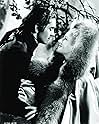


- Comte de Provence
- (as Albert Van Dekker)


Reseñas destacadas
Rediscovering Norma Shearer
We're now able to see her talent for ourselves, thanks largely to Turner Classic Movies, and Norma Shearer's star is rising again.
If you've never seen a Shearer movie, Marie Antoinette is a good beginning. It is one of Hollywood's great epics of the 1930s, with lavish costumes and scenery, and its historic setting holds up well. Shearer plays the doomed French queen from teenager to the Guillotine, and the final scenes as she awaits death in prison are among the finest of her career.
In recent years, Shearer has gained new respect for her silent and pre-code films, in which she was one of the most accomplished young actresses of the era. She often played sexually sophisticated women with a sly wit. She was not a typical ingénue, and you can see why audiences of the time were enchanted by her.
Norma's zenith and with one exception the end of her reign
But this is certainly a grand way to end her time at the top. Norma does well in the lead her occasional lapses into grandiosity are well suited to a queen and don't get in the way of her characterization like they often did in several of her other films and her smaller moments are well played. Although this really should have been in color, the sets, wigs and costumes are almost impossibly lavish and are dazzling even in B&W. It's an enjoyable if questionably accurate historical account of Marie's rise and fall.
Aside from Shearer Robert Morley gives a gem of a performance as the not terribly bright Louis XVI, never making him seem a simpleton just a gentle man unequal to the role thrust upon him by birth. There are a few other good performances from Gladys George as the cheap but flashily dressed Madame du Barry and Joseph Schildkraut as the queen's venal cousin. Tyrone Power is impossibly handsome but his part is really window dressing so he doesn't make much of an impression.
Fine through they all are the film would be nothing without Norma. The title role requires someone whose well seasoned star power couldn't be overpowered by the sumptuous trappings and this is Norma's show straight down the line. Perhaps the one she was most suited to it's certainly one of her strongest performances. The film itself is a trifle overlong but for those who stick with it worthwhile entertainment.
Top Ten Reasons why "Marie Antoinette" is quite possibly the best movie ever made in Hollywood
Uncredited as a scriptwriter is novelist F. Scott Fitzgerald. His love scenes are extremely elaborate and exquisitely structured. They also introduce innovations that have since become clichés and the hallmark of 'women pictures' everywhere.
9. The actors
Barrymore is unforgettable as the regally cranky Louis XV. Morley gives one of his best interpretations. Schildkraut plays the best two-faced villain of his entire body of work. As for Power... remember the anecdote about the reporter asking romance-writer Barbara Cartland (Lady Di's stepmother) how she could possibly have written so many romance novels before she was even married and while she was still a virgin? Her answer was: 'Oh! We didn't have sex in those days. We had Tyrone Power.'
8. The director
Van Dyke was an expert at handling large crowds and acts of God. His directing style was a compromise between time-efficiency and giving the stars leeway as long as they respected the general style of the piece. This 'honour system' seems to have encouraged the actors to do their homework and present a credible, coherent performance every time. He also got an assist here from uncredited French genius Julien Duvivier.
7. Artistic direction
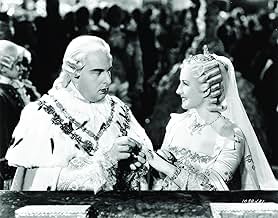
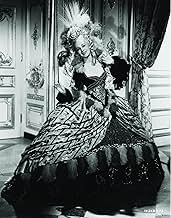
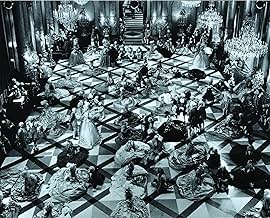
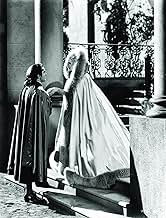
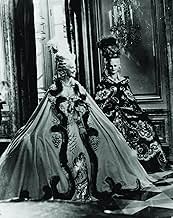
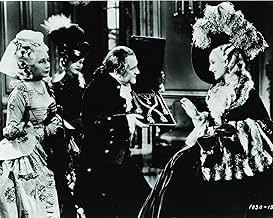
What can you say about a period film that tackled the challenge of recreating Versailles in the XVIIIth century on the MGM back lot? The production values are staggering. The Gallery of Mirrors is actually longer, higher and wider than the original. The costumes tread a fine line between historical accuracy (covered shoulders and revealed cleavage) and the requirements of the movie code (exposed shoulders were tolerated but bosoms had to be covered) but still manage to convey the era and the fairy-tale quality of Marie's court. The costumes were also specially constructed to shine, glitter and shimmer on black and white film.
6. Historical accuracy
The film's script is based (in part) on Stefan Zweig's groundbreaking biography of the Queen, "Marie Antoinette, Portrait of an Ordinary Woman", which tried to create the first accurate, adult, factual but Freudian-inspired narrative of the Queen's life by using documents and correspondence that had long been overlooked or suppressed. The book was the first to reveal Louis XVI's mechanical sexual problems, which prevented his consummating the marriage during its first seven years (until a slight surgical intervention) and explained in turn the Queen's extravagant spendthrift personality, in Freudian terms, as extreme sexual frustration. This story actually makes it to the screen in a large degree. Compare this to recent biopics like "A Beautiful Mind", whose scriptwriters conveniently 'forget' essential but non-mainstream plot elements like the fact that John Nash's paranoia may have been caused or amplified by the McCarthy era persecution of homosexuals. Some historical events have been telescoped into one another in order to accommodate the general American public's limited understanding of French history and the Orléans character was used to maintain tension by representing the turncoat part of the nobility which exploited MA for their own various agendas.
5. The music
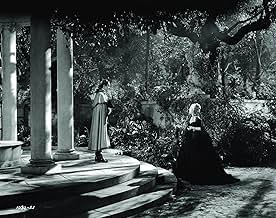
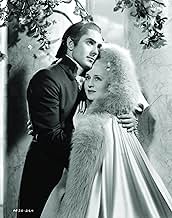
Herbert Stothart may not be a household word but he did win an Oscar for his original score to "The Wizard of Oz", based, of course in part on Harold Arlen's melodies. Besides giving Miss Gulch/the Wicked Witch her immortal theme, he is also one half of the composing team that produced the operetta "Rose Marie". Stothart shines in two respects: the approximate recreation of XVIIIth century dance music in the court scenes, emphasizing the bored grandeur of the proceedings, and the psychological music that accompanies everything from exciting chase scenes to the love scenes between Shearer and Tyrone. Note especially the use of the harpsichord in a rupture scene between Orléans and MA and the use of the viola d'amour in the garden love scene.
4. The cinematography
MA is in 'glorious black and white', but especially in the escape to Varennes sequence which has the most credible - and suspenseful - 'day for night' sequence ever filmed. The marriage scene may have inspired Queen Elizabeth II's coronation. Also notable are the matte paintings, the overwhelming use of cranes to move in on particular characters in a crowd scene and the chiaroscuro of the last meeting with Fersen.
3. Detail and scope
Every scene has something special added to it in characterization, movement, rhythm, lighting, art direction, choreography (and not just in the dance scenes). The costumes could have starred in a picture by themselves.
2. The lost art of story-telling
This film was planned with intelligence and skill and was built around the principle stated by Selznick when filming GWTW: 'The secret of adapting a book to the screen is to give the impression that you are adapting a book to the screen.' Which means that many literary devices are used to give the story many interesting arcs and recurring themes. The story is well balanced in terms of spectacular action, recreation of important historical events (giving the impression of the passage of time) and intimate scenes. It is truly 'the intimate epic' that Mankiewicz's 'Cleopatra' was supposed to be. Need I add I am really dreading the Sofia Coppola version...
1. Norma Shearer
Norma Shearer is an unjustly forgotten star of the first magnitude. MA is permanent testament to her uncanny abilities. In this film she portrays the main character from the age of sixteen to her death as a prematurely aged and debilitated woman of 38, all with perfect verisimilitude, thanks to her magnificent vocal instrument and stage presence. As a fairy-queen, she makes Cate Blanchett as Galadriel (in LOTR) look like Carol Burnett's charwoman. Her virtuosity as the fated widowed Queen is all the more poignant when one realizes that at the time she was Thalberg's widow in her last husband-approved venture and that the Hollywood suits were rapidly closing in on her.
Empathy defined
This is one of the truly great films. If you want to find out how deeply someone can feel, show it to them and observe. Norma Shearer set a standard I fear has been forgotten, as evidenced by the way tinsel town hands out awards today for mediocre work pushed onto the modern consciousness by glitzy ad campaigns and self-serving accolades.
One of the best and most sumptuous film biographies of all time.


¿Sabías que...?
- CuriosidadesAccording to Wikipedia, the movie had thousands of costumes and lavish set designs. Adrian visited France and Austria in 1937 researching the period. He studied the paintings of Marie Antoinette, even using a microscope on them so that the embroidery and fabric could be identical. Fabrics were specially woven and embroidered with stitches sometimes too fine to be seen with the naked eye. The attention to detail was extreme, from the framework to hair. Some gowns became extremely heavy due to the embroidery, flounces and precious stones used. Norma Shearer's gowns alone had a combined weight of over 1,768 lb., the heaviest being the wedding dress.
- PifiasAt the time of their wedding, the Dauphin, Louis, was 15 and Marie Antoinette was 14. Norma Shearer could (barely) get away with portraying a 14-year-old (as she portrayed a 13-year-old Juliet in ROMEO AND JULIET (1936) because many noble/royal females were more mature and had regal bearing), but Robert Morley looked 35, not 15.
- Citas
Marie Antoinette: You thought of me as something quite wonderful, didn't you? But instead you found an empty-headed, ill-mannered little fool. You see, monsieur, how sadly I am changed.
Count Axel de Fersen: Oh no, madame! You've made pleasure a shield against lonliness and slander, but you could never change so deep a heart, so eager to be loved. Everyone, even the highest, has some dream of love in his heart and unless he achieve it he must fill that emptiness with noise, fame, excitement, pleasure.
Marie Antoinette: Where did you learn this, monsieur?
Count Axel de Fersen: In museums, mostly.
Marie Antoinette: Museums?
Count Axel de Fersen: They're very dull, most of them, and neglected, but you'll always find someone there gazing over the relics of queens who were true lovers. There isn't much to see... a ring, a glove, a fan perhaps, but we preserve them as much as we do our laws and we have much more faith in them.
Marie Antoinette: Do you think one-hundred years hence some Swedish gentleman wandering in Paris might smile over a relic of Marie Antoinette? A miniature perhaps, or a ring? This very ring, for instance.
[She removes a ring from her hand and shows it to him]
Marie Antoinette: Its centuries old. It has an inscription on it
[She reads it aloud]
Marie Antoinette: "Everything leads me to thee."
[Now she places the ring in his hand]
Marie Antoinette: Can you see it? Lying on a velvet cushion in its little glass case?
Count Axel de Fersen: I don't know... you might make a present of it, perhaps, to some man who had loved you and it would be worn on his hand for as long as he lived and buried with him when he died because he loved you reverently and as was fitting from a respectable distance but with all his heart for all this life.
- Versiones alternativas"Unrestored" film has now been restored and is available on DVD. When the film played the Carthay Circle in Los Angeles and the Astor Theatre in New York as a reserved seat "road show" attraction, the print ran eleven minutes longer than the generally available 149 minute Turner Library print. These eleven minutes contained an overture, entr'acte, and exit music, with an intermission immediately following Antoinette's emotional farewell to Fersen on the steps of Versailles. These remnants of the "road show" presentation have now been restored to the new Warner Bros. Home Video DVD, which runs a little over 157 minutes.
- ConexionesEdited into Hollywood: The Dream Factory (1972)
Selecciones populares
- How long is Marie Antoinette?Con tecnología de Alexa
Detalles
- Fecha de lanzamiento
- País de origen
- Idioma
- Títulos en diferentes países
- Marie Antoinette
- Localizaciones del rodaje
- Chateau de Versailles, Versailles, Yvelines, Francia(palace backgrounds)
- Empresa productora
- Ver más compañías en los créditos en IMDbPro
Taquilla
- Presupuesto
- 2.926.000 US$ (estimación)
- Duración
- 2h 29min(149 min)
- Relación de aspecto
- 1.37 : 1