Calendario de lanzamientosLas 250 mejores películasPelículas más popularesExplorar películas por géneroTaquilla superiorHorarios y ticketsNoticias sobre películasNoticias destacadas sobre películas de la India
    Qué hay en la TV y en streamingLas 250 mejores seriesProgramas de televisión más popularesExplorar series por géneroNoticias de TV
    ¿Qué verÚltimos tráileresOriginales de IMDbSelecciones de IMDbDestacado de IMDbGuía de entretenimiento familiarPodcasts de IMDb
    OscarsHoliday Watch GuideGotham AwardsPremios STARmeterCentral de premiosCentral de festivalesTodos los eventos
    Personas nacidas hoyCelebridades más popularesNoticias de famosos
    Centro de ayudaZona de colaboradoresEncuestas
Para profesionales de la industria
  • Idioma
  • Totalmente compatible
  • English (United States)
    Parcialmente compatible
  • Français (Canada)
  • Français (France)
  • Deutsch (Deutschland)
  • हिंदी (भारत)
  • Italiano (Italia)
  • Português (Brasil)
  • Español (España)
  • Español (México)
Lista de seguimiento
Iniciar sesión
  • Totalmente compatible
  • English (United States)
    Parcialmente compatible
  • Français (Canada)
  • Français (France)
  • Deutsch (Deutschland)
  • हिंदी (भारत)
  • Italiano (Italia)
  • Português (Brasil)
  • Español (España)
  • Español (México)
Usar la aplicación
  • Reparto y equipo
  • Reseñas de usuarios
  • Curiosidades
  • Preguntas frecuentes
IMDbPro

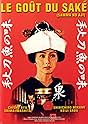
El sabor del sake

Título original: Sanma no aji
  • 1962
  • A
  • 1h 53min
PUNTUACIÓN EN IMDb
8,0/10
12 mil
TU PUNTUACIÓN
El sabor del sake (1962)
japonésDrama

Un viudo entrado en años acuerda el matrimonio de su única hija.Un viudo entrado en años acuerda el matrimonio de su única hija.Un viudo entrado en años acuerda el matrimonio de su única hija.

  • Director/a
    • Yasujirô Ozu
  • Guionistas
    • Kôgo Noda
    • Yasujirô Ozu
  • Estrellas
    • Chishû Ryû
    • Shima Iwashita
    • Keiji Sada
  • Ver la información de la producción en IMDbPro
  • PUNTUACIÓN EN IMDb
    8,0/10
    12 mil
    TU PUNTUACIÓN
    • Director/a
      • Yasujirô Ozu
    • Guionistas
      • Kôgo Noda
      • Yasujirô Ozu
    • Estrellas
      • Chishû Ryû
      • Shima Iwashita
      • Keiji Sada
    • 48Reseñas de usuarios
    • 66Reseñas de críticos
    • 91Metapuntuación
  • Ver la información de la producción en IMDbPro
  • Ver la información de la producción en IMDbPro
    • Premios
      • 4 premios y 1 nominación en total

    Imágenes78

    Ver cartel
    Ver cartel
    Ver cartel
    Ver cartel
    Ver cartel
    Ver cartel
    + 73
    Ver cartel

    Reparto Principal26

    Editar
    Chishû Ryû
    Chishû Ryû
    • Shuhei Hirayama
    Shima Iwashita
    Shima Iwashita
    • Michiko Hirayama
    Keiji Sada
    Keiji Sada
    • Koichi Hirayama
    Mariko Okada
    Mariko Okada
    • Akiko Hirayama
    Teruo Yoshida
    Teruo Yoshida
    • Yutaka Miura
    Noriko Maki
    Noriko Maki
    • Fusako Taguchi
    Shin'ichirô Mikami
    Shin'ichirô Mikami
    • Kazuo Hirayama
    Nobuo Nakamura
    Nobuo Nakamura
    • Shuzo Kawai
    Eijirô Tôno
    Eijirô Tôno
    • Sakuma - The 'Gourd'
    Kuniko Miyake
    Kuniko Miyake
    • Nobuko
    Kyôko Kishida
    Kyôko Kishida
    • 'Kaoru' no Madame
    Michiyo Tamaki
    • Tamako, gosai
    Ryûji Kita
    Ryûji Kita
    • Shin Horie
    Toyo Takahashi
    Toyo Takahashi
    • 'Wakamatsu' no Okami
    Shinobu Asaji
    • Youko Sasaki, hisho
    Masao Oda
    Masao Oda
    • Dousousei Watanabe
    Fujio Suga
    Fujio Suga
    • Suikyaku A
    Zen'ichi Inagawa
      • Director/a
        • Yasujirô Ozu
      • Guionistas
        • Kôgo Noda
        • Yasujirô Ozu
      • Todo el reparto y equipo
      • Producción, taquilla y más en IMDbPro

      Reseñas de usuarios48

      8,011.7K
      1
      2
      3
      4
      5
      6
      7
      8
      9
      10

      Reseñas destacadas

      10solstice5555

      The beauty of things

      I can whole-heartedly relate to previous reviewers' sentiments about this movie. From my own perspective it is also an awesome celebration of beauty. The theme is the same Ozu's favorite—separation of father and his grown-up daughter-- however it is presented in a different, less nerve-wrecking and more humorous way (as compared to Late Spring), but most of all -- within the colorful kaleidoscope of everyday things looking as works of art in themselves. Ozu rejoices in showing the beauty of such mundane objects as mugs, bowls, kimonos, tables, lamp shades, houses, fences, even industrial chimneys and such. Colors and shapes are arranged into perfect compositions and sometimes it seems that still objects actually govern the mood and the flow of people around them. The parallel with Tarkovskij's movies, like Solaris and Stalker, where the harmony of individual objects creates its own layer of movie symbolism, seems natural, only Russian movies were shot more than a decade later. I watched An Autumn Afternoon several times with the same joyful interest and gratitude for the gift of showing us the beauty of everyday life.
      8claudio_carvalho

      Revisiting "Banshun" in the Swan Song of the Great Master

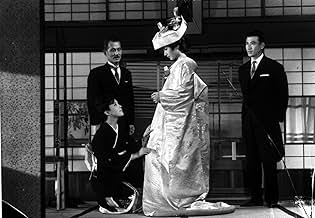
      In the early 60's in Tokyo, the widower Hirayama (Chishû Ryû) is a former captain from the Japanese navy that works as a manager of a factory and lives with his twenty-four year-old daughter Michiko (Shima Iwashita) and his son Kazuo (Shin'ichirô Mikami) in his house. His older son Koichi (Keiji Sada) is married with Akiko (Mariko Okada) that are compulsive consumers and Akiko financially controls their expenses.

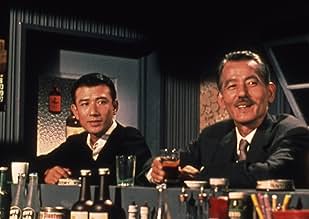
      Hirayama frequently meets his old friends Kawai (Nobuo Nakamura) and Professor Horie (Ryûji Kita), who is married with a younger wife, to drink in a bar. When their school teacher Sakuma (Eijiro Tono) comes to a reunion of Hirayama with old school mates, they learn that the old man lives with his daughter that stayed single to take care of him. Michiko lives a happy life with her father and her brother, but Hirayama feels that it is time to let her go and tries to arrange a marriage for her.

      "Sanma no aji" is the last movie of the Japanese director Yasujiro Ozu about his favorite theme: family and human relationship. Actually he revisits in color thirteen years later, the theme of the wonderful "Banshun". Both story lines are about an old father that realizes that he can not hold his daughter with him anymore and she needs to get married with an arranged marriage as a natural order of life in the traditional Japan. The beautiful and touching story shows also the contrast between the traditional and the newer generation formed by consumers and is supported by awesome performances and the use of magnificent camera work, with symmetrically framed images. Last but not the least, it is impressive how the characters drink in this movie. My vote is eight.

      Title (Brazil):"A Rotina Tem Seu Encanto" ("The Routine Has its Charm")
      8madcardinal

      Let This Movie Gently Win You Over

      A sensitive film which observes a widower and his family as they navigate through their days and nights in post-WWII Japan, a place where etiquette and custom are still important and individuality counts for less than it does in the U.S.A. We witness a world where unmarried women are expected to take care of their partner-less fathers and brothers.

      This film features excellent use of color, especially the placement of yellows and reds.

      "An Autumn Afternoon" grows on you as you slowly, steadily work your way into the lives of Mr. Hirayama and his family; it's as if the camera were a guest gaining the acceptance of the major characters.

      Will Mr. Hirayama come upon his own personal autumn afternoon - a state of philosophical clarity where he can discern things soberly and make a wise and compassionate decision?

      A must-see for devotees of Japanese cinema, director Ozu, and those who love quiet, gentle films.
      9planktonrules

      An updated version of BANSHUN

      My favorite Yasujiro Ozu film is BANSHUN. And so, as I sat watching SANMA NO AJI, I quickly realized that this film is essentially a retooling of BANSHUN. Both films are about a devoted daughter living quite happily with her widower father. The father, however, realizes that the daughter is giving up a lot, so it's his goal to get her out and married for her own good. There are some differences, though, in the films. In SANMA NO AJI, it's not just the father but also the young lady's employer who sees a need for her to marry. In addition to taking care of her father, there also is a younger brother in the home. Still, it is essentially the same story with a few twists--and in color.

      It's also highly reminiscent of many of the mid to late Ozu films in a variety of ways. Like his usual style, the camera is stationary and often is at floor level--with cuts instead of closeups. You may not notice this at first, but it's clearly the director's trademark. In addition, the film has the typical slow and gentle pace and is about the conflicts between modern Japanese life and tradition. In this sense, there's not a lot that's too new about the film other than a light and modern (for 1962) soundtrack--very bouncy yet gentle.

      As for the film, the father (Shuhei) has a pretty nice life. He has a nice job, often goes out with friends to drink and Michiko (the daughter) takes care of his needs at home. However, as the film progresses he notices in other people's relationships that something is missing. In particular, meeting with an old school teacher from 40 years ago is a wake-up, as this old man also lives with his unmarried daughter--and his life is a bit pathetic. Shuhei is afraid that in later years, his and his daughter will have a similar relationship. So, he and his married son go about trying to arrange a marriage for Michiko--who does want to marry, though judging by her outward appearance and insistence that she wants to stay home and take care of her father, you's never know it.

      Overall, it's an incredibly slow but satisfying film and a nice end to Ozu's career, as it is his last film. Well worth seeing and full of lovely and realistic vignettes. For those who are looking for action and excitement, you may not like this film. For those who can appreciate a slower and more deliberately paced film, this is hard to beat. A lovely portrait of life in Japan circa 1962.

      By the way, is it me or did those people in the film really drink a lot?! Wow!
      10TheLittleSongbird

      What a swan song!

      I have seen many visually beautiful and emotionally moving films, but not as many recently. An Autumn Afternoon is one of those primary examples. Meditative in its pacing it is, but it is never dull. How everything is made and written really makes an interesting and very rewarding experience indeed. It is incredibly well made to start off with, the camera is kept at low angles and is still, but for me this allowed me to explore and really admire the scenery and the framing which are very elegantly done. Kojan Siato's score is one of those soothing and unobtrusive scores that helps the audience to connect with An Autumn Afternoon's gentle mood. How An Autum Afternoon is written is also exceptional, as well as the gentle tone, the story has this great warmth, wisdom and humanity. As well as Ozu's meticulous as ever direction what is also great about An Autumn Afternoon is the lead performance, Chishu Ryu's performance is dignified and altogether very touching. In conclusion, not just one of the cinema's greatest swan-song but a masterpiece of a film also. 10/10 Bethany Cox

      Más del estilo

      Otoño tardío
      7,9
      Otoño tardío
      Primavera tardía
      8,2
      Primavera tardía
      Principios de verano
      8,0
      Principios de verano
      Primavera precoz
      7,7
      Primavera precoz
      Flores de equinoccio
      7,8
      Flores de equinoccio
      La hierba errante
      7,9
      La hierba errante
      Crepúsculo en Tokio
      8,0
      Crepúsculo en Tokio
      El otoño de la familia Kohayagawa
      7,7
      El otoño de la familia Kohayagawa
      El sabor del té verde con arroz
      7,6
      El sabor del té verde con arroz
      Cuentos de Tokio
      8,1
      Cuentos de Tokio
      El hijo único
      7,7
      El hijo único
      Una gallina al viento
      7,4
      Una gallina al viento

      Intereses relacionados

      Hidetoshi Nishijima and Tôko Miura in Drive My Car (2021)
      japonés
      Naomie Harris, Mahershala Ali, Janelle Monáe, André Holland, Herman Caheej McGloun, Edson Jean, Alex R. Hibbert, and Tanisha Cidel in Moonlight (2016)
      Drama

      Argumento

      Editar

      ¿Sabías que...?

      Editar
      • Curiosidades
        Yasujirô Ozu: [static camera] There is not a single camera movement in the entire film, as in many of Ozu's films.
      • Citas

        [English subtitled version]

        Yoshitaro Sakamoto: If Japan had won the war, how would things be?

        Shuhei Hirayama: I wonder.

        Yoshitaro Sakamoto: More whiskey! Bring us the whole bottle. If we'd won, we'd both be in New York now. New York. And not just a pachinko parlor called New York. The real thing!

        Shuhei Hirayama: Think so?

        Yoshitaro Sakamoto: Absolutely. Because we lost, our kids dance around and shake their rumps to American records. But if we had won, the blue-eyed ones would have chignon hairdos and chew gum while plunking tunes on the shamisen.

        Shuhei Hirayama: But I think it's good we lost.

        Yoshitaro Sakamoto: You think? Yeah, maybe you're right. The dumb militarists can't bully us anymore.

      • Créditos adicionales
        The film title and credits are set against a backdrop of painted fronds.

        Generally Yasujirô Ozu films have the credits placed before a backdrop of plain sackcloth.
      • Conexiones
        Featured in Yasujirô Ozu, le cinéaste du bonheur (2023)
      • Banda sonora
        Gunkan kôshinkyoku
        (Warship March)

        Written by Tôkichi Setoguchi

      Selecciones populares

      Inicia sesión para calificar y añadir a tu lista para recibir recomendaciones personalizadas
      Iniciar sesión

      Preguntas frecuentes17

      • How long is An Autumn Afternoon?Con tecnología de Alexa

      Detalles

      Editar
      • Fecha de lanzamiento
        • 18 de noviembre de 1962 (Japón)
      • País de origen
        • Japón
      • Idioma
        • Japonés
      • Títulos en diferentes países
        • El gust del peix a la tardor
      • Localizaciones del rodaje
        • Tokio, Japón(setting of the action)
      • Empresa productora
        • Shochiku
      • Ver más compañías en los créditos en IMDbPro

      Taquilla

      Editar
      • Recaudación en todo el mundo
        • 27.189 US$
      Ver información detallada de taquilla en IMDbPro

      Especificaciones técnicas

      Editar
      • Duración
        • 1h 53min(113 min)
      • Color
        • Color
      • Mezcla de sonido
        • Mono
      • Relación de aspecto
        • 1.37 : 1

      Contribuir a esta página

      Sugerir un cambio o añadir el contenido que falta
      • Más información acerca de cómo contribuir
      Editar página

      Más por descubrir

      Visto recientemente

      Habilita las cookies del navegador para usar esta función. Más información.
      Obtener la aplicación IMDb
      Inicia sesión para tener más accesoInicia sesión para tener más acceso
      Sigue a IMDb en las redes sociales
      Obtener la aplicación IMDb
      Para Android e iOS
      Obtener la aplicación IMDb
      • Ayuda
      • Índice del sitio
      • IMDbPro
      • Box Office Mojo
      • Licencia de datos de IMDb
      • Sala de prensa
      • Anuncios
      • Empleos
      • Condiciones de uso
      • Política de privacidad
      • Your Ads Privacy Choices
      IMDb, una empresa de Amazon

      © 1990-2025 by IMDb.com, Inc.