

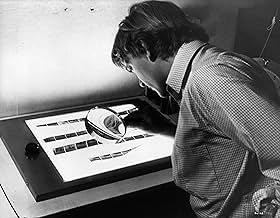
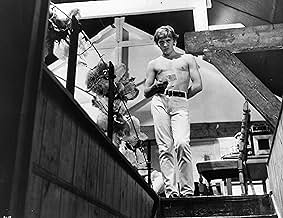
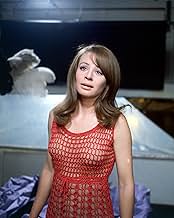
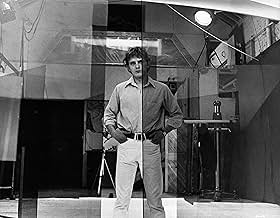
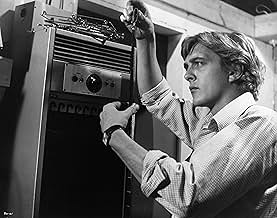
Un fotógrafo de moda capta, sin saberlo, una muerte en unas fotos después de seguir a dos amantes en un parque.Un fotógrafo de moda capta, sin saberlo, una muerte en unas fotos después de seguir a dos amantes en un parque.Un fotógrafo de moda capta, sin saberlo, una muerte en unas fotos después de seguir a dos amantes en un parque.
- Director/a
- Guionistas
- Estrellas
- Nominado para 2 premios Óscar
- 8 premios y 9 nominaciones en total




Veruschka von Lehndorff
- Verushka
- (as Verushka)


Jeff Beck
- Self - The Yardbirds
- (sin acreditar)
Roy Beck
- Boy dancing In Ricki Tick Club
- (sin acreditar)
Charlie Bird
- Homeless Man
- (sin acreditar)

Susan Brodrick
- Antique shop owner
- (sin acreditar)
Robin Burns
- Homeless Man
- (sin acreditar)

Tsai Chin
- Thomas's receptionist
- (sin acreditar)

Julio Cortázar
- Homeless Man
- (sin acreditar)

Chris Dreja
- Self - The Yardbirds
- (sin acreditar)
7,471.7K
1
2
3
4
5
6
7
8
9
10
Reseñas destacadas
You always miss something
I would recommend that people who are considering watching this film for the first time not read the following. I don't mention the film's ending, I just believe its far more satisfying to let the films potent details nervously sink into place on their own.
It is not about cameras. It is not about seeing. It is about our perception of our individual world. It throws shadows on the very judgments we build our lives upon. Without mentioning the obvious references to illusion (the mimes, the abstract picture of the corpse, etc.), I offer the following expert signposts Antonioni leaves for us to find.
1) The guitar neck David snatches at the rave-up has value only until he is not being chased for it, whereupon he discards it in the street. The pedestrian who then picks it up sees it only as junk.
2) Dialogue with his model friend at the pot party: DAVID - ` I thought you were in Paris.' THE GIRL - `I am'.
3) Appearances and Disappearance (2 of the many). The Lynn Redgrave character pops up as he arrives at his apartment. His question `How did you find me' is not explained. Later in the story, it is notably odd when David wakes up the following morning after the pot party that there is no one to be seen in the party house. Even the decorations like the clothes hung on the statue the night before have vanished.
4) David teaches the affectations of smoking to the woman. She must create an impression.
5) His painter friend describes his painting. `They don't mean anything to me while I work on them. Its only later that I ascribed something to them. Like this leg.' Whereupon he points out a place in a painting that might be a human leg. When he paints, he is tapping subconscious language, something apart from subjective and objective reality. Its as if Antonioni is offering us an even further vantage point to the events to come, dream reality.
6) The rambling diversion of events shows David's inability to `focus' on working through his mystery.
7) So much is hidden from the viewer. Its almost suggested that the real end to the narrative takes place someplace after the movie has already finished, jarring our sense of story, insinuating an ending we never get to `see'.
8) David announces at one point to his friend, `If only I had more money I'd be all right.'. Meanwhile he drives through the whole movie in his Rolls Royce.
This is a very remarkable film. I was irked by the pacing and the diversions as I watched it, but that was exactly why it all kept coming and coming at me for hours after until finally in bed it all rushed through me like a gorgeous musical event. I know for certain there are many more hidden corners to it, but this is what I got in my first viewing. Just that gut feeling that I missed something, I believe, is exactly where Antonioni was going. You always miss something.
It is not about cameras. It is not about seeing. It is about our perception of our individual world. It throws shadows on the very judgments we build our lives upon. Without mentioning the obvious references to illusion (the mimes, the abstract picture of the corpse, etc.), I offer the following expert signposts Antonioni leaves for us to find.
1) The guitar neck David snatches at the rave-up has value only until he is not being chased for it, whereupon he discards it in the street. The pedestrian who then picks it up sees it only as junk.
2) Dialogue with his model friend at the pot party: DAVID - ` I thought you were in Paris.' THE GIRL - `I am'.
3) Appearances and Disappearance (2 of the many). The Lynn Redgrave character pops up as he arrives at his apartment. His question `How did you find me' is not explained. Later in the story, it is notably odd when David wakes up the following morning after the pot party that there is no one to be seen in the party house. Even the decorations like the clothes hung on the statue the night before have vanished.
4) David teaches the affectations of smoking to the woman. She must create an impression.
5) His painter friend describes his painting. `They don't mean anything to me while I work on them. Its only later that I ascribed something to them. Like this leg.' Whereupon he points out a place in a painting that might be a human leg. When he paints, he is tapping subconscious language, something apart from subjective and objective reality. Its as if Antonioni is offering us an even further vantage point to the events to come, dream reality.
6) The rambling diversion of events shows David's inability to `focus' on working through his mystery.
7) So much is hidden from the viewer. Its almost suggested that the real end to the narrative takes place someplace after the movie has already finished, jarring our sense of story, insinuating an ending we never get to `see'.
8) David announces at one point to his friend, `If only I had more money I'd be all right.'. Meanwhile he drives through the whole movie in his Rolls Royce.
This is a very remarkable film. I was irked by the pacing and the diversions as I watched it, but that was exactly why it all kept coming and coming at me for hours after until finally in bed it all rushed through me like a gorgeous musical event. I know for certain there are many more hidden corners to it, but this is what I got in my first viewing. Just that gut feeling that I missed something, I believe, is exactly where Antonioni was going. You always miss something.
Success and image; fantasy and reality (SPOILERS)
Antonioni's Blow-Up was the biggest hit of the Italian director's career, the superficial elements of the fashion world, Swinging London and orgies on purple paper ensuring its commercial success.
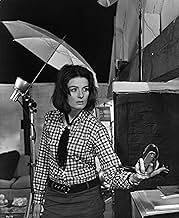
Models such as Veruschka (who appears in the film), Twiggy and fashion photographers at the time have complained about its unrealistic depiction of the industry and claimed that its central character, Thomas (played by the late David Hemmings) was clearly based on David Bailey.
To look at Blow-Up as an analysis of the fashion business in the Sixties is to misunderstand the film's intentions. In any case, when watching this film it may be difficult to tell what its all about if you're unfamiliar with Antonioni's films but it obviously has little to do with the fashion world which is merely the setting for the story and nothing more.
Antonioni made the clearest statement of his motivation as a filmmaker at the end of Beyond the Clouds when he talked about his belief that reality is unattainable as it is submerged by layers of images which are only versions of reality.
This is a rather pretentious way of saying that everyone perceives reality in their own way and ultimately see only what they want to see.
With this philosophy in mind, Blow-Up is probably Antonioni's most personal film.
Thomas' hollow, self-obsessed world is shattered when he discovers that he may have photographed a murder when casually taking pictures in a park. He encounters a mysterious woman, Jane (Vanessa Redgrave) who demands he hand over the film and when he refuses she appears at his studio, although Thomas never told her his address.
When the evidence disappears shortly afterwards, Blow-Up seems to deal in riddles that have no solution. Redgrave re-appears and then vanishes before the photographer's eyes, Thomas returns to the park without his camera and sees the body. The film concludes with Thomas, having discovered the body has disappeared, watching a group of mimes playing tennis without a ball or rackets in the park where the murder may have taken place.
It is only in the final scene of the film where the riddle is solved. Thomas throws the imaginary ball back into the court and watches the game resume. The look of realisation on his face is all too apparent as the game CAN BE HEARD taking place out of shot.
There is a ball, there are rackets and this is a real game of tennis. What we have seen up until this point is the photographer's perception of reality: the murder, the mysterious woman in the park, the photographic evidence and the body.
The following exchange between Hemmings and Redgrave is the key to the film:
Thomas: Don't let's spoil everything, we've only just met.
Jane: No, we haven't met. You've never seen me.
Models such as Veruschka (who appears in the film), Twiggy and fashion photographers at the time have complained about its unrealistic depiction of the industry and claimed that its central character, Thomas (played by the late David Hemmings) was clearly based on David Bailey.
To look at Blow-Up as an analysis of the fashion business in the Sixties is to misunderstand the film's intentions. In any case, when watching this film it may be difficult to tell what its all about if you're unfamiliar with Antonioni's films but it obviously has little to do with the fashion world which is merely the setting for the story and nothing more.
Antonioni made the clearest statement of his motivation as a filmmaker at the end of Beyond the Clouds when he talked about his belief that reality is unattainable as it is submerged by layers of images which are only versions of reality.
This is a rather pretentious way of saying that everyone perceives reality in their own way and ultimately see only what they want to see.
With this philosophy in mind, Blow-Up is probably Antonioni's most personal film.
Thomas' hollow, self-obsessed world is shattered when he discovers that he may have photographed a murder when casually taking pictures in a park. He encounters a mysterious woman, Jane (Vanessa Redgrave) who demands he hand over the film and when he refuses she appears at his studio, although Thomas never told her his address.
When the evidence disappears shortly afterwards, Blow-Up seems to deal in riddles that have no solution. Redgrave re-appears and then vanishes before the photographer's eyes, Thomas returns to the park without his camera and sees the body. The film concludes with Thomas, having discovered the body has disappeared, watching a group of mimes playing tennis without a ball or rackets in the park where the murder may have taken place.
It is only in the final scene of the film where the riddle is solved. Thomas throws the imaginary ball back into the court and watches the game resume. The look of realisation on his face is all too apparent as the game CAN BE HEARD taking place out of shot.
There is a ball, there are rackets and this is a real game of tennis. What we have seen up until this point is the photographer's perception of reality: the murder, the mysterious woman in the park, the photographic evidence and the body.
The following exchange between Hemmings and Redgrave is the key to the film:
Thomas: Don't let's spoil everything, we've only just met.
Jane: No, we haven't met. You've never seen me.
A confusing but thought provoking film!
Antonioni was not a director that worried too much about people completely understanding his films. In fact I'd bet that he actually hoped they didn't understand everything. So I did not find it strange or surprising when after finishing the movie I felt quite confused. But the movie made me think for a very long time, which in my opinion is what a good film should do. There are so many aspects to this film that if you give them a chance and think about them, they will keep you reeling for hours on possible interpretations. The first and probably most important aspect of this film dealt with love. From what I have seen of his films, love is Antonioni's favorite subject. But this love was different than that of past films; it is much more shallow and un-centered. Thomas, the photographer, is surrounded by women, he goes from one to the next without thinking twice, treating them like dogs the entire time. But he can do this and get away with it because he is a famous photographer and can make the women what they all desperately want to be, Beautiful. For The first half of the movie I honestly did not like his character whatsoever. Whereas in the past the director has chosen mainly to explore the ups and downs of married life, or the problems of being hopelessly devoted to one person, he now points the camera at the single, care free, over sexed, youth of the sixties. Half an hour into the movie I found myself wondering what the heart of the film was going to be. We were introduced to Thomas and his world, but there seemed to be no conflict driving the story forward. Then came the quasi-murder mystery. This is what is really interesting and unique about this film in my opinion. Antonioni for a while leads us to believe that the movie is going to turn into some suspense thriller, or murder mystery, but never seems to quite get there. He has all the elements ready to go, but never follows through with them. He introduces this alluring and mysterious woman who is in on the murder and then never brings her back. The murder victim is discovered, but his identity is never revealed, nor a motive given for his murder. Thomas, after a very energetic and exciting photo investigation seems to not really care too much as to what happens with the investigations results, only telling a couple of his friends who couldn't care less. Antonioni seems to have used this whole murder mystery convention as some sort of glue to hold the rest of the real story together. The story of a mindless, beauty obsessed, celebrity idolizing, drug addicted, and violence obsessed culture. Probably my favorite scene in the film is after fighting over the piece of broken guitar with the other fans; Thomas just discards his prize as garbage. Something that kept bugging me was the antique shop. I kept wondering what in the world it had to do with anything in the movie; it stuck out like a sore thumb. But I knew it that there was some major purpose or explanation for its existence in the film, and then it just kind of clicked. Upon his first entry into the Antique store Thomas encounters an angry old man who we eventually find out is not the stores real owner, the true owner is a beautiful young woman who is planning to sell the old place and travel the world in search of something new. All this stuff she owns, the gold of past cultures, is old and useless now. She has a hard time making a living because nobody wants the stuff any longer. Here is where I think Antonioni's major message is hidden: That is the way life is, it moves on constantly, things change, people die, cultures evolve and the only thing that remains in the end is nature itself. Antonioni finishes the film beautifully, Thomas stands alone in a large field of grass, the only thing heard is the wind and the trees, as the camera backs away slowly, he disappears leaving nothing but the grass blowing in the wind, for like all the antiques and all the people that created them in the past, eventually Thomas's life will end and so will the current popular culture in which he takes part. Change is life's only constant.
Patience will be rewarded
If you believe that the ending makes the movie, Blowup is for you. The first 30 minutes seem aimless and wandering, but they set up the main character and what is he is to discover about himself, about his occupation and about art in general. Antonioni builds tension (or frustration as you're watching it) not with plot, but with anti-plot. You want to scream at David Hemmings's character to: focus! screw those models! do something! But as the film unfolds you will see why Antonioni chose this actor, this profession and those girls. A wonderful manifesto about the dangers of voyeurism and what it does to a man's sexuality that is 40 years ahead of its time. The symbolism might get heavy handed at times (mimes, a broken guitar), but the sets are so full of creativity and the actors so beautiful (this will give my age away, but Vanessa Redgrave, who knew?) that you forgive Antonioni (he's Italian after all). Hemmings is Hugh Grant before Hugh Grant, but in this role at least, much more interesting. He's highly sexual, but unlike his painter roommate, his chosen art form represses him, all in the name of the shot. And when he finally gets the perfect shot in the perfect light, it's so perfect that someone steals it, and for good reason. Did those events actually take place or just through his camera lens? When the photos are the proof of what you see, then when that proof is taken away, did you see?
Through A Glass Darkly
Some interpret this existential film to mean that human reality is defined in the context of the group, not the individual. Hence, in the film, to Thomas (David Hemmings), the murder did occur. But, the murder's "reality" is objective only if Thomas can verify it through someone else's experience. Otherwise, Thomas' observed event is subjective and problematic. Each individual thus sees through a glass darkly ... even when the glass is an "objective" camera lens. Ironically, the same could be said for Antonioni.
This film came out only three years after the JFK assassination. I find it hard to believe that that event did not play into this film to some extent. There are all kinds of references to the assassination: the grassy area and picket fence; photographic evidence of a "badge man" character with gun hiding in the bushes; the subsequently developed pictures having been presumably stolen or altered as part of some conspiracy. It's almost as if Thomas and his camera represent the Zapruder film component of the assassination. Indeed, the causal "reality" of the JFK murder was, and still is, to some extent a function of human perception, derived from an interpretation of what the camera sees.
"Blowup" is unlike most films. There are long takes, with minimal editing. This gives the film a slow, meandering feel. Dialogue is minimal. Natural sounds override music, throughout. And like other Antonioni films, this one is mostly visual. The cinematography is striking.
Another characteristic is that the film is not plot intensive. Nor are the characters sympathetic. Thomas is not at all likable. And other characters are mere mannequins. I question whether Antonioni needed two hours to convey his message. More of a plot might have reduced the need for so much seemingly irrelevant filler.
"Blowup" is mostly for viewers who like unconventional, arty films that impart abstruse philosophical "meaning". The film is therefore aimed at people who like to think and ponder.
This film came out only three years after the JFK assassination. I find it hard to believe that that event did not play into this film to some extent. There are all kinds of references to the assassination: the grassy area and picket fence; photographic evidence of a "badge man" character with gun hiding in the bushes; the subsequently developed pictures having been presumably stolen or altered as part of some conspiracy. It's almost as if Thomas and his camera represent the Zapruder film component of the assassination. Indeed, the causal "reality" of the JFK murder was, and still is, to some extent a function of human perception, derived from an interpretation of what the camera sees.
"Blowup" is unlike most films. There are long takes, with minimal editing. This gives the film a slow, meandering feel. Dialogue is minimal. Natural sounds override music, throughout. And like other Antonioni films, this one is mostly visual. The cinematography is striking.
Another characteristic is that the film is not plot intensive. Nor are the characters sympathetic. Thomas is not at all likable. And other characters are mere mannequins. I question whether Antonioni needed two hours to convey his message. More of a plot might have reduced the need for so much seemingly irrelevant filler.
"Blowup" is mostly for viewers who like unconventional, arty films that impart abstruse philosophical "meaning". The film is therefore aimed at people who like to think and ponder.


¿Sabías que...?
- CuriosidadesThe film contains a rare performance of The Yardbirds during the period when Jimmy Page and Jeff Beck were both in the band. Jeff Beck would leave a few months later.
- PifiasWhen Thomas is frolicking with the two girls on the purple paper backdrop in the studio, two crew members, including a camera operator, can be seen just sitting there in the top right side of the frame.
- Versiones alternativasSome of the music was rescored for the Warner DVD release, namely the latter part of the opening title music. The VHS releases' music remain intact.
- ConexionesFeatured in Film Review: How I Learned to Live with Being a Star (1967)
- Banda sonoraMain Title (Blow-Up)
Written and Performed by Herbie Hancock
Selecciones populares
Inicia sesión para calificar y añadir a tu lista para recibir recomendaciones personalizadas
- How long is Blow-Up?Con tecnología de Alexa
Detalles
- Fecha de lanzamiento
- Países de origen
- Sitio oficial
- Idioma
- Títulos en diferentes países
- Blowup. Deseo de una mañana de verano
- Localizaciones del rodaje
- Maryon Park, Woolwich Road, Charlton, Londres, Inglaterra, Reino Unido(scenes where Thomas first photographs Jane and where mime artists play tennis at the end)
- Empresas productoras
- Ver más compañías en los créditos en IMDbPro
Taquilla
- Presupuesto
- 1.800.000 US$ (estimación)
- Recaudación en todo el mundo
- 41.788 US$
Contribuir a esta página
Sugerir un cambio o añadir el contenido que falta