

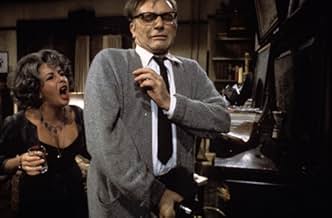
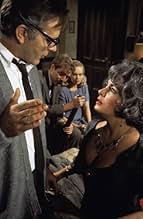
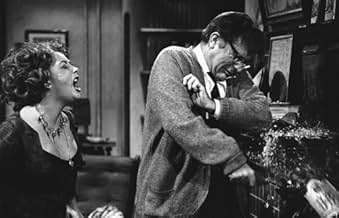
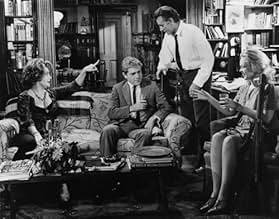
Una pareja amargada y envejecida, con la ayuda del alcohol, utiliza a sus jóvenes huéspedes para alimentar la angustia y el dolor emocional hacia el otro en el transcurso de una angustiosa n... Leer todoUna pareja amargada y envejecida, con la ayuda del alcohol, utiliza a sus jóvenes huéspedes para alimentar la angustia y el dolor emocional hacia el otro en el transcurso de una angustiosa noche.Una pareja amargada y envejecida, con la ayuda del alcohol, utiliza a sus jóvenes huéspedes para alimentar la angustia y el dolor emocional hacia el otro en el transcurso de una angustiosa noche.
- Director/a
- Guionistas
- Estrellas
- Ganó 5 premios Óscar
- 22 premios y 26 nominaciones en total


- Director/a
- Guionistas
- Todo el reparto y equipo
- Producción, taquilla y más en IMDbPro
8,083.4K
1
2
3
4
5
6
7
8
9
10
Reseñas destacadas
Still powerful, harrowing view of the "Anti-Ozzie and Harriet"
This is still an exceptional film from the 1960s. Though some of the epithets are obviously softening much stronger words, the language is frank and brutal, Martha's bludgeoning body-blows balanced by George's icepick thrusts. Edward Lehman's respectful screenplay gently opens up Edward Albee's one-set play while keeping a certain claustrophobic atmosphere. Mike Nichols' first directing effort is stunning in its lack of artifice; rarely do you feel that the director has done much more than turn on the camera and watch four actors, all at the top of their game, tear into their roles. George Segal's work in this movie is criminally underrated, but his reactive work as studly, ultimately disappointing Nick should be mandatory study by all young actors. Sandy Dennis' fluttery turn as mousy, wifey Honey is powerful also; a lot more is going on than you might think. Richard Burton is staggering as George ("Georgie Porgie Put-upon Pie"), and his performance demonstrates the magic that he could bring to a worthy role. Elizabeth Taylor's work here still astounds. The physical transformation she undertook to become aging harpy Martha is amazing enough, but her performance seems to channel a hurricane's force and fury. By turns hilarious, maddening and then, at the end, exhausted and defeated yet again, Taylor demonstrates acting, particularly film acting, at its best. The film is by no means easy or "Hollywood" in feel-- the audience is as exhausted as the characters at the end. But this was a bracing, necessary antidote to the impossible ideal of marriage usually portrayed in the movies. A towering film.
"George and Martha,.......sad........sad........sad"
Edward Albee's award winning play, Who's Afraid of Virginia Woolf ran for 664 performances on Broadway and just closed down when this film version made its debut in 1966. The Broadway play was set entirely in the living room of George and Martha's home and starred Uta Hagen, Arthur Hill, Melinda Dillon, and George Grizzard. All eminently respectable players, but none of them exactly movie box office.
This film was destined to make money when the most publicized couple of the decade, Elizabeth Taylor and Richard Burton, chose it as a star vehicle for themselves. Of course what was not clear was how well a one stage play would adapt to film.
It adapted very well and went quite beyond one stage. The action of the film moved effortlessly to an all night diner at one point with some stops along the way. You'd hardly know the story as originally told only had one setting.
There's no real plot to it. For reasons I can't fathom this middle aged and bitter couple George and Martha have a younger couple, Nick and Honey, over to their house at two in the morning. I don't know about you, but I'm usually not my best at that time. Also they had just come from a party at Martha's father's house. Martha's dad is the president of a college and George teaches there. Nick and Honey are a newly hired professor and his wife.
The late night and the liquor bring out the worst in everybody. A whole lot of ugly truths get told.
Who's Afraid of Virginia Woolf was the summit of the professional team of Elizabeth Taylor and Richard Burton. Playing against type, Elizabeth Taylor got her second Oscar the one she felt she earned. She always disparaged the one received for Butterfield 8 as it came on the heels of her well publicized pneumonia bout.
In fact all four members of the cast were nominated with Sandy Dennis winning Best Supporting Actress. Ironically Richard Burton didn't win, losing to Paul Scofield for A Man for All Seasons. I guess the Academy voters figured Burton would get another shot. He never brought home the big prize though.
George Segal usually gets overlooked. This film and Ship of Fools was the start of his long career, but no Oscar for him either.
Who's Afraid of Virginia Woolf is quite the indictment against marriage, especially after the love has died. It's far from the whole story of marriage. There are many who stay married longer than George and Martha and happily. But it wasn't in Edward Albee's life experience to draw from.
But this should be seen to see Liz and Dick at their very best.
This film was destined to make money when the most publicized couple of the decade, Elizabeth Taylor and Richard Burton, chose it as a star vehicle for themselves. Of course what was not clear was how well a one stage play would adapt to film.
It adapted very well and went quite beyond one stage. The action of the film moved effortlessly to an all night diner at one point with some stops along the way. You'd hardly know the story as originally told only had one setting.
There's no real plot to it. For reasons I can't fathom this middle aged and bitter couple George and Martha have a younger couple, Nick and Honey, over to their house at two in the morning. I don't know about you, but I'm usually not my best at that time. Also they had just come from a party at Martha's father's house. Martha's dad is the president of a college and George teaches there. Nick and Honey are a newly hired professor and his wife.
The late night and the liquor bring out the worst in everybody. A whole lot of ugly truths get told.
Who's Afraid of Virginia Woolf was the summit of the professional team of Elizabeth Taylor and Richard Burton. Playing against type, Elizabeth Taylor got her second Oscar the one she felt she earned. She always disparaged the one received for Butterfield 8 as it came on the heels of her well publicized pneumonia bout.
In fact all four members of the cast were nominated with Sandy Dennis winning Best Supporting Actress. Ironically Richard Burton didn't win, losing to Paul Scofield for A Man for All Seasons. I guess the Academy voters figured Burton would get another shot. He never brought home the big prize though.
George Segal usually gets overlooked. This film and Ship of Fools was the start of his long career, but no Oscar for him either.
Who's Afraid of Virginia Woolf is quite the indictment against marriage, especially after the love has died. It's far from the whole story of marriage. There are many who stay married longer than George and Martha and happily. But it wasn't in Edward Albee's life experience to draw from.
But this should be seen to see Liz and Dick at their very best.
One of the greatest
Simply put, this is one of my favourite films of all time. Great acting, great writing and great camerawork make this close to cinematic perfection. Liz Taylor and Richard Burton give the performances of their lives. Sandy Dennis also shines in an early-ish role. It's a dramatic film, but the wicked humour that permeates the film is absolutely devastating, and I mean that in the best possible way. Many moments in the film I find myself laughing only to think, "Should I be laughing at this." Certainly the film is loaded with uncomfortable moments, enhanced by the camerawork replete with uneasy close-ups. Most of all, this film shows how a lot can be accomplished with just a little: a cast of four and minimal scenery changes. "Who's Afraid Of Virginia Woolf" has become an absolute icon of American cinema. If you haven't seen it, what are you waiting for?
10OttoVonB
Distilled Human Viciousness
Ailing couple George (Burton) and Martha (Taylor) invite a young couple over for a late-night drink - much to quiet and repressed George's annoyance - and what starts off as a twisted game by sultry Martha to annoy her husband and get her way with young stud Nick (George Segal) ends up in a horrific duel of wits.
Adapted from the play and boasting very few locations, "Virginia Woolf" is notable for many unsuspected reasons. Designed for the stage, the film makes the story uniquely cinematic and tense, amped up by stunning photography (in Black and White, a daring choice in 1966). The younger leads are superb, but Burton and Taylor still manage to walk away with film, giving stunning renditions of the world's most demented couple. They make the surreal dialogue hurt and touch in ways never thought possible.
Though there are countless reasons to recommend this jewel of a film, there are also reasons why one would wish to avoid it. This is the kind of film that makes you feel like having a showing (or a very concentrated drink) to wash away the grit and human evil and pain absorbed. You'll feel dirty, but in a way you'll also feel enlightened: that a small character film can carry more punch than any explosion-packed blockbuster out there is a thing of beauty indeed!
Adapted from the play and boasting very few locations, "Virginia Woolf" is notable for many unsuspected reasons. Designed for the stage, the film makes the story uniquely cinematic and tense, amped up by stunning photography (in Black and White, a daring choice in 1966). The younger leads are superb, but Burton and Taylor still manage to walk away with film, giving stunning renditions of the world's most demented couple. They make the surreal dialogue hurt and touch in ways never thought possible.
Though there are countless reasons to recommend this jewel of a film, there are also reasons why one would wish to avoid it. This is the kind of film that makes you feel like having a showing (or a very concentrated drink) to wash away the grit and human evil and pain absorbed. You'll feel dirty, but in a way you'll also feel enlightened: that a small character film can carry more punch than any explosion-packed blockbuster out there is a thing of beauty indeed!
"Liberame Domine"
One only has sympathy for these ultimately dysfunctional characters as they unfold their little "fun and games," like "Down the Host," "Hump the Hostess," and "Get the Guests." If only George and Martha had retired a wee bit earlier none of this would've happened.
Then, too, why didn't Nick and Honey simply leave, rather than stick around for the "full treatment"? Can it be that "like attracts like," so much so that they couldn't leave?
The final denouement suggests that a new day may be in the offing for poor Martha and George, after the latter has "killed off the 'little bugger.' " Although Martha's admittedly still fearful, she clings firmly to George's hand. Perhaps there's some hope, anyway, for this emotionally spent couple.
Edward Albee, taking no small degree of awareness from Tennessee Williams and Harold Pinter, crafted a play that certainly communicated to a goodly number of people.
Personally recalling sitting in its Broadway run, watching Uta Hagen and cast go through their paces, I remember being as impressed with the riotous audience laughter as with the play itself. The raw lines coming from up-to-then very respectable status characters, namely college prof and wife, seemed to provide some kind of early 60s liberation from the staid and repressive 50s.
By the time the film was released in '66, the public was ready for its no-holds-barred dialogue. It ushered in an new era of social upheaval, of which we're still feeling the effects today.
The "boozy battle" between the hosts, hosts and guests, and guests and guests, paralleled the cultural "steam" being released during that politically "hot" period. The American home drastically changed as a nation experienced more domestic squabbles, separations, divorces, custody battles, and family breakdowns--the last including a noted demise of the traditional "family meal."
In Albee's "long night's journey into morning," the audience must endure two hours of fighting, bickering, insulting, and lamenting before any ray of hope is introduced (during its last five minutes). A long time to wait, but there it is: a glimmer that there may be something better ahead. But we're not sure; after all, "Is this fact or fiction, Martha?"
In an extensive GM Quarterly interview, Director Mike Nichols revealed that this was a very troubled production that almost didn't get finished--with a leading cast boozing and pill-dosing even during lunch breaks--stretching the very limits of professionalism.
Yet in the end, Nichols, Cinematographer Haskell Wexler, and Composer Alex North all got what they wanted. A question is, "was it all worth the effort?" That's something only the individual viewer can answer: is this a case of "nothing from nothing leaves nothing?" or "a cathartic and emotionally moving experience?"
Then, too, why didn't Nick and Honey simply leave, rather than stick around for the "full treatment"? Can it be that "like attracts like," so much so that they couldn't leave?
The final denouement suggests that a new day may be in the offing for poor Martha and George, after the latter has "killed off the 'little bugger.' " Although Martha's admittedly still fearful, she clings firmly to George's hand. Perhaps there's some hope, anyway, for this emotionally spent couple.
Edward Albee, taking no small degree of awareness from Tennessee Williams and Harold Pinter, crafted a play that certainly communicated to a goodly number of people.
Personally recalling sitting in its Broadway run, watching Uta Hagen and cast go through their paces, I remember being as impressed with the riotous audience laughter as with the play itself. The raw lines coming from up-to-then very respectable status characters, namely college prof and wife, seemed to provide some kind of early 60s liberation from the staid and repressive 50s.
By the time the film was released in '66, the public was ready for its no-holds-barred dialogue. It ushered in an new era of social upheaval, of which we're still feeling the effects today.
The "boozy battle" between the hosts, hosts and guests, and guests and guests, paralleled the cultural "steam" being released during that politically "hot" period. The American home drastically changed as a nation experienced more domestic squabbles, separations, divorces, custody battles, and family breakdowns--the last including a noted demise of the traditional "family meal."
In Albee's "long night's journey into morning," the audience must endure two hours of fighting, bickering, insulting, and lamenting before any ray of hope is introduced (during its last five minutes). A long time to wait, but there it is: a glimmer that there may be something better ahead. But we're not sure; after all, "Is this fact or fiction, Martha?"
In an extensive GM Quarterly interview, Director Mike Nichols revealed that this was a very troubled production that almost didn't get finished--with a leading cast boozing and pill-dosing even during lunch breaks--stretching the very limits of professionalism.
Yet in the end, Nichols, Cinematographer Haskell Wexler, and Composer Alex North all got what they wanted. A question is, "was it all worth the effort?" That's something only the individual viewer can answer: is this a case of "nothing from nothing leaves nothing?" or "a cathartic and emotionally moving experience?"


¿Sabías que...?
- CuriosidadesThis became the first movie in Academy Awards history since Cimarrón (1931) to be nominated for every Academy Award category in which it was eligible, including Best Adapted Screenplay (Ernest Lehman), Director (Mike Nichols), all of the acting categories (Richard Burton, Dame Elizabeth Taylor, George Segal and Sandy Dennis) and Picture of the Year (Ernest Lehman).
- PifiasThe four characters stop at a bar after the first soiree at George's house. It is clearly after 2:00 a.m., since the time was stated during the first segment. No bars, however, would have been open after 1 or 2 a.m. in the New England states, where the film is set.
- ConexionesEdited from La carta (1940)
- Banda sonoraWho's Afraid of Virginia Woolf?
(to the tune of "Here We Go Round the Mulberry Bush")
Traditional English melody
Original lyrics ("Who's Afraid of the Big Bad Wolf?") by Frank Churchill and Ann Ronell; modified by Edward Albee
Performed by Elizabeth Taylor
Selecciones populares
Inicia sesión para calificar y añadir a tu lista para recibir recomendaciones personalizadas
Detalles
- Fecha de lanzamiento
- País de origen
- Idiomas
- Títulos en diferentes países
- Qui té por de Virginia Woolf?
- Localizaciones del rodaje
- Cambridge, Massachusetts, Estados Unidos(location)
- Empresas productoras
- Ver más compañías en los créditos en IMDbPro
Taquilla
- Presupuesto
- 7.500.000 US$ (estimación)
- Recaudación en Estados Unidos y Canadá
- 28.000.000 US$
- Recaudación en todo el mundo
- 28.007.258 US$
- Duración
- 2h 11min(131 min)
- Color
- Mezcla de sonido
- Relación de aspecto
- 1.85 : 1
Contribuir a esta página
Sugerir un cambio o añadir el contenido que falta