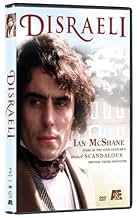
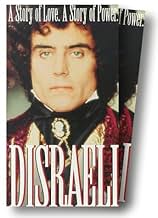
Añade un argumento en tu idiomaA penetrating look at one of British history's most enigmatic and controversial figure, Benjamin Disraeli--a dandy, womanizer and a Jew.A penetrating look at one of British history's most enigmatic and controversial figure, Benjamin Disraeli--a dandy, womanizer and a Jew.A penetrating look at one of British history's most enigmatic and controversial figure, Benjamin Disraeli--a dandy, womanizer and a Jew.
- Nominado para 2 premios Primetime Emmy
- 2 nominaciones en total
Explorar episodios
7,6290
1
2
3
4
5
6
7
8
9
10
Reseñas destacadas
Exceptional BBC Miniseries
I was only about 12 when PBS here in the US originally aired this, and I recall pretending to be sick and staying home one day from school so that I could catch the final episode one weekday afternoon. I probably learned more about history that day than I did in a year wasted in our public schools, and it was entertaining, too.
Sadly, the BBC doesn't seem to produce shows like this anymore, and if they do PBS isn't buying them. Pity.
Ian IS Dizzy
In the role of a lifetime, Ian McShane gives a shaded, multi-dimensional performance as Queen Victoria's favorite prime minister, covering his early career tight through his latter day triumphs. For the many fans who have come to admire this durable actor in more recent years, this early triumph is a must.
Mary Peach is extremely moving as his wife, older than he and as supportive as could be humanly possible. David Butler's screenplay and Claude Whatham's direction are up to the task of presenting not merely the momentous points but also the most endearing and sensitive moments. And Rosemary Leach is subtle and unassuming in a key role portraying Queen Victoria.
Learning your history the enjoyable way
There was a time when Masterpiece Theatre truly showed masterpieces rather than sordid and foul detective series or more recent novels that are perhaps a notch above Harlequin Romances. One of the better series, I recall, told the story of the life, loves and political triumphs of Benjamin Disraeli; and I have often longed to see it again, knowing full well it went the way of many old films introduced by Alistaire Cooke in the good old days.
Well lo and behold! Acorn Media has made Disraeli: Portrait of a Romantic available once more in a boxed set of four one-hour video tapes. It runs at some 220 minutes and is priced at $79.95. This might be a stiff price for individuals (although it would make a superb gift to someone whose intelligence you respect), but I feel that schools and libraries should pay heed to what I say below.
Like most BBC historical recreations, this one-although produced on a modest budget, as one can tell from the absence of crowd scenes-is extremely accurate as to décor, dress, speech patterns, body language, and all those details that so add to our enjoyment and appreciation of the subject matter. Then again we have the grand British acting tradition in which even the smaller roles are played with individuality and an avoidance of stereotyping.
Ian McShane is our Disraeli and viewers of Lovejoy ` and `The Dick Francis Mysteries' just might recognize him. The historically accurate way in which the younger Disraeli overdressed himself as a defense against anti-Semitism is worth the price of the set alone, as are the looks he gets when he changes to almost Puritan black and enters Parliament as a new man. After what we just went through in our nation's capital, it is refreshing to see the story of a truly talented man who acted for the good of his country and when he thought his Party wrong, told them so!
Even when he decided that marriage with a rich widow considerably older than himself was the only way to pay his debts, he spent most of the rest of his life as the happiest of married men. The estimable Mary Anne is played wrinkles and all by Mary Peach, who perfectly portrays the sort of wife that such a man needs. And after seeing the dour Queen Victoria of Judi Dench in the recent film `Mrs. Brown,' it is a bit surprising to see the almost jolly Victoria of Rosemary Leach. Very human, very believable.
Of course, a little boning up on what `Liberal,' `Conservative,' `Tory,' and so on meant back then would help a little toward better understanding the intricacies of the political situation-but this is exactly what I hinted at above. What better way to teach the history of any period than to feed it up in a thumping good story. For myself, I found the social posturing of the times as much fun as the history lesson. By the way, very little of both have changed, since those who do not read their history are bound to repeat its mistakes.
As you watch you cannot help but see how important it was to oppose the party in power no matter what plan they had for the country. The important thing was to act for Your Party, which usually meant fighting the Other Party tooth and nail over everything. If this sounds familiar, you see my point.
Most of all, this is the story of a man taking social prejudices in the only way that works: showing them that he is better than any of them. For example, when Baron Rothchild was elected to Parliament, he refused to take the oath on anything but the Old Testament. When Disraeli wanted to shame the House for their bigotry, he appealed to them as a Christian (he had converted long before that) and reminded them that Rothchild was of the same religion as Christ. In a later sequence, he asked his bitterest opponent to be Viceroy of India because Disraeli thought him the best man for the job. This is what we used to call integrity.
Well lo and behold! Acorn Media has made Disraeli: Portrait of a Romantic available once more in a boxed set of four one-hour video tapes. It runs at some 220 minutes and is priced at $79.95. This might be a stiff price for individuals (although it would make a superb gift to someone whose intelligence you respect), but I feel that schools and libraries should pay heed to what I say below.
Like most BBC historical recreations, this one-although produced on a modest budget, as one can tell from the absence of crowd scenes-is extremely accurate as to décor, dress, speech patterns, body language, and all those details that so add to our enjoyment and appreciation of the subject matter. Then again we have the grand British acting tradition in which even the smaller roles are played with individuality and an avoidance of stereotyping.
Ian McShane is our Disraeli and viewers of Lovejoy ` and `The Dick Francis Mysteries' just might recognize him. The historically accurate way in which the younger Disraeli overdressed himself as a defense against anti-Semitism is worth the price of the set alone, as are the looks he gets when he changes to almost Puritan black and enters Parliament as a new man. After what we just went through in our nation's capital, it is refreshing to see the story of a truly talented man who acted for the good of his country and when he thought his Party wrong, told them so!
Even when he decided that marriage with a rich widow considerably older than himself was the only way to pay his debts, he spent most of the rest of his life as the happiest of married men. The estimable Mary Anne is played wrinkles and all by Mary Peach, who perfectly portrays the sort of wife that such a man needs. And after seeing the dour Queen Victoria of Judi Dench in the recent film `Mrs. Brown,' it is a bit surprising to see the almost jolly Victoria of Rosemary Leach. Very human, very believable.
Of course, a little boning up on what `Liberal,' `Conservative,' `Tory,' and so on meant back then would help a little toward better understanding the intricacies of the political situation-but this is exactly what I hinted at above. What better way to teach the history of any period than to feed it up in a thumping good story. For myself, I found the social posturing of the times as much fun as the history lesson. By the way, very little of both have changed, since those who do not read their history are bound to repeat its mistakes.
As you watch you cannot help but see how important it was to oppose the party in power no matter what plan they had for the country. The important thing was to act for Your Party, which usually meant fighting the Other Party tooth and nail over everything. If this sounds familiar, you see my point.
Most of all, this is the story of a man taking social prejudices in the only way that works: showing them that he is better than any of them. For example, when Baron Rothchild was elected to Parliament, he refused to take the oath on anything but the Old Testament. When Disraeli wanted to shame the House for their bigotry, he appealed to them as a Christian (he had converted long before that) and reminded them that Rothchild was of the same religion as Christ. In a later sequence, he asked his bitterest opponent to be Viceroy of India because Disraeli thought him the best man for the job. This is what we used to call integrity.
Disraeli's Private Life & Career Highlights
No secrets here: Benjamin Disraeli was perhaps the most impressive Prime Minister ever and a great friend and ally of Queen Victoria. I just finished viewing the vintage 4-part British television series Disraeli: Portrait of a Romantic on YouTube starring Ian McShane. I found part 1 something of a slog - the political rock star's youth as he emerges - a popular novelist - from his father's country house and into polite society, overdressed in multi-colored velvets, jewels, crisscrossing chains, wild curly dark hair dazzling the womenfolk and uttering political gems in sotto voce. By Part 2, he is well on his way up the greased flagpole, as he describes it in a later episode, championing various causes in Parliament and being named - although not interested in finance - the Chancellor of the Exchequer, where, under a ceremonial black and gold blanket, he wordlessly approaches, on his knees, the mighty and suspicious Queen Victoria. By Episode 3, he states his views before her and her husband Prince Albert who immediately change their negative views of him by realizing he thinks like they do. Onward and upward he goes, marrying an older widow whose husband was one of Dizzy's faithful supporters - she too is a hit with the royals. A political ally mentions, drolly, that if Ben wants to rise in his public life he should stop "dressing like an Italian dance master." Next scene, the two, all in black complete with top hats, quietly take their seats in the House of Commons. Sadly, our hero continues to the end to dress in most subdued and serious clothing as his once bushy hair slowly but steadily disappears. Meanwhile, Mrs. Dizzy cuts her husband's hair at home every 2 weeks while he feverishly prepares speeches at his desk. She dutifully clips and saves every newspaper article that mentions his name, clearly adoring him. On he goes, until, slowly, she dies and leaves him all alone. He makes his romantic moves on more society women, to no avail. He is ejected from the home he and his wife shared for 20 years, as it was only hers until her death and it reverted back to her deceased spouse's family - so Dizzy had to move into a hotel, of all things. We don't see him at the famed 10 Downing Street which I know from other sources he had renovated - I think this part of his story would have made a wonderful episode in itself. There is a lot of the great man's life we don't see - and I, being American, had a difficult time following the political conflicts Disraeli navigated but watching him converse with the German Iron Chancellor Otto Von Bismarck and slyly purchasing the Suez Canal were, for me, highlights of the series. I do like Ian McShane, having watched every one of his Lovejoy episodes - he is a wonderful, energetic, well-spoken actor who can convincingly portray the most charming of rogues.
Twaddle.
I have seen a few British mini series from the 1970's and most of them have been disappointing. In that regard Disraeli lives up to that expectation.This is a complete load of twaddle with no entertainment value whatsoever.Ian Mcshane portrays the main character as some sort of nancy boy with heterosexual leanings.A most unattractive thing to behold. I gave up watching after about the 50 minute mark and can only advise do yourself a favour and give this show a miss.
¿Sabías que...?
- CuriosidadesThe Disraeli (1978) miniseries was widely praised. The American television magazine Panorama wrote that "McShane captures the inner contradictions of the man" and "It says a lot for Ian McShane's performance in this television series that he brings out both the likable and the questionable qualities in Disraeli's character."
- ConexionesFeatured in The 32nd Annual Primetime Emmy Awards (1980)
Selecciones populares
Inicia sesión para calificar y añadir a tu lista para recibir recomendaciones personalizadas
- How many seasons does Disraeli: Portrait of a Romantic have?Con tecnología de Alexa
Detalles
- Fecha de lanzamiento
- País de origen
- Idioma
- Títulos en diferentes países
- Disraeli: Portrait of a Romantic
- Empresa productora
- Ver más compañías en los créditos en IMDbPro
Contribuir a esta página
Sugerir un cambio o añadir el contenido que falta