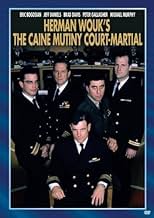
El juicio del motín del Caine
Título original: The Caine Mutiny Court-Martial
PUNTUACIÓN EN IMDb
6,8/10
829
TU PUNTUACIÓN

Una adaptación completa, originalmente escenificada como obra de teatro, del segmento del consejo de guerra de la novela "El Motín del Caine".Una adaptación completa, originalmente escenificada como obra de teatro, del segmento del consejo de guerra de la novela "El Motín del Caine".Una adaptación completa, originalmente escenificada como obra de teatro, del segmento del consejo de guerra de la novela "El Motín del Caine".
- Director/a
- Guionista
- Estrellas
- Premios
- 1 nominación en total


Ronny Lynch
- Signalman Third Class Junius Urban
- (as Ronald Lynch)

Kenneth V. Jones
- Legal Assistant
- (as Ken Jones)


- Director/a
- Guionista
- Todo el reparto y equipo
- Producción, taquilla y más en IMDbPro
6,8829
1
2
3
4
5
6
7
8
9
10
Reseñas destacadas
Queeg wasn't fit to stand alongside Skipper Jonas Grumby
Excellent dramatic rendition of the final segment of Wouk's great novel. All the players made this picture come off looking like a real court marshall. Davis' portrayal of the oddball Queeg showed a man with a skewed personality and totally obsessed with an authority complex. Finally, Bogosian's Barney Greenwald's rant at the celebration party was the high point of the film. Courtroom enthusiasts should go for this one.
Dark
I love Robert Altman's persona, a kind of hippy apres la lettre. He'd be fun to have dinner with. But I can never get with his movies. No matter how carefully he explains why he constructed them as he did, it always comes out sounding to me like a burglar's explanation of why the victim brought it on himself because he should never have left the windows wide open in the first place. This TV production is better than most of his movies, though. As a courtroom drama it almost has to be since the focus is almost always on exchanges between two or three people in an otherwise silent courtroom. (When Altman gets a chance, as in the party scene, he lets everything go so that when Barney Greenwald gives his climactic speech, the signal is almost buried in the surrounding noise.) I hate to be negative because, as I say, I like Altman and think the novel is marvelous -- I reread it every two years or so. But the production seems underlighted and unnecessarily dark, which casts a gloom over the exciting proceedings. The performances are okay but they don't always fit the part. Bogosian is nice as Greenwald. Daniels is a bit trim and comes across as more intelligent than he might be. (He ought to be like a brown bull getting the banderillas placed.) The Keefer character is miscast, period. Here, he is soft-spoken and deliberate, completely in control of himself, whereas Keefer knew very well that he was tanking his close friend during his testimony and was nervous and guilty. (His right foot danced all during his testimony in the novel, and he could not meet Maryk's intense gaze.) Keefer is always nervous -- except when he's lambasting the navy, then he comes into his own. These nervous tics are here given to the psychiatrist, a guy who definitely should NOT have had them, so that his frosty complacency could be more effectively destroyed by Greenwald. Altman turns the shrink into a complete fool with big pursed lips and thick glasses, which is extremely amusing, whether it fits or not. Just looking at this poor neurotic is a treat! Much of the success or failure of the production devolves onto Brad Davis's performance, and again the results are mixed. He is the person whose presence undergoes the most dramatic change, and Davis delivers during the breakdown scene. When I first saw this, in 1988, I was somewhat surprised at a particular twist Davis gave Queeg's character, especially during his first court appearance, a kind of wispy lisping quality, and I thought, "Geeze, is Davis trying to suggest Queeg was a homosexual?" I worried that he was going to wind up in a snit when he went to pieces, but Davis in the end projects a genuine-enough paranoid anger. Maybe if I'd never read the novel I'd have enjoyed the movie more, although I did in fact enjoy it. At least it was never insulting. I'd happily watch it again if it were on.
An Interesting Variant on the story
The television movie version of THE CAINE MUTINY COURT-MARTIAL is a nice production by Robert Altman. It lacks the briny spirit of the film - so much of which was shot on ships or at sea (including a typhoon sequence). But it is taught and claustrophobic for most of the story - it being set in the Court-Martial room (a bit of the end of the play is at the post-trial acquittal party). The results is a different telling of the story, and one relying on the audience's own evaluation of the truth or lies of the different witnesses. While it still ends in the revelation of Queeg's (Brad Davis's) behavior on the stand, there is more that comes out.
I've mentioned this when reviewing the movie. Queeg is first taken down a peg by Greenwald (Eric Bogosian) not on issues of fitness of command, but on his honesty. It turns out that Queeg (like other commanders of the naval ships) were allowed a certain level of tax free purchases from Hawaii to the mainland of various luxury items, such as alcohol. Queeg had overused this right - actually exceeded the legal limit, and was chastised for this by the Pearl Harbor command. Queeg denies this happened, but Greenwald explains that he can ask for an hour's delay to get the necessary officers to come and testify if necessary. So Queeg suddenly "remembers" there was some kind of chastisement. It is the first misstep the Captain makes in his testimony.
Greenwald also faces secret hostility (not shown in the film, by the way) as a Jewish officer. There is an undercurrent working against Greenwald and his clients in the anti-Semitism of the Navy brass, especially the prosecutor. At the end of the trial, aware that Greenwald has destroyed what should have been an open-and-shut case of mutiny, the prosecutor actually reveals his anti-Semitic feelings about the "tricks" used by Greenwald.
The other major change is at the conclusion. In the film, a drunken Greenwald (Jose Ferrer) confronts Lt. Tom Keefer (Fred MacMurray) at the celebration party as the real manipulator of the Caine Mutiny, who kept himself clean at the expense of Maryk and Keith), and after tossing a drink into his face and saying if he wants to make anything of it to come outside. Greenwald also tells off the crew officers present that they failed to give Queeg the support he asked for at one point - that Queeg for all his flaws was defending the country while they were nice and safe. The stunned men leave the party one by one, leaving a disgraced Keefer all alone.
In the play, Greenwald does show up, and does tell off Keefer and the crew's officers, but all the officers (except Keefer, who is disgraced), are already drunk, and they don't listen to what Greenwald is saying. Not even Maryk and Keith (Jeff Daniels and Daniel Jenkins) - who are too busy celebrating to care. It is an interesting difference from the movie's conclusion. Nice production, with a different style and angle to the story.
I've mentioned this when reviewing the movie. Queeg is first taken down a peg by Greenwald (Eric Bogosian) not on issues of fitness of command, but on his honesty. It turns out that Queeg (like other commanders of the naval ships) were allowed a certain level of tax free purchases from Hawaii to the mainland of various luxury items, such as alcohol. Queeg had overused this right - actually exceeded the legal limit, and was chastised for this by the Pearl Harbor command. Queeg denies this happened, but Greenwald explains that he can ask for an hour's delay to get the necessary officers to come and testify if necessary. So Queeg suddenly "remembers" there was some kind of chastisement. It is the first misstep the Captain makes in his testimony.
Greenwald also faces secret hostility (not shown in the film, by the way) as a Jewish officer. There is an undercurrent working against Greenwald and his clients in the anti-Semitism of the Navy brass, especially the prosecutor. At the end of the trial, aware that Greenwald has destroyed what should have been an open-and-shut case of mutiny, the prosecutor actually reveals his anti-Semitic feelings about the "tricks" used by Greenwald.
The other major change is at the conclusion. In the film, a drunken Greenwald (Jose Ferrer) confronts Lt. Tom Keefer (Fred MacMurray) at the celebration party as the real manipulator of the Caine Mutiny, who kept himself clean at the expense of Maryk and Keith), and after tossing a drink into his face and saying if he wants to make anything of it to come outside. Greenwald also tells off the crew officers present that they failed to give Queeg the support he asked for at one point - that Queeg for all his flaws was defending the country while they were nice and safe. The stunned men leave the party one by one, leaving a disgraced Keefer all alone.
In the play, Greenwald does show up, and does tell off Keefer and the crew's officers, but all the officers (except Keefer, who is disgraced), are already drunk, and they don't listen to what Greenwald is saying. Not even Maryk and Keith (Jeff Daniels and Daniel Jenkins) - who are too busy celebrating to care. It is an interesting difference from the movie's conclusion. Nice production, with a different style and angle to the story.
Made for television but as fine as any of Altman's big screen films.
Filmed theatre and made for television, yet as brilliant as any of Robert Altman's feature films, (and more brilliant than some), "The Caine Mutiny Court Martial", as its title attests, deals only with the trial that makes up the last part of Herman Wouk's novel "The Caine Mutiny" and is based on the Broadway play rather than the 1954 film version with which it will undoubtedly be compared. Of course, Dmytryk's film has already become legendary thanks almost entirely to Humphrey Bogart's brilliant turn as Captain Queeg, here played by Brad Davis and he's this films weakest link. What made Bogart's performance great was that his Queeg was a multi-faceted character whereas Davis comes across as a certifiable loon from the get-go. On the other hand, everyone else is just fine; Jeff Daniels as the lieutenant charged with mutiny, Eric Bogosian as his defending lawyer, Michael Murphy as the presiding officer at the court martial, Peter Gallagher as the judge advocate prosecuting the case and Altman's roving camera and use of sound ensures this is as cinematic as anything he did.
Better than Bogart? Yes.
All of the comments before this one are perfectly true in saying this is a great film, even more so considering it was made for TV. Having read The Caine Mutiny and having seen the movie numerous times I already knew many of the incidents referred to in the courtmartial dialog. I wondered how good a film it would be to someone totally unfamiliar with the Bogart film and the book. Queeg was a stinker but I still felt sorry for the SOB. Now in REAL life, Maryk would have been found guilty no matter how loony his CO was.


¿Sabías que...?
- CuriosidadesKeith Carradine was offered the role of Queeg, and it would have reunited him with director Robert Altman for the first time since Nashville (1975). Carradine turned it down due to a conflict with another movie starting Glenn Close. Carradine later regretted it, and Altman never reached out to him again for another role.
- PifiasThe gymnasium floor where trial is held has modern basketball court markings.
- Citas
Lt. Barney Greenwald: Forget it! I don't take on a case just to lose it!
- ConexionesFeatured in Altman (2014)
Selecciones populares
Inicia sesión para calificar y añadir a tu lista para recibir recomendaciones personalizadas
Detalles
- Fecha de lanzamiento
- País de origen
- Idioma
- Títulos en diferentes países
- El consell de guerra del motí del Caine
- Localizaciones del rodaje
- Empresas productoras
- Ver más compañías en los créditos en IMDbPro
Contribuir a esta página
Sugerir un cambio o añadir el contenido que falta