PUNTUACIÓN EN IMDb
7,0/10
18 mil
TU PUNTUACIÓN


Un asesino a sueldo se traslada al desierto donde encuentra hábiles espadachines para llevar a cabo sus asesinatos por contrato.Un asesino a sueldo se traslada al desierto donde encuentra hábiles espadachines para llevar a cabo sus asesinatos por contrato.Un asesino a sueldo se traslada al desierto donde encuentra hábiles espadachines para llevar a cabo sus asesinatos por contrato.
- Director/a
- Guionistas
- Estrellas
- Premios
- 9 premios y 13 nominaciones en total


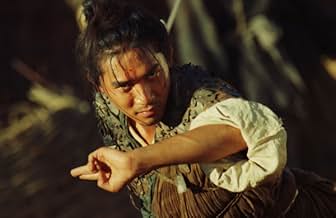




Tony Leung Chiu-wai
- Blind Swordsman
- (as Tony Chiu Wai Leung)


Collin Chou
- Swordsman
- (sin acreditar)

Shun Lau
- Leader of Ouyang's Opponents in Opening Battle
- (sin acreditar)
Li Yin
- Rebel swordsman
- (sin acreditar)
- Director/a
- Guionistas
- Todo el reparto y equipo
- Producción, taquilla y más en IMDbPro
Reseñas destacadas
10zdac
Loosely based on the Chinese heroic literature classic, "The Eagle-Shooting Heroes" by prolific Wuxia author Louis Cha, ASHES OF TIME is conspicuous for the unusual and postmodern approach it takes to a genre so firmly entrenched in Hong Kong cinema.
The "story" consists interactions between various characters as they weave in and out of each other's lives, with a small village in a bleak desert wasteland as the crossroads. These vignettes are not always sequential, and we must gradually piece together the relationships and backgrounds of the protagonists, some of which contribute to a larger story, while others do not. The all-star cast portrays a varied palette of characters, perfectly flawed incarnations of fantastical beings, with performances teetering on the line between disarming humanity and iconic romanticism.
One thing to love about this movie is the way that director Wong Kar-Wai takes the reflective internal monologues and quirky, alienated losers from his other films and transposes them to the world of Chinese heroic fantasy. It's an interesting idea that both ennobles and deconstructs the genre. Martial-arts superheroes who can literally shear mountainsides with a wave of the sword, mired in their own personal conflicts and bouts with inadequacy, in the points of time that occur between the legend-worthy events. This unusual treatment lends these mythic characters a familiar dimension that is both poetic and banal. The cast and the desert are wrenchingly beautiful in the same starkly desolate way. The music consists of odd synth dirges, like a moody clash of Ennio Morricone and Vangelis (particularly the 1492 soundtrack), but it is nonetheless hauntingly atmospheric.
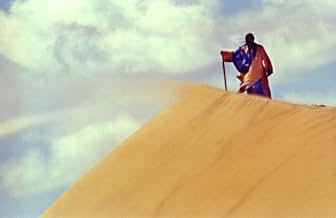
ASHES OF TIME is a truly beautiful movie. The cinematography is a lush blend of stunningly arid vistas, iconic posturing, minute sensual gestures, grainy documentary-style camera-work, and stylish, impressionistic fight sequences. A visual metaphor for textiles and tapestry persists, with the various interwoven plots echoed in the camera's almost tactile attention to fabric and texture throughout... sometimes tightly bound like an inescapable net, others fraying apart like elusive memories.
That said, this movie is not going to appeal to everyone. The disjointed dreamlike narrative can be confusing initially, with so many characters behaving in obscure ways, backwards and forwards in time. Still, in the end, if you take some time to retrace your steps, it all does fit together remarkably well. The puzzle pieces really do form a coherent picture, but for most people it will probably take a second viewing to see it all.
Also, those looking for the action sequences Hong Kong movies are famous for, will find the emphasis is on the characters and their meandering thoughts. When the (nonetheless exciting and very cool) action scenes do take place, they are blurred hyperkinetic washes of motion. While Hong Kong action films have some of the greatest choreography captured on film, ASHES OF TIME attempts to capture an impressionistic, psychological aspect as well, sometimes obscuring the action as much as displaying it.
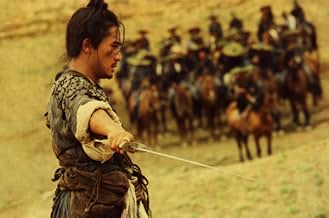
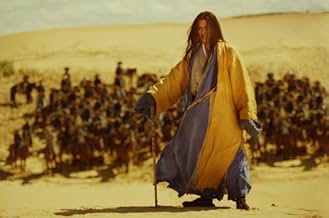
This movie takes many of its cues from Sergio Leone's revisionist westerns. The stylized desert environment is the wastes of New Mexico revisited through Chinese legend, complete with tormented superhumanly-skilled anti-hero swordsmen/gunslingers, lost, deromanticized ideals, melodramatic showdowns, and roving hundreds-strong gangs of horse thieves. Still, Ashes of Time manages to be its own beast, a technical, artistic, visual, sentimental masterpiece, that gives a new twist on old conventions, while simultaneously managing to belong very much to Wong Kar-Wai's thematic oeuvre. A movie you won't easily forget.
The "story" consists interactions between various characters as they weave in and out of each other's lives, with a small village in a bleak desert wasteland as the crossroads. These vignettes are not always sequential, and we must gradually piece together the relationships and backgrounds of the protagonists, some of which contribute to a larger story, while others do not. The all-star cast portrays a varied palette of characters, perfectly flawed incarnations of fantastical beings, with performances teetering on the line between disarming humanity and iconic romanticism.
One thing to love about this movie is the way that director Wong Kar-Wai takes the reflective internal monologues and quirky, alienated losers from his other films and transposes them to the world of Chinese heroic fantasy. It's an interesting idea that both ennobles and deconstructs the genre. Martial-arts superheroes who can literally shear mountainsides with a wave of the sword, mired in their own personal conflicts and bouts with inadequacy, in the points of time that occur between the legend-worthy events. This unusual treatment lends these mythic characters a familiar dimension that is both poetic and banal. The cast and the desert are wrenchingly beautiful in the same starkly desolate way. The music consists of odd synth dirges, like a moody clash of Ennio Morricone and Vangelis (particularly the 1492 soundtrack), but it is nonetheless hauntingly atmospheric.
ASHES OF TIME is a truly beautiful movie. The cinematography is a lush blend of stunningly arid vistas, iconic posturing, minute sensual gestures, grainy documentary-style camera-work, and stylish, impressionistic fight sequences. A visual metaphor for textiles and tapestry persists, with the various interwoven plots echoed in the camera's almost tactile attention to fabric and texture throughout... sometimes tightly bound like an inescapable net, others fraying apart like elusive memories.
That said, this movie is not going to appeal to everyone. The disjointed dreamlike narrative can be confusing initially, with so many characters behaving in obscure ways, backwards and forwards in time. Still, in the end, if you take some time to retrace your steps, it all does fit together remarkably well. The puzzle pieces really do form a coherent picture, but for most people it will probably take a second viewing to see it all.
Also, those looking for the action sequences Hong Kong movies are famous for, will find the emphasis is on the characters and their meandering thoughts. When the (nonetheless exciting and very cool) action scenes do take place, they are blurred hyperkinetic washes of motion. While Hong Kong action films have some of the greatest choreography captured on film, ASHES OF TIME attempts to capture an impressionistic, psychological aspect as well, sometimes obscuring the action as much as displaying it.
This movie takes many of its cues from Sergio Leone's revisionist westerns. The stylized desert environment is the wastes of New Mexico revisited through Chinese legend, complete with tormented superhumanly-skilled anti-hero swordsmen/gunslingers, lost, deromanticized ideals, melodramatic showdowns, and roving hundreds-strong gangs of horse thieves. Still, Ashes of Time manages to be its own beast, a technical, artistic, visual, sentimental masterpiece, that gives a new twist on old conventions, while simultaneously managing to belong very much to Wong Kar-Wai's thematic oeuvre. A movie you won't easily forget.
Near the end, the proprietor of an inn perched on the windy edge of a sandy desert that stretches to the horizon has an epiphany; he has never before actually stopped to observe the desert, not as a transition, but as destination, as something that you don't calculate how to cross, but observe as a place you have crossed to reach. I have written the almost exact same idea (different setting) in one of my screenplays. This is the personal connection with a favourite film I value so much. Film becomes more than film, I see film as dream, a consciousness briefly shared then forgotten. It's that feeling of dreaming the same dream with a great artist that makes me tingle.
This is a film like the best of novels, a web woven of fragmented image and word, drives and desires, rendered cinematically alive when the two coalesce to reveal yawning chasms of human experience, the one common shared human experience we all know. The film's opening serves as present tense and WKW builds fascinating removes from it to the point where the final story of the film climaxes in the past with shocking reverberations that make me rush through the entire film, clawing my way back to the present and previous past occurrences, to change my perspective.
At the beginning of the film, a master swordsman arrives at an inn to offer the inn keeper a gulp from a wine that makes you forget the past. The inn keeper refuses. Throughout the film we happen upon characters, or characters happen upon the film as it passes time in that wind-torn inn by the desert, fixed in position by memory, by their inability or willinglessness to let go a human passion or folly, revenge or love however distant and impossible. We all need something to live for the inn keeper muses, and we know sometime we'll cling to the uglier most obsessive aspects of our nature to get us through the night. But this is all we have, not something to separate us from animals because even a dog will come to know the hand that strikes it, but all we have as humans to distinguish us from creation, being able to cling to that sad bitter memory of unfulfillment for years and make our unvanquished madness dear to us.
This is all a bit of a game, life is through the remove of storytelling, it becomes myth and fabrication, but what wouldn't we give to go back and play it again. In the end we discover that the wine that makes you forget the past is regular wine and a character is only set free when he finds out his love, love he had and denied until he realized how precious it was to him and came back to find it gone, has died. But that was already two years ago and he's stood in place for those two years, allowing himself to be released from his selfimposed exile when a piece of paper reaches his hands, as though even absolution from guilt or shame or obligation can only properly come to pass in an official manner.
WKW gives us swordplaying spectacle to go with this but he doesn't focus on it. Swords strike and fighters leap into the air in blurry shapes of color and motion yet the eye doesn't rest on the details of the fight but rather centers on facial expressions and the maddening ferocity of it all, like it's all a dance and we're dancing right in the middle of it. To say this is a wuxia is to set different expectations for it. Here poetry is not a poetry of appearances. As with his previous films, WKW tells us marvellous things about obsession and release, the yearning to remember and forget, and about letting ourselves go into new beginnings.
This is a film like the best of novels, a web woven of fragmented image and word, drives and desires, rendered cinematically alive when the two coalesce to reveal yawning chasms of human experience, the one common shared human experience we all know. The film's opening serves as present tense and WKW builds fascinating removes from it to the point where the final story of the film climaxes in the past with shocking reverberations that make me rush through the entire film, clawing my way back to the present and previous past occurrences, to change my perspective.
At the beginning of the film, a master swordsman arrives at an inn to offer the inn keeper a gulp from a wine that makes you forget the past. The inn keeper refuses. Throughout the film we happen upon characters, or characters happen upon the film as it passes time in that wind-torn inn by the desert, fixed in position by memory, by their inability or willinglessness to let go a human passion or folly, revenge or love however distant and impossible. We all need something to live for the inn keeper muses, and we know sometime we'll cling to the uglier most obsessive aspects of our nature to get us through the night. But this is all we have, not something to separate us from animals because even a dog will come to know the hand that strikes it, but all we have as humans to distinguish us from creation, being able to cling to that sad bitter memory of unfulfillment for years and make our unvanquished madness dear to us.
This is all a bit of a game, life is through the remove of storytelling, it becomes myth and fabrication, but what wouldn't we give to go back and play it again. In the end we discover that the wine that makes you forget the past is regular wine and a character is only set free when he finds out his love, love he had and denied until he realized how precious it was to him and came back to find it gone, has died. But that was already two years ago and he's stood in place for those two years, allowing himself to be released from his selfimposed exile when a piece of paper reaches his hands, as though even absolution from guilt or shame or obligation can only properly come to pass in an official manner.
WKW gives us swordplaying spectacle to go with this but he doesn't focus on it. Swords strike and fighters leap into the air in blurry shapes of color and motion yet the eye doesn't rest on the details of the fight but rather centers on facial expressions and the maddening ferocity of it all, like it's all a dance and we're dancing right in the middle of it. To say this is a wuxia is to set different expectations for it. Here poetry is not a poetry of appearances. As with his previous films, WKW tells us marvellous things about obsession and release, the yearning to remember and forget, and about letting ourselves go into new beginnings.
This classic ultra-stylized and (in the words of the NYFF blurb) "insanely gorgeous" 1994 martial arts or 'wuxia' film based on the Louis Cha novel 'The Eagle-Shooting Horses' needs no introduction to film fans now, though before Tarantino's release of 'Chungking Exrpess' Americans had to go to Chinatown theaters or rent pirated videotapes to see it; I saw it in Chinatown in a double bill with 'As Tears Go By' (1988). A cinematic icon today, Wong Kar-wai didn't get international recognition till 1997 at Cannes (for 'Happy Together'), and the majority of US art-house viewers didn't notice him till 'In the Mood for Love' (2000). Now ironically since the huge blowout and exhaustion of Wong's epic '2046' (2004), a summing-up of his 60's nostalgia themes and characters, he seems to have reached a point of exhaustion, and his English-language romance 'Blueberry Nights' (2007) was a critical failure. Re-editing 'Ashes of Time' looks like another example of treading water, but it's still great to have it; many have still not seen it, and any films as visually magnificent as Wong's are best seen in theaters. It's also fortunate that all his films can be seen on decent DVD's now with readable subtitles for English speakers, instead of the weird earlier Hong Kong prints with flickering titles in Chinese and peculiar English that disappeared before you could read them. 'Ashes of Time Redux' has the best English subtitles yet both visually and linguistically.
According to Wong, 'Ashes of Time' negatives weren't in very good shape, and a search of various versions led him to a huge warehouse somewhere near San Francisco's Chinatown that contained the entire history of Hong Kong movies. He and his team put together various versions, adding a bit to what we already know, digitally cleaning up the images and "enhancing" some of the color and doing things with the sound, adding a new score and "re-arrangement" by Wu Tong including cello solos by Yo Yo Ma.
Experts will have to comb over all this to explain the differences. The cinematographer Christopher Doyle, who was present at the press screening of the film at the NYFF, doesn't like the enhancing of the color and neither do I. A lot of yellows and oranges are heightened, greenish-turquoise touches are set in, and many of the desert sand landscapes seem to have lost their surface detail. This seems unnecessary and even obtrusive, but it's not enough to spoil the experience. Other images simply look more pristine and clear. Wong wouldn't say what specific changes were made in the editing. He preferred to talk about how he adapted Louis Cha's novel and how this film relates to his oeuvre. Both for him and for Doyle it was an essential milestone. The cast features the late Leslie Cheung, both Tony Leungs (Chiu Wai and Ka Fai) and Jacky Cheung, and has Maggie Cheung as The Woman and martial arts film great Brigitte Lin as Murong Yin and Murong Yang, the sister and brother. Lin, now retired, was responsible for the revival of the genre and is central to this film, though Maggie Cheung is its diva, its dream lover.
Cha's novel is a complicated 4-volume wuxia genre epic, very popular but little known or appreciated in the West. Wong studied it carefully (and made a parody of it called 'Eagle-Shooting Heroes') but then though he says this film unlike all his others had a fixed plan (and thus made for a story full of fatalism), he threw away the story and just took a couple of the main characters and made up another simpler story imagining what the characters' lives were like when they were young. A simpler story. Well. The story has always seemed completely incomprehensible to me but after re-watching 'Redux' it obviously is nonetheless a coherent narrative; it's just intricate and, above all, cyclical. It ends as it begins, with the narrator looking into the camera and repeating the opening lines.
'Ashes of Time' was shot in the desert. Doyle had never done that. The film was long delayed and the shoot was difficult. Doyle knew nothing about martial arts or 'Jianghu,' the parallel universe of martial arts fiction. He was under extreme constraints, having very little artificial light. Nonetheless he produced some of the most beautiful sequences in modern film, because he's a great cinematographer, perhaps the greatest of recent decades, as Wong Kar-Wai is one of the defining contemporary cinematic geniuses.
Wong is notable for his meditative and arresting voice-overs. Here is a sample: "People say that if a sword cuts fast enough, the blood spurting out will emit a sound like a sigh. Who would have guessed that the first time I heard that sound it would be my own blood?" "You gained an egg, but lost a finger. Was it worth it?" There are aphorisms or bits of advice: "Fooling a woman is never as easy as you think." The film is anchored and structured by the Chinese calendar: the Chinese almanac is divided into 24 solar terms and the narrative moves forward selectively through these terms, which contain weather descriptions (naturally) and advice as to what is propitious or unlucky and in what regions and directions. There is also a great deal about oblivion and forgetfulness (which are linked with wine, including a magic wine that eliminates memory). The desert and drinking are visual touchstones throughout as are pairs, opposites, and contrasts; and there is cross-dressing and perhaps bisexual love. The images are full of flickering light. The sword fights, which do not begin until more than half way into the film, are without the acrobatic feats actually performed or digitally faked as in current martial arts films, though they are elaborately staged by the action choreographer Sammo Hung. They are a symphony of fast cutting, closeups, blurs, and slow motion (which Wong intended particularly to express the fatigue of the Blind Swordsman in the film).
According to Wong, 'Ashes of Time' negatives weren't in very good shape, and a search of various versions led him to a huge warehouse somewhere near San Francisco's Chinatown that contained the entire history of Hong Kong movies. He and his team put together various versions, adding a bit to what we already know, digitally cleaning up the images and "enhancing" some of the color and doing things with the sound, adding a new score and "re-arrangement" by Wu Tong including cello solos by Yo Yo Ma.
Experts will have to comb over all this to explain the differences. The cinematographer Christopher Doyle, who was present at the press screening of the film at the NYFF, doesn't like the enhancing of the color and neither do I. A lot of yellows and oranges are heightened, greenish-turquoise touches are set in, and many of the desert sand landscapes seem to have lost their surface detail. This seems unnecessary and even obtrusive, but it's not enough to spoil the experience. Other images simply look more pristine and clear. Wong wouldn't say what specific changes were made in the editing. He preferred to talk about how he adapted Louis Cha's novel and how this film relates to his oeuvre. Both for him and for Doyle it was an essential milestone. The cast features the late Leslie Cheung, both Tony Leungs (Chiu Wai and Ka Fai) and Jacky Cheung, and has Maggie Cheung as The Woman and martial arts film great Brigitte Lin as Murong Yin and Murong Yang, the sister and brother. Lin, now retired, was responsible for the revival of the genre and is central to this film, though Maggie Cheung is its diva, its dream lover.
Cha's novel is a complicated 4-volume wuxia genre epic, very popular but little known or appreciated in the West. Wong studied it carefully (and made a parody of it called 'Eagle-Shooting Heroes') but then though he says this film unlike all his others had a fixed plan (and thus made for a story full of fatalism), he threw away the story and just took a couple of the main characters and made up another simpler story imagining what the characters' lives were like when they were young. A simpler story. Well. The story has always seemed completely incomprehensible to me but after re-watching 'Redux' it obviously is nonetheless a coherent narrative; it's just intricate and, above all, cyclical. It ends as it begins, with the narrator looking into the camera and repeating the opening lines.
'Ashes of Time' was shot in the desert. Doyle had never done that. The film was long delayed and the shoot was difficult. Doyle knew nothing about martial arts or 'Jianghu,' the parallel universe of martial arts fiction. He was under extreme constraints, having very little artificial light. Nonetheless he produced some of the most beautiful sequences in modern film, because he's a great cinematographer, perhaps the greatest of recent decades, as Wong Kar-Wai is one of the defining contemporary cinematic geniuses.
Wong is notable for his meditative and arresting voice-overs. Here is a sample: "People say that if a sword cuts fast enough, the blood spurting out will emit a sound like a sigh. Who would have guessed that the first time I heard that sound it would be my own blood?" "You gained an egg, but lost a finger. Was it worth it?" There are aphorisms or bits of advice: "Fooling a woman is never as easy as you think." The film is anchored and structured by the Chinese calendar: the Chinese almanac is divided into 24 solar terms and the narrative moves forward selectively through these terms, which contain weather descriptions (naturally) and advice as to what is propitious or unlucky and in what regions and directions. There is also a great deal about oblivion and forgetfulness (which are linked with wine, including a magic wine that eliminates memory). The desert and drinking are visual touchstones throughout as are pairs, opposites, and contrasts; and there is cross-dressing and perhaps bisexual love. The images are full of flickering light. The sword fights, which do not begin until more than half way into the film, are without the acrobatic feats actually performed or digitally faked as in current martial arts films, though they are elaborately staged by the action choreographer Sammo Hung. They are a symphony of fast cutting, closeups, blurs, and slow motion (which Wong intended particularly to express the fatigue of the Blind Swordsman in the film).
Without a doubt, Ashes of Time is a beautiful, deeply felt movie. The acting and cinematography are outstanding. The color and camera angles are poetic. But the DVD quality is barely acceptable and the plot, what there is of it, is very confusing. The movie is less a journey from point A to point B than it is a dream-like dance around a central theme: regret for the way we treat those we love.
For those who would watch the movie for the martial arts-- the main characters are mostly swordsmen and martial artists-- the movie is less than satisfying. The fight scenes are highly stylized, employing fast cuts, blurs of motion, and disorienting lighting and camera angles. The fight scenes are more about camera technique than martial arts technique.
Ashes of Time is not a movie that can be absorbed in one viewing. For many viewers, though, it will be worth a second or even third.
For those who would watch the movie for the martial arts-- the main characters are mostly swordsmen and martial artists-- the movie is less than satisfying. The fight scenes are highly stylized, employing fast cuts, blurs of motion, and disorienting lighting and camera angles. The fight scenes are more about camera technique than martial arts technique.
Ashes of Time is not a movie that can be absorbed in one viewing. For many viewers, though, it will be worth a second or even third.
'Dung Che Sai Duk' (aka 'Ashes of Time') is a beautiful visual tapestry. It is another fine example of poetry on canvas. The story does not follow a linear structure but at the same time the dazzling visuals grip the viewer and involve us in the characters' life. The first time I watched 'Dung Che Sai Duk' I was engaged throughout the entire duration but by the end I was left a little confused. This is because I overlooked the layers and some of the important details. It also didn't help that the subtitles were poor. After second viewing, this time with better subtitles, it became a lot more clearer and my appreciation has increased much more.
Almost the entire film is set in the desert. There are plenty of swordfights to enjoy but this is secondary to the story which is mainly about unrequited love and how the fights are a projection of their anger and way of dealing with rejection. The fight scenes are well choreographed. However, I felt slow motion was overused. The editing is good but I was disappointed that so many sequences were cut from the Redux version. The dialogues are marvelously poetic. The tricky cinematography is conducted through various angles and so astonishingly effective. The soundtrack is superb and atmospheric. The cast boasts of top talented names like, Leslie Cheung, Maggie Cheung, Brigitte Lin, Tony Leung Chiu Wai, Jacky Cheung and Carina Lau all of whom do full justice to their roles with subtle performances.
Kar Wai Wong is known for experimenting with different themes and here he does that with unrequited love. Although the treatment of the story is slightly different when compared to his other works, the same essence remains within the characters. It is a movie that stays with you and invites you to revisit.
Almost the entire film is set in the desert. There are plenty of swordfights to enjoy but this is secondary to the story which is mainly about unrequited love and how the fights are a projection of their anger and way of dealing with rejection. The fight scenes are well choreographed. However, I felt slow motion was overused. The editing is good but I was disappointed that so many sequences were cut from the Redux version. The dialogues are marvelously poetic. The tricky cinematography is conducted through various angles and so astonishingly effective. The soundtrack is superb and atmospheric. The cast boasts of top talented names like, Leslie Cheung, Maggie Cheung, Brigitte Lin, Tony Leung Chiu Wai, Jacky Cheung and Carina Lau all of whom do full justice to their roles with subtle performances.
Kar Wai Wong is known for experimenting with different themes and here he does that with unrequited love. Although the treatment of the story is slightly different when compared to his other works, the same essence remains within the characters. It is a movie that stays with you and invites you to revisit.


¿Sabías que...?
- CuriosidadesThis film had an exhausting effect on Wong Kar-Wai. While on hiatus during the editing process he wrote and shot Chungking Express (1994) to "clear his head".
- Citas
Ou-yang Feng: People say, when you can't have what you want, the best you can do is not to forget.
- Versiones alternativasWong Kar-wai revisited the film and created the Redux version which premiered at the Cannes Film Festival 2008. This version has alternative footage and changes in the order of scenes. The Redux version has new opening titles, and the season's fade-ins introducing each chapter are new. It also has a new color-scheme and a new soundtrack. Some scenes from the original version have been deleted, for example the two main character's introduction in the beginning. The overall run time of the Redux version is slightly shorter than the original theatrical version.
- ConexionesFeatured in Century of Cinema: Naamsaang-neuiseung (1996)
Selecciones populares
Inicia sesión para calificar y añadir a tu lista para recibir recomendaciones personalizadas
Detalles
Taquilla
- Presupuesto
- 40.000.000 HKD (estimación)
- Recaudación en Estados Unidos y Canadá
- 174.273 US$
- Fin de semana de estreno en EE. UU. y Canadá
- 21.372 US$
- 12 oct 2008
- Recaudación en todo el mundo
- 2.009.694 US$
Contribuir a esta página
Sugerir un cambio o añadir el contenido que falta