

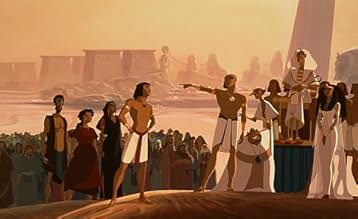
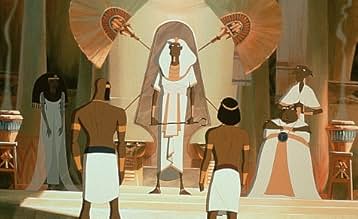
El príncipe egipcio Moisés descubre su identidad como hebreo y su destino de convertirse en el libertador elegido de su pueblo.El príncipe egipcio Moisés descubre su identidad como hebreo y su destino de convertirse en el libertador elegido de su pueblo.El príncipe egipcio Moisés descubre su identidad como hebreo y su destino de convertirse en el libertador elegido de su pueblo.
- Directores/as
- Guionistas
- Estrellas
- Ganó 1 premio Óscar
- 12 premios y 27 nominaciones en total

Val Kilmer
- Moses
- (voz)
- …

Ralph Fiennes
- Rameses
- (voz)


Sandra Bullock
- Miriam
- (voz)

Jeff Goldblum
- Aaron
- (voz)

Danny Glover
- Jethro
- (voz)

Patrick Stewart
- Seti
- (voz)


Steve Martin
- Hotep
- (voz)

Martin Short
- Huy
- (voz)


Francesca Marie Smith
- Additional Voices
- (as Francesca Smith)

Shira Roth
- Hebrew Child
- (doblaje en canto)
- Directores/as
- Guionistas
- Todo el reparto y equipo
- Producción, taquilla y más en IMDbPro
7,2158.8K
1
2
3
4
5
6
7
8
9
10
Reseñas destacadas
Atheist but always astonished by this masterpiece
Let's forget for a while religions and conflicts between humans. Let's focus on the huge amount of creativity and greatness that made this masterpiece. Although DreamWorks have imitated Disney on different levels but the result surprised all those who watched it. The title itself implies that a great story took place in an old great civilization.
In my opinion, the story of this movie is not like what most of people think: conflict between good and bad. It's way beyond that. It's a story of two real brothers who love each other to the core but they were obliged to become enemies due to their differences in beliefs and religion. Don't you think that it's time for people to forget about their differences and become compassionate and empathetic? Love will unite us while religions make us enemies to each other.
The music was outstanding, as well as the songs. The soundtracks of this film make the spectator live in old Egypt which is a very genius innovation by the composer. Very few composers know how to connect their music with an epoch, land and a place.
The first scene when slaves were building the pyramids was one of the best starts in movies history.
Simply it's one of the best movies in history. It's a combination of greatness and beauty.
Applause to Dreamworks for this beautiful tribute to Exodus.
There is probably no greater literary classic than the Bible, and as such it is an obvious choice for Hollywood. But why then are there so few attempts to bring the stories we grew up on to the Big Screen? A very simple reason. In filming a Bible story, producers tread a very thin line. They know they have to make the story interesting, the graphics new and innovative or the movie will flop. But they cannot tamper too much with the original for fear of upsetting those who hold the story dear to their hearts. Unbelievably, Hollywood has finally managed to tread that thin line in 'The Prince of Egypt'.
At the very beginning of the movie, a beautiful worded statement appears on the screen, and as I cannot possibly say it better, I will reproduce it here. "The motion picture you are about to see is an adaptation of the Exodus story. While artistic and historical license has been taken, we believe that this film is true to the essence, values and integrity of a story that is a cornerstone of faith for millions of people worldwide. The biblical story of Moses can be found in the book of Exodus." Now that was just a classy thing to do. Yes, they did tamper with the story ever so slightly, but they never did anything to mess up the main storyline. They took some liberties with the character of Zipporah, Miriam, etc., but they never messed with the core elements of the story. Some of their changes are debatable, but not to the point of destroying the main point of the story. As a strong Christian, even I found nothing whatsoever to complain about in their telling of it.
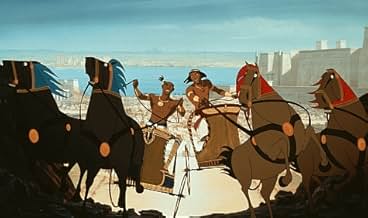
Technically, the film is a triumph of computerized animation. The chariot race scene is revolutionary in that the "camera" is able to move around within a moving frame. It is one of the many subtle ways that this animated movie hardly seems animated at all. The parting of the Red Sea was enough to take my breath away, and the Plagues of Egypt sequence was also very, very good.
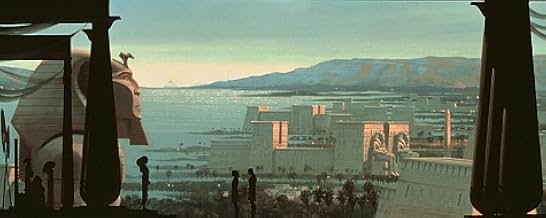
There was obviously a lot of research that went into the making of 'The Prince of Egypt'. Many of the monuments, frescoes, pieces of furniture, statues, etc. are genuine and can be found in the real life Egypt. Somebody did a lot of studying on Hieroglyphics and Egyptian paintings, as several specific scenes in the movie can attest.
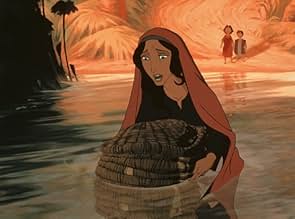
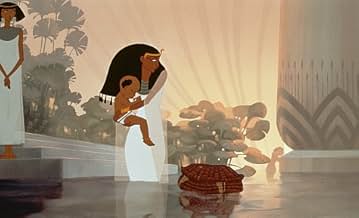
I'd also like to say a few things about the meshing of music with the story. In general, when somebody starts to sing a song, the action stops. Not so in 'The Prince of Egypt'. Indeed, almost the opposite usually occurs. Time compresses within the song, with the action happening at almost double the speed of non-song time. For example, one song covers a span of approximately 40 years, from the time Moses first arrives in Midian to his burning bush experience. In this way, the guys at Dreamworks got the nuts and bolts of the story compressed down in order to give themselves more time to develop characters and other things necessary to make a good movie. I was very impressed at the subtlety of this approach. And the songs themselves are very well done. The soundtrack is a great mix of reverence, ethnic flavor and adventure. Various themes associated with certain events and people wind their way through the music in a better-than-Wagnerian fashion. Moses' mother's lullaby is especially poignant - bravo to the composer. It actually made me cry.
The entire movie is a masterpiece. I'm so glad it made money and did so well. I hope that its great success will allow the people at Dreamworks to make another Biblically based movie, hopefully as good as its predecessor. 'The Prince of Egypt' is not only a great story, it has the advantage of being "true". The tone is very religious, while not being preachy. The burning bush scene is absolutely beautiful. Watch the movie just for that, and enjoy the rest of it as well. The Death of the Firstborn is very dramatic, but not creepy like in 'The Ten Commandments'. I was thoroughly impressed. But above all, the story is interesting, fast-paced and engrossing. The characters are real and their problems are very relatable. There are marvelous moments of comedic relief and moments of terrible mental anguish. This is no dry story from some dusty old book. This is a living, breathing, story. 'The Prince of Egypt' has become one of my very favorite movies and one of the few "cartoons" that continues to be frequently reached for.
At the very beginning of the movie, a beautiful worded statement appears on the screen, and as I cannot possibly say it better, I will reproduce it here. "The motion picture you are about to see is an adaptation of the Exodus story. While artistic and historical license has been taken, we believe that this film is true to the essence, values and integrity of a story that is a cornerstone of faith for millions of people worldwide. The biblical story of Moses can be found in the book of Exodus." Now that was just a classy thing to do. Yes, they did tamper with the story ever so slightly, but they never did anything to mess up the main storyline. They took some liberties with the character of Zipporah, Miriam, etc., but they never messed with the core elements of the story. Some of their changes are debatable, but not to the point of destroying the main point of the story. As a strong Christian, even I found nothing whatsoever to complain about in their telling of it.
Technically, the film is a triumph of computerized animation. The chariot race scene is revolutionary in that the "camera" is able to move around within a moving frame. It is one of the many subtle ways that this animated movie hardly seems animated at all. The parting of the Red Sea was enough to take my breath away, and the Plagues of Egypt sequence was also very, very good.
There was obviously a lot of research that went into the making of 'The Prince of Egypt'. Many of the monuments, frescoes, pieces of furniture, statues, etc. are genuine and can be found in the real life Egypt. Somebody did a lot of studying on Hieroglyphics and Egyptian paintings, as several specific scenes in the movie can attest.
I'd also like to say a few things about the meshing of music with the story. In general, when somebody starts to sing a song, the action stops. Not so in 'The Prince of Egypt'. Indeed, almost the opposite usually occurs. Time compresses within the song, with the action happening at almost double the speed of non-song time. For example, one song covers a span of approximately 40 years, from the time Moses first arrives in Midian to his burning bush experience. In this way, the guys at Dreamworks got the nuts and bolts of the story compressed down in order to give themselves more time to develop characters and other things necessary to make a good movie. I was very impressed at the subtlety of this approach. And the songs themselves are very well done. The soundtrack is a great mix of reverence, ethnic flavor and adventure. Various themes associated with certain events and people wind their way through the music in a better-than-Wagnerian fashion. Moses' mother's lullaby is especially poignant - bravo to the composer. It actually made me cry.
The entire movie is a masterpiece. I'm so glad it made money and did so well. I hope that its great success will allow the people at Dreamworks to make another Biblically based movie, hopefully as good as its predecessor. 'The Prince of Egypt' is not only a great story, it has the advantage of being "true". The tone is very religious, while not being preachy. The burning bush scene is absolutely beautiful. Watch the movie just for that, and enjoy the rest of it as well. The Death of the Firstborn is very dramatic, but not creepy like in 'The Ten Commandments'. I was thoroughly impressed. But above all, the story is interesting, fast-paced and engrossing. The characters are real and their problems are very relatable. There are marvelous moments of comedic relief and moments of terrible mental anguish. This is no dry story from some dusty old book. This is a living, breathing, story. 'The Prince of Egypt' has become one of my very favorite movies and one of the few "cartoons" that continues to be frequently reached for.
a true classic
This is one of the best animated movie of all time. It's not every day that they make a animated movie about a story of the bible. The writers, and animators were very accurate about telling the story. As a Christian I like it when they make movies about the bible. The animation, and music was truly awesome. I like everything about this movie. I recommend this movie to anyone and everyone. Children will love this movie. I'll tell you now you wont be disappointed. I really wasn't.
Why are you sitting there when you could be seeing this film?
Quite possibly the most astonishing achievement in animation since Beauty and the Beast (and surpassing same), The Prince of Egypt is a lovingly crafted, engaging piece of cinema. The main characters are well-realized, three-dimensional characters. The focus of the film is the conflict between Ramses and his adopted brother, Moses, set against the backdrop of the epic events in the book of Exodus. The result is a religious tale that treats the oft-ignored human element. Instead of merely relating the tale as it is, the story asks "how would a person *feel* if God appeared to them and told them to do this? How would others react?" The script is light-years beyond any past biblical epic. The animation style owes a small debt to Disney's house style, but goes above and beyond in the details in character design (the Hebrews and Egyptians and Midians are clearly of different ethnic backgrounds, and no character suffers from the doe-eyed Disney Belle syndrome). Computer Generated Imagery blends -- for the first time in an animated film -- seamlessly with traditional cel animation. The film also takes some fairly audacious risks; Moses has a dream sequence in stiffly animated hieroglyphics, completely switching animation styles for about five minutes, which I believe is completely unprecedented in animation. There are moments when the visual effects made me forget to breathe. If you blink during the parting of the red sea, you'll regret it. There is, I believe I can safely say, not a second of the film that does not offer some sort of visual delight -- from the deep symbolism of the hieroglyphics to the dizzying chariot race in the opening sequence. The music has been touted by some critics as the film's weak link; such is definitely not the case. Stephen Schwartz' songs combine elements of Broadway-esque show tunes with native Hebrew and Egyptian music. The songs are powerful and moving, sometimes no more than one verse in length, sometimes full-blown seven-minute extravaganzas like "Let My People Go." The one weaker song, surprisingly, is the theme "When You Believe." Even freed from Mariah Carey/Whitney Houston R&B cheese as it is in the movie, it's a watery definition of faith at best. Still, the scene in which it takes place is powerful and the song is beautifully performed. If the film has a weak link, it might be the voice casting,Val Kilmer and Patrick Stewart in particular. The two voices are distinctive of the gentleman who possess them, and thus are distracting in this format. But such is a minor quibble, and should not dissuade anyone from seeing the greatest animated story ever told.
A triumph of graphic excellence
As the author of THE WORLD OF ANIMATION, an Eastman Kodak book which won three international book festival awards and as an animation writer-director, I have for many years longed for the U.S. animation industry to remember that Walt Disney, nor any of the pioneers of animation limited their art to children's audiences.
With THE PRINCE OF EGYPT, the DreamWorks animation team has finally taken us full circle and helped the United States join the rest of the world in offering us the first U.S. animated feature since, perhaps, FANTASIA, created for mature audiences while remaining child-friendly. If you aspire to art in any form, and/or specifically love line art and graphics as I do, you must not miss seeing this film on the big screen. I applaud DreamWorks for this triumph in graphic excellence.
Two brief critiques: First, the choice of story. The story is based on Exodus from the Old Testament (and other Scripture) which is scanty, to say the least. Although the studio made an effort to flesh out the story with the Ramses/Moses relationship there is simply not enough meat to go around. This opinion is debatable, a very minor aspect and only my view as a story teller. At the bottom line the overall work is so extraordinary any possible lack in literacy is more than made up for in the visual mounting and production of the film, something which is nothing less than inspiring.
The other criticism is in the highly questionable use of "name" voices for casting, a puzzling development since there is no meaningful box office data supporting it. This practice is known to conflict the viewer psychologically as the drawn images begin to do battle with the ones in the audience memory with the cerebral bridge of highly recognizable photo images of known voices. Walt Disney knew this quite well and avoided it. Indeed, he used the voice of a complete unknown for Snow White, Adriana Caselotti, (who passed away in 1997). Disney was careful to avoid the existing Hollywood queens of song of the period, Judy Garland and Deanna Durbin, the latter, whose prodigious vocal talent actually saved Universal Pictures from going belly up a short time later.
However, at the bottom line, THE PRINCE OF EGYPT will become a true classic and has taken the art of animation up to a new threshold, a model to which future animators will aspire.
Raul daSilva, New Haven, CT, USA
With THE PRINCE OF EGYPT, the DreamWorks animation team has finally taken us full circle and helped the United States join the rest of the world in offering us the first U.S. animated feature since, perhaps, FANTASIA, created for mature audiences while remaining child-friendly. If you aspire to art in any form, and/or specifically love line art and graphics as I do, you must not miss seeing this film on the big screen. I applaud DreamWorks for this triumph in graphic excellence.
Two brief critiques: First, the choice of story. The story is based on Exodus from the Old Testament (and other Scripture) which is scanty, to say the least. Although the studio made an effort to flesh out the story with the Ramses/Moses relationship there is simply not enough meat to go around. This opinion is debatable, a very minor aspect and only my view as a story teller. At the bottom line the overall work is so extraordinary any possible lack in literacy is more than made up for in the visual mounting and production of the film, something which is nothing less than inspiring.
The other criticism is in the highly questionable use of "name" voices for casting, a puzzling development since there is no meaningful box office data supporting it. This practice is known to conflict the viewer psychologically as the drawn images begin to do battle with the ones in the audience memory with the cerebral bridge of highly recognizable photo images of known voices. Walt Disney knew this quite well and avoided it. Indeed, he used the voice of a complete unknown for Snow White, Adriana Caselotti, (who passed away in 1997). Disney was careful to avoid the existing Hollywood queens of song of the period, Judy Garland and Deanna Durbin, the latter, whose prodigious vocal talent actually saved Universal Pictures from going belly up a short time later.
However, at the bottom line, THE PRINCE OF EGYPT will become a true classic and has taken the art of animation up to a new threshold, a model to which future animators will aspire.
Raul daSilva, New Haven, CT, USA


¿Sabías que...?
- CuriosidadesThe production team and executive producer Jeffrey Katzenberg conferred with roughly 600 religious experts to make this movie as accurate and faithful to the original story as possible. After previewing the developing movie, all of the religious scholars, experts, and leaders associated in the making of this movie noted that the studio executives listened and responded to their ideas, and praised the studio for reaching out for comment from outside sources.
- PifiasAfter Moses and Tzipporah are wed, they go off to dance. As the camera starts to zoom between them towards Jethro, the animation of Tzipporah freezes.
- Citas
Moses: Yes, Aaron, it's true. Pharaoh has the power. He can take away your food, your home, your freedom. He can take away your sons and daughters. With one word, Pharaoh can take away your very lives. But there is one thing he cannot take away from you: your faith. Believe, for we will see God's wonders.
- Créditos adicionalesAt the end of the closing credits, there are verses from religious texts - the Hebrew Bible, the New Testament and the Koran - in praise of Moses.
- Versiones alternativasLater prints of the movie, such as the 2018 Blu-ray release and the Peacock print, add the 2013 Universal Pictures logo.
- ConexionesFeatured in Troldspejlet: Episodio #19.13 (1998)
- Banda sonoraDeliver Us
Performed by Ofra Haza and Eden Riegel
Ofra Haza appears courtesy of BMG Ariola Munich
Produced by Hans Zimmer
Additional arrangements by Martin Erskine and Andrew Lippa
Music and Lyrics by Stephen Schwartz
Selecciones populares
Inicia sesión para calificar y añadir a tu lista para recibir recomendaciones personalizadas
Detalles
- Fecha de lanzamiento
- Países de origen
- Idiomas
- Títulos en diferentes países
- El príncep d'Egipte
- Localizaciones del rodaje
- Empresas productoras
- Ver más compañías en los créditos en IMDbPro
Taquilla
- Presupuesto
- 70.000.000 US$ (estimación)
- Recaudación en Estados Unidos y Canadá
- 101.413.188 US$
- Fin de semana de estreno en EE. UU. y Canadá
- 14.524.321 US$
- 20 dic 1998
- Recaudación en todo el mundo
- 218.613.188 US$
- Duración
- 1h 39min(99 min)
- Color
- Mezcla de sonido
- Relación de aspecto
- 1.85 : 1
Contribuir a esta página
Sugerir un cambio o añadir el contenido que falta