
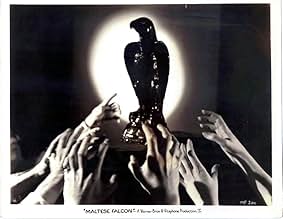
Agrega una trama en tu idiomaA lovely dame with dangerous lies employs the services of a private detective, who is quickly caught up in the mystery and intrigue of a statuette known as the Maltese Falcon.A lovely dame with dangerous lies employs the services of a private detective, who is quickly caught up in the mystery and intrigue of a statuette known as the Maltese Falcon.A lovely dame with dangerous lies employs the services of a private detective, who is quickly caught up in the mystery and intrigue of a statuette known as the Maltese Falcon.
- Premios
- 2 premios ganados en total


- Capt. John Jacobi
- (sin créditos)

- Jailbird Seeking Cigarette
- (sin créditos)
- Baggage Clerk
- (sin créditos)

- District Attorney
- (sin créditos)

- Jailbird
- (sin créditos)

- Sarah - Prison Matron
- (sin créditos)
Opiniones destacadas
early version of the classic
I found this version slow going, mainly because it's an early talkie - the dialogue pacing isn't quite right. You can drive a truck through the pauses. The only one with a more modern feel for the dialogue is the handsome, smiling Cortez, and he's absolutely marvelous as Spade. His Spade is more relaxed than Bogie's, less sardonic, more delightfully crooked - in short, he has a lot more fun. He fits just as well into this version as world-weary Bogie does into the 1941 version.
Bebe Daniels is attractive and alluring as the greedy and totally ruthless Miss Wonderly. The gay subplot between Greenstreet and Lorre everyone assumes isn't as apparent in this film between Wilmer (Dwight Frye) and Caspar Guttman (Dudley Digges).
I found the comments in the first post on the actors' approaches to their roles very interesting; I'm not sure I totally agree, but for sure, Cortez spoke louder and Daniels did underplay (which she did not do in "42nd Street" - at all). However, as far as the pace, I still Cortez did better in keeping the dialogue going than anyone else.
This is a fascinating film - so different from the 1941 version, which I hope to see this evening - it's definitely worth catching.
Not bad first version (which John Huston must have seen!)
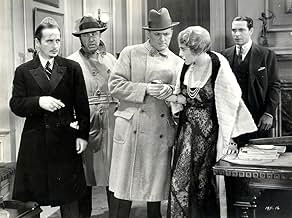
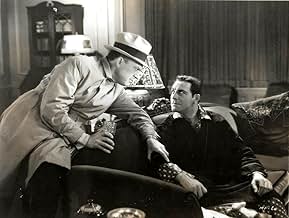
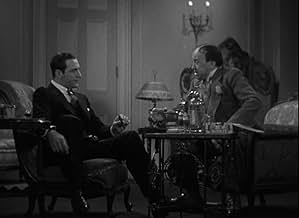
All the same Huston, who was working at Warner Bros. when this was made, must have liked something about this movie-- the scene where Spade first meets Joel Cairo (Otto Mattiesen, doing an excellent Peter Lorre imitation years before the fact) is repeated almost shot for shot and inflection for inflection in the Huston version, the only such case of direct inspiration I spotted here. Mattiesen, a familiar silent era character actor, sadly died not long after the film came out; had he lived he certainly could have had as interesting a talkie career as Lorre eventually did.
The Original Screen Version of The Maltese Falcon
DANGEROUS FEMALE is interesting in several ways, and perhaps most deeply so as an example of the struggle that ensued when sound first roared. What had proved effective on the silent screen suddenly seemed highly mannered when voices were added, and both directors and stars struggled to find new techniques--and DANGEROUS FEMALE offers a very vision of the issues involved.
It is a myth that the advent of sound forced directors to lock down the camera, but it is true that many directors preferred simple camera set-ups in early sound films; it gave them one less thing to worry about. And with this film, Roy Del Ruth is no exception: in a visual sense, DANGEROUS FEMALE is fairly static. The performing decisions made by the various actors are also illustrative and informative, particularly re leads Ricardo Cortez and Bebe Daniels. Cortez is still clearly performing in the "silent mode," and he reads as visually loud; Daniels, however, has elected to underplay, and while she is stiff by current standards, her performance must have seemed startlingly innovative at the time. And then there are two performers who are very much of the technology: Una Merkle as Spade's secretary and Thelma Todd as Iva Archer, both of whom seem considerably more comfortable with the new style than either Cortez or Daniels.
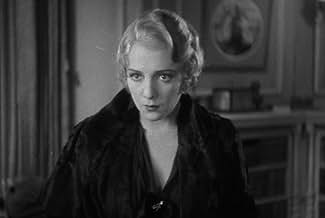
The film is also interesting as a "Pre-Code" picture, for it is sexually explicit in ways most viewers will not expect from a 1930s film, and indeed it is surprisingly explicit even in comparison to other pre-code films. Hero Sam Spade is a womanizer who seduces every attractive female who crosses his path--and the film opens with a shot of just such a woman pausing to straighten her stockings before leaving his office. Still later, the dubious Miss Wonderly tempts Spade with her cleavage, lolls in his bed after a thick night, splashes in his bathtub, and finally winds up stripped naked in his kitchen! It is also interesting, of course, to compare DANGEROUS FEMALE to its two remakes. Directed by William Dieterle and starring Warren William and Bette Davis, the 1936 Satan MET A LADY would put Hammett's plot through the wringer--and prove a critical disaster and a box office thud. But then there is the justly celebrated 1941 version starring Humphrey Bogart and Mary Astor under the direction of John Huston.
Both the 1931 and 1941 films lifted great chunks of dialogue from Hammett's novel, and very often the dialogue is line-for-line the same. But two more completely different films could scarcely be imagined. Where the 1931 film strives for an urbane quality, the 1941 film is memorably gritty--and in spite of being hampered by the production, considerably more sexually suggestive as well, implying the homosexuality of several characters much more effectively than the 1931 version dared.
In the final analysis, the 1931 THE MALTESE FALCON (aka DANGEROUS FEMALE) will appeal most to those interested in films that illustrate the transition between silent film and sound, to collectors of "pre-code" movies, and to hardcore FALCON fans who want everything associated with Hammett, his novel, and the various film versions. But I hesitate to recommend it generally; if you don't fall into one of those categories, you're likely to be unimpressed.
Gary F. Taylor, aka GFT, Amazon reviewer
Wilmer is played by Renfield!
Interesting version of a classic
As in "Satan Met a Lady", the detective is made out to be a sleazy ladies' man in this movie. When we first see him, he's kissing a woman goodbye; we never actually see her face, but we see her adjusting her stocking, and when Sam returns to his office, the pillows from his couch are in disarray. He seems to be getting some from Effie as well (and I must point out that Una Merkel, as Effie, is hot, hot, hot in this movie; quite a contrast to the matronly Lee Patrick in the 1941 version).
Overall, though, this movie is still somewhat unsatisfying. I suppose if we had never seen the Bogart/Huston version, this would stand as an acceptable adaptation of Hammett's novel (by the standards of the time). It follows the novel fairly closely, but skimps on the plot somewhat. The subplot where Wonderley disappears, and then reappears (as O'Shaughnessy) because she realizes Gutman is in town is missing, as is all the great interplay between Spade and Wilmer ("Just keep riding me, buster", "This'll put you in solid with your boss", etc.) that was such a treat in the later version. True, this movie is a little more explicit about the relationship between Gutman and Wilmer, but Wilmer is such a minor character (with literally only a few minutes of screen time) that their relationship still seems more fully-developed in the 1941 movie. There's also a very odd change at the end (just before the prison scene) that seems like something of a cop-out.
And, finally, it must be pointed out that Ricardo Cortez really stinks in this movie. He spends most of the movie with a smirk plastered on his face, and his performance in general is extremely stiff. I suppose that's to be expected in such an early talkie, but, combined with the general aura of sleaziness that his character exudes, it makes it impossible to really care what happens to him. In the end, this is an enjoyable movie, but mainly for reasons of historical curiosity, and it never comes anywhere near the "classic" status that the later remake has achieved.


¿Sabías que…?
- TriviaArt director Robert M. Haas performed the same function on El halcón maltés (1941).
- ErroresThe same prop is used for the suitcase that Spade finds in Miss Wonderly's room and the suitcase which contains the falcon. The travel stickers are identical on each one.
- Citas
Effie Perrine: Sam, it's a gorgeous new customer.
Sam Spade: Gorgeous?
Effie Perrine: A knockout.
Sam Spade: Send her right in, honey.
Effie Perrine: [to the off-screen customer] Will you step in, please?
[Joel Cairo walks in.]
- ConexionesFeatured in Great Performances: Bacall on Bogart (1988)
Selecciones populares
- How long is The Maltese Falcon?Con tecnología de Alexa
Detalles
- Tiempo de ejecución
- 1h 20min(80 min)
- Color