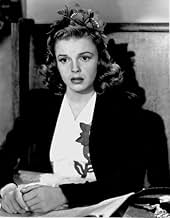
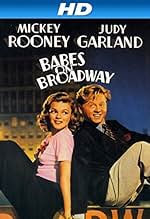
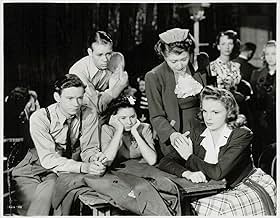
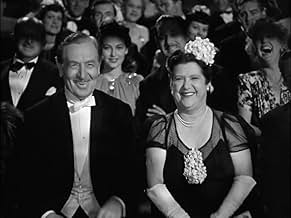
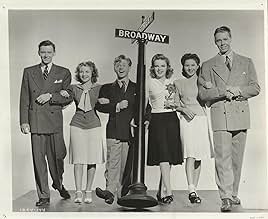
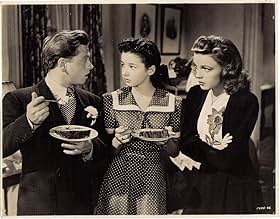
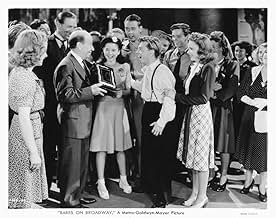
Penny Morris y Tommy Williams son dos jóvenes adolescentes atraídos por las estrellas, pero nadie parece darles ninguna oportunidad de actuar. Deciden montar su propio espectáculo para recau... Leer todoPenny Morris y Tommy Williams son dos jóvenes adolescentes atraídos por las estrellas, pero nadie parece darles ninguna oportunidad de actuar. Deciden montar su propio espectáculo para recaudar dinero para un campamento de verano.Penny Morris y Tommy Williams son dos jóvenes adolescentes atraídos por las estrellas, pero nadie parece darles ninguna oportunidad de actuar. Deciden montar su propio espectáculo para recaudar dinero para un campamento de verano.
- Dirección
- Escritura
- Estrellas
- Nominado a 1 premio Óscar
- 1 nominación en total
- Man
- (escenas eliminadas)
- Elinor Downing, War Refugee
- (sin créditos)
- Butch
- (sin créditos)
- Mrs. Crainen, the Matron
- (sin créditos)
- Dirección
- Escritura
- Todo el elenco y el equipo
- Producción, taquilla y más en IMDbPro
Opiniones destacadas
Shock over a minstrel show??? How do you think Al Jolson became famous?
But it amuses me to see young commentators expressing "shock" and dismay at the blackface routines shown in the big finale. They never knew how popular minstrel shows were, even into the 1940s? Where have they have been living? They never heard of Al Jolson and how he rode to stardom on his blackface routines?
The film actually rises above its clichéd plot whenever Judy takes the spotlight with a song. Never has she looked so radiantly youthful and vibrant. Rooney, while of course obviously talented, tends to ham it up a bit too much whenever he's given the spotlight, which is a little too often for my taste. Fay Bainter does nicely as a patron of the arts while James Gleason gets on the nerves with his frustrated bit as a producer.
Amusing to see gangly RICHARD QUINE hoofing it up (before he became a film director). The standout dancer is Ray MacDonald, the fresh faced kid who lights up the screen whenever he dances, resembling, in style and acting technique, Donald O'Connor. Tragically he, like others in the cast, ended his life much too soon.
Judy and Mickey do a fabulous version of "How About You?" and Buby Berkeley's genius at staging intricate dance routines is nowhere more evident than in the "Hoe Down" number, probably one of the catchiest of all the musical routines.
There are slow spots and the film could easily have omitted footage to pare it down to a running time of, say, an hour and forty minutes. As it is, you have to be willing to stick with it for the full two hours, something only likely to occur if you're a true fan of Garland and Rooney.
You can catch a brief glimpse of two up and coming stars, Margaret O'Brien and Donna Reed. Reed has a brief moment as a receptionist.
Trivia note: Shirley Temple was originally considered for the Virginia Wiedler role. Might have been OK too, since the part is not that demanding musically and Temple could certainly still do the required amount of hoofing.
Remember the TIME FRAME
This movie is a product of its times. But these times aren't much better. Which is worse, black face routines or movies with gratuitous sex and blatant violence, blood, and guts? Racism is a horrible thing but it goes on in movies even today (in films made by Caucasian and African-Americans). What makes the black face routine even worse is that it was totally unnecessary to the plot and they could have done something better.
You can't get rickets listening to the crickets
What seems to get the most reaction here on IMDb is not surprisingly the minstrel number at the close of the show with all of the actors in blackface. Yes it's dated and offensive but some of the comments here are way over the top. One imbecilic individual even said Mickey Rooney shouldn't have been allowed to work again! Put the Kool-Aid down, kid.
A Product Of Its Time
Several talented young people, just starting out, try to make it big on Broadway. That's the story premise. The script presents a thin, superficial plot. Dialogue lacks significant subtext. But, of course, the plot's real purpose is to create continuity in a film meant to showcase the musical talents of its two big stars: Mickey Rooney and Judy Garland. They, along with a large cast, sing and dance in various musical productions, some good, some not so good.
Which leads to my main criticism of this film: the editing. With a thin plot and a runtime of two hours, large chunks could have been chopped out. I have no idea why they included a Beethoven piano performance by a child prodigy; it has no connection to anything. Similarly, the "Hoe Down" musical segment is arguably weak. And, though I commend the producers for acknowledging Great Britain's War efforts, devoted plot elements are thematically irrelevant and overly long.
On the other hand, the best sequence in the film is its grand musical finale, a tribute to the American South. This segment provides a nice contrast to New York's Broadway allure. Dialogue here refers to an "old-fashioned" minstrel show. Most of the songs are from decades earlier. Musical lyrics include the wording "And boy that Southern cooking is okay". Clearly, the intent is to salute the South. So putting performers in black face is entirely appropriate within the well-defined historical context.
Performances are fine. Judy Garland shines. Fay Bainter, ideally cast as a theatrical agent, also gives a good performance. At various points Ray McDonald excels as a tap dancer; he's almost in the same league as Fred Astaire. And impersonating "Brazil bombshell" Carmen Miranda, Mickey Rooney is funny in drag, wearing platform shoes, tawdry women's jewelry, and a flamboyant hat as he sings Miranda's signature song "Mamae Eu Quero". Throughout the film Rooney exudes confidence, energy, and a highly animated persona.
The film's sets and costumes, dialogue about tough times, as well as the selected music and the big accent on tap dancing, combine to give viewers a pretty good feel for American pop culture in the early 1940s. It's by no means a perfect film. But it's worth watching, mostly for nostalgia, as representative of an era that is gone forever.
Mickey Rooney - A Talent Unsurpassed and Unappreciated
¿Sabías que…?
- TriviaVincente Minnelli conceived and supervised the "Ghost Theater" sequence where Garland and Rooney imitate theatrical notables of the past.
- ErroresWhen Alexander Woollcott is introducing the story, at one point his bow tie disappears and his collar is open.
- Citas
Maxine, Little Girl at Audition: Please wait, don't send my brother to the chair, don't let him burn, please, please warden, please.
- Versiones alternativasSome older television prints of the film delete the minstrel show finale.
- ConexionesEdited into Hollywood: The Dream Factory (1972)
- Bandas sonorasBabes on Broadway
(uncredited)
Music by Burton Lane
Lyrics by E.Y. Harburg
Played and sung by a chorus during the opening credits
Reprised as a production number with the principal cast near the end
Sung and danced to by Judy Garland and Mickey Rooney in blackface
Danced to by Ray McDonald in blackface
Selecciones populares
- How long is Babes on Broadway?Con tecnología de Alexa
Detalles
- Fecha de lanzamiento
- País de origen
- Idioma
- También se conoce como
- Babes on Broadway
- Locaciones de filmación
- Productora
- Ver más créditos de la compañía en IMDbPro
Taquilla
- Presupuesto
- USD 940,068 (estimado)
- Tiempo de ejecución
- 1h 58min(118 min)
- Color
- Relación de aspecto
- 1.37 : 1