

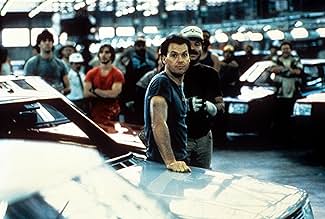
Cuando una empresa de automóviles japonesa compra una planta estadounidense, el enlace estadounidense debe mediar en el choque de actitudes laborales entre la dirección extranjera y la mano ... Leer todoCuando una empresa de automóviles japonesa compra una planta estadounidense, el enlace estadounidense debe mediar en el choque de actitudes laborales entre la dirección extranjera y la mano de obra nativa.Cuando una empresa de automóviles japonesa compra una planta estadounidense, el enlace estadounidense debe mediar en el choque de actitudes laborales entre la dirección extranjera y la mano de obra nativa.
- Dirección
- Escritura
- Estrellas
- Premios
- 1 premio ganado en total
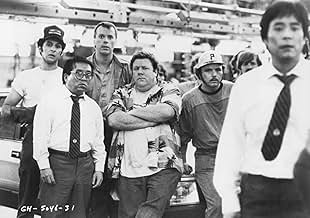



- Mr. Sakamoto
- (as Soh Yamamura)


- Umeki Kazihiro
- (as Patti Yasuiake)


- Dirección
- Escritura
- Todo el elenco y el equipo
- Producción, taquilla y más en IMDbPro
Opiniones destacadas
Not edgy, but funny
Come back with me, children, to a time when Michael Keaton was a straight-up comedy guy, and you might find some joy in this film. It's a gentle comedy -- the kind Ron Howard specializes in -- but if that's your thing, you should check this out. Keaton's low-key charm is just right for this project.
"Gung Ho" is a bit dated, because it takes places in the last stage of the pre-global economy world, when it still mattered what country a business was based in. That said, it delivers laughs as well as a lesson on how people can learn from each other, to great benefit.
You could watch this film and enjoy it without remembering one scene in particular you really liked, but that's because the whole movie provides a slow but constant stream of laughs. It's like an I.V. drip. And I mean that in a good way.
Michael Keaton At His Best! A Great Comedy!
WOW! I can't believe this movie is so poorly rated.
An entertaining culture clash comedy.
There is plenty of comedy relief in the film, from culture clashes to slapstick humor. There's also bits of heroism in the film, including Hunt's town's survival being contingent on the car company staying afloat and including Japanese company manager Oishi Kazihiro (Gedde Watanabe) showing honor to his boss, colleagues and family in getting the car making job done.
Overall, an entertaining film with touches of Americana and Japanese cultures.
Grade B+
Welcome Back to the Lost World of the 80's.
"Gung Ho" does a better job of capturing the mood of the American industrial workforce than just about any other popular movie made during that period. Certainly the movie has its flaws -- some loose plot threads and mediocre acting jobs by everyone except Michael Keaton and Gedde Watanabe. But the story really is about the meeting of East and West: Keaton's Hunt Stevenson personifies America, brash and confident on the outside yet insecure underneath. Watanabe's Kazuhiro personifies Japan, on top of the heap with a successful system, but wondering if there is more to be learned from their Western rivals. The movie's plot, flawed as it is, simply provides a framework for the conflict, and eventually synthesis, of their two personalities.
Keaton's acting overshadows everyone else's, and practically makes the movie by itself. I've always admired Keaton for his ability to deliver lines that feel improvised, no matter what script he's following. His character, Hunt Stevenson, is a likable, affable everyman, a natural leader with a wise-ass streak. But he has a fatal flaw common to many of us: he doesn't want to disappoint anyone. He'll distract the crowd with inspirational anecdotes, and even lie, rather than point out the ugly truth.
Kazuhiro is the mirror image of Stevenson: shy and introspective, but also, because of his Japanese upbringing, reluctant to be the bearer of bad news. The scene in which Stevenson first comes to Kazuhiro with the employees' grievances captures perfectly the Japanese approach to workplace conflict. Kazuhiro replies to Stevenson's complaints with "I understand what you are saying," but won't refuse his requests out loud. Stevenson misinterprets this as agreement, and goes away saying, "Okay, we've got that settled." (This is still a problem in Japanese-American business relations in the 21st century!)
Ultimately, Kazuhiro and Stevenson have the same problem: get the factory working smoothly, meet production goals, and fulfill their responsibility to the workers under them. In working towards this goal, they each have to take a page from the others' book. Kazuhiro's family becoming more "Americanized" is an obvious example. Also note that Stevenson thinks it's odd when Kazuhiro explains how he had to make a public apology to his workers for failing them -- and yet, later in the movie, Stevenson does exactly that himself.
The plot and its resolution are a little cornball, but hey, this is a comedy. If you can overlook the movie's flaws, there is a great story about self-realization and open-mindedness here.


¿Sabías que…?
- TriviaAccording to Bloomberg Businessweek, Toyota executives later used the movie as an example of how not to manage Americans.
- ErroresIn the opening at the management training center, the old worker is shown in subtitles as referring to his family (to support). But the Japanese words do not mention them at all. He only apologizes and says he will work hard.
- Citas
Hunt Stevenson: If you walk out that door, you're going to miss a great comeback. We're ready to roll here, Jack.
Mr. Sakamoto: This will never be like a Japanese factory... *Jack.*
Hunt Stevenson: Oh, yeah? You're right. You know what else? So what?
Mr. Sakamoto: You failed.
Hunt Stevenson: Really? Wanna know something? I got one of the first cars ever made here. I got *the* first car ever - I don't think I want it anymore. As a matter of fact, here.
[hands keys to Mr. Sakamoto]
Hunt Stevenson: Why don't you take the keys, okay? I'd rather have one of those cars.
[points to cars in assembly line]
Hunt Stevenson: I'd rather have one of these cars that *we* made *together,* by hand. Your guys and my guys, together. You know why? Because those cars stand for something. Those cars stand for something pretty great. I'm proud of those cars. I'm taking one.
[Turns to workers]
Hunt Stevenson: Gentlemen, I'm going home in my new car!
[All workers cheer and applaud, then silently pray that Hunt's new car has a working engine. Hunt starts the car, and the workers cheer. However, the car literally falls apart after about two yards, and the workers start to moan. Hunter gets out of the car]
Hunt Stevenson: I tell ya, I thought it handled great!
- Versiones alternativasSome international editions distributed by Paramount on DVD, reduced the aspect ratio from original 2.39:1 to 2.09:1.
- ConexionesFeatured in Generation X: The Power of Disruption (2016)
- Bandas sonorasDon't Get Me Wrong
Written by Chrissie Hynde
Performed by The Pretenders
Produced by Jimmy Lavine and Bob Clearmountain
Courtesy of Sire Records Company
Selecciones populares
- How long is Gung Ho?Con tecnología de Alexa
Detalles
Taquilla
- Presupuesto
- USD 18,000,000 (estimado)
- Total en EE. UU. y Canadá
- USD 36,611,610
- Fin de semana de estreno en EE. UU. y Canadá
- USD 7,170,830
- 16 mar 1986
- Total a nivel mundial
- USD 36,611,610
- Tiempo de ejecución
- 1h 52min(112 min)
- Color
- Relación de aspecto
- 2.35 : 1