Longitude
- Miniserie de TV
- 2000
- 1h 39min
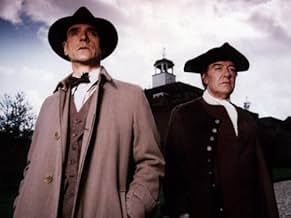
En dos historias paralelas, el relojero John Harrison construye el cronómetro marino para la navegación segura en el mar en el siglo XVIII y el horólogo Rupert Gould se obsesiona con restaur... Leer todoEn dos historias paralelas, el relojero John Harrison construye el cronómetro marino para la navegación segura en el mar en el siglo XVIII y el horólogo Rupert Gould se obsesiona con restaurarlo en el siglo XX.En dos historias paralelas, el relojero John Harrison construye el cronómetro marino para la navegación segura en el mar en el siglo XVIII y el horólogo Rupert Gould se obsesiona con restaurarlo en el siglo XX.
- Ganó 5premios BAFTA
- 7 premios ganados y 5 nominaciones en total
Opiniones destacadas
great masterpiece
As a side note, Sir Isaac Newton (1642--1727) was in the same era as in the time setting of the story. I wonder if Sir Isaac Newton had ever involved with this 'board of longitude' ;)
Remarkably Good
The story flip flops back and forth between the life of a shell shocked (literally) 20th century academic and the tale of an 18th century clockmaker, John Harrison, obsessed with winning the Prize of Queen Anne for calculating longitude.
The surprising part is that the two loosely related plot lines work so well together, despite frequent and rapid cuts back and forth. This is a tribute to the great acting skills of the cast, including Jeremy Irons as the 20th century academic. At times, you have to wonder what the heck Iron's struggles with sanity have to do with the 18th century story, but it all seems to quietly tie together in the end.
Harrison knows that if he can develop an accurate watch, solving longitude was a breeze. This may seem academic, but the lives of British seamen were literally at stake. Developing an accurate timepiece was a far more difficult task than we can today imagine, and Harrison faced a skeptical board of theoreticians who preferred more complex scientific solutions than they thought could be provided by a humble clockmaker. The board utterly fails to grasp that the simple solution is the product of a profoundly complex and innovative device.
We think so highly of the great technological achievements of our times, and they are great. We need to be reminded from time to time, as this film does so well, that the breakthroughs of other generations were in there time quite profound. Moreover, we would not be where we are today without them. As the great Sir Issac Newton once said, "If I have seen further, it is because I have stood on the backs of giants".
Time flew
Awesome.Must see.
We didn't leave that kitchen for the 3 nights the series was on and merrily sorted out the after-dinner mess,all the while conversing on how to build IT.Anecdote: on the last night my eldest aughter who was 7 came into the kitchen to see what we were watching,and at that age, was captivated. It is also a great tribute to the ethics of learning and wanting,working to achieve something. Sorry if I sounded a bit Victorian in that sense.(Am not). Please watch and recommend this.
An excellent intellectual adventure!!
If you enjoy intelligent movies, then you should definitely seek this film out. It sounds dreadfully boring if you read the plot summary, but it isn't. It is wonderfully written and produced and contains much light humor as well, making it truly entertaining.
One film that it reminded me of is "Master and Commander" because of the similar scenes of the British navy and the theme of the struggle of science and progress in the face of war and politics with intelligence and perseverance winning out in the end.
The interwoven story of Rupert Gould is just as interesting and provides an artistic counterpoint to the main story. Again, we have the story of a man who continues with his work in spite of numerous obstacles of the most serious magnitude because he knows that the world will be a better place as a result of that work.
The film is long and you should wait until you have enough time to sit down and watch it through to the end because once you begin you will have difficulty turning it off.
¿Sabías que…?
- TriviaJeremy Irons' character, Rupert Gould, is only mentioned in one paragraph of Dava Sobel's book. When he was writing the screenplay, Director Charles Sturridge conceived the idea of telling Gould's story in parallel with Harrison's. This gave modern audiences a more sympathetic and relatable character to follow through the story.
- ErroresDuring the entire movie, when H1 is seen, the ticking that can be heard belongs to H3. The actual H1 and H2 tick in a rather dull way, but H3 is instantly recognizable, which is probably why its sound was used for H1 and H2 too. H4 appears to use the correct sound.
- Citas
Sir Edmund Halley: Don't touch that, boy!
William Harrison: I didn't, sir, honest, I was just looking.
Sir Edmund Halley: Do you know what that is?
William Harrison: To tell the movements of the stars.
Sir Edmund Halley: How do you know that?
William Harrison: It's my job at home.
Sir Edmund Halley: You have one of these at home!?
William Harrison: No, sir, we use Mr. Johnson next door's chimney.
Sir Edmund Halley: And, pray, what is it that you learn from Mr. Johnson next door's chimney?
William Harrison: The time.
Sir Edmund Halley: How can you tell the time with a chimney?
William Harrison: If you stand in the right place, you can see Sirius.
Sir Edmund Halley: Sirius?
William Harrison: It moves behind Mr. Johnso's chimney 3 minutes and 56 seconds earlier every day. We need the time for our timepiece, to tell if it's true.
Sir Edmund Halley: And is it?
William Harrison: It's bloody perfect, sir.
- ConexionesReferenced in 500 días con ella (2009)
Selecciones populares
Detalles
- Tiempo de ejecución
- 1h 39min(99 min)
- Color
- Mezcla de sonido
- Relación de aspecto
- 1.78 : 1