CALIFICACIÓN DE IMDb
7.6/10
12 k
TU CALIFICACIÓN
Consiste en cinco fases de la vida de un hombre sobre los motivos que le condujeron al suicidio.Consiste en cinco fases de la vida de un hombre sobre los motivos que le condujeron al suicidio.Consiste en cinco fases de la vida de un hombre sobre los motivos que le condujeron al suicidio.
- Dirección
- Escritura
- Estrellas
- Premios
- 20 premios ganados y 7 nominaciones en total
Ko Seo-hie
- Kyung-ah
- (as Seo-hie Ko)
Park Ji-yeon
- Female student
- (as Ji-Yeon Park)
Kim Kyeong-ik
- Myung-sik
- (as Kim Gyeong-ik)
Jeong Woo-hyeok
- Corporal Park
- (as Woo-hyeok Jeong)
Bae Jang-soo
- Camera shop owner
- (as Jang-soo Bae)
- Dirección
- Escritura
- Todo el elenco y el equipo
- Producción, taquilla y más en IMDbPro
7.612.1K
1
2
3
4
5
6
7
8
9
10
Opiniones destacadas
Brilliant! More please!
A smart film! We get to follow a man back in time (in the "wrong" chronological order!?). At first he seems to be a cruel, evil and bitter man. But the further back in time the film takes us we get another picture. A picture of how an ordinary nice guy turns in to a sadistic man by the "system". Maybe the film makers wants us to see that no man is born evil.
Incredible
I saw this movie in a college class, and it's possible to have an entire lecture on it. Unfortunately, my professor only had about twenty minutes, though I'm sure he would've loved a couple hours.
Granted, the subtitles weren't the greatest. Being Korean, I had a much easier time understanding everything, because if there was something I couldn't quite understand in Korean, I had the subtitles to help me along.
To paraphrase my professor, this movie isn't just about the story of one man, but how this one man's life signifies the past fifty years of Korean history as well, a people subject to the influences of forces greater than they.
To give a quick Korean history lesson, for the first half of the century, the Koreans were brutally subjugated by the Japanese, who not only wanted to colonize it, but to assimilate the people and culture completely into their own. Then came WW2, and following that, the start of the Cold War conflicts, beginning of course with the Korean War, where brother fought brother and a people was torn apart.
The second half of the century, following the Korean War, has been defined by dictatorships, as the oppressive Korean government put down democratic student movements, as seen in part of the film. It is only recently that true democracy has begun to form and strengthen.
The main character of the movie is shown in the beginning, a ruined man, and one can assume from following sequences, shown in backwards chronological order, that he is an evil and corrupt man. However, the purpose of the movie is to show how he was corrupted by larger forces, mirroring the Korean people's own search for their lost innocence. It is in the seemingly mundane scenes of his life that we see how trite and ordinary violence and depravity have become, yet we also travel back to see where every part of him came from.
I'm sure I could say a lot more, but basically it's about a lot more than the story of one man, and the seemingly irrelevant stories of his life signify more about both him and the Korean people as a whole. Terrific movie.
Granted, the subtitles weren't the greatest. Being Korean, I had a much easier time understanding everything, because if there was something I couldn't quite understand in Korean, I had the subtitles to help me along.
To paraphrase my professor, this movie isn't just about the story of one man, but how this one man's life signifies the past fifty years of Korean history as well, a people subject to the influences of forces greater than they.
To give a quick Korean history lesson, for the first half of the century, the Koreans were brutally subjugated by the Japanese, who not only wanted to colonize it, but to assimilate the people and culture completely into their own. Then came WW2, and following that, the start of the Cold War conflicts, beginning of course with the Korean War, where brother fought brother and a people was torn apart.
The second half of the century, following the Korean War, has been defined by dictatorships, as the oppressive Korean government put down democratic student movements, as seen in part of the film. It is only recently that true democracy has begun to form and strengthen.
The main character of the movie is shown in the beginning, a ruined man, and one can assume from following sequences, shown in backwards chronological order, that he is an evil and corrupt man. However, the purpose of the movie is to show how he was corrupted by larger forces, mirroring the Korean people's own search for their lost innocence. It is in the seemingly mundane scenes of his life that we see how trite and ordinary violence and depravity have become, yet we also travel back to see where every part of him came from.
I'm sure I could say a lot more, but basically it's about a lot more than the story of one man, and the seemingly irrelevant stories of his life signify more about both him and the Korean people as a whole. Terrific movie.
Life Is Beautiful. Isn't It?
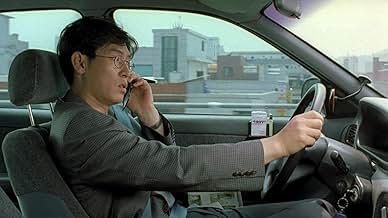
If you manage to not be annoyed during its opening minutes that features a deranged asshole with suicidal tendencies putting up an extraordinary display of craziness before killing himself by getting run over by a train, you just might be able to enjoy Peppermint Candy and even end up being impressed by it too. Told in reverse chronology, this film covers the past 20 years in the life of that stupid maniac & depicts the events that eventually led to his suicide while also showing that he was not such a weirdo from the beginning but was slowly transformed into one by the Korean 'system'.
Nicely directed by Lee Chang-dong for the manner he has narrated this story, well-written too for how the events depicted in the life of the protagonist clash with relevant moments of Korean history, manically performed by its lead actor that also included few moments where he went completely over the top & was hamming like a freak, and displaying fine technical execution throughout its runtime, Peppermint Candy is a sad portrait of a young life wasted away by cynicism & loss of love that didn't really work as well as I would've liked & eventually felt much longer than its runtime.
the origins of a Korean man's destruction
while it may take being Korean (and being part of the "386-generation" that really went through all the turbulent events of this movie's timeline) to fully appreciate this movie, it is nevertheless a powerful, graphic, and grippingly emotional commentary on South Korea of the the last twenty years. Director Chang-dong Lee masterfully presents the plot in reverse chronological order, and protagonist Kyung-gu Sol handily goes from broken buisnessman to lovesick schoolboy by the movie's end/his troubled road's beginning. In a way, this movie is perhaps Korea's unique and tragic answer to a movie like "Forrest Gump." "Na ottoke" ("what do I do?") - indeed, what does one do when faced with such experiences? Easily one of the best Korean movies I've seen to date.
Great film
At the beginning and at the end of the film I did not like his character and his horrible nature. but a good story. at the beginning of the storyline presented by people who are very depressed and suicidal, we will be presented with a flow of flasback back to the steps of the past, step by step from various character changes and behavioral conditions experienced.
I was curious that I read on the internet this film raised the issue of tragic events in 1980 (Gwangju Murder) through individual figures. Through this film, the director seems to want to illustrate the dramatic effect of the cruel event, the victims were not only civilians, but also "perpetrators", soldiers who had just carried out orders.
we can be prejudiced about this film but we can reflect on life that someone's future that might be destroyed can also be formed by a dark past.
¿Sabías que…?
- TriviaSeo-hie Ko's debut.
- ConexionesReferenced in Making Memories of Murder (2004)
- Bandas sonorasCatch the Rainbow
Written & Performed by Ritchie Blackmore and Ronnie James Dio
(Blackmore and Dio are member of Rainbow)
Selecciones populares
Inicia sesión para calificar y agrega a la lista de videos para obtener recomendaciones personalizadas
- How long is Peppermint Candy?Con tecnología de Alexa
Detalles
Taquilla
- Total a nivel mundial
- USD 89,184
Contribuir a esta página
Sugiere una edición o agrega el contenido que falta