CALIFICACIÓN DE IMDb
8.0/10
90 k
TU CALIFICACIÓN


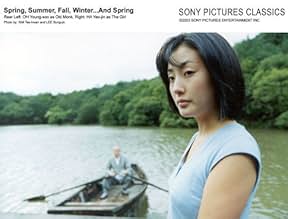
Un monje budista cría a un niño en un templo flotante en el que los años pasan igual de rápido que las estaciones.Un monje budista cría a un niño en un templo flotante en el que los años pasan igual de rápido que las estaciones.Un monje budista cría a un niño en un templo flotante en el que los años pasan igual de rápido que las estaciones.
- Dirección
- Escritura
- Estrellas
- Premios
- 16 premios ganados y 9 nominaciones en total





Oh Yeong-su
- Old Monk
- (as Young-soo Oh)


Seo Jae-kyeong
- Boy Monk
- (as Jae-kyeong Seo)

Ji Dae-han
- Detective Ji
- (as Dae-han Ji)


- Dirección
- Escritura
- Todo el elenco y el equipo
- Producción, taquilla y más en IMDbPro
8.089.9K
1
2
3
4
5
6
7
8
9
10
Opiniones destacadas
understated beautiful contemplative
a film of about the cycles of life, about solitude and love, innocence, corruption and redemption. stunning cinematography. lots of allusions and metaphors, as you might expect from Korean cinema. contemplative.
the story appears to centre on the life of buddhist monks living on a floating house, but as the film progresses, one sees that this is a film about the constancy within change and renewal. The female characters are not the most positive roles, representing corruption and temptation, tho also providing the means for renewal.
There are some memorable scenes not least the house in winter and the knife writing scene, this is not for those seeking martial arts action,
personally i found it slipped into one of favourite films list.
the story appears to centre on the life of buddhist monks living on a floating house, but as the film progresses, one sees that this is a film about the constancy within change and renewal. The female characters are not the most positive roles, representing corruption and temptation, tho also providing the means for renewal.
There are some memorable scenes not least the house in winter and the knife writing scene, this is not for those seeking martial arts action,
personally i found it slipped into one of favourite films list.
SYMBOLISM AND MEANING
At the risk of boring you all senseless here are some observations off the top of my head.
THE HUT Representing the self. All the possessions and shelter needed is on the floating hut. When the young man can no longer live at peace and comfort in the hut then bad things transpire. He never commits lustful acts in the hut. When we seek happiness outside ourselves, we are never truly content.
THE DOORS The doors by the lakeside and in the hut are symbolic rather than prescriptive. The fact there are no walls means their use is not forced but elected. They represent morality and discipline. Morality is not defined by a higher power but by society and the self. By adopting the constraints the doors engender, self-discipline is attained. As soon as the young man transgresses these self-imposed boundaries, to sneak across to the young woman, then disaster follows.
THE DEAD ANIMALS The Master allows the young boy to let the animals die. He does not become an all powerful father figure, cleaning up after him, but allows him to make mistakes and suffer the consequences. Buddhism does not have a higher power but rather promotes self-awareness.
THE MILLSTONE AND BUDDHA Represent the twin stones of regret for killing the fish and the snake. What you do unto others, you do unto yourself. He has carried that karma around with him all his life until he transcends them both, carrying them to the top of the hill, near heaven. Here he cuts himself free and attains redemption through struggle.
THE MASTER Is a great teacher, but does not lecture. Hardly a word is spoken, but lessons are learned. A good teacher points the way for a student to discover self-evident knowledge for themselves.
THE MOTHER The veil, representing guilt and shame are ultimately the cause of her downfall. Hiding from the outside world can bring about ruin.
THE YOUNG BOY Both at the beginning and the end, represents us. A good life is attained not by the absence of bad thoughts, but rather by their mastery, so they have no hold over us. We choose our behaviour rather than it choose us. The new boy is not born without sin, but rather must walk his own path to divinity. The same actor playing the young boy show the eternal cycle of the human soul.
THE SEASONS The endless cycle of birth, growth and death.
THE HUT Representing the self. All the possessions and shelter needed is on the floating hut. When the young man can no longer live at peace and comfort in the hut then bad things transpire. He never commits lustful acts in the hut. When we seek happiness outside ourselves, we are never truly content.
THE DOORS The doors by the lakeside and in the hut are symbolic rather than prescriptive. The fact there are no walls means their use is not forced but elected. They represent morality and discipline. Morality is not defined by a higher power but by society and the self. By adopting the constraints the doors engender, self-discipline is attained. As soon as the young man transgresses these self-imposed boundaries, to sneak across to the young woman, then disaster follows.
THE DEAD ANIMALS The Master allows the young boy to let the animals die. He does not become an all powerful father figure, cleaning up after him, but allows him to make mistakes and suffer the consequences. Buddhism does not have a higher power but rather promotes self-awareness.
THE MILLSTONE AND BUDDHA Represent the twin stones of regret for killing the fish and the snake. What you do unto others, you do unto yourself. He has carried that karma around with him all his life until he transcends them both, carrying them to the top of the hill, near heaven. Here he cuts himself free and attains redemption through struggle.
THE MASTER Is a great teacher, but does not lecture. Hardly a word is spoken, but lessons are learned. A good teacher points the way for a student to discover self-evident knowledge for themselves.
THE MOTHER The veil, representing guilt and shame are ultimately the cause of her downfall. Hiding from the outside world can bring about ruin.
THE YOUNG BOY Both at the beginning and the end, represents us. A good life is attained not by the absence of bad thoughts, but rather by their mastery, so they have no hold over us. We choose our behaviour rather than it choose us. The new boy is not born without sin, but rather must walk his own path to divinity. The same actor playing the young boy show the eternal cycle of the human soul.
THE SEASONS The endless cycle of birth, growth and death.
Perfect Simplicity
Perfect Simplicity
My review of this film should end with those two words. However, the 10 line minimum requirement that IMDb requires of all reviews belies the differences between my world and the world shown to me in Spring, Summer, Fall, Winter and Spring. I understand why IMDb does not want 1000's of (apparently) useless two-word reviews in their database. However, I would hope that they could make an exception for this film.
Perfect: The film is as close to perfect as a film could get. No shot is presented to us, nor a line of dialog uttered that does not make us ponder and understand at the same time. The film is also beautiful. (Like the previous reviewer, I am a fan of Asian cinema and never tire of the stunning ability of Asian directors to capture beauty on film.) This film exceeds most other Asian films I have seen in the cinematography regard. However, its beauty is surprisingly deceptive. Like most great films, it surpasses the 'cinematography' level of beauty and delves into the beauty of existence through its story. For example, the Old Monk has a different pet during each 'season' of his life. This is not discussed by the characters nor shoved in our face by the director as would have been done if Hollywood had done this film. It is merely background we experience and come to understand. Two days after viewing the film, I am still finding new reflections in my mind that encompass the cinematography, the literal story and the underlying context of the film.
Simplicity: This film approaches a level of cinematic Haiku. While I don't recall the entire dialog with any specificity, I am sure you could print the script on one page of paper. The amazing part is that while you are watching the film, you don't notice this. Every shot moves the story along. The simplicity of life as shown by the story is reflected in the simplicity of the film. After the film ended, I had a strong urge to move away from civilization and live or die in peace with nature. I enjoy (and have come to be too dependent upon) modern inventions, so I will stay at home. However, this film will remain in my heart. It does exactly what good story-telling is supposed to do: Take us completely out of our world and put us in another. There is no wonder that this film was selected for so many film festivals.
My review of this film should end with those two words. However, the 10 line minimum requirement that IMDb requires of all reviews belies the differences between my world and the world shown to me in Spring, Summer, Fall, Winter and Spring. I understand why IMDb does not want 1000's of (apparently) useless two-word reviews in their database. However, I would hope that they could make an exception for this film.
Perfect: The film is as close to perfect as a film could get. No shot is presented to us, nor a line of dialog uttered that does not make us ponder and understand at the same time. The film is also beautiful. (Like the previous reviewer, I am a fan of Asian cinema and never tire of the stunning ability of Asian directors to capture beauty on film.) This film exceeds most other Asian films I have seen in the cinematography regard. However, its beauty is surprisingly deceptive. Like most great films, it surpasses the 'cinematography' level of beauty and delves into the beauty of existence through its story. For example, the Old Monk has a different pet during each 'season' of his life. This is not discussed by the characters nor shoved in our face by the director as would have been done if Hollywood had done this film. It is merely background we experience and come to understand. Two days after viewing the film, I am still finding new reflections in my mind that encompass the cinematography, the literal story and the underlying context of the film.
Simplicity: This film approaches a level of cinematic Haiku. While I don't recall the entire dialog with any specificity, I am sure you could print the script on one page of paper. The amazing part is that while you are watching the film, you don't notice this. Every shot moves the story along. The simplicity of life as shown by the story is reflected in the simplicity of the film. After the film ended, I had a strong urge to move away from civilization and live or die in peace with nature. I enjoy (and have come to be too dependent upon) modern inventions, so I will stay at home. However, this film will remain in my heart. It does exactly what good story-telling is supposed to do: Take us completely out of our world and put us in another. There is no wonder that this film was selected for so many film festivals.
I was left speechless by this movie
This film left me speechless, and I still have a hard time putting how I feel about this movie into words. After seeing it the first time in the theater, my friend and I couldn't bring ourselves to say a word to each other...not even in the car on the ride back. The second time I saw it, after purchasing it, another friend and I walked around the campus for half an hour in silence. The third time, a friend and I sat in silence in her room for an hour after the movie was over. This film is that profound, touching, and moving.
Spring, Summer, Fall, Winter...Spring is the most beautiful movie I have ever seen. Visually it is fantastic, though several films surpass it in this aspect. However, the film manages to speak directly to the soul (or...failing to believe in the soul...something deep inside anyone watching it), and this is where it's beauty lies. Parts are so affecting that a painful nostalgia for a place you never knew overwhelms you.
I am sorry I cannot be more helpful...the quality that makes this movie so wonderful is well beyond words for me.
Spring, Summer, Fall, Winter...Spring is the most beautiful movie I have ever seen. Visually it is fantastic, though several films surpass it in this aspect. However, the film manages to speak directly to the soul (or...failing to believe in the soul...something deep inside anyone watching it), and this is where it's beauty lies. Parts are so affecting that a painful nostalgia for a place you never knew overwhelms you.
I am sorry I cannot be more helpful...the quality that makes this movie so wonderful is well beyond words for me.
a Buddhist meditation on life and death, and what surrounds us
I remember when I saw this film on screen last year, I was struck by the rhythm director Kim Ki-Duk used in the film. It's deliberate, too deliberate for most I'd suppose. But like a reading good piece of philosophy, the filmmaker allows the viewer to get as much as they may find in the work. The story is more of a fable than a really conventional narrative- a baby is delivered to the steps of a Buddhist house on a lake, where the boy is raised by a master. He grows up, and falls temptation to the desires of the world. He decides to leave, only to return and find himself again. In the end, as winter comes, things come full circle. Each of the 'seasons' of the film are handled delicately, with the kind of simplicity that may appeal even more to children (the segment of the first 'spring' with the child transcends religion and goes into the basic stance of nature). The scenes of finding lust in 'summer' is not terribly graphic, but it puts the point on what is right and wrong in the customs and traditions of the religion. Then in 'Autumn', there are harsher lessons to be learned, and this also contains the best acting from the old master and the young, angry pupil. And 'Winter' becomes the most meditative of them all, with next to no dialog. Indeed that may be the turn off to most viewers- to say that the film isn't supported by dialog is an under-statement. And its not necessarily documentary realism. What I sensed from the film, and what stuck with me for a few days afterward, was the spiritual attitude behind the style, the confidence that the rhythm had a connection with the subject matter. It's one of the most soulful films to come out of the Eastern world in some time. It's less a traditional drama than a unique experience, for better or worse, really more for the better.


¿Sabías que…?
- TriviaThe inscription on the floor is "The Heart Sutra", one of the most important Sutra of Mahayana Buddhism, written in literary Chinese.
- ErroresWhen the young monk finishes inscribing the Heart Sutra on the floor and falls down exhausted, the inscriptions below him change between shots (even though he is lying motionless). In one shot, the inscriptions he is lying on have been painted; and as he wakes up, the paint is gone.
- Versiones alternativasThe local Korean version of this film is approximately 90 seconds longer than the International release; a sequence was removed near the end of the film (at about the 100-minute point). This is reflected in the DVD releases, as the Tartan R2 (UK) release and the Columbia/Tristar R1 (USA) release use the International cut of the film, while the Bitwin R3 (Korean) DVD uses the original cut.
- ConexionesFeatured in Arirang (2011)
- Bandas sonorasJeongseon Arirang
Traditional
Performed by Kim Young Im
Selecciones populares
Inicia sesión para calificar y agrega a la lista de videos para obtener recomendaciones personalizadas
- How long is Spring, Summer, Fall, Winter... and Spring?Con tecnología de Alexa
Detalles
- Fecha de lanzamiento
- Países de origen
- Sitio oficial
- Idioma
- También se conoce como
- Spring, Summer, Fall, Winter... and Spring
- Locaciones de filmación
- Productoras
- Ver más créditos de la compañía en IMDbPro
Taquilla
- Total en EE. UU. y Canadá
- USD 2,380,788
- Fin de semana de estreno en EE. UU. y Canadá
- USD 42,561
- 4 abr 2004
- Total a nivel mundial
- USD 8,842,902
- Tiempo de ejecución
- 1h 43min(103 min)
- Color
- Mezcla de sonido
- Relación de aspecto
- 1.85 : 1
Contribuir a esta página
Sugiere una edición o agrega el contenido que falta