
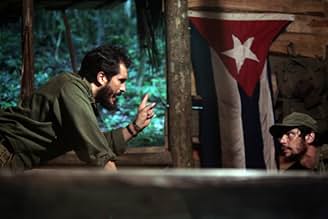
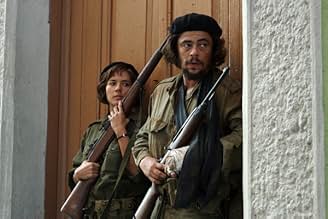
En 1956, Ernesto 'Che' Guevara y un grupo de exiliados cubanos liderados por Castro movilizan un ejército para derrocar al régimen del dictador Fulgencio Batista.En 1956, Ernesto 'Che' Guevara y un grupo de exiliados cubanos liderados por Castro movilizan un ejército para derrocar al régimen del dictador Fulgencio Batista.En 1956, Ernesto 'Che' Guevara y un grupo de exiliados cubanos liderados por Castro movilizan un ejército para derrocar al régimen del dictador Fulgencio Batista.
- Dirección
- Escritura
- Estrellas
- Premios
- 4 premios ganados y 13 nominaciones en total



- Interpreter
- (as Óscar Isaac)

- María Antonia
- (as María Isabel Díaz)

- Fidel Castro
- (as Demian Bichir)


- Héctor
- (as Ramón Fernández)

- Alejandro Ramírez
- (as Yul Vázquez)


- Jorge Sotús
- (as Jsu García)
- Rebel Messenger #1
- (as Luis Rodríguez Sánchez)

- Juan Almeida
- (as Roberto Luis Santana)
- Dirección
- Escritura
- Todo el elenco y el equipo
- Producción, taquilla y más en IMDbPro
Opiniones destacadas
Engaging, interesting and informative.
Of course, the icon that I refer to is quite obviously Cuban revolutionist Ernesto 'Che' Guevara here played by Benicio Del Toro, a figure now embellished upon the memories of those with slightest interest in political history. If not, then you probably have his face on a t-shirt somewhere and you didn't know. Yet it doesn't matter how or why you know of Guevara before you view Che because Peter Buchman does a fine job of introducing you to him here. Plus, coupled with a performance that never begs for attention but instead simply plays the man he's supposed to be portraying with no overt padding, Del Toro goes a long way to giving Che the right amount of conviction that is needed to keep thing interesting and dynamic. Make no mistake, this is no dramatization of the man's life, so Del Toro never piles on the melodrama or anything to that degree to win over the audience, and this is reflected not only through the movie's ensemble of performances, but through the entire production itself.
Had the feature remained its original singular, five hour form however, a different opinion may have been garnered, but as it stands, the movie does well on its own merit. Part One, which details the initial struggle of the revolution of Cuba, is less about Guevara and more about his cause under the leadership of Fidel Castro. Granted, focus is shifted every now and again to set up part two's inevitable centralization upon Che himself, but for the most part, Part One remains more as a wide-angled view on the movement in which Guevara was part of. This shift in focus does well to once again distance the movie away from mere speculative entertainment and more towards the form of an educational informant. Yes, there are scenes that drag on and on, and generally some of these seem superfluous and dubious to the overall arc of the production, but for the most part, the script and direction remains coherent in its willingness to merely document rather than emote.
As a whole, Che's first half is an unassuming picture. At first glance, it isn't anything remotely special, and probably won't provide viewers with any degree of resonance if they are not interested in the man and his people's struggle beforehand, yet the same can be said for a number of similar features. Instead, I can only recommend this to those who are interested in the revolution and don't mind slow paced, attention-demanding material that does entertain from time to time, but only as a natural result of its historical importance. Again, those looking for a character piece similar to Stone's portrayal of George W. Bush last year would be wise to reevaluate their will to see Che; although titled after the man himself, and a biopic on a purely ostensible level, Che is more about his fight than the man himself. There are no real moments of personal insight here, no cathartic revelations or studies of psyche. No, instead the movie tells the facts as they were, straight from the horses mouth, and while they can sometimes work against the common desires of cinema goers' need for personal fulfillment, if digested objectively, can provide a strongly engaging, interesting and informative piece of historically significant art.
- A review by Jamie Robert Ward (http://www.invocus.net)
Radio Rebelde / Radical Writings on Guerilla Warfare
He retained however what I believe would be Malick's approach: no politics and a just visual poem about the man behind the image, exhaustive as the horrible slog through Cuban jungles and windswept Andean plateaus must have been. Malick applied this to his New World that he abandoned Che for, lyrical many times over.
But Soderbergh being an ambitious filmmaker, he puzzled over this a little more. Here was a man of action at the center of many narratives about him, some fashioned by himself, conflictingly reported as iconic revolutionary or terrorist, charismatic leader or ruthless thug, erudite Marxist thinker or brutal soldier.
So how to visually exemplify this contradicting ethos as our film about him? And how to arrange a world around this person in such a way as to absorb him whole, unfettered from narrative - but writing it as he goes along - off camera - but ironically on - and as part of that world where narratives are devised to explain him. As flesh and bones, opposed to a cutout from a history book.
One way to do this, would be via Brecht and artifice. The Korda photograph would reveal lots, how we know people from images, how we build narratives from them. Eisenstein sought the same in a deeper way, coming up with what he termed the 'dialectical montage': a world assembled by the eye, and in such ways as the eye aspires to create it.
So what Soderbergh does, is everything by halves: a dialectic between two films trailing opposite sides of struggle, glory and failure, optimism and despair. Two visual palettes, two points of view in the first film, one in the presence of cameras hoping to capture the real person, the other were that image was being forged in action.
The problem, is of course that Brecht and Eisenstein made art in the hope to change the world, to awaken consciousness, Marxist art with its trappings. By now we have grown disillusioned with the idea, and Soderbergh makes no case and addresses no present struggles.
But we still have the cinematic essay about all this.
The first part: a narrative broadcast from real life, meant to reveal purpose, ends, revolution. The second part: we get to note in passing a life that is infinitely more expansive than any story would explain, more complex, beautiful, frustrating, and devoid of any apparent purpose other than what we choose as our struggle, truly a guerilla life.
I imagine a tremendous film from these notions. Just notice the remarkable way Part 2 opens. Che arrives at Bolivia in disguise, having shed self and popular image. No longer minister, spokesman, diplomat, guerilla, he is an ordinary man lying on a hotel bed, one among many tourists. Life could be anything once more, holds endless possibility. Cessation.
What does he do? He begins to fashion the same narrative as before, revolution again. Chimera this time. Transient life foils him in Bolivia. Instead of changing the world once more, he leaves behind a story of dying for it. We have a story about it as our film, adding to the rest.
Atmospheric and well made but...
Don't get me wrong, there is nothing specifically wrong with this film. It portrays a fairly accurate (if, as I said, sanitised) picture of the March on Santa Clara and the victory of Castro's rebels. However much in the same way as the kind of perpetually running museum film that you can dip in and out of it is largely uninspiring and leaves you feeling quite detached. The problem is not the direction or the acting which does manage to transport you into the heart of a Civil War ravaged Cuba. It is the fact that we learn next to nothing about Cuba, Che himself or the goals of the revolutionaries. We learn nothing of why the Batista regime was so bad that people wanted to overthrow it. Which means that this simply stands alone as a war film where there are lots of explosions, lots of running around and some scenes of people celebrating in the streets. While I understand from reports that Che Part Two is rather different I think that nevertheless the slight blandness of Che Part One means that, though it looks good, it does feel like a rather wasted opportunity.
Hard, Gritty and To the Point But Not In the Way You Expect
The acting of the cast all around was very good but Benicio Del Toro took the movie by storm but he did this in a very subtle way. His performance displayed how Che's spirit was able to superseded the hardships faced in the Cuban Revolution. It did not display any brutality or recklessness but a devotion to a cause. Del Toro's perforations was that worthy of an Oscar nomination but I don't think Che Guervara cared to much about awards.
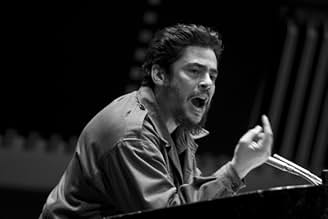
The directing by Steven Soderbergh was visually stunning at times with much of the scenes shot in the forest. What kept the movie upbeat though were the scenes of Che in New York giving interviews and addressing the U.N. It added an extra layer to the film allowing you to see another side of Che. The side in which he shows his political and speaking abilities. The writing was very good with the dialog always keeping you engrossed. The music, though not much of it, was very good and stayed within rhythm of the rest of the film.
Overall the film succeeds in showing Che as a well rounded man never developing into oversimplified or unnecessarily complex portrayal of a man. The movie was very accurate and refused to take on a role of being inspiring or Hollywoodish which I enjoyed. The only problem with the film I had was that it seems to have a little too much of a feel of a war film rather than a biopic. Still I highly recommend this film.
Rage Against the Machine
If this means that we may not get exactly a fully rounded portrait of its titular protagonist/hero, then that's probably the only real liability that the picture has. Maybe, perhaps, rightfully so; Che wasn't a guy, at least in his prime revolutionary years, to be one that had much warmth or moments of doubt (and if he had them, they were behind closed doors and out of any record of diaries). So what we get in Part 1, the conventional "Rise" of the character in the story, is the tale of how to do a revolution right- or rather, how to take over a government by military force, and it's Che as a man who pretty quickly becomes a natural leader, a stern taskmaster and also someone who "loves" as a revolutionary must, Che says.
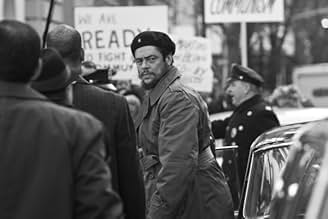
It's gripping film-making nevertheless, with Soderbergh commanding the narrative wonderfully between a color-filmed part-digital-part-35mm Red-camera on the 1957-1959 events in Cuba and the 1964 trip to the UN in New York filmed in grainy black and white. What we get is part documentary and part bio-pic, words straight from the guerrilla's mouth, as it were, and the events that led up to the take-over (which serves as the climax of the picture) in Santa Clara, Cuba. Some of the elements, as noted, are conventional of just a war picture: we get the young kids (16 and 14) who will do anything to fight with Guevara and his group; we get the supposed love interest, only (thankfully) muted with only one scene with small talk; and we get the moments of enthusiasm, humor, camaraderie, and unlikely bravery in the heat of battle.
But most importantly we see Benicio del-Toro take command of this role like he does seemingly often but rarely with such force. In fact, he probably elevates this Che past some possible pit-falls (this project was actually his baby, as he serves as co-producer and developed the project for years), and makes him as human as he can be, using Che's health-tic (asthma) to its fullest, and reveling in going for broke as far as gusto and revelation go. For all of Soderbergh's command of the film-making style- most of all, for me, during the climactic battle where we get to see him awesomely direct a battle sequence- del-Toro, for any scene he's in, steals the show. If for nothing else, whatever your political stance or thoughts on Che, he's worth the admission. 8.5/10


¿Sabías que…?
- TriviaFor his role, Benicio Del Toro spent seven years researching Guevara's life.
- ErroresWhen the guerrilleros are in the Sierra Maestra, we can hear the coqui (Eleutherodactylus coqui) singing in the night. However, this small frog is endemic to Puerto Rico and the Virgin Islands, thus not possible to be heard in Cuba.
- Citas
Lisa Howard: What is the most important quality for a revolutionary to possess?
Ernesto Che Guevara: El amor.
Cuban Diplomat #1: [translating] Love.
Lisa Howard: Love?
Cuban Diplomat #1: Love of humanity... of justice and truth. A real revolutionary goes where he is needed.
- ConexionesFeatured in Así se hizo - Che El Argentino (2008)
- Bandas sonorasBasura
Written and Performed by Mark A. Mangini (as Mark Mangini)
Selecciones populares
Detalles
Taquilla
- Presupuesto
- USD 35,000,000 (estimado)
- Total en EE. UU. y Canadá
- USD 748,555
- Fin de semana de estreno en EE. UU. y Canadá
- USD 61,070
- 14 dic 2008
- Total a nivel mundial
- USD 34,209,066
- Tiempo de ejecución
- 2h 14min(134 min)
- Color
- Mezcla de sonido
- Relación de aspecto
- 2.39 : 1