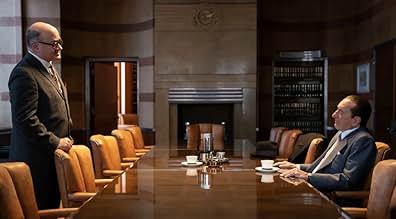
Vito Genovese y Frank Costello, una pareja de italoamericanos que dirigen dos familias del crimen distintas a mediados del siglo XX. Genovese intentó asesinar a Costello en 1957, aunque éste... Leer todoVito Genovese y Frank Costello, una pareja de italoamericanos que dirigen dos familias del crimen distintas a mediados del siglo XX. Genovese intentó asesinar a Costello en 1957, aunque éste se retiró de la mafia.Vito Genovese y Frank Costello, una pareja de italoamericanos que dirigen dos familias del crimen distintas a mediados del siglo XX. Genovese intentó asesinar a Costello en 1957, aunque éste se retiró de la mafia.
- Dirección
- Escritura
- Estrellas
- Premios
- 1 premio ganado y 1 nominación en total
- Dirección
- Escritura
- Todo el elenco y el equipo
- Producción, taquilla y más en IMDbPro
5.918K
1
2
3
4
5
6
7
8
9
10
Opiniones destacadas
Sort of a history lesson
Barry Levinson directed this mediocre gangster movie, with writer Nick Pileggi turning a potentially dramatic story into a generally dull exercise in nostalgia, genre cliches and a showpiece for Robert DeNiro to show off his considerable acting skills.
First hour is uninvolving and hard to sit through, thanks to an awkward flashback structure and rat-a-tat-tat editing. It opens with De Niro has mobster Frank Costello surviving an assassination attempt in 1957, and then fills in the his story and that of his childhood friend, mobster Vito Genovese (also played by DeNiro), leading up to the second half where their troubled relationship comes to an end -and the picture gets interesting. Too late for me, after suffering through that first half.
Levinson is bogged down in nostalgia, all the vintage cars, lots of old footage of familiar real-life celebs ranging from Louis Prima and Louie Bellson to James Cagney and Little Richard, and hectic montages of still photos. After a while, I was wishing that this was a Ken Burns documentary titled "The Crime Families" instead.
The entire movie is told from Costello's point-of-view, with sort of a third DeNiro playing old age Costello and looking more like Martin Scorsese (my peculiar reaction only). DeNiro's acting plus the script sugarcoat the Costello character to such an extent that he comes off as the "good guy" of the story.
But it is DeNiro as hothead/nutcase Genovese that is the flamboyant role here, especially compared to the overly bland Costello presentation. Levinson would have been better off casting Joe Pesci as Genovese. The gimmick of DeNiro times two, playing both leading roles in a movie, comes off in a technical sense, but is distracting from the story.
Supporting cast is extremely weak, mostly making no impression at all. An exception is Kathrine Narducci as Genovese's fiery wife Anna -she's the best thing in the picture. Debra Messing as Costello's wife is stuck in a nothing part. Of all the subsidiary gangsters in a large cast, only Michael Rispoli as Albert Anastasia stands out of the crowd.
First hour is uninvolving and hard to sit through, thanks to an awkward flashback structure and rat-a-tat-tat editing. It opens with De Niro has mobster Frank Costello surviving an assassination attempt in 1957, and then fills in the his story and that of his childhood friend, mobster Vito Genovese (also played by DeNiro), leading up to the second half where their troubled relationship comes to an end -and the picture gets interesting. Too late for me, after suffering through that first half.
Levinson is bogged down in nostalgia, all the vintage cars, lots of old footage of familiar real-life celebs ranging from Louis Prima and Louie Bellson to James Cagney and Little Richard, and hectic montages of still photos. After a while, I was wishing that this was a Ken Burns documentary titled "The Crime Families" instead.
The entire movie is told from Costello's point-of-view, with sort of a third DeNiro playing old age Costello and looking more like Martin Scorsese (my peculiar reaction only). DeNiro's acting plus the script sugarcoat the Costello character to such an extent that he comes off as the "good guy" of the story.
But it is DeNiro as hothead/nutcase Genovese that is the flamboyant role here, especially compared to the overly bland Costello presentation. Levinson would have been better off casting Joe Pesci as Genovese. The gimmick of DeNiro times two, playing both leading roles in a movie, comes off in a technical sense, but is distracting from the story.
Supporting cast is extremely weak, mostly making no impression at all. An exception is Kathrine Narducci as Genovese's fiery wife Anna -she's the best thing in the picture. Debra Messing as Costello's wife is stuck in a nothing part. Of all the subsidiary gangsters in a large cast, only Michael Rispoli as Albert Anastasia stands out of the crowd.
I don't see why all the hate
I don't see why all the "hate" for this movie. It's a decent mafia movie. Not great, not terrible. I see people complaining that De Niro shouldn't been playing two characters, especially the main characters. I think he did a good job, which shows his incredible talent of getting into different characters. Yes, you could see it's the same person, the difference was not big, Frank Costello and Vito Genovese didn't look alike but you could see who was who in the movie.
It's not the typical, highly violent mafia movie we're used to and perhaps that's why it doesn't get up there in the top. It's hard to compare it to the classics. I remind you that The Irishman was also different from what we're used to when it comes to mafia movies, De Niro and Scorsese. But that's how it is, they can't make the same format of movies because we'd get bored of it.
This movie stands in its own, and shouldn't be compared with the classics. It's a different approach.
Anyway, like I said, it's not a masterpiece nor a fiasco. It's a good, decent movie for people interested in the mafia/gangster genre.
It's not the typical, highly violent mafia movie we're used to and perhaps that's why it doesn't get up there in the top. It's hard to compare it to the classics. I remind you that The Irishman was also different from what we're used to when it comes to mafia movies, De Niro and Scorsese. But that's how it is, they can't make the same format of movies because we'd get bored of it.
This movie stands in its own, and shouldn't be compared with the classics. It's a different approach.
Anyway, like I said, it's not a masterpiece nor a fiasco. It's a good, decent movie for people interested in the mafia/gangster genre.
Fine addition to the De Niro mobster canon.
After seeing over the years Robert De Niro star in gangster films such as Mean Streets, Goodfellas, Casino, and The Irishman, it's astonishing to see him play gangster fresh in The Alto Knights. Sure, we've seen most of his facial and vocal turns before, but never in two different mobsters in the same film with two distinct personalities.
Narrator Frank Costello (De Nir0) is an analytical businessman not wholly invested in being a mid-twentieth century icon; his former best friend from youth, Vito Genovese (De Niro), is a hot head bound to lead the mob in the US, regardless of his friendship with current mob head, Frank. To see De Niro play both nose to nose in negotiations is to see one of the great film actors of all time.
When you look into Frank's eyes, you see latent menace that has caused countless deaths. Looking at Vito's glasses, you don't have the depth but rather a surface violence, hardly hidden. A great actor brings both distinct personalities alive.
Director Barry Levinson also brings his memorable work with Bugsy and Wag the Dog while writer Nicholas Pileggi brings traces of success from Goodfellas and Casino. With the three pedigrees converging in The Alto Knights, you must expect greatness, and you get it, maybe not throughout but enough to say that if Coppola and Brando had also been involved, this film would have been incomparable.
Most scenes are intimate as Frank's wife Bobbie (Debra Messing), and he quietly map out their fate. More flamboyant is Vito's wife, Anna (Katherine Narducci), whose courtroom histrionics as she testifies against him is the stuff of in your face while it contrasts with De Niro's subtler approach (not his usual path). The variety of acting and its excellence makes this a gangster film you should not refuse.
Narrator Frank Costello (De Nir0) is an analytical businessman not wholly invested in being a mid-twentieth century icon; his former best friend from youth, Vito Genovese (De Niro), is a hot head bound to lead the mob in the US, regardless of his friendship with current mob head, Frank. To see De Niro play both nose to nose in negotiations is to see one of the great film actors of all time.
When you look into Frank's eyes, you see latent menace that has caused countless deaths. Looking at Vito's glasses, you don't have the depth but rather a surface violence, hardly hidden. A great actor brings both distinct personalities alive.
Director Barry Levinson also brings his memorable work with Bugsy and Wag the Dog while writer Nicholas Pileggi brings traces of success from Goodfellas and Casino. With the three pedigrees converging in The Alto Knights, you must expect greatness, and you get it, maybe not throughout but enough to say that if Coppola and Brando had also been involved, this film would have been incomparable.
Most scenes are intimate as Frank's wife Bobbie (Debra Messing), and he quietly map out their fate. More flamboyant is Vito's wife, Anna (Katherine Narducci), whose courtroom histrionics as she testifies against him is the stuff of in your face while it contrasts with De Niro's subtler approach (not his usual path). The variety of acting and its excellence makes this a gangster film you should not refuse.
Shoulda Woulda Coulda
Bobby shoulda only played Frank and it coulda been better had he woulda.
Fine lead actor and to some degree he can perform character actor but playing opposite himself was distracting for me. His voice inflections and tonality, mannerisms, and basic personality made scenes with both characters very monotone. That carried over to solo scenes as well. Makeup was good but not good enough to dispell.
Overall I enjoyed the movie, but would have appreciated it with Keitel, Pacino, Hoffman, or many other possible actors playing opposite in the Vito role.
Messing was great.
PS Joe Bonanno would slap you senseless had he seen where you made him old and frail before his time. I knew him in the 1970s and he still presented a formidable presence.
Fine lead actor and to some degree he can perform character actor but playing opposite himself was distracting for me. His voice inflections and tonality, mannerisms, and basic personality made scenes with both characters very monotone. That carried over to solo scenes as well. Makeup was good but not good enough to dispell.
Overall I enjoyed the movie, but would have appreciated it with Keitel, Pacino, Hoffman, or many other possible actors playing opposite in the Vito role.
Messing was great.
PS Joe Bonanno would slap you senseless had he seen where you made him old and frail before his time. I knew him in the 1970s and he still presented a formidable presence.
Why 2 De Niro??
This film was a bit like all of the other Robert De Niro Italian Mafia films, so you know what you're going to get. It's enjoyable, and by no means a bad film, but a tad formulaic.
I am unclear why De Niro played both main characters - at times it felt a little confused and, to be honest, my mind wandered to the prosthesis that went in to differentiating his looks. Was the fact he played both, a metaphor on the nature of the individuals (because this was based on real people), a commentary on the nature of the type of people involved, just a bit of fun for the actor, or an attempt to save money? Whichever, whilst it didn't have much of an impact on the film, it was odd.
As I say above, even though formulaic, an Nobel film, but with no surprises.
I am unclear why De Niro played both main characters - at times it felt a little confused and, to be honest, my mind wandered to the prosthesis that went in to differentiating his looks. Was the fact he played both, a metaphor on the nature of the individuals (because this was based on real people), a commentary on the nature of the type of people involved, just a bit of fun for the actor, or an attempt to save money? Whichever, whilst it didn't have much of an impact on the film, it was odd.
As I say above, even though formulaic, an Nobel film, but with no surprises.
Banda sonora
Previsualiza la banda sonora aquí y sigue escuchando en Amazon Music.
¿Sabías que…?
- TriviaMarlon Brando had said he had based his raspy voice portrayal of Don Vito Corleone in El padrino (1972) on Frank Costello's voice as heard from hearings aired on TV. Robert De Niro who also played a young Vito Corleone in El padrino (parte II) (1974) goes full circle and portrays Frank Costello. However, in this film they stayed away from Costello's raspy voice imitation.
- ErroresIn the barber shop when a character is shot, there are two shooters firing at him. Even though both assassins use six-shooter revolvers and never reload, meaning max. 12 shots could be fired, more than 20 shots are heard.
- ConexionesFeatures Alma negra (1949)
- Bandas sonorasThat Old Black Magic
Written by Harold Arlen and Johnny Mercer
Performed by Louis Prima and Keely Smith
Selecciones populares
Inicia sesión para calificar y agrega a la lista de videos para obtener recomendaciones personalizadas
- How long is The Alto Knights?Con tecnología de Alexa
Detalles
- Fecha de lanzamiento
- País de origen
- Sitio oficial
- Idioma
- También se conoce como
- The Alto Knights
- Locaciones de filmación
- Productoras
- Ver más créditos de la compañía en IMDbPro
Taquilla
- Presupuesto
- USD 45,000,000 (estimado)
- Total en EE. UU. y Canadá
- USD 6,103,664
- Fin de semana de estreno en EE. UU. y Canadá
- USD 3,165,349
- 23 mar 2025
- Total a nivel mundial
- USD 10,203,664
- Tiempo de ejecución
- 2h 3min(123 min)
- Color
- Mezcla de sonido
- Relación de aspecto
- 2.39 : 1
Contribuir a esta página
Sugiere una edición o agrega el contenido que falta