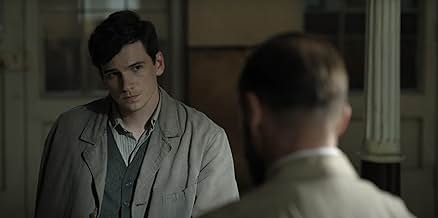
El exigente Dr. Guthrie recluta a niños para un coro tras alistarse sus hombres en la Primera Guerra Mundial. Juntos experimentan la alegría de cantar mientras los niños se enfrentan a su in... Leer todoEl exigente Dr. Guthrie recluta a niños para un coro tras alistarse sus hombres en la Primera Guerra Mundial. Juntos experimentan la alegría de cantar mientras los niños se enfrentan a su inminente reclutamiento.El exigente Dr. Guthrie recluta a niños para un coro tras alistarse sus hombres en la Primera Guerra Mundial. Juntos experimentan la alegría de cantar mientras los niños se enfrentan a su inminente reclutamiento.
- Dirección
- Escritura
- Todo el elenco y el equipo
- Producción, taquilla y más en IMDbPro
6.6839
1
2
3
4
5
6
7
8
9
10
Opiniones destacadas
Thy judgment now is near.
Having finished "Regretting You" where I was (uncomfortably) the oldest person in the screening, I walked straight into "The Choral" where I was (comfortably) the youngest person in the room. I think I appreciated aspect of the film, more than actually loving it.
During the first World War, with many of the men away at the front, the Northern Mill town of Ramsden are looking to revamp their choral society. Led by the Alderman and mill owner Bernard Duxbury (Roger Allam), the committee pick Dr Henry Guthrie (Ralph Fiennes). Though talented and driven, Guthrie is a controversial choice as he's recently lived and worked in Germany, and his appreciation for the musical maestros of the country remains, despite the wartime opposition.
Within the scope of what I've written above there are dozens of smaller stories, some about class and respectability, some about love and fidelity in a time of shifting associations, some about loss, xenophobia, homophobia, the desire to get to the war and prove yourself, the hypocrisy of those who control it, the painful realities of who comes back and who never will. If anything, there is perhaps too much going on, too many little stories to service. Some are hinted at but never really explored, some filter out. It might have benefited more from being a Sunday evening BBC series, than a two-hour film.
The performances are never less than excellent though, as is the historical recreation - though finding a town like Saltaire to film in probably does most of that work.
I had no regrets whilst watching the film, though I doubt I'll plan to revisit it again any time soon.
During the first World War, with many of the men away at the front, the Northern Mill town of Ramsden are looking to revamp their choral society. Led by the Alderman and mill owner Bernard Duxbury (Roger Allam), the committee pick Dr Henry Guthrie (Ralph Fiennes). Though talented and driven, Guthrie is a controversial choice as he's recently lived and worked in Germany, and his appreciation for the musical maestros of the country remains, despite the wartime opposition.
Within the scope of what I've written above there are dozens of smaller stories, some about class and respectability, some about love and fidelity in a time of shifting associations, some about loss, xenophobia, homophobia, the desire to get to the war and prove yourself, the hypocrisy of those who control it, the painful realities of who comes back and who never will. If anything, there is perhaps too much going on, too many little stories to service. Some are hinted at but never really explored, some filter out. It might have benefited more from being a Sunday evening BBC series, than a two-hour film.
The performances are never less than excellent though, as is the historical recreation - though finding a town like Saltaire to film in probably does most of that work.
I had no regrets whilst watching the film, though I doubt I'll plan to revisit it again any time soon.
A Very British Film: Amusing, touching and well-crafted
It's the summer of 1916, and the industrial town of Ramsden in Yorkshire is feeling the effects of World War I. When their choirmaster volunteers, the committee of the local choral society reluctantly recruits the controversial Dr Guthrie - German-loving, atheist and gay - to lead their efforts.
Led by a predictably titanic performance from Ralph Fiennes, the film's strong cast lead us through many of the varying complexities of life during the war with a combination of humour and pathos, taking - for the most part - a relatively light touch. That approach creates the film's major strength and its major weakness: in touching upon these issues without drawing them out, it keeps the focus on the music and the tone of the movie relatively pleasant and enjoyable; however, in introducing so many social issues and then failing to address any of them properly, it feels somewhat like the filmmakers chickened out of making the film they wanted to make.
The principal focus is, of course, the music, and this is (eventually) performed wonderfully, led by the impressive vocal talents of Amara Okereke and Jacob Dudman. The journey from the ragtag band of overinflated egos to the denouement performance is well-told, if a tad predictable.
The other major theme is the war, and here the film underplays its hand a little. Elements of it are touching, but - despite some serious injuries on display, a soliloquy on the hell of war from Clyde, and a conversation about "the things you've seen" - the impact of the conflict on the returning soldiers is mostly left unexplored. Clyde, for example, appears to be far more concerned about his lost love than any physical or psychological scars he bears from his time in the trenches. It seems singing cures all such ills.
Other social issues of the time, such as religion, class division, even prostitution, are mostly played for laughs. The film seems intent at some points on making a serious point about homosexuality, but having set itself up for this, it fizzles out without anything of substance landing. At various points the film also seems ready to embark on a treatise that there is more that unites Britain and Germany than divides them, but again seems to lose heart.
The result is a film that is pleasant, enjoyable, and very watchable, but which fails to land any meaningful blows on most of the issues it raises.
Led by a predictably titanic performance from Ralph Fiennes, the film's strong cast lead us through many of the varying complexities of life during the war with a combination of humour and pathos, taking - for the most part - a relatively light touch. That approach creates the film's major strength and its major weakness: in touching upon these issues without drawing them out, it keeps the focus on the music and the tone of the movie relatively pleasant and enjoyable; however, in introducing so many social issues and then failing to address any of them properly, it feels somewhat like the filmmakers chickened out of making the film they wanted to make.
The principal focus is, of course, the music, and this is (eventually) performed wonderfully, led by the impressive vocal talents of Amara Okereke and Jacob Dudman. The journey from the ragtag band of overinflated egos to the denouement performance is well-told, if a tad predictable.
The other major theme is the war, and here the film underplays its hand a little. Elements of it are touching, but - despite some serious injuries on display, a soliloquy on the hell of war from Clyde, and a conversation about "the things you've seen" - the impact of the conflict on the returning soldiers is mostly left unexplored. Clyde, for example, appears to be far more concerned about his lost love than any physical or psychological scars he bears from his time in the trenches. It seems singing cures all such ills.
Other social issues of the time, such as religion, class division, even prostitution, are mostly played for laughs. The film seems intent at some points on making a serious point about homosexuality, but having set itself up for this, it fizzles out without anything of substance landing. At various points the film also seems ready to embark on a treatise that there is more that unites Britain and Germany than divides them, but again seems to lose heart.
The result is a film that is pleasant, enjoyable, and very watchable, but which fails to land any meaningful blows on most of the issues it raises.
Good faith movie but otherwise a very average tale
Watched at the 2025 Toronto International Film Festival.
Ralph Fiennes provides a very strong and energetic performance in an otherwise, cheesy and predictable period piece tale about WWII. The writing and direction pretty follows every single cheesy, predictable and basic structure for period piece movies in recent times. While it does offer some new insight about the time era and the characters purposes and setting, as a whole, the movie doesn't really offer much to add. Because many of the narrative choices and structure was predictable, cliche and uninteresting.
Throughout, the musical moments are pretty good as there are some heartfelt purposeful singing and musical scores. The production designs are good and the performances from Fiennes and the other are pretty good. However, character-wise, they all feel one noted. Their development is pretty lacking and are displayed like many cliched historical movies without substance or creativity.
Alongside with some bland camerawork and pacing issues, the movie does have some strange coloring effects that makes the movie at times, feel unnecessarily dull. Including with some pacing issues.
Overall, it has good intentions but the experience was pretty forgettable.
Ralph Fiennes provides a very strong and energetic performance in an otherwise, cheesy and predictable period piece tale about WWII. The writing and direction pretty follows every single cheesy, predictable and basic structure for period piece movies in recent times. While it does offer some new insight about the time era and the characters purposes and setting, as a whole, the movie doesn't really offer much to add. Because many of the narrative choices and structure was predictable, cliche and uninteresting.
Throughout, the musical moments are pretty good as there are some heartfelt purposeful singing and musical scores. The production designs are good and the performances from Fiennes and the other are pretty good. However, character-wise, they all feel one noted. Their development is pretty lacking and are displayed like many cliched historical movies without substance or creativity.
Alongside with some bland camerawork and pacing issues, the movie does have some strange coloring effects that makes the movie at times, feel unnecessarily dull. Including with some pacing issues.
Overall, it has good intentions but the experience was pretty forgettable.
Very moving & emotional.
Some huge names in this film. Was expecting a lot and it didn't disappoint. Was very impressed with the acting and costumes.
Great opening scene with the telegram coming to the door and the lady with her little boy. Probably being told his dad is dead!
The script is very well thought out and extremely moving.
Went to see it on remembrance Sunday and was a great experience.
Well done to all involved.
Great opening scene with the telegram coming to the door and the lady with her little boy. Probably being told his dad is dead!
The script is very well thought out and extremely moving.
Went to see it on remembrance Sunday and was a great experience.
Well done to all involved.
Beautiful and moving
It might have been because I love the dialogue of Alan Bennett, it might have been also because it was filmed within 5 miles of my house and I could revel in the street and mill scenes that are so familiar to me, it might also have been because I can happily sit and listen to music like this and just be. What I think it actually was, was the story - coming of age, the futility of war, the nonsense of people judging others - all contributing to a feel good lovely piece of cinema.
And yes the man I met in a shop recently who gleefully told me about this film at the till and how he was in it - so I watched for him too and saw his moment of scene time with pleasure.
¿Sabías que…?
- TriviaIn one scene, a 17-year-old boy is handed a white feather by a woman in order to shame him into volunteering, despite being under-age. The practice of women handing white feathers to men of fighting age spread rapidly in 1914 and continued throughout the war, despite the introduction of conscription for all men between 18 and 40 in January 1916. The White Feather movement was notoriously over-zealous, and frequently handed white feathers out to under-age boys, soldiers home on leave, and men who had been discharged from the armed forces - often with serious injuries. Seaman George Samson famously received a feather when he was on his way to a reception held in his honour to receive the Victoria Cross as a reward for his bravery at Gallipoli.
- ErroresThe film depicts Sir Edward Elgar receiving an honorary degree from the University of Manchester in 1916. In his life, Elgar received honorary degrees from the Universities of Durham, Cambridge, Oxford, London, Birmingham, Leeds, and Aberdeen, but never Manchester (which at the time was known as the Victoria University of Manchester).
- Citas
Dr. Guthrie: Life is short. So sing.
- ConexionesReferenced in CTV News at Six Toronto: Episode dated 5 September 2025 (2025)
Selecciones populares
Inicia sesión para calificar y agrega a la lista de videos para obtener recomendaciones personalizadas
2025 TIFF Festival Guide
See the current lineup for the 50th Toronto International Film Festival this September.
Detalles
- Fecha de lanzamiento
- Países de origen
- Idioma
- También se conoce como
- Sinfonia de Guerra
- Locaciones de filmación
- Productoras
- Ver más créditos de la compañía en IMDbPro
Taquilla
- Total a nivel mundial
- USD 4,422,320
- Tiempo de ejecución
- 1h 53min(113 min)
- Color
- Relación de aspecto
- 2.00 : 1
Contribuir a esta página
Sugiere una edición o agrega el contenido que falta