ÉVALUATION IMDb
6,9/10
3,7 k
MA NOTE


Un seul événement dévastateur entrelace la vie d'un adolescent malheureux, une femme fatiguée avec une maladie cardiaque dégénérative critique et une équipe de médecins; tous de parfaits étr... Tout lireUn seul événement dévastateur entrelace la vie d'un adolescent malheureux, une femme fatiguée avec une maladie cardiaque dégénérative critique et une équipe de médecins; tous de parfaits étrangers, parfaitement interconnectés.Un seul événement dévastateur entrelace la vie d'un adolescent malheureux, une femme fatiguée avec une maladie cardiaque dégénérative critique et une équipe de médecins; tous de parfaits étrangers, parfaitement interconnectés.
- Réalisation
- Scénaristes
- Vedettes
- Prix
- 8 nominations au total





6,93.7K
1
2
3
4
5
6
7
8
9
10
Avis en vedette
Nicely observed, but a little self-indulgent in the edit
Katell Quillévéré's film 'Heal the Living' takes a look at the modern miracle of organ transplants; and the grim truth that the best source of donor material is often the otherwise undamaged body of someone unfortunate enough to die of sudden, localised shock. We see the personal stories of the families of the dead, and the potentially revitalised; we also get glimpses of the medical staff. Their situations are nicely realised, with humanity but without melodrama; however, there's a little too much emotional music to tell us that this is a life or death story in case for any reason we have failed to notice. I like it, but Kieslowski would have done it better in an hour.
Heart-rending, heart stopping, all heart descriptive words
The movie makes me want to read the book because there might be so much more, I would think, in the novel. But the beauty of the ocean, the city from the plane juxtaposed with the wharves at La Havre and the bareness of the hallways in the hospital probably could not be realized in the book. Beautiful. I am obsessed, however with finding out about the music. What was the concert pianist playing? Can anyone tell me.
Unique view into the human body and soul
This is a film about hearts, but not in the way films usually treat this subject. It's not about lonely hearts, or hearts on fire, or hearts going out to someone, but real hearts. The powerful muscle that pumps blood through the body. I can't remember ever having seen a heart, but in 'Réparer les vivants' it's shown in all its glory. It looks quite different than I thought it would, by the way.
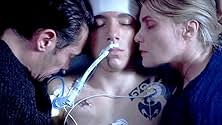
The story is simple. A car crash leaves seventeen year old Simon brain dead, and his devastated parents decide his organs can be transplanted. Because of this decision Claire, a mother of two boys Simon's age, is saved from a certain death.
The events are shown as they are. We see the grief of Simon's parents when they hear of his fate. We see their doubts about the organ transplant. We see how difficult it is for the doctor to inform them about the possibilities of organ donation. We see Claire's reluctance to receive a new heart. We understand why she doesn't want to tell her son what is going on. We also see the concentration of the medical team during the two operations - one to remove the heart and one to replace it.
In the film, the emotions speak for themselves. They are powerful enough not to need any additional effects. No side stories, no cheap metaphors, no heavy dialogue spelling it all out. For example, we never hear how Simon's parents come to their decision. We see them grieve together, and then tell the doctor they agree.
The last part of the film, showing the operations, is very powerful. Director Katell Quillévéré shows it in an almost documentary style. The transplant centre where hearts, livers and lungs are being distributed as if they were ordinary merchandise, the ice box in which the heart is transported (by a small airplane) and the operation itself, which gives the viewer a unique view into the human body.
'Reparer les vivants' is not a tearjerker in the traditional way: there are no cheap emotional effects. But it's full of genuine emotions, beautifully filmed, which might have a tear inducing effect.
The story is simple. A car crash leaves seventeen year old Simon brain dead, and his devastated parents decide his organs can be transplanted. Because of this decision Claire, a mother of two boys Simon's age, is saved from a certain death.
The events are shown as they are. We see the grief of Simon's parents when they hear of his fate. We see their doubts about the organ transplant. We see how difficult it is for the doctor to inform them about the possibilities of organ donation. We see Claire's reluctance to receive a new heart. We understand why she doesn't want to tell her son what is going on. We also see the concentration of the medical team during the two operations - one to remove the heart and one to replace it.
In the film, the emotions speak for themselves. They are powerful enough not to need any additional effects. No side stories, no cheap metaphors, no heavy dialogue spelling it all out. For example, we never hear how Simon's parents come to their decision. We see them grieve together, and then tell the doctor they agree.
The last part of the film, showing the operations, is very powerful. Director Katell Quillévéré shows it in an almost documentary style. The transplant centre where hearts, livers and lungs are being distributed as if they were ordinary merchandise, the ice box in which the heart is transported (by a small airplane) and the operation itself, which gives the viewer a unique view into the human body.
'Reparer les vivants' is not a tearjerker in the traditional way: there are no cheap emotional effects. But it's full of genuine emotions, beautifully filmed, which might have a tear inducing effect.
Every second counts!
An hymn to the importance and, at the same time, fragility of life. Every single moment has been carefully planned to weaved together a multitude of strands which will only make sense at the end. Every human being play a fundamental role in the game of life: never forget that! This film is a reality check to remind us that we are here for a higher purpose even if we can't yet see it. If you are looking for an inspirational story, look no further: a must watch!
Isn't it crazy that serfs didn't surf?
For as beautiful and sincere as this film is, it's honestly a little frustrating.
There isn't really anything to complain about concerning the presentation of the film. It looks very good, with the visual nature of certain scenes creating a sort of dream like state, which is fitting considering the meditative nature of the story. The music is fine, though I don't think it's especially memorable except for maybe a couple of instances, one of those being the jarring opening track, which frankly does not fit the tone of the film nor does it compliment the musical accompaniment for the remainder of the run time. That's no biggie though. It's just one slip up in an otherwise competent score. Of course the acting's good. You should pretty much assume that'll be the case for all good film.
So if the presentation tends to range from pretty good to spellbinding, then where does the frustration come from? The issue that I have this film is that it's difficult to really say with any certainty what exactly is intentional in it. That issue applies to not only the presentation, but the story as a whole. This might be a problem with my perception, but what I found was happening repeatedly as I watched this film was that I had to stop and ask "Why is this happening?". I don't mean to say that events in the story didn't make sense, it' not that hard to follow. What I have to wonder is, why exactly did the director choose to put certain moments in the film? What is tying it all together? The thing with meditative films, which I have no fundamental problem with, is that the lack of urgency should be supplanted with clear theme and motive from a story telling perspective. The sequence of events in a film don't all have to connect to each other via the plot, but rather via the theme.
This shouldn't come as a surprise, but I really struggled to come up with a clear thesis for how all the scenes in this film really complimented each other. The film clearly wants to be a commentary on life and death. The problem is that every film is about life and death, so that isn't really good enough for tackling this film. Too bad I can't really get any more specific without sort of just guessing at it with little confidence. The best answer I can come up with is that this film is trying to say that you can't fully appreciate life without accepting the reality of death. That doesn't sound too bad, and maybe it fits. Ultimately though, I can't formulate an answer that brings all the disparate elements of this film together in a cohesive way.
One final note which might add clarity to my lack of confidence in the direction of this film whose individual scenes are all wonderful works of art, is in the ending of this film. Naturally I'm not going into the specifics of the plot, but I should say that there is a moment in the latter half of the third act which seems to betray the spirit of the film as a meditative piece on the relationship between life and death. For the most part, this film lacks any real sense of urgency or legitimate conflict. I think that's totally acceptable in this instance, however, it is not consistent. The final sequence in this film tries to create a sort of false sense of tension which not only contradicts the rest of the presentation of the film, but which is not even believable in and of itself. There was never any point in this film where I was especially surprised by the sequence of events or felt that there was any real peril. So when the director tries to suggest it in order to satisfy a formula which doesn't even fit the type of film she's making, it sort of calls into question what else in the film was actually meant to fit in the way that I perceived.
This film is beautiful. I like it a lot, and if you haven't seen it yet then I would recommend it. Despite what I feel are some disingenuous moments, this film is born out of sincere intention and presents its subject matter with a clear mind towards honesty and integrity. Maybe after I watch it a second time I'll like it even better. Who knows.
There isn't really anything to complain about concerning the presentation of the film. It looks very good, with the visual nature of certain scenes creating a sort of dream like state, which is fitting considering the meditative nature of the story. The music is fine, though I don't think it's especially memorable except for maybe a couple of instances, one of those being the jarring opening track, which frankly does not fit the tone of the film nor does it compliment the musical accompaniment for the remainder of the run time. That's no biggie though. It's just one slip up in an otherwise competent score. Of course the acting's good. You should pretty much assume that'll be the case for all good film.
So if the presentation tends to range from pretty good to spellbinding, then where does the frustration come from? The issue that I have this film is that it's difficult to really say with any certainty what exactly is intentional in it. That issue applies to not only the presentation, but the story as a whole. This might be a problem with my perception, but what I found was happening repeatedly as I watched this film was that I had to stop and ask "Why is this happening?". I don't mean to say that events in the story didn't make sense, it' not that hard to follow. What I have to wonder is, why exactly did the director choose to put certain moments in the film? What is tying it all together? The thing with meditative films, which I have no fundamental problem with, is that the lack of urgency should be supplanted with clear theme and motive from a story telling perspective. The sequence of events in a film don't all have to connect to each other via the plot, but rather via the theme.
This shouldn't come as a surprise, but I really struggled to come up with a clear thesis for how all the scenes in this film really complimented each other. The film clearly wants to be a commentary on life and death. The problem is that every film is about life and death, so that isn't really good enough for tackling this film. Too bad I can't really get any more specific without sort of just guessing at it with little confidence. The best answer I can come up with is that this film is trying to say that you can't fully appreciate life without accepting the reality of death. That doesn't sound too bad, and maybe it fits. Ultimately though, I can't formulate an answer that brings all the disparate elements of this film together in a cohesive way.
One final note which might add clarity to my lack of confidence in the direction of this film whose individual scenes are all wonderful works of art, is in the ending of this film. Naturally I'm not going into the specifics of the plot, but I should say that there is a moment in the latter half of the third act which seems to betray the spirit of the film as a meditative piece on the relationship between life and death. For the most part, this film lacks any real sense of urgency or legitimate conflict. I think that's totally acceptable in this instance, however, it is not consistent. The final sequence in this film tries to create a sort of false sense of tension which not only contradicts the rest of the presentation of the film, but which is not even believable in and of itself. There was never any point in this film where I was especially surprised by the sequence of events or felt that there was any real peril. So when the director tries to suggest it in order to satisfy a formula which doesn't even fit the type of film she's making, it sort of calls into question what else in the film was actually meant to fit in the way that I perceived.
This film is beautiful. I like it a lot, and if you haven't seen it yet then I would recommend it. Despite what I feel are some disingenuous moments, this film is born out of sincere intention and presents its subject matter with a clear mind towards honesty and integrity. Maybe after I watch it a second time I'll like it even better. Who knows.


Le saviez-vous
- AnecdotesBased on the novel "The Heart" by Maylis de Kerangal.
- ConnexionsFeatures L'homme tranquille (1952)
- Bandes originalesPaint me colors
Performed by Girlpool
Meilleurs choix
Connectez-vous pour évaluer et surveiller les recommandations personnalisées
- How long is Heal the Living?Propulsé par Alexa
Détails
Box-office
- Brut – États-Unis et Canada
- 3 176 $ US
- Fin de semaine d'ouverture – États-Unis et Canada
- 3 176 $ US
- 16 avr. 2017
- Brut – à l'échelle mondiale
- 2 225 770 $ US
- Durée
- 1h 43m(103 min)
- Couleur
- Rapport de forme
- 2.35 : 1
Contribuer à cette page
Suggérer une modification ou ajouter du contenu manquant