

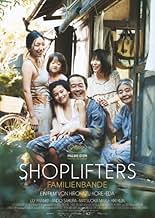
Une famille japonaise avec des revenus insuffisants dépend du vol pour joindre les deux bouts.Une famille japonaise avec des revenus insuffisants dépend du vol pour joindre les deux bouts.Une famille japonaise avec des revenus insuffisants dépend du vol pour joindre les deux bouts.
- Réalisation
- Scénariste
- Vedettes
- Nommé pour 1 oscar
- 49 victoires et 98 nominations au total




Sosuke Ikematsu
- 4 ban-san
- (as Sôsuke Ikematsu)
7,993.4K
1
2
3
4
5
6
7
8
9
10
Avis en vedette
Filmmaking at its finest.
A breathtaking display of realism, I'm in complete awe right now, Shoplifters tells a touching story that evokes so many emotions and it does it well, it's seemingly simple at first sight but it's so nuanced to a point where you'd find yourself expecting a certain ending, preferably happy, but this film sticks to realism and it dismantles the social norms with such grace to a point where it offers a new insight to a world unknown to most, where people long for family love and they're desperate to have someone to call family, I must admit that it made me tear up at certain times on account of the raw emotions it conveys.
the acting here is marvelous, it's more of a team effort as every character completes another and ultimately form an arc that tells the story in a brilliant way.
Shoplifters is a rare exercise of social realism, it gets its message across so elegantly, filmmaking at its finest.
A thoughtful and provocative japanese film.
A small family of small-scale thieves finds a lost girl on the outskirts of a cold street and decides to give her shelter.
Enter with this film waiting for a kind of family history with light teachings, however, I end up being a very special work full of sweet moments and at the same time provocative, with ideas and messages that challenge us about our true definition of family and trust. With a sad and melancholic narrative that makes us feel small moments of beauty and union, but little by little begins to reveal layer by layer on a more bittersweet and human truth.
Filmed in an excellent way with a cinematography designed to stay around the eyes of youngsters, with a soft and melancholic soundtrack that perfectly complements the scenes. The performances are fantastic from the entire cast, especially the children, who give a realistic and humane representation when it comes to their performances. The script is fantastic and human, teaching them a hard reality and difficult to grasp many times by our intangible minds, people who try to survive day by day through bad actions, but still try to keep their intentions pure and good.
A film quite unique, original and emotional, full of hard and sad moments that move us completely but eventually end up revealing a new truth different from what we believed, highly recommended without a doubt.
Enter with this film waiting for a kind of family history with light teachings, however, I end up being a very special work full of sweet moments and at the same time provocative, with ideas and messages that challenge us about our true definition of family and trust. With a sad and melancholic narrative that makes us feel small moments of beauty and union, but little by little begins to reveal layer by layer on a more bittersweet and human truth.
Filmed in an excellent way with a cinematography designed to stay around the eyes of youngsters, with a soft and melancholic soundtrack that perfectly complements the scenes. The performances are fantastic from the entire cast, especially the children, who give a realistic and humane representation when it comes to their performances. The script is fantastic and human, teaching them a hard reality and difficult to grasp many times by our intangible minds, people who try to survive day by day through bad actions, but still try to keep their intentions pure and good.
A film quite unique, original and emotional, full of hard and sad moments that move us completely but eventually end up revealing a new truth different from what we believed, highly recommended without a doubt.
Powerful
This film tells the story of a family who takes in a young girl they found on the street.
The story is slow, but as it unfolds, it gets increasingly interesting. I could not imagine the plot to end up like this. The ending is very powerful. It really exposes how the lowest social class struggle to stay alive. It is a very sad story.
The story is slow, but as it unfolds, it gets increasingly interesting. I could not imagine the plot to end up like this. The ending is very powerful. It really exposes how the lowest social class struggle to stay alive. It is a very sad story.
multi-generational poverty
Greetings again from the darkness. We typically think of family as blood relatives, those affiliated by marriage or adoption, and those funky cousins (sometimes 'removed') that, according to the family tree, are supposedly related to us. Expert Japanese filmmaker Hirokazu Kore-eda (LIKE FATHER LIKE SON, 2013) presents a story that will have you questioning whether the strongest connection is blood, heart, or money.
We first witness 'father' Osamu Shibata (played by Lily Franky) and adolescent 'son' Shota (Jyo Kairi) in a well-coordinated shoplifting maneuver at the local grocery store. On the way home they stumble across a shivering child, maybe 4 or 5 years old, who has been seemingly abandoned by her parents. They take her home to warm her up and feed her, and it's here we discover the multi-generational family living in a tiny apartment. This family also consists of 'grandmother' Hatsue (an excellent Kirin Kiki), 'mother/wife' Nobuyo (Sakura Ando), and teenage daughter Aki (rising star Mayu Matsuoka).
When the family discovers signs of abuse on the little girl Yuri (Miyu Sasaki), they decide to keep her - less an informal adoption than an admission to the club. See, this family lives in poverty, and finds comfort in working odd jobs and shoplifting. They do bad things out of necessity, in a kind of twisted 'honor among thieves'. Each person, regardless of age is expected to contribute to the team. The eldest provides a steady income through her deceased ex-husband's pension, and by scamming mercy money from his second family. Osamu and Nobuyo have regular part time jobs, while Aki works in a sexy chat room. Shota polishes his shoplifting skills and even tiny Yuri begins to learn by watching him. Everyone contributes in what can be described as a pyramid scheme of petty cons.
As the film progresses, we get to know each of the characters and begin to care about them ... rooting for them to find success. Writer-Director Kore-eda draws us in with subtle scenes of interaction between the characters, each willing to sacrifice for the other. He raises the question on whether choosing one's family might create a stronger bond than those blood ties. What really seems to matter is where we feel we belong, and where are accepted.
The film won the Palme d'Or at the 2018 Cannes Film Festival, and it's likely due to the devastating and expert final act. In a dramatic shift in tone, true character is revealed - it's a shocking revelation on some fronts, and fully expected on others. Each family member has a backstory that slowly unfolds through the first two acts, and then abruptly slaps us upside the head as the film nears conclusion. There are many social aspects to be discussed after this one, including how the child welfare system (seemingly regardless of country) sometimes works against a child's best interest, even with the best intentions. This is one that will grab your heart and then stick with you for a while.
We first witness 'father' Osamu Shibata (played by Lily Franky) and adolescent 'son' Shota (Jyo Kairi) in a well-coordinated shoplifting maneuver at the local grocery store. On the way home they stumble across a shivering child, maybe 4 or 5 years old, who has been seemingly abandoned by her parents. They take her home to warm her up and feed her, and it's here we discover the multi-generational family living in a tiny apartment. This family also consists of 'grandmother' Hatsue (an excellent Kirin Kiki), 'mother/wife' Nobuyo (Sakura Ando), and teenage daughter Aki (rising star Mayu Matsuoka).
When the family discovers signs of abuse on the little girl Yuri (Miyu Sasaki), they decide to keep her - less an informal adoption than an admission to the club. See, this family lives in poverty, and finds comfort in working odd jobs and shoplifting. They do bad things out of necessity, in a kind of twisted 'honor among thieves'. Each person, regardless of age is expected to contribute to the team. The eldest provides a steady income through her deceased ex-husband's pension, and by scamming mercy money from his second family. Osamu and Nobuyo have regular part time jobs, while Aki works in a sexy chat room. Shota polishes his shoplifting skills and even tiny Yuri begins to learn by watching him. Everyone contributes in what can be described as a pyramid scheme of petty cons.
As the film progresses, we get to know each of the characters and begin to care about them ... rooting for them to find success. Writer-Director Kore-eda draws us in with subtle scenes of interaction between the characters, each willing to sacrifice for the other. He raises the question on whether choosing one's family might create a stronger bond than those blood ties. What really seems to matter is where we feel we belong, and where are accepted.
The film won the Palme d'Or at the 2018 Cannes Film Festival, and it's likely due to the devastating and expert final act. In a dramatic shift in tone, true character is revealed - it's a shocking revelation on some fronts, and fully expected on others. Each family member has a backstory that slowly unfolds through the first two acts, and then abruptly slaps us upside the head as the film nears conclusion. There are many social aspects to be discussed after this one, including how the child welfare system (seemingly regardless of country) sometimes works against a child's best interest, even with the best intentions. This is one that will grab your heart and then stick with you for a while.
Subtle and nuanced
For this stunning masterpiece Shoplifters, Hirokazu Koreeda should win the Academy Award for Best Director. It is unbelievable that the rather complicated characters and their relationships are depicted in just two hours. The approach is mild, understated, low-profile, subtle and nuanced. Much room, space and thought are left to the viewers. The direction is simply super smart.
The cinematography is extraordinary, with some surprising long shots, close-ups and beautiful shots from tight angles. The editing is speechless, connecting numerous scenes just seamlessly. Not a single minute is wasted, and the film is largely intense and arresting. Together with the brilliant performances from the ensemble cast, the result is a satisfying and deeply affecting drama on lower class in Japan.
The cinematography is extraordinary, with some surprising long shots, close-ups and beautiful shots from tight angles. The editing is speechless, connecting numerous scenes just seamlessly. Not a single minute is wasted, and the film is largely intense and arresting. Together with the brilliant performances from the ensemble cast, the result is a satisfying and deeply affecting drama on lower class in Japan.


Le saviez-vous
- AnecdotesThe original title of the film, Manbiki Kazoku, literally translates as Shoplifting Family.
- Citations
Nobuyo Shibata: If someone hits you and tells you they are doing it because they love you, they are a liar.
[Hugging Yuri]
Nobuyo Shibata: This is what someone does when they love you.
- ConnexionsFeatured in 2019 Golden Globe Awards (2019)
Meilleurs choix
Connectez-vous pour évaluer et surveiller les recommandations personnalisées
- How long is Shoplifters?Propulsé par Alexa
Détails
Box-office
- Brut – États-Unis et Canada
- 3 313 513 $ US
- Fin de semaine d'ouverture – États-Unis et Canada
- 89 264 $ US
- 25 nov. 2018
- Brut – à l'échelle mondiale
- 67 958 782 $ US
- Durée
- 2h 1m(121 min)
- Couleur
- Mixage
- Rapport de forme
- 1.85 : 1
Contribuer à cette page
Suggérer une modification ou ajouter du contenu manquant