ÉVALUATION IMDb
6,4/10
13 k
MA NOTE
Quelque part le long de la frontière de la côte est américaine du milieu du XIXe siècle, deux couples voisins se battent contre la misère et l'isolement, témoins d'un paysage splendide mais ... Tout lireQuelque part le long de la frontière de la côte est américaine du milieu du XIXe siècle, deux couples voisins se battent contre la misère et l'isolement, témoins d'un paysage splendide mais éprouvant.Quelque part le long de la frontière de la côte est américaine du milieu du XIXe siècle, deux couples voisins se battent contre la misère et l'isolement, témoins d'un paysage splendide mais éprouvant.
- Réalisation
- Scénaristes
- Vedettes
- Prix
- 5 victoires et 8 nominations au total
Karina Ziana Gherasim
- Nellie
- (as Karina Gherasim)
Ioachim Ciobanu
- Widow Weldon's Son
- (as Kim Ciobanu)
Sandra Personnic-House
- Mrs. Nottoway
- (as Sandra J House)
6,412.6K
1
2
3
4
5
6
7
8
9
10
Avis en vedette
Beautiful and Sad
Like all lesbian romance period pieces, it was about undeniable feelings that must be denied.
But something about it felt very deep and real. I didn't cry or feel much, but it made me think and wonder.
I really really loved the set and costumes. I couldn't find any trace that it was filmed in the 21st century.
But something about it felt very deep and real. I didn't cry or feel much, but it made me think and wonder.
I really really loved the set and costumes. I couldn't find any trace that it was filmed in the 21st century.
It was 1856 in the Northeast US.
On the surface this might seem to be a story about two repressed lesbians, but it is so much more than that. It is hard for us today to relate to how it was in the mid 1800s. A man married a woman so she could give him children, she could do daily chores, like milk the cow and feed the pigs and chickens. They had none of the conveniences we take for granted, any entertainment had to come from within.
This is a story spanning about the first nine months of the year 1856. Of two young couples, each working nearby farms. One had a 4-yr-old child that became sick and died. The other couple were unable to have children and the man blamed it on his wife.
So although each wife was attractive, capable, and smart the husbands came to be less and less happy with them. The two young wives found happiness being with each other, sharing thoughts and emotions they could not with their husbands. A way to bring some light into their dreary days.
Yes, when it was all done one might say they were lesbians. Or maybe they were just forced into an attraction and hidden relationship that was their only choice in this bleak existence. No matter it is a good movie and I prefer to look at it as making the best of your situation.
On DVD from my public library, my wife chose to skip.
This is a story spanning about the first nine months of the year 1856. Of two young couples, each working nearby farms. One had a 4-yr-old child that became sick and died. The other couple were unable to have children and the man blamed it on his wife.
So although each wife was attractive, capable, and smart the husbands came to be less and less happy with them. The two young wives found happiness being with each other, sharing thoughts and emotions they could not with their husbands. A way to bring some light into their dreary days.
Yes, when it was all done one might say they were lesbians. Or maybe they were just forced into an attraction and hidden relationship that was their only choice in this bleak existence. No matter it is a good movie and I prefer to look at it as making the best of your situation.
On DVD from my public library, my wife chose to skip.
A Classic Tragedy
This is a most melancholy film that skirts tragedy at every turn. Beautiful performances by both Katherine Waterston and Vanessa Kirby. Casey Affleck evokes great affinity in his supporting role. Very unique in our cinematic culture and definitely not for every palette. I'm not sure how I feel about it beyond what I've said. I give this film a 6 (moody) out of 10. {Tragedy}
anguish as a way of life
Greetings again from the darkness. I'd be hard-pressed to name a movie that is more somber, front beginning to end, than this film from director Mona Fastvold (writer of VOX Lux, 2018) and co-writers Ron Hansen (THE ASSASSINATION OF JESSE JAMES BY THE COWARD ROBERT FORD, 2017) and Jim Shepard (based on his short story). Allowing only a few sparks of hope in the second act, the film's ending finds us nearly as beaten down as the four main characters we've just watched.
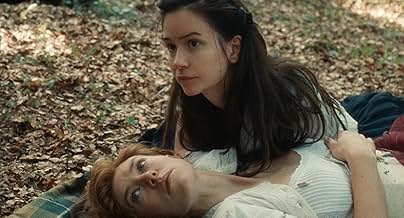
Structured as though Abigail (Katherine Waterston) is reading her own journal entries as they play out in real life, the film captures the brutal conditions of working a hillside farm in upstate New York during 1856. But more than that, it conveys the price of a joyless existence on the frontier, when days were spent adhering to chores. For everyone, this meant little social interaction; and for women this meant cooking, cleaning, and giving birth. Abigail mesmerizes with her balletic poetry in describing the drudgery of her life and marriage to Dyer (Casey Affleck). Dyer is a sullen man who says little, but remains dutiful in his responsibilities. He is attuned enough to allow Abigail her space after diphtheria claims their young daughter ... though he seems mostly unchanged by the tragedy.
Abigail's emptiness and unrequited quest for meaning seem her destiny until the day that new arrivals rent the next farm over. As Finney (Christopher Abbott) guides the wagon by, Abigail and Tallie (Vanessa Kirby) lock eyes, signaling to them (and us) that life on the frontier is about to become more exciting than collecting that day's eggs from the chicken coup. This moment arrives mere weeks after Abigail as narrator has informed us, "With little pride and less hope, we begin the new year." And just like that, she has hope.
The two women begin to spend days together building a connection first borne from isolation and loneliness, and soon growing into a true relationship. Dyer deals with his wife's affinity for the new girl with a nonchalance that masks his agitation. Finney, on the other hand, is a quietly simmering man of anger that wreaks of a violent nature just below the surface. These are combustible elements in a world where this type of relationship between women is simply not discussed or admitted.
We witness the beginning, middle, and end of the relationship between Abigail and Tallie. We see how each lights up around the other ... although Tallie's well-coiffed auburn hair always seems out of place in an environment where showers and shampoo would be scarce. It's really Abigail's narration and lyrical use of language that propels the story, and as lovely as her words are, the actual pacing of the film is a bit slow at times. Of course, that corresponds to the oppressive bleakness of this world, adding to the challenge for viewers.
The four lead performances are all terrific. The two men have less screen time and certainly less dialogue, but we never once doubt where they stand. Ms. Waterston has been a standout with her work over the past few years, and Ms. Kirby recently posted one of last year's finest performances in PIECES OF A WOMAN. She's clearly a star in the making. Composer Daniel Blumberg's work is a good fit, and cinematographer Andre Chemetoff works wonders with the muted color palette. Bucharest is the stand in for 19th century upstate New York, allowing us to see the harshness. Period lesbian romances are rare, though this is the third in a short period of time along with AMMONITE (2020) and PORTRAIT OF A LADY ON FIRE (2019). Just prepare yourself for an hour and a half of anguish. In theaters February 12th, 2021 and on digital March 2nd, 2021
Structured as though Abigail (Katherine Waterston) is reading her own journal entries as they play out in real life, the film captures the brutal conditions of working a hillside farm in upstate New York during 1856. But more than that, it conveys the price of a joyless existence on the frontier, when days were spent adhering to chores. For everyone, this meant little social interaction; and for women this meant cooking, cleaning, and giving birth. Abigail mesmerizes with her balletic poetry in describing the drudgery of her life and marriage to Dyer (Casey Affleck). Dyer is a sullen man who says little, but remains dutiful in his responsibilities. He is attuned enough to allow Abigail her space after diphtheria claims their young daughter ... though he seems mostly unchanged by the tragedy.
Abigail's emptiness and unrequited quest for meaning seem her destiny until the day that new arrivals rent the next farm over. As Finney (Christopher Abbott) guides the wagon by, Abigail and Tallie (Vanessa Kirby) lock eyes, signaling to them (and us) that life on the frontier is about to become more exciting than collecting that day's eggs from the chicken coup. This moment arrives mere weeks after Abigail as narrator has informed us, "With little pride and less hope, we begin the new year." And just like that, she has hope.
The two women begin to spend days together building a connection first borne from isolation and loneliness, and soon growing into a true relationship. Dyer deals with his wife's affinity for the new girl with a nonchalance that masks his agitation. Finney, on the other hand, is a quietly simmering man of anger that wreaks of a violent nature just below the surface. These are combustible elements in a world where this type of relationship between women is simply not discussed or admitted.
We witness the beginning, middle, and end of the relationship between Abigail and Tallie. We see how each lights up around the other ... although Tallie's well-coiffed auburn hair always seems out of place in an environment where showers and shampoo would be scarce. It's really Abigail's narration and lyrical use of language that propels the story, and as lovely as her words are, the actual pacing of the film is a bit slow at times. Of course, that corresponds to the oppressive bleakness of this world, adding to the challenge for viewers.
The four lead performances are all terrific. The two men have less screen time and certainly less dialogue, but we never once doubt where they stand. Ms. Waterston has been a standout with her work over the past few years, and Ms. Kirby recently posted one of last year's finest performances in PIECES OF A WOMAN. She's clearly a star in the making. Composer Daniel Blumberg's work is a good fit, and cinematographer Andre Chemetoff works wonders with the muted color palette. Bucharest is the stand in for 19th century upstate New York, allowing us to see the harshness. Period lesbian romances are rare, though this is the third in a short period of time along with AMMONITE (2020) and PORTRAIT OF A LADY ON FIRE (2019). Just prepare yourself for an hour and a half of anguish. In theaters February 12th, 2021 and on digital March 2nd, 2021
Quiet, yet resonant
This is much more of a period romance done right: it´s an excellent one. A movie that lives up the expectations thanks to striking performances, great score and really good direction. A superb work!
Le saviez-vous
- AnecdotesThe film was shot in a national park in Romania, and every set was designed by renowned production designer Jean-Vincent Puzos, and built from scratch.
- GaffesWhen Dyer meets Tallie for the first time he greets her by saying "hello". But hello did not become a greeting like that until the late 19th century when Alexander Graham Bell popularized it as a telephone greeting. In the mid 19th century, "hello" was mainly used as an exclamation or to draw attention to something. The proper greeting in the 1850s would have been "good day".
- ConnexionsReferenced in Late Night with Seth Meyers: Casey Affleck/Anthony Atamanuik (2021)
- Bandes originalesThe World to Come
Written & Performed by Daniel Blumberg and Josephine Foster
Published by Wise Music Group/Fire Songs
Courtesy of Node Records
Meilleurs choix
Connectez-vous pour évaluer et surveiller les recommandations personnalisées
- How long is The World to Come?Propulsé par Alexa
Détails
- Date de sortie
- Pays d’origine
- Sites officiels
- Langue
- Aussi connu sous le nom de
- Прийдешній світ
- Lieux de tournage
- sociétés de production
- Consultez plus de crédits d'entreprise sur IMDbPro
Box-office
- Brut – États-Unis et Canada
- 116 143 $ US
- Fin de semaine d'ouverture – États-Unis et Canada
- 51 245 $ US
- 14 févr. 2021
- Brut – à l'échelle mondiale
- 205 878 $ US
- Durée
- 1h 45m(105 min)
- Couleur
- Rapport de forme
- 1.66 : 1
Contribuer à cette page
Suggérer une modification ou ajouter du contenu manquant