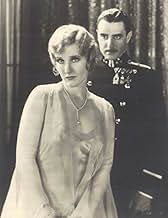
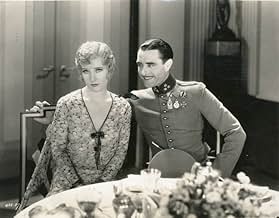
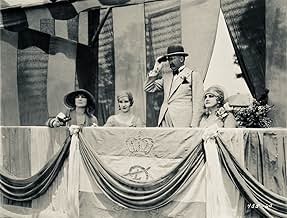
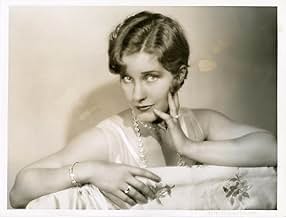
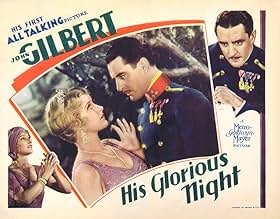
Ajouter une intrigue dans votre langueA princess must end her affair with a guard captain for an arranged marriage. He threatens to pose as a con man and expose their relationship unless allowed one night with her.A princess must end her affair with a guard captain for an arranged marriage. He threatens to pose as a con man and expose their relationship unless allowed one night with her.A princess must end her affair with a guard captain for an arranged marriage. He threatens to pose as a con man and expose their relationship unless allowed one night with her.
- Réalisation
- Scénaristes
- Vedettes
Agostino Borgato
- Waiter
- (uncredited)
Carrie Daumery
- Race Spectator
- (uncredited)
Adolph Faylauer
- Race Spectator
- (uncredited)
Curt Furberg
- Race Spectator
- (uncredited)
6,6121
1
2
3
4
5
6
7
8
9
10
Avis en vedette
His Career Collapse
I have never seen this film, except on a series about Hollywood in the Silent Film period made in the 1980s (James Mason narrated). In an episode about Gilbert and Garbo, and how the sound revolution did not hurt her (it enhanced her sexual allure and mystery) while it smashed his career. Supposedly the verile Gilbert sounded squeaky, and the clearest example of this was this film, where Gilbert was forced to recite lousy dialogue. The snippet of film had him declaring over and over again "Darling, I love you! I love your!" It would have been more lethal than an iceberg in sinking Gilbert.
Still, I would be curious to see the film (if they ever show it again). The script is based on a play by Ferenc Molnar, Hungary's greatest playwrite (his best known plays are THE PLAY'S THE THING, and LILLIOM - the original drama that the musical CAROUSEL is based on), so while it may have been below par it still might be worth listening to (outside of poor Gilbert's dialogue). Later films of the sound period, like QUEEN CHRISTINA and THE CAPTAIN HATES THE SEA suggest that Gilbert's voice was sufficiently masculine for his career to have survived had his films been chosen more carefully. But the public only remembered "Darling, I love you! I love you!" Very regretable.
John Gilbert Vindicated
I agree with the other reviewer "Not John Gilbert's Fault" that this movie fails, not through the fault of John Gilbert. It falls flat through a conspiracy of incompetence between the writer(s), the director, and Catherine Dale Owen. No wonder audiences laughed. The person whose career should have been ruined was the creator of the dialogue which is what is most funny about this "comedy" romance. And who was it that thought Catherine Dale Owen was an actress? Her cringe-worthy performance makes you wish someone would show up and plant a cream pie in her face. She and Nance O'Neil are the deadweight that sink this movie, aided by Lionel Barrymore who should have known better. I've loved old classic movies for many years so am well-practiced at suspension of disbelief and making allowances, but His Glorious Night is a hard watch even for me just as it was for audiences in 1929. As film history and a time capsule, it is fascinating, but not so great as entertainment. Even so, I'm glad this was restored and made available again.
Not John Gilbert's Fault
This early talkie fails, not because of John Gilbert's voice, but because of the stiff, stagey performance of co-star Catherine Dale Owen as Princess Orsolini. In almost every scene she faces stiffly forward, slightly looking off camera left/stage right, and barely acknowledges anyone else in the scene. Her delivery is a one-note haughtiness as if the world must revolve around her and her apparent embarrassment at being made a fool of by the duplicitous Captain Kovacs (John Gilbert). All of the other main characters - her mother, the elderly Sargent or General who summons Captain Kovacs to her room, and Captain Kovacs, John Gilbert - play their parts naturally with believable reactions and vocal modulations.
"Singing in the Rain"'s mocking of this film is spot on in the Lina Lamont (Jean Hagen) character whose voice and mannerisms parody Catherine Dale Owen here, and in the awfully cheesy dialogue Don Lockwood (Gene Kelly) is given to deliver in his first talkie, "The Dueling Cavalier". Poor John Gilbert deserved better than this - his voice is fine, even as he plays his part in this overly melodramatic script.
Grading on a curve, it ain't bad
Okay, I've been hearing for decades about what a catastrophe this is, that Gilbert has a feminine voice. That's absolute nonsense.
First off, it's an early talkie. Secondly, Gilbert's voice was fine. If you've seen any of his later pictures, his voice sounds the same.
The single greatest shortcoming is that it's based on a stage play. Given the technology of the day, it's never able to rise above that. The dialogue and pacing and plodding. The performances look like early melodrama.
Compare this to another star of the silent screen. Mary Pickford's "Coquette" is unwatchable. She won an Oscar for her performance. Gilbert got slapped down for this much better movie.
First off, it's an early talkie. Secondly, Gilbert's voice was fine. If you've seen any of his later pictures, his voice sounds the same.
The single greatest shortcoming is that it's based on a stage play. Given the technology of the day, it's never able to rise above that. The dialogue and pacing and plodding. The performances look like early melodrama.
Compare this to another star of the silent screen. Mary Pickford's "Coquette" is unwatchable. She won an Oscar for her performance. Gilbert got slapped down for this much better movie.
Out Came Talk, Talk, Talk
HIS GLORIOUS NIGHT is deadly dull as directed by Lionel Barrymore. This film is based on a play by Molnar with all the liveliness of a dictionary. After a decent opening that introduces the main characters and has John Gilbert as the dashing Captain Kovacs winning a horse race (obviously speeded up), it settles into a static, music-less, slog of talk.
Remember what Norma Desmond said. "So they opened their big mouths and out came talk, talk, talk!" She obviously saw this film. Basic plot has Gilbert as the dashing captain who is romancing a princess (Catherine Dale Owen). But the mother does not approve and so has a crony spill the beans that Gilbert is the son of a shoemaker. "You peasant!" she cries.
To get even Gilbert spreads a false rumor that he's actually a fraud and that he's really a notorious swindler posing as a Captain (apparently worse than being a peasant). Once the princess and mother (Nance O'Neil) get wind of this they are terrified of an embarrassing scandal. The mother tries to marry off the daughter to the limp Tyrrell Davis and it almost works. But Gilbert has the fun of calling their bluff and admitting that he's really just a peasant (not a swindler). Faced with Davis over Gilbert, Owen comes to her meager senses and humiliates herself by chasing after Gilbert.
This is shot with almost no camera movement. The actors sit around talking. On the sidelines are a humorous older count and his wife (Richard Carle, Eva Dennison) and the ambitious Americans (Hedda Hopper and her daughter Doris Hill). Gustav von Seyffertitiz plays the gossiping crony.
Gilbert's voice is fine, maybe a little sing-songy. It's the material that lacks. The film was a modest hit. There is an "I LOVE YOU bit a la Singin' in the Rain but it's said off camera while the lovers are in the bushes.
John Gilbert gets a pass; Lionel Barrymore gets a fail.
Remember what Norma Desmond said. "So they opened their big mouths and out came talk, talk, talk!" She obviously saw this film. Basic plot has Gilbert as the dashing captain who is romancing a princess (Catherine Dale Owen). But the mother does not approve and so has a crony spill the beans that Gilbert is the son of a shoemaker. "You peasant!" she cries.
To get even Gilbert spreads a false rumor that he's actually a fraud and that he's really a notorious swindler posing as a Captain (apparently worse than being a peasant). Once the princess and mother (Nance O'Neil) get wind of this they are terrified of an embarrassing scandal. The mother tries to marry off the daughter to the limp Tyrrell Davis and it almost works. But Gilbert has the fun of calling their bluff and admitting that he's really just a peasant (not a swindler). Faced with Davis over Gilbert, Owen comes to her meager senses and humiliates herself by chasing after Gilbert.
This is shot with almost no camera movement. The actors sit around talking. On the sidelines are a humorous older count and his wife (Richard Carle, Eva Dennison) and the ambitious Americans (Hedda Hopper and her daughter Doris Hill). Gustav von Seyffertitiz plays the gossiping crony.
Gilbert's voice is fine, maybe a little sing-songy. It's the material that lacks. The film was a modest hit. There is an "I LOVE YOU bit a la Singin' in the Rain but it's said off camera while the lovers are in the bushes.
John Gilbert gets a pass; Lionel Barrymore gets a fail.
Le saviez-vous
- AnecdotesThe filming of the movie and its disastrous reception were one of the main inspirations for the film Chantons sous la pluie (1952).
- Autres versionsRESTORATION PROLOGUE: "When His Glorious Night was sold by M-G-M to Paramount for a remake (A Breath of Scandal - 1960), the original 1929 camera negative was stored in the vaults, unseen for almost hundred years, apart from a short extract used in When the Lion Roars." "Now fully restored, the film that served as a basis for Singin' in the Rain and once again be seen." "His Glorious Night could not have been restored without the cooperation, support, and guidance of Paramount Pictures, Library of Congress, The Film Preserve, Ltd & The Maltese Film Works."
- ConnexionsAlternate-language version of Olimpia (1930)
Meilleurs choix
Connectez-vous pour évaluer et surveiller les recommandations personnalisées
Détails
- Date de sortie
- Pays d’origine
- Langue
- Aussi connu sous le nom de
- Ladrón de amor
- Lieux de tournage
- société de production
- Consultez plus de crédits d'entreprise sur IMDbPro
- Durée
- 1h 20m(80 min)
- Couleur
- Rapport de forme
- 1.20 : 1
Contribuer à cette page
Suggérer une modification ou ajouter du contenu manquant