
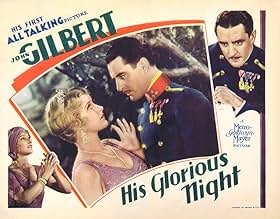
Ajouter une intrigue dans votre langueA princess must end her affair with a guard captain for an arranged marriage. He threatens to pose as a con man and expose their relationship unless allowed one night with her.A princess must end her affair with a guard captain for an arranged marriage. He threatens to pose as a con man and expose their relationship unless allowed one night with her.A princess must end her affair with a guard captain for an arranged marriage. He threatens to pose as a con man and expose their relationship unless allowed one night with her.
- Réalisation
- Scénaristes
- Vedettes




Agostino Borgato
- Waiter
- (uncredited)

Carrie Daumery
- Race Spectator
- (uncredited)

Adolph Faylauer
- Race Spectator
- (uncredited)
Curt Furberg
- Race Spectator
- (uncredited)
6,6121
1
2
3
4
5
6
7
8
9
10
Avis en vedette
Questionable Hollywood lore
Even amongst the reviews featured on this platform, the widely believed stories about John Gilbert's speaking voice are repeated. There really is nothing wrong with his voice at all. Arguably it would suit him better if it was a little deeper, but this could be learned over a period of time with voice coaches. The reason this movie was such a disaster for him is the script. The lines he is given to speak are just so utterly utter. I love you. I love you. You're driving me insane your eyes sparkle like diamonds and blah blah blah. It's just annoying really. I make every allowance for the fact that this is a very early talking picture and some performers were still learning how to adjust away from their silent film techniques. I don't think any actor could rise above this dialogue and I certainly would expect something better from Lionel Barrymore as the director. John Gilbert could have recovered over a period of time except for the fact that it seems as though Lewis B Mayer may have had it in for him but that is another story.
There's lots of blame to go around here
In an obscure European kingdom, the princess Orsini (Catherine Dale Owen) carries on a clandestine affair with the dashing Captain Kovacs. Her mother apparently knows all about this romance, and convinces her to break it off given that the princess is to soon be engaged to Prince Luigi Caprilli (Tyrell Davis) as part of an arrangement between her kingdom and his. Afterwards, news comes to the princess that Kovacs is actually a famous confidence artist and that, as a result, unwanted publicity may come to the kingdom and perhaps bring the relationship between Kovacs and the princess to light. Complications ensue.
This is the talkie debut of John Gilbert, the film that allegedly brought down his career, and yet I really don't see anything wrong with his voice given what he has to work with as far as dialogue, which at times is ridiculous. But then I already knew what John Gilbert sounded like. Maybe people were expecting something like Clark Gables growly low pitched voice? At any rate, Gilbert had leading roles at MGM for four more years through 1933 and had a leading role in his last film in 1934, so it's not like this film completely ruined him.
Like most early talkie films the thing is entirely too talkie. There is tons of dialogue that really serves no purpose and many scenes are over long and tiresome. The princess and her mother have the most screen time, and they seem more like much older sister and much younger sister than mother and daughter given their casual way with each other.
Tyrell Davis is excellent in his small role as Prince Luigi, Princess Orsini's betrothed. He is terrific at being as desirable as a plate of cold scrambled eggs. MGM made good use of this lack of chemistry between Davis and Owens when they teamed them in another early talkie the following year - "Strictly Unconventional" in which their lack of chemistry is the central theme.
If you are an early talkie fan or just curious about this important entry in John Gilbert's filmography I'd recommend it, but do realize that pacing wise it is a long hard slog.
This is the talkie debut of John Gilbert, the film that allegedly brought down his career, and yet I really don't see anything wrong with his voice given what he has to work with as far as dialogue, which at times is ridiculous. But then I already knew what John Gilbert sounded like. Maybe people were expecting something like Clark Gables growly low pitched voice? At any rate, Gilbert had leading roles at MGM for four more years through 1933 and had a leading role in his last film in 1934, so it's not like this film completely ruined him.
Like most early talkie films the thing is entirely too talkie. There is tons of dialogue that really serves no purpose and many scenes are over long and tiresome. The princess and her mother have the most screen time, and they seem more like much older sister and much younger sister than mother and daughter given their casual way with each other.
Tyrell Davis is excellent in his small role as Prince Luigi, Princess Orsini's betrothed. He is terrific at being as desirable as a plate of cold scrambled eggs. MGM made good use of this lack of chemistry between Davis and Owens when they teamed them in another early talkie the following year - "Strictly Unconventional" in which their lack of chemistry is the central theme.
If you are an early talkie fan or just curious about this important entry in John Gilbert's filmography I'd recommend it, but do realize that pacing wise it is a long hard slog.
'His Inglorious Morning-After' followed, unfortunately for Mr. Gilbert
Here's a famous -- or should I say "infamous"? -- early talkie which was generally inaccessible to the public until quite recently. His Glorious Night was the second talkie vehicle produced for MGM's top male star John Gilbert, but the first to be released by his home studio. Urban legend suggests it was an ignominious flop, and that audiences laughed at Gilbert's unexpectedly high-pitched voice. But now, at long last, we can see (and hear) for ourselves, and recognize that Gilbert's voice was not the problem.
His Glorious Night was based on a Hungarian stage play, a light comedy called 'Olympia' by the distinguished Ferenc Molnár. It was adapted into English by the equally distinguished Sidney Howard, and played successfully on Broadway in 1928. It concerns a European princess, betrothed to a man she does not love. She falls in love with a commoner, a dashing officer. But when she suspects the worst of him, and insults him, he devises a ruse to teach her a lesson -- and, not incidentally, spend 'one glorious night' with him.
So far, so good. Distinguished writers, saucy plot, romance. There was nothing wrong with the concept. The biggest problem is the film's dialog, which, in two key scenes, is dreadful. Without having read the play, I don't know if the responsible party was Molnár, Howard, or MGM's adapter Willard Mack. But early in the film, two extended love scenes between Gilbert and leading lady Catherine Dale Owen (which have been excerpted in Hollywood documentaries over the years) damage the picture badly. In order to play up Gilbert's 'Great Lover' persona, the two performers were given reams of sappy verbiage for these scenes, which they recite before a motionless camera. In the second scene, corny music plays under. Our leading man must deliver lines such as "Oh, darling! Oh darling, dearest one, what have I done but wait, wait, wait ever since I've known you," and "I don't wish it to be a secret: I love you. I've told you that a hundred times a week, I love you." His voice is fine, but not even Ronald Colman would have come off any better with material like that. To make matters worse, leading lady Catherine Dale Owen gives an amateurish performance, like something you'd expect in a high school play. Her princess is 'haughty,' and that's all. No depth, no nuance.
Thus, the first half of the movie is a slog. However, around the midway point, the actors seemed to remember they were making a light comedy. There are some mildly amusing moments. For me, the proceedings improved with the arrival of German character actor Gustav Von Seyffertitz, unforgettable as the evil Mr. Grimes in Mary Pickford's Sparrows. Here, he plays a somewhat dim-witted officer. And although he speaks with a thick accent, every word comes across clearly, and his performance energizes the other players. The pacing, so draggy in the first half, picks up a little. There is also an amusing comic performance by Tyrell Davis as Prince Luigi, the man Owen is supposed to marry. Davis, who usually played foppish characters, has the piping, feminine voice which myth falsely attributed to Gilbert. Yet when they converse, Gilbert's voice sounds almost basso profundo compared to Davis!
If you can make it to the second half, you'll find this film is not the total disaster it is reputed to be. Still, where Gilbert's career was concerned, this marked the beginning of the end. He never regained his foothold as a top star. But now that we can finally examine the evidence, we discover the problem was never Gilbert's voice, it was clumsy handling by a studio that -- as legend also has it -- seemingly wanted him to fail.
His Glorious Night was based on a Hungarian stage play, a light comedy called 'Olympia' by the distinguished Ferenc Molnár. It was adapted into English by the equally distinguished Sidney Howard, and played successfully on Broadway in 1928. It concerns a European princess, betrothed to a man she does not love. She falls in love with a commoner, a dashing officer. But when she suspects the worst of him, and insults him, he devises a ruse to teach her a lesson -- and, not incidentally, spend 'one glorious night' with him.
So far, so good. Distinguished writers, saucy plot, romance. There was nothing wrong with the concept. The biggest problem is the film's dialog, which, in two key scenes, is dreadful. Without having read the play, I don't know if the responsible party was Molnár, Howard, or MGM's adapter Willard Mack. But early in the film, two extended love scenes between Gilbert and leading lady Catherine Dale Owen (which have been excerpted in Hollywood documentaries over the years) damage the picture badly. In order to play up Gilbert's 'Great Lover' persona, the two performers were given reams of sappy verbiage for these scenes, which they recite before a motionless camera. In the second scene, corny music plays under. Our leading man must deliver lines such as "Oh, darling! Oh darling, dearest one, what have I done but wait, wait, wait ever since I've known you," and "I don't wish it to be a secret: I love you. I've told you that a hundred times a week, I love you." His voice is fine, but not even Ronald Colman would have come off any better with material like that. To make matters worse, leading lady Catherine Dale Owen gives an amateurish performance, like something you'd expect in a high school play. Her princess is 'haughty,' and that's all. No depth, no nuance.
Thus, the first half of the movie is a slog. However, around the midway point, the actors seemed to remember they were making a light comedy. There are some mildly amusing moments. For me, the proceedings improved with the arrival of German character actor Gustav Von Seyffertitz, unforgettable as the evil Mr. Grimes in Mary Pickford's Sparrows. Here, he plays a somewhat dim-witted officer. And although he speaks with a thick accent, every word comes across clearly, and his performance energizes the other players. The pacing, so draggy in the first half, picks up a little. There is also an amusing comic performance by Tyrell Davis as Prince Luigi, the man Owen is supposed to marry. Davis, who usually played foppish characters, has the piping, feminine voice which myth falsely attributed to Gilbert. Yet when they converse, Gilbert's voice sounds almost basso profundo compared to Davis!
If you can make it to the second half, you'll find this film is not the total disaster it is reputed to be. Still, where Gilbert's career was concerned, this marked the beginning of the end. He never regained his foothold as a top star. But now that we can finally examine the evidence, we discover the problem was never Gilbert's voice, it was clumsy handling by a studio that -- as legend also has it -- seemingly wanted him to fail.
Miss Owen Stinks Up The Joint
Princess Catherine Dale Owen breaks off her affair with dashing officer John Gilbert to facilitate her marriage to Prince Tyrell Davis, using the excuse he is actually a commoner. Then it turns out he is not just a commoner, but a convicted swindler.
Based on a Molnar play that played 37 shows on Broadway, this movie suffers from a lot of common problems of movies from 1929, particularly from MGM. It is visually inert, people talk very loudly so they can be heard on the primitive sound equipment. Add to that the fact it isn't a very good play, and you are already operating under a handicap, it's hard to think of anything good to say about it.
But wait! There's more! This is the legendary stinker that demonstrated that either John Gilbert had a high, squeaky voice or Louis Mayer had the sound department wreck the recording because he hated Gilbert. It was so ludicrous that it was used as the model of the botched early talkie film in SINGIN' IN THE RAIN.
Guess what! Gilbert's voice is perfectly fine. Instead, it's Miss Owen who offers an annoyingly bad performance, one a four-year-old might offer in reprimanding a stuffed bear at a tea party in her nursery. She may be excused in part because the dialogue is poor, but she spends most of her time gazing off to the left, seemingly unengaged with her fellow players. That must be blamed for the director of this movie, Lionel Barrymore.
Based on a Molnar play that played 37 shows on Broadway, this movie suffers from a lot of common problems of movies from 1929, particularly from MGM. It is visually inert, people talk very loudly so they can be heard on the primitive sound equipment. Add to that the fact it isn't a very good play, and you are already operating under a handicap, it's hard to think of anything good to say about it.
But wait! There's more! This is the legendary stinker that demonstrated that either John Gilbert had a high, squeaky voice or Louis Mayer had the sound department wreck the recording because he hated Gilbert. It was so ludicrous that it was used as the model of the botched early talkie film in SINGIN' IN THE RAIN.
Guess what! Gilbert's voice is perfectly fine. Instead, it's Miss Owen who offers an annoyingly bad performance, one a four-year-old might offer in reprimanding a stuffed bear at a tea party in her nursery. She may be excused in part because the dialogue is poor, but she spends most of her time gazing off to the left, seemingly unengaged with her fellow players. That must be blamed for the director of this movie, Lionel Barrymore.
His Career Collapse
I have never seen this film, except on a series about Hollywood in the Silent Film period made in the 1980s (James Mason narrated). In an episode about Gilbert and Garbo, and how the sound revolution did not hurt her (it enhanced her sexual allure and mystery) while it smashed his career. Supposedly the verile Gilbert sounded squeaky, and the clearest example of this was this film, where Gilbert was forced to recite lousy dialogue. The snippet of film had him declaring over and over again "Darling, I love you! I love your!" It would have been more lethal than an iceberg in sinking Gilbert.
Still, I would be curious to see the film (if they ever show it again). The script is based on a play by Ferenc Molnar, Hungary's greatest playwrite (his best known plays are THE PLAY'S THE THING, and LILLIOM - the original drama that the musical CAROUSEL is based on), so while it may have been below par it still might be worth listening to (outside of poor Gilbert's dialogue). Later films of the sound period, like QUEEN CHRISTINA and THE CAPTAIN HATES THE SEA suggest that Gilbert's voice was sufficiently masculine for his career to have survived had his films been chosen more carefully. But the public only remembered "Darling, I love you! I love you!" Very regretable.
Still, I would be curious to see the film (if they ever show it again). The script is based on a play by Ferenc Molnar, Hungary's greatest playwrite (his best known plays are THE PLAY'S THE THING, and LILLIOM - the original drama that the musical CAROUSEL is based on), so while it may have been below par it still might be worth listening to (outside of poor Gilbert's dialogue). Later films of the sound period, like QUEEN CHRISTINA and THE CAPTAIN HATES THE SEA suggest that Gilbert's voice was sufficiently masculine for his career to have survived had his films been chosen more carefully. But the public only remembered "Darling, I love you! I love you!" Very regretable.


Le saviez-vous
- AnecdotesThe filming of the movie and its disastrous reception were one of the main inspirations for the film Chantons sous la pluie (1952).
- Autres versionsRESTORATION PROLOGUE: "When His Glorious Night was sold by M-G-M to Paramount for a remake (A Breath of Scandal - 1960), the original 1929 camera negative was stored in the vaults, unseen for almost hundred years, apart from a short extract used in When the Lion Roars." "Now fully restored, the film that served as a basis for Singin' in the Rain and once again be seen." "His Glorious Night could not have been restored without the cooperation, support, and guidance of Paramount Pictures, Library of Congress, The Film Preserve, Ltd & The Maltese Film Works."
- ConnexionsAlternate-language version of Olimpia (1930)
Meilleurs choix
Connectez-vous pour évaluer et surveiller les recommandations personnalisées
Détails
- Date de sortie
- Pays d’origine
- Langue
- Aussi connu sous le nom de
- Ladrón de amor
- Lieux de tournage
- société de production
- Consultez plus de crédits d'entreprise sur IMDbPro
- Durée
- 1h 20m(80 min)
- Couleur
- Rapport de forme
- 1.20 : 1
Contribuer à cette page
Suggérer une modification ou ajouter du contenu manquant