

Ajouter une intrigue dans votre langueChester Kent struggles against time, romance, and a rival's spy to produce spectacular live "prologues" for movie houses.Chester Kent struggles against time, romance, and a rival's spy to produce spectacular live "prologues" for movie houses.Chester Kent struggles against time, romance, and a rival's spy to produce spectacular live "prologues" for movie houses.
- Réalisation
- Scénaristes
- Vedettes
- Prix
- 3 victoires au total





- Chorus Girl
- (uncredited)

- Chorus Girl
- (uncredited)
Avis en vedette
James Cagney in a Busby Berkeley masterpiece
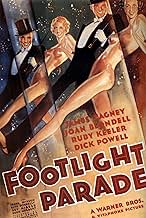
Cagney develops live musical prologues to be shown on stage at movie houses before the start of a film. (If you've seen the "Let's Go To The Movies" number in ANNIE you get the idea.) It's one catastrophe after another as Cagney tries to keep things running smoothly while staying a step ahead of the competition.
Joan Blondell is great as Cagney's secretary, who loves him more than he realizes. The solid cast also includes Busby Berkeley regulars Dick Powell and Ruby Keeler as a young new tenor and a secretary-turned- leading lady, respectively, with Frank McHugh as the perpetually worried dance instructor and Hugh Herbert as the morality adviser/censor. Lloyd Bacon directs the showbiz tale, with spectacular choreography by the inimitable Busby Berkeley.
I've seen this film's contemporaries (42ND STREET and GOLD DIGGERS OF 1933) and usually feel lukewarm toward these early musicals, but I found myself surprisingly receptive to FOOTLIGHT PARADE. I really liked Blondell's performance, with the romantic tension and snappy wit, and I could tolerate Keeler in her role. McHugh adds whiny comic relief and the script has some racy pre-Code touches. The film also benefits from James Cagney's screen presence. Cagney, best known for his gangster roles, demonstrates some dance steps in this rare musical appearance.
Berkeley choreographs a handful of routines (including an awkward cat- themed number), but saves the three biggest for the very end: "Honeymoon Hotel", "By A Waterfall", and "Shanghai Lil". As was often the case, the dance numbers are meant to be staged within the context of the story (a show within a show) and as was always the case, Berkeley choreographs cinematically, using camera movements, insert shots, and cuts that make no sense within the reality of the story. But his routines are meant for the moviegoers and they are awe-inspiring.
The water nymph routine will blow you away. I've seen my fair share of Busby Berkeley numbers, but the water nymph sequence may be his masterpiece. Did Berkeley invent synchronized swimming? I don't know, but he might as well have. There are unbelievable kaleidoscopic overhead shots as well as underwater choreography. I can't figure out how they did the shot of the swimmers in concentric rings, spinning in different directions, since the swimmers seemed to be lying still in the water. (Movie magic?) The more complex overhead shots are some of the most impressive visuals I've ever seen in a musical.
"Honeymoon Hotel" is a racy little number about couples spending their first night together in a hotel. Men in pajamas, women in negligees, bedrooms. There's a peculiar "child" that runs around causing mischief, but the scene has a neat larger-than-life dollhouse shot and a creative bit of stop-motion animation. "Shanghai Lil" follows a sailor through a crowded saloon in search of an elusive woman. There's a brawl, there are marching soldiers in formation, there's Ruby Keeler dolled up like a Chinese call girl, and there's Jimmy Cagney dancing and singing.
With a great cast and impressive dances, this is an enjoyable ride. Maybe the best of the early WB musicals.
"Is it my fault if somebody invented talking pictures?"
First-rate Busby Berkeley musical from Warner Bros. with a terrific cast and the wonderful choreography Berkeley was known for. Most of the musical numbers are saved for the last half-hour but they're all great. James Cagney and Joan Blondell are lots of fun. They always had perfect chemistry. There's also a lot of snappy pre-Code lines, particularly from Blondell. Dick Powell and Ruby Keeler are also enjoyable. Nice support from solid character actors Frank McHugh, Guy Kibbee, Arthur Hohl, and Hugh Herbert. Fast-paced and highly entertaining. Essential for fans of Berkeley or the great leads.
James Cagney goes on the dancing tour.
Cagney is even doing a bit of singing in this one and also quite an amount of dancing. And it needs to be said that he was not bad at it. He plays the role with a lot of confidence. He apparently had some dancing jobs in his early life before his acting career started to take off big time, so it actually isn't a weird thing that he also took on some musical acting roles in his career. He obviously also feels at ease in this totally different genre than most people are accustomed to seeing him in.
The movie is directed by Lloyd Bacon, who was perhaps among the best and most successful director within the genre. His earliest '30's musicals pretty much defined the musical genre and he also was responsible for genre movies such as "42nd Street". His musicals were always light and fun to watch and more comedy like than anything else really. '30's musicals never were really about its singing, this was something that more featured in '40's and later made musicals, mainly from the MGM studios.
As usual it has a light and simple story, set in the musical world, that of course is also predictable and progresses in a formulaic way. It nevertheless is a fun and simple story that also simply makes this an entertaining movies to watch. So do the characters and actors that are portraying them. Sort of weird though that that the total plot line of the movie gets sort of abandoned toward the end of the movie, when the movie only starts to consists out of musical number routines.
The musical moments toward the ending of the movie are also amusing and well done, even though I'm not a too big fan of the genre itself. Once again the musical numbers also feature a young Billy Barty. he often played little boys/babies/mice and whatever more early on in his career, including the movie musical "Gold Diggers of 1933", of one year earlier.
A recommendable early genre movie.
8/10
http://bobafett1138.blogspot.com/
Depression Era Musical Masterpiece
Busby, of course, is the undisputed master of the Hollywood musical with "Gold Diggers of 1933" and "42nd Street" to his credit (as Dance Director). Footlight Parade is graced by hundreds of scantily-clad chorus girls, a Berkeley trademark. The elaborate dance numbers were shot with only one camera and Busby was the first director to film close-ups of the dancers. His obsession with shapely legs and "rear-view" shots is amply demonstrated here. The overall effect is highly erotic and mesmerizing.
Our boy Jimmy Cagney plays Chester Kent, a producer of "prologues" or short musical stage productions that were performed in movie theaters to entertain the audience before the talkies were shown. He's surrounded by crooked partners, a corporate spy, and a gold-digging girlfriend. Although Cagney had a solid background in vaudeville, this was the first film in which he showed his dancing talents. Joan Blondell is memorable as Cagney's wise-cracking, lovestruck secretary. And Ruby Keeler is adorable, as always.
The film climaxes with three outstanding production numbers, "Honeymoon Hotel", "The Waterfall", and "Shanghai Lil", each one a masterpiece and not likely to be duplicated in today's Hollywood where so-called "special effects" have replaced creative cinematography.
Claudia's Bottom Line: Clever and erotic, with some of the best musical production numbers ever put on celluloid. A thoroughly enjoyable Depression era romp.
"Beside a waterfall"
Watching it again tonight, I was, however, struck yet once again by the genius of Busby Berkeley in staging the last three numbers, the "prologues." Most remarkable of a very remarkable trio for me is "Beside a waterfall." It just keeps building and building and building. Yes, of course, some of the shots of the women in the water are very erotic. It was 1933, after all, and before the Hayes Code. Berkeley and Warner Brothers understood that pretty women posed erotically had a real appeal to men,
------------------------------------
I watched the end of this movie again this morning. Perhaps I paid closer attention to this number this time, perhaps I was just in the right "mood." Either way, I marveled at the suggestiveness of so much of it. Those jets of water spurting up - I use the verb advisedly - between the swimming women's legs. All those shots of women opening and closing their legs. It was remarkably erotic on my 46" tv screen. What must it have been like in 1933 on huge movie theater screens in the era before multiplexes????
==========================================
But these erotic poses are not JUST erotic poses. The number keeps building and building and building. What will he do next, you keep wondering? Oh, that. But "that" is even more incredible than what has come before. By the time you get to the end of this number, you're exhausted, not just physically and erotically, but imaginatively as well. How could anyone have maintained and built on that suspense for 10 whole minutes? I can't tell you, but Berkeley did.
Third of the three prologues, "Shanghai Lil," is definitely not something that could have been filmed the same way just a year or two later when the Production Code was put in force. We see an opium den, a lot of prostitutes, at least one interracial couple, etc.
Having watched it again tonight, I will add that this is a strange "musical." There is almost no music for the first hour and a half. It's all in the three closing numbers. But what numbers!


Le saviez-vous
- AnecdotesFirst film where James Cagney dances - showing off his vaudeville and stage experience as a song-and-dance man. Cagney lobbied Warner Bros. to play this role. He would show off these talents to their fullest in La Glorieuse Parade (1942).
- GaffesAfter the "By A Waterfall" prologue ends, the film cuts to the audience giving an animated and thunderous applause, but in the balcony there is no applause or reaction. In fact, there is no movement whatsoever. They are perfectly still which indicates that a photo or painting was used for the balcony audience and then merged with the live theatre audience. The same photo/painting was also used for the "Shanghai Lil" balcony audience.
- Citations
Nan Prescott: You scram, before I wrap a chair around your neck!
Vivian Rich: [Angrily] It's three o'clock in the morning - where do you want me to go?
[Nan starts to speak, but Vivian immediately cuts her off]
Vivian Rich: You cheap stenographer...
Nan Prescott: Outside, countess. As long as they've got sidewalks YOU'VE got a job.
[Shoves her out, gives her a swift kick in the rump, and slams the door behind her]
- Autres versionsThere is an Italian edition of this film on DVD, distributed by DNA srl, "VIVA LE DONNE! (1933) + AMORE IN OTTO LEZIONI (1936)" (2 Films on a single DVD), re-edited with the contribution of film historian Riccardo Cusin. This version is also available for streaming on some platforms.
- ConnexionsEdited into Les Enfants de la crise (1933)
- Bandes originalesA Vision of Salome
(1908) (uncredited)
Music by J. Bodewalt Lampe
Played during the prologue scene in the movie theater
Meilleurs choix
Détails
- Date de sortie
- Pays d’origine
- Langues
- Aussi connu sous le nom de
- Footlight Parade
- Lieux de tournage
- société de production
- Consultez plus de crédits d'entreprise sur IMDbPro
Box-office
- Budget
- 703 000 $ US (estimation)
- Brut – à l'échelle mondiale
- 276 $ US
- Durée
- 1h 44m(104 min)
- Couleur
- Rapport de forme
- 1.37 : 1