ÉVALUATION IMDb
7,8/10
67 k
MA NOTE


Un rédacteur en chef utilise des astuces pour empêcher son ex-blonde de se remarier.Un rédacteur en chef utilise des astuces pour empêcher son ex-blonde de se remarier.Un rédacteur en chef utilise des astuces pour empêcher son ex-blonde de se remarier.
- Réalisation
- Scénaristes
- Vedettes
- Prix
- 5 victoires et 1 nomination au total

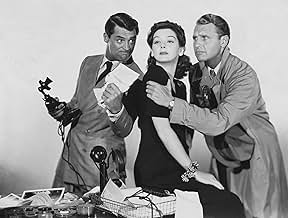
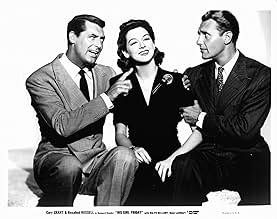
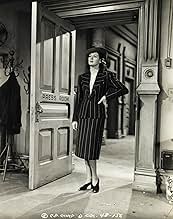
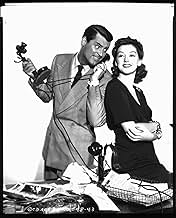


7,866.9K
1
2
3
4
5
6
7
8
9
10
Avis en vedette
10TuckMN
Slapstick comedy that moves faster than the speed of laughter...
This screen adaptation of the Ben Hecht and Charles MacArthur play "The Front Page" was adapted for the talents of Cary Grant and Rosalind Russell -- there is no such character as Hildy Johnson (Russell) in that play.
Director Howard Hawks wanted to show the whirlwind pace of the newsroom in the criminal courts system so he had his actors overlap their lines -- so much so that at times it seems as though everyone is talking at once; it even gets difficult to understand all that is going on.
He also had the cast move FAST so the film looks totally frenetic from scene to scene with no respite -- either from the laughs or from the action.
There are two really good "inside" jokes in the script: The first is where Walter Burns (Grant) is describing Hildy's fiancee and says that "he looks like that guy in the movies -- Bellamy," Well, it WAS Ralph Bellamy playing that part!
The other is when Burns says something about someone he once knew named "Archie Leach" which just happens to be Cary Grant's real name.
This is one of the true gems of Hollywood's most prolific era. It has incredible pacing, acting, photography and an authentic gritty feeling that would be associated with hard-boiled, "anything for a story" newspaper people.
It has long been one of my favorite films and deserves to be watched over and over again -- just for all the dialogue and great acting that may have gone by so fast you missed it the first time.
Director Howard Hawks wanted to show the whirlwind pace of the newsroom in the criminal courts system so he had his actors overlap their lines -- so much so that at times it seems as though everyone is talking at once; it even gets difficult to understand all that is going on.
He also had the cast move FAST so the film looks totally frenetic from scene to scene with no respite -- either from the laughs or from the action.
There are two really good "inside" jokes in the script: The first is where Walter Burns (Grant) is describing Hildy's fiancee and says that "he looks like that guy in the movies -- Bellamy," Well, it WAS Ralph Bellamy playing that part!
The other is when Burns says something about someone he once knew named "Archie Leach" which just happens to be Cary Grant's real name.
This is one of the true gems of Hollywood's most prolific era. It has incredible pacing, acting, photography and an authentic gritty feeling that would be associated with hard-boiled, "anything for a story" newspaper people.
It has long been one of my favorite films and deserves to be watched over and over again -- just for all the dialogue and great acting that may have gone by so fast you missed it the first time.
Not So Quiet on the Western Front... Page...
If Howard Hawks's screwball classic "His Girl Friday" isn't a perfect film, it had at least a perfect role for Cary Grant and Rosalind Russell... and that's the stuff durable greatness is made of.
Indeed, Grant was the epitome of wisecracking charm and his Walter Burns happened to be an obnoxious fellow delivering so many wisecracks that by the time the receiver found the proper repartee, someone was already being verbally crucified.
Rosalind Russell wasn't a star... yet... until she portrayed Burns' ace reporter and ex-wife Hildy Johnson, reliable and relatable 'girl Friday'. These two backgrounds explain why she plays in the same rhetorical league, she's a match to him... even when there's no matching anymore.
But maybe because she's taller than many actresses, she can get above Grant's shoulder high enough not to be totally swollen off by his charismatic despicability. She talks the talks but can walk the walk even if he's gallant enough to hold her the door... but why would a woman calling herself a newspaperman expect gallantry?
At a time where gender talk wasn't such a sensitive subject and this is where the film got tricky, Hildy is engaged to insurance agent Bruce Baldwyn and is determined to become his devoted housewife, to have children and live a peaceful life in Albany, of all the towns... so she expects some gentlemanly behavior from her editor and former husband... might as well expect Hitler to sign a Peace Treaty.
The titular 'Girl Friday' can't wait for her existential 'week-end', torn between her job and her future. The way the film makes these two situations irreconcilable can seem far-fetched but given the way Hildy handles her job, it's hard to imagine the combo. The lady must make up her mind. Meanwhile, Burns gets an opportunity that instantly tilts in his mind "thanks God, it's Friday!".
As usual with screwball comedies, the timing is crucial and when a top reporter is missing and an execution is polarizing opinions because of proclaimed insanity and suspicion of political motivations, someone must cover the news and Hildy happened to be in the right place at the right moment.
For Walter, Hildy's presence is to be exploited even if it means using every bit of his malevolent creativity against the gentle but rather bland Bruce... who looks exactly like Ralph Bellamy, according to Burns (or was it Grant having fun with the script?). Given the mistreatment poor Bruce undergoes, "His Girl Friday" is a tale of Machiavellian ingenuity at the services of one profession: journalism. Basically, the ends justify the means if it means covering the hottest topic of the day (pre-war days but they didn't know).
So Burns uses every trick of his sleeve to prevent Bruce from taking the train and forces Hildy to be on the front... and for the front, fully aware that her professional conscience will finally get the best of her. And there is something in Russell's performance, the way she resists the call of her profession while being fiercely attached to her fiancée that calls for admiration.
Whether she handles the other journalists who pose like vulture-like creatures, indifferent to the pleas of Williams' friend and hungry for any scandal or tip to it, she knows how to adapt her manners, to talk different languages, but that would be too easy with screwball comedy. We noticed from the start that the pace of the dialogue is as quick as if the box office depended on it, yet Hawks gratifies us with scenes where journalists and Burns are all together, sometimes, Bruce and Walter talk to Hildy and on the phone and the rhythm is so fast it sounds like harmonious cacophony.
The film was known for having a dialogue that could be contained in a twice longer film but Hawks insisted on having something natural that could flow simply and easily because people did talk like this in real life. And only for the rapid fire delivery of Russell, I'm glad they didn't take someone else, I can't imagine Katharine Hepburn in that role, Russell had the street smarts, the modern touch, the look, the sexiness... she got the scandal but the only thing she didn't get was an Oscar nomination, and that was a scandal too.
I didn't like the film at first because I have a problem with the schematic aspect of screwball comedies, the two men in love with the same woman and one of them has no chance because the other is Grant, that's why I didn't like "The Philadelphia Story"... but here, Grant is so unlikable you've got to wonder how come he had to get Russell at the end except to show that these two were equally unlikable thus meant to be together, which in that case makes the film modern in its daring anti-family bias.
And the ending doesn't imply that Hildy made the right personal choices, maybe journalists have a way with every non-personal matters but are totally ignorant of the things of life. I recently saw "Sweet Smell of Success" and I guess it's a common trope of Hollywood to depict journalism as a business dealing with cops, politicians, uses of bribes or blackmails and many methods that can only give it a cynical flavor.
Grant could embody these traits without being totally detestable, maybe it's because we try to see them from the eyes of Hildy and we accept that he's not such a bad guy after all. Ironically, when Hildy becomes the newspaper man, she lets the woman takes the upper hand and encourage Burns to show a more comprehensive and gentle side. But Hawks was a smart director, if he was smart enough to know that he could remake "The Front Page" with a gender swap, he could handle his characters as well.
After all, they might be unlikable but they have a likable way to be unlikable, and that's also the stuff durable greatness is made on.
Indeed, Grant was the epitome of wisecracking charm and his Walter Burns happened to be an obnoxious fellow delivering so many wisecracks that by the time the receiver found the proper repartee, someone was already being verbally crucified.
Rosalind Russell wasn't a star... yet... until she portrayed Burns' ace reporter and ex-wife Hildy Johnson, reliable and relatable 'girl Friday'. These two backgrounds explain why she plays in the same rhetorical league, she's a match to him... even when there's no matching anymore.
But maybe because she's taller than many actresses, she can get above Grant's shoulder high enough not to be totally swollen off by his charismatic despicability. She talks the talks but can walk the walk even if he's gallant enough to hold her the door... but why would a woman calling herself a newspaperman expect gallantry?
At a time where gender talk wasn't such a sensitive subject and this is where the film got tricky, Hildy is engaged to insurance agent Bruce Baldwyn and is determined to become his devoted housewife, to have children and live a peaceful life in Albany, of all the towns... so she expects some gentlemanly behavior from her editor and former husband... might as well expect Hitler to sign a Peace Treaty.
The titular 'Girl Friday' can't wait for her existential 'week-end', torn between her job and her future. The way the film makes these two situations irreconcilable can seem far-fetched but given the way Hildy handles her job, it's hard to imagine the combo. The lady must make up her mind. Meanwhile, Burns gets an opportunity that instantly tilts in his mind "thanks God, it's Friday!".
As usual with screwball comedies, the timing is crucial and when a top reporter is missing and an execution is polarizing opinions because of proclaimed insanity and suspicion of political motivations, someone must cover the news and Hildy happened to be in the right place at the right moment.
For Walter, Hildy's presence is to be exploited even if it means using every bit of his malevolent creativity against the gentle but rather bland Bruce... who looks exactly like Ralph Bellamy, according to Burns (or was it Grant having fun with the script?). Given the mistreatment poor Bruce undergoes, "His Girl Friday" is a tale of Machiavellian ingenuity at the services of one profession: journalism. Basically, the ends justify the means if it means covering the hottest topic of the day (pre-war days but they didn't know).
So Burns uses every trick of his sleeve to prevent Bruce from taking the train and forces Hildy to be on the front... and for the front, fully aware that her professional conscience will finally get the best of her. And there is something in Russell's performance, the way she resists the call of her profession while being fiercely attached to her fiancée that calls for admiration.
Whether she handles the other journalists who pose like vulture-like creatures, indifferent to the pleas of Williams' friend and hungry for any scandal or tip to it, she knows how to adapt her manners, to talk different languages, but that would be too easy with screwball comedy. We noticed from the start that the pace of the dialogue is as quick as if the box office depended on it, yet Hawks gratifies us with scenes where journalists and Burns are all together, sometimes, Bruce and Walter talk to Hildy and on the phone and the rhythm is so fast it sounds like harmonious cacophony.
The film was known for having a dialogue that could be contained in a twice longer film but Hawks insisted on having something natural that could flow simply and easily because people did talk like this in real life. And only for the rapid fire delivery of Russell, I'm glad they didn't take someone else, I can't imagine Katharine Hepburn in that role, Russell had the street smarts, the modern touch, the look, the sexiness... she got the scandal but the only thing she didn't get was an Oscar nomination, and that was a scandal too.
I didn't like the film at first because I have a problem with the schematic aspect of screwball comedies, the two men in love with the same woman and one of them has no chance because the other is Grant, that's why I didn't like "The Philadelphia Story"... but here, Grant is so unlikable you've got to wonder how come he had to get Russell at the end except to show that these two were equally unlikable thus meant to be together, which in that case makes the film modern in its daring anti-family bias.
And the ending doesn't imply that Hildy made the right personal choices, maybe journalists have a way with every non-personal matters but are totally ignorant of the things of life. I recently saw "Sweet Smell of Success" and I guess it's a common trope of Hollywood to depict journalism as a business dealing with cops, politicians, uses of bribes or blackmails and many methods that can only give it a cynical flavor.
Grant could embody these traits without being totally detestable, maybe it's because we try to see them from the eyes of Hildy and we accept that he's not such a bad guy after all. Ironically, when Hildy becomes the newspaper man, she lets the woman takes the upper hand and encourage Burns to show a more comprehensive and gentle side. But Hawks was a smart director, if he was smart enough to know that he could remake "The Front Page" with a gender swap, he could handle his characters as well.
After all, they might be unlikable but they have a likable way to be unlikable, and that's also the stuff durable greatness is made on.
"You've got an old fashioned idea divorce is something that lasts forever..."
"His Girl Friday" is a romantic comedy that belongs almost entirely to the screwball tradition. The screenplay is adapted from the 1928 play "The Front Page" by Ben Hecht and Charles MacArthur. This is the second, and by far the most successful, film adaptation of that story.
We follow former star reporter Hildy Johnson, who is about to marry insurance agent Bruce Baldwin. Their plan is simple: to start a family and settle into a quiet life in Albany. But there's a catch-Hildy happens to be the ex-wife of Walter Burns, a ruthless and manipulative newspaper editor determined to derail their plans. Walter convinces Hildy to cover just one more story before she leaves with Bruce. The case seems simple-a chance killing-but beneath it lies a tangle of political corruption. Hildy agrees, on the condition that Walter buys a life insurance policy from Bruce, but by doing so she steps straight into Walter's treacherous game...
Howard Hawks directs with a whirlwind pace: the lines are exchanged at lightning speed, often without pause, like bursts of rapid-fire. This rhythm adds energy to the comedy and makes the escalating entanglements feel endless. Hawks was known to allow improvisation, cutting a scene only when it was necessary to move on to the next sequence. The result is that the audience feels immersed in the true circus of a newsroom. The camera faithfully follows the protagonists, while close-ups highlight the irony and satirical edge of their relationships. Romance here takes a back seat, almost as if life itself is unfair to Hildy. It's clear, however, that ambition drives every character forward.
Thematically, the film exposes corrupt politics and the sensationalism of the press, through the fate of a condemned man abandoned by the justice system. Its characters move through a sharp, cynical game that raises questions about ambition, marriage, emancipation, and honesty in relationships.
Cary Grant is outstanding as Walter Burns-manipulative, unscrupulous, and yet irresistibly charming. He is both an editorial demon and a slippery seducer, and yet the audience can't help but root for him. His charisma makes us sympathize with him, even when we cannot fully grasp his motives. Once again, Grant is flawless in his element.
Rosalind Russell plays Hildy Johnson, the beating heart of the film. Hildy is smart, witty, and resourceful-a woman torn between her desire for domestic peace and the irresistible pull of reporting. She holds her own against Walter in every exchange, and their chemistry, especially in their quarrels, is nothing short of electric.
Ralph Bellamy, as Bruce Baldwin, is the good-natured, gentlemanly fiancé who is hopelessly out of place in the chaos of journalism. His character is the complete opposite of Walter and Hildy, providing a perfect counterbalance that deepens the comedy. Bellamy is superb in the role, though one might joke that his fans should start a petition never to cast him opposite Grant again-because no one escapes Walter's tricks unscathed.
"His Girl Friday" is a film about the speed of life, the power of words, and the manipulative games that unfold within the noisy world of politics and journalism. Love and professional passion collide in a single point, while truth remains as slippery and fleeting as a tabloid headline. For lovers of romantic comedy, this film is essential viewing and stands as one of the finest examples of the genre from the 1940s.
We follow former star reporter Hildy Johnson, who is about to marry insurance agent Bruce Baldwin. Their plan is simple: to start a family and settle into a quiet life in Albany. But there's a catch-Hildy happens to be the ex-wife of Walter Burns, a ruthless and manipulative newspaper editor determined to derail their plans. Walter convinces Hildy to cover just one more story before she leaves with Bruce. The case seems simple-a chance killing-but beneath it lies a tangle of political corruption. Hildy agrees, on the condition that Walter buys a life insurance policy from Bruce, but by doing so she steps straight into Walter's treacherous game...
Howard Hawks directs with a whirlwind pace: the lines are exchanged at lightning speed, often without pause, like bursts of rapid-fire. This rhythm adds energy to the comedy and makes the escalating entanglements feel endless. Hawks was known to allow improvisation, cutting a scene only when it was necessary to move on to the next sequence. The result is that the audience feels immersed in the true circus of a newsroom. The camera faithfully follows the protagonists, while close-ups highlight the irony and satirical edge of their relationships. Romance here takes a back seat, almost as if life itself is unfair to Hildy. It's clear, however, that ambition drives every character forward.
Thematically, the film exposes corrupt politics and the sensationalism of the press, through the fate of a condemned man abandoned by the justice system. Its characters move through a sharp, cynical game that raises questions about ambition, marriage, emancipation, and honesty in relationships.
Cary Grant is outstanding as Walter Burns-manipulative, unscrupulous, and yet irresistibly charming. He is both an editorial demon and a slippery seducer, and yet the audience can't help but root for him. His charisma makes us sympathize with him, even when we cannot fully grasp his motives. Once again, Grant is flawless in his element.
Rosalind Russell plays Hildy Johnson, the beating heart of the film. Hildy is smart, witty, and resourceful-a woman torn between her desire for domestic peace and the irresistible pull of reporting. She holds her own against Walter in every exchange, and their chemistry, especially in their quarrels, is nothing short of electric.
Ralph Bellamy, as Bruce Baldwin, is the good-natured, gentlemanly fiancé who is hopelessly out of place in the chaos of journalism. His character is the complete opposite of Walter and Hildy, providing a perfect counterbalance that deepens the comedy. Bellamy is superb in the role, though one might joke that his fans should start a petition never to cast him opposite Grant again-because no one escapes Walter's tricks unscathed.
"His Girl Friday" is a film about the speed of life, the power of words, and the manipulative games that unfold within the noisy world of politics and journalism. Love and professional passion collide in a single point, while truth remains as slippery and fleeting as a tabloid headline. For lovers of romantic comedy, this film is essential viewing and stands as one of the finest examples of the genre from the 1940s.
The Front Page remade
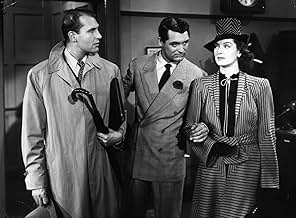
This gloriously funny romp by Howard Hawks is rightly remembered as one of the fastest-talking movies ever made. Originally done as 'The Front Page', the play by Hecht and McArthur takes on new life here as the character of Hildy Johnson metamorphoses in this version to be a sparky woman (played by Rosalind Russell), former wife of the harassed columnist Walter Burns (played with characteristic bewilderment and charm by Cary Grant). Hildy is about to marry again, to the nice but dull Bruce Baldwin (played by Ralph Bellamy as a character so boring he 'is like Ralph Bellamy' - how Hollywood liked its in-jokes).
With that fire-cracking script, a sizable amount of sparks between Grant and Russell, and good support from Bellamy and a cast which includes Gene Lockhart, Cliff Edwards, Clarence Kolb, and Regis Toomey, 'His Girl Friday' is one of those classic gems which never age and which remain hugely entertaining.
With that fire-cracking script, a sizable amount of sparks between Grant and Russell, and good support from Bellamy and a cast which includes Gene Lockhart, Cliff Edwards, Clarence Kolb, and Regis Toomey, 'His Girl Friday' is one of those classic gems which never age and which remain hugely entertaining.
Roz Russell Is on the Case
Every good thing you've heard about this movie is true. It may very well be the fastest paced movie I've ever seen. Jerry Bruckheimer's most hyperbolic action movie ain't got nothing' on this one.
Cary Grant and Rosalind Russell were a brilliant screen pair (indeed, it seems that no one was bad casting when paired with Cary Grant) as rival reporters in a furiously paced news office. Russell is the odd man, or should I say odd girl, out, due to her lack of a penis, but she proves herself more than capable of holding her own with the boys.
Russell charges across the screen and never loses momentum for a second. She's goofy, sexy and hysterical. The funniest moment in the film comes when she's chasing a man down the street (I won't go into details) and dive tackles him to the ground.
One of the first films from the 40s and a highlight of the decade.
Grade: A+
Cary Grant and Rosalind Russell were a brilliant screen pair (indeed, it seems that no one was bad casting when paired with Cary Grant) as rival reporters in a furiously paced news office. Russell is the odd man, or should I say odd girl, out, due to her lack of a penis, but she proves herself more than capable of holding her own with the boys.
Russell charges across the screen and never loses momentum for a second. She's goofy, sexy and hysterical. The funniest moment in the film comes when she's chasing a man down the street (I won't go into details) and dive tackles him to the ground.
One of the first films from the 40s and a highlight of the decade.
Grade: A+


Le saviez-vous
- AnecdotesRosalind Russell thought, while shooting, that she didn't have as many good lines as Cary Grant had, so she hired an advertisement writer through her brother-in-law and had him write more clever lines for the dialog. Since Howard Hawks allowed for spontaneity and ad-libbing, he, and many of the cast and crew didn't notice it, but Grant knew she was up to something, leading him to greet her every morning: "What have you got today?"
- GaffesWhen Bruce Baldwin comes to the press room late in the movie, an electric fan and small shelf on the wall to the left of the door both completely disappear. Both have been there in all previous scenes and both reappear after this scene.
- Citations
[describing Bruce]
Walter Burns: He looks like that fellow in the movies - Ralph Bellamy.
- Générique farfeluOpening credits prologue: It all happened in the "Dark Ages" of the newspaper game--when to a reporter "Getting that story" justified anything short of murder.
Incidentally you will see in this picture no resemblance to the man and woman of the press today.
Ready?
Well, once upon a time - -
- ConnexionsEdited into Michael Jackson's This Is It (2009)
Meilleurs choix
Connectez-vous pour évaluer et surveiller les recommandations personnalisées
Détails
- Date de sortie
- Pays d’origine
- Langues
- Aussi connu sous le nom de
- His Girl Friday
- Lieux de tournage
- société de production
- Consultez plus de crédits d'entreprise sur IMDbPro
Box-office
- Brut – à l'échelle mondiale
- 330 $ US
- Durée
- 1h 32m(92 min)
- Couleur
- Rapport de forme
- 1.37 : 1
Contribuer à cette page
Suggérer une modification ou ajouter du contenu manquant