ÉVALUATION IMDb
6,9/10
5,4 k
MA NOTE

En 1940, l'équipage hétéroclite d'un cargo britannique, le SS Glencairn se prépare pour un périple périlleux des Antilles à Baltimore, puis jusqu'en Angleterre.En 1940, l'équipage hétéroclite d'un cargo britannique, le SS Glencairn se prépare pour un périple périlleux des Antilles à Baltimore, puis jusqu'en Angleterre.En 1940, l'équipage hétéroclite d'un cargo britannique, le SS Glencairn se prépare pour un périple périlleux des Antilles à Baltimore, puis jusqu'en Angleterre.
- Réalisation
- Scénaristes
- Vedettes
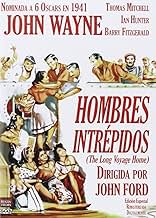
- Nommé pour 6 oscars
- 8 victoires et 7 nominations au total


Wilfrid Lawson
- Captain
- (as Wilfred Lawson)


Joe Sawyer
- Davis
- (as Joseph Sawyer)


Constant Franke
- Norway
- (as Constant Frenke)

David Hillary Hughes
- Scotty
- (as David Hughes)

6,95.3K
1
2
3
4
5
6
7
8
9
10
Avis en vedette
One of John Ford's best. Maybe THE best.
The Long Voyage home is not a typical film from this period. It differs in that it focuses on an ensemble cast instead of on a star. That's common nowadays, but not back then. Ford's Stagecoach, made the previous year, had quite an ensemble cast, but the film was always focused on Ringo and Dallas. Here, John Wayne is just one of the stars. Thomas Mitchell, who played Doc Washburn in Stagecoach, has a role that's as big as Wayne's in Voyage. Others are as prominent.
The plot is also pretty tenuous and episodic. And, unlike most films of the time, the focus was not on a goal, but just on the events and lives of the seaman aboard the Glencairn. We see them sail through the war-torn Atlantic, between the U.S. and Europe. They have fun, they fight, they talk about home. It's all rather gentle and beautiful, very subtle. The script is great, which is probably due to Eugene O'Neil, for of whose plays this film is based on (they are blended together seamlessly).
The actors are marvelous. Mitchell and Wayne are probably the best known, but there are also Ian Hunter, Barry Fitzgerald, John Qualen, Ward Bond, Mildred Natwick, and many other great character actors. John Wayne was probably the draw, considering how popular Stagecoach had made him, but, as I said, his role is not out in the front. In fact, he doesn't have many lines. His schtick is that he is a Swede who can't speak English well, so he is generally pretty quiet (Wayne can't muster the best Swedish accent, either, so that's kind of a good thing!). He has one great scene where he has some long bits of dialogue. But even without the dialogue, he emotes so well in his face. I knew his character intimately by the end of the film. We don't often think of Wayne as a great actor, but he certainly was. Although The Searchers probably contains his best role, The Long Voyage Home would certainly be worth a major mention when talking about his career.
If you could say that there is a single "star" of this film, that would have to be Greg Tolland. Of course, he photographed Citizen Kane in the next year, as well as Ford's Best Picture winning How Green Was My Valley and The Grapes of Wrath. The cinematography is some of the most impressive to be found in the American cinema. John Ford himself is just as much the star of The Long Voyage Home. He definitely put his heart into this one. The direction is beautiful, artful. It is as good here as it is in The Grapes of Wrath, My Darling Clementine, and The Searchers, that is, it is one of his very best films, if not THE best. To date, it's the only Ford film that made me shed tears. 10/10.
The plot is also pretty tenuous and episodic. And, unlike most films of the time, the focus was not on a goal, but just on the events and lives of the seaman aboard the Glencairn. We see them sail through the war-torn Atlantic, between the U.S. and Europe. They have fun, they fight, they talk about home. It's all rather gentle and beautiful, very subtle. The script is great, which is probably due to Eugene O'Neil, for of whose plays this film is based on (they are blended together seamlessly).
The actors are marvelous. Mitchell and Wayne are probably the best known, but there are also Ian Hunter, Barry Fitzgerald, John Qualen, Ward Bond, Mildred Natwick, and many other great character actors. John Wayne was probably the draw, considering how popular Stagecoach had made him, but, as I said, his role is not out in the front. In fact, he doesn't have many lines. His schtick is that he is a Swede who can't speak English well, so he is generally pretty quiet (Wayne can't muster the best Swedish accent, either, so that's kind of a good thing!). He has one great scene where he has some long bits of dialogue. But even without the dialogue, he emotes so well in his face. I knew his character intimately by the end of the film. We don't often think of Wayne as a great actor, but he certainly was. Although The Searchers probably contains his best role, The Long Voyage Home would certainly be worth a major mention when talking about his career.
If you could say that there is a single "star" of this film, that would have to be Greg Tolland. Of course, he photographed Citizen Kane in the next year, as well as Ford's Best Picture winning How Green Was My Valley and The Grapes of Wrath. The cinematography is some of the most impressive to be found in the American cinema. John Ford himself is just as much the star of The Long Voyage Home. He definitely put his heart into this one. The direction is beautiful, artful. It is as good here as it is in The Grapes of Wrath, My Darling Clementine, and The Searchers, that is, it is one of his very best films, if not THE best. To date, it's the only Ford film that made me shed tears. 10/10.
A set of sea plays
I was expecting this film about a tramp steamer with a cargo of high explosives to be a wartime drama along the lines of "San Demetrio"; in fact, the war is pretty peripheral. Even when the ship does come under attack, somewhere around the middle of the picture, she apparently escapes unscathed via means unspecified (did the enemy simply run out of bombs after missing with all of them?) It's really a story about life on the lower decks, with the officers making distant appearances and the wartime background intruding from time to time, but with the main focus on the relationships among the crew.
According to the credits, it was adapted from a set of "sea plays" by Eugene O'Neill, which accounts for the very episodic feel of the film. It's not really a complete story; it's a set of individual isolated incidents, some of which are never really explained (all the signalling with torches, for instance, which is apparently not anything to do with undercover spies -- I actually assumed there were two ships in the opening scene, one being the tramp steamer and the other a British naval vessel!) On the other hand, it did succeed in several places in making me care about the characters; I was convinced that Smitty was being falsely accused, and desperate by the end for Ole to escape successfully from seaboard life as his shipmates are determined that he should do, despite the heavy foreshadowing otherwise.
The film was billed as "John Wayne in Eugene O'Neill's The Long Voyage Home", but that's presumably a retrospective attempt to cash in on Wayne's name; the lead actors are Thomas Mitchell as the burly Irishman Driscoll, and Ian Hunter as the middle-class Englishman who is the odd one out among his cheery companions. John Wayne plays Ole, the simple Swedish farmboy whose role is largely passive and monosyllabic, though he gets a good scene where he talks nostalgically about his home during the final drunken bar-crawl.
There are no very great surprises here, and the pace is quite slow -- extremely slow at the beginning, which is presumably intended to indicate the heat and tedium of a tropical night. I can see these individual 'episodes' working better in the original format as one-act plays, each with its definitive ending, than as an attempt at one continuing story. I didn't find the film quite successful (not nearly so much so as the English production "San Demetrio, London"), but on the other hand, it's not entirely mediocre -- and it's not as gung-ho as an actual war film would probably have been. (The shadowy role of the war is explained, in retrospect, by the fact that the source material was written twenty years earlier!)
I'd probably rate it 7/10: worth taping from TV, not worth paying for :-p
According to the credits, it was adapted from a set of "sea plays" by Eugene O'Neill, which accounts for the very episodic feel of the film. It's not really a complete story; it's a set of individual isolated incidents, some of which are never really explained (all the signalling with torches, for instance, which is apparently not anything to do with undercover spies -- I actually assumed there were two ships in the opening scene, one being the tramp steamer and the other a British naval vessel!) On the other hand, it did succeed in several places in making me care about the characters; I was convinced that Smitty was being falsely accused, and desperate by the end for Ole to escape successfully from seaboard life as his shipmates are determined that he should do, despite the heavy foreshadowing otherwise.
The film was billed as "John Wayne in Eugene O'Neill's The Long Voyage Home", but that's presumably a retrospective attempt to cash in on Wayne's name; the lead actors are Thomas Mitchell as the burly Irishman Driscoll, and Ian Hunter as the middle-class Englishman who is the odd one out among his cheery companions. John Wayne plays Ole, the simple Swedish farmboy whose role is largely passive and monosyllabic, though he gets a good scene where he talks nostalgically about his home during the final drunken bar-crawl.
There are no very great surprises here, and the pace is quite slow -- extremely slow at the beginning, which is presumably intended to indicate the heat and tedium of a tropical night. I can see these individual 'episodes' working better in the original format as one-act plays, each with its definitive ending, than as an attempt at one continuing story. I didn't find the film quite successful (not nearly so much so as the English production "San Demetrio, London"), but on the other hand, it's not entirely mediocre -- and it's not as gung-ho as an actual war film would probably have been. (The shadowy role of the war is explained, in retrospect, by the fact that the source material was written twenty years earlier!)
I'd probably rate it 7/10: worth taping from TV, not worth paying for :-p
Lots of silly fistfights and drinking, but the threat of a story, too, and GREAT photography
The Long Voyage Home (1940)
Any movie with Gregg Toland behind the camera is worth watching, with an emphasis on the visual experience. From Wuthering Heights (1939) to the Little Foxes, Ball of Fire, and Citizen Kane (all 1941), in three years, Toland lifted (again) the standards of the best Hollywood could do. This isn't just me saying this, and of course there are other great cinematographers, but if you've seen these movies you know they are exceptional. I falls right in the middle of this great stretch, and it has the revered John Ford directing, letting Toland do his thing, right from the first scene.
This is a solid, sometimes moving, sometimes dramatic movie, for sure. But the long first part is a composite of manly clichés: drinking, fighting, and womanizing. It's all in good fun, in a way, and the exoticness is made to sell movies. But there's quite a lot of nothing going on beyond seducing native women in some unnamed distant land. The dancing and fighting are filmed with Toland perfection, but it turns quickly to farce, or stereotype.
Thomas Mitchell is a lively Irishman in his best form, and John Wayne is an improbable Swede, and doesn't stand out much from the bunch except toward the end, when he is a block of wood with a bad accent. The story is a series of misunderstandings and friendships, but since the plot is made of four different Eugene O'Neill plays (from 20 years earlier), there is a little discontinuity to it all.
All of this is set during that strange cusp between World War II beginning in Europe and the U.S. still not joining in. The ship is carrying ammunition, and hints of things that really matter are given right at the start, with some news reports crackling into the seeming isolation of the ship. As the captain says as they are to depart from New York with the military cargo, "If it doesn't get there it'll be missed. But we won't."
Isolationism gets a more famous treatment in Casablanca two years later, after the Americans are already at war, so in a way, a big name movie like this had more potential influence on American sentiment. It's fascinating to see this Walter Wanger/John Ford/John Wayne collaboration after their breakthrough Stagecoach the year before (producer, director, star). But the stakes are raised, and the production level is much higher.
Any movie with Gregg Toland behind the camera is worth watching, with an emphasis on the visual experience. From Wuthering Heights (1939) to the Little Foxes, Ball of Fire, and Citizen Kane (all 1941), in three years, Toland lifted (again) the standards of the best Hollywood could do. This isn't just me saying this, and of course there are other great cinematographers, but if you've seen these movies you know they are exceptional. I falls right in the middle of this great stretch, and it has the revered John Ford directing, letting Toland do his thing, right from the first scene.
This is a solid, sometimes moving, sometimes dramatic movie, for sure. But the long first part is a composite of manly clichés: drinking, fighting, and womanizing. It's all in good fun, in a way, and the exoticness is made to sell movies. But there's quite a lot of nothing going on beyond seducing native women in some unnamed distant land. The dancing and fighting are filmed with Toland perfection, but it turns quickly to farce, or stereotype.
Thomas Mitchell is a lively Irishman in his best form, and John Wayne is an improbable Swede, and doesn't stand out much from the bunch except toward the end, when he is a block of wood with a bad accent. The story is a series of misunderstandings and friendships, but since the plot is made of four different Eugene O'Neill plays (from 20 years earlier), there is a little discontinuity to it all.
All of this is set during that strange cusp between World War II beginning in Europe and the U.S. still not joining in. The ship is carrying ammunition, and hints of things that really matter are given right at the start, with some news reports crackling into the seeming isolation of the ship. As the captain says as they are to depart from New York with the military cargo, "If it doesn't get there it'll be missed. But we won't."
Isolationism gets a more famous treatment in Casablanca two years later, after the Americans are already at war, so in a way, a big name movie like this had more potential influence on American sentiment. It's fascinating to see this Walter Wanger/John Ford/John Wayne collaboration after their breakthrough Stagecoach the year before (producer, director, star). But the stakes are raised, and the production level is much higher.
Not a typical "John Wayne film",but still excellent
John Wayne is misleadingly top-billed ,presumably to bring in the crowds who thought they were going to see typical Wayne heroics in this one.He is actually part of an excellent ensemble cast in this film,which has seamlessly adapted by Dudley Nichols from a group of one-act plays by the great Eugene O'Neill. Nichols' writing is so good that unless you're an O'Neill expert,it is VERY difficult to tell where O'Neill leaves off and Nichols takes over,except perhaps in the episode involving British actor Ian Hunter (in the performance of a lifetime) as a presumed German spy. The plays,written in the early 1900's,have been updated to take place during WW II,but the propaganda angle is very tastefully handled and almost non-existent;in fact,here Nichols and director John Ford show great respect for the integrity of O'Neill's plays.
The cast is excellent,but Wayne actually hasn't got much to do in comparison with his other films,and this is a film of dialogue,not action.Perhaps that's why the previous reviewer found it interminable. [John Wayne uses a Swedish (!) accent in this movie,which he actually does quite well--don't laugh!] The most intense acting is done by Thomas Mitchell (Scarlett O'Hara's dad in "Gone With The Wind") and Barry Fitzgerald,who are actually the stars of the movie.And director John Ford shows us what a true master of his craft he is by equalling Hitchcock's accomplishment in "Lifeboat" in keeping the action confined to a small space without making it seem tiresome. The back-and-white photography is stunningly good--the best American photography in a black-and-white 1940's American film,aside from "Citizen Kane",of course.
John Wayne fans shouldn't pass this one up,and all non-fans should still enjoy this fine film.
The cast is excellent,but Wayne actually hasn't got much to do in comparison with his other films,and this is a film of dialogue,not action.Perhaps that's why the previous reviewer found it interminable. [John Wayne uses a Swedish (!) accent in this movie,which he actually does quite well--don't laugh!] The most intense acting is done by Thomas Mitchell (Scarlett O'Hara's dad in "Gone With The Wind") and Barry Fitzgerald,who are actually the stars of the movie.And director John Ford shows us what a true master of his craft he is by equalling Hitchcock's accomplishment in "Lifeboat" in keeping the action confined to a small space without making it seem tiresome. The back-and-white photography is stunningly good--the best American photography in a black-and-white 1940's American film,aside from "Citizen Kane",of course.
John Wayne fans shouldn't pass this one up,and all non-fans should still enjoy this fine film.
Couldn't Warm to This Episodic Film
A strange, episodic film about a group of seamen who are charged with transporting munitions from a tropical port to England to help the British war effort.
These men aren't in the military themselves, which puts them in a sort of limbo. Though their mission is driven by the war, and their lives will be in danger from German U-boats prowling the sea they have to pass through, the war itself is only a vague specter in their actual lives, which are much more concerned with personal emotions and motives: homesickness being the primary one. The movie could serve as a representation for America as a country at the time of the film's release -- not directly involved in a war that one way or another was going to have a huge impact on it regardless.
John Ford gives the film a melancholy and even rather eerie vibe, helped in no small part by Gregg Toland's cinematography. But I can't say I ever really warmed to the film. Its episodic nature starts to feel monotonous after a while. We just start to learn something about a character and then the narrative moves along to yet another long drunken fistfight. Something about the movie remains deeply unsatisfying, even if one can appreciate the artistry that went into it.
John Wayne is now given top billing for this film, but he's part of a large ensemble cast without a real star. And oh my goodness, no one should have asked him to try a Swedish accent.
"The Long Voyage Home" was nominated for six Oscars, though it went home empty handed: Outstanding Production, Best Screenplay (Dudley Nichols), Best Cinematography (B&W), Best Film Editing (Sherman Todd), Best Original Score (Richard Hageman), and Best Special Effects (R.T. Layton, R.O. Binger, and Thomas T. Moulton).
Grade: B
These men aren't in the military themselves, which puts them in a sort of limbo. Though their mission is driven by the war, and their lives will be in danger from German U-boats prowling the sea they have to pass through, the war itself is only a vague specter in their actual lives, which are much more concerned with personal emotions and motives: homesickness being the primary one. The movie could serve as a representation for America as a country at the time of the film's release -- not directly involved in a war that one way or another was going to have a huge impact on it regardless.
John Ford gives the film a melancholy and even rather eerie vibe, helped in no small part by Gregg Toland's cinematography. But I can't say I ever really warmed to the film. Its episodic nature starts to feel monotonous after a while. We just start to learn something about a character and then the narrative moves along to yet another long drunken fistfight. Something about the movie remains deeply unsatisfying, even if one can appreciate the artistry that went into it.
John Wayne is now given top billing for this film, but he's part of a large ensemble cast without a real star. And oh my goodness, no one should have asked him to try a Swedish accent.
"The Long Voyage Home" was nominated for six Oscars, though it went home empty handed: Outstanding Production, Best Screenplay (Dudley Nichols), Best Cinematography (B&W), Best Film Editing (Sherman Todd), Best Original Score (Richard Hageman), and Best Special Effects (R.T. Layton, R.O. Binger, and Thomas T. Moulton).
Grade: B


Le saviez-vous
- AnecdotesBarry Fitzgerald, who plays the character of Cocky, and Arthur Shields, who played Donkeyman, were brothers in real life. They also appeared together in director John Ford's L'homme tranquille (1952).
- GaffesAt the beginning of the film, when Driscoll sneaks back to the ship, he jumps from a rowboat into the water and climbs up the anchor chain. The next time onscreen, he appears dry from head to toe.
- ConnexionsFeatured in Film Preview: Episode #1.2 (1966)
- Bandes originalesBlow the Man Down
(uncredited)
Traditional
Played during the opening credits
Sung often by crewmen
Sung a cappella by J.M. Kerrigan
Variations played as part of the score
Meilleurs choix
Connectez-vous pour évaluer et surveiller les recommandations personnalisées
- How long is The Long Voyage Home?Propulsé par Alexa
Détails
- Date de sortie
- Pays d’origine
- Langues
- Aussi connu sous le nom de
- Hombres del mar
- Lieux de tournage
- Los Angeles Harbor, Wilmington, Los Angeles, Californie, États-Unis(scenes on S.S. Munami)
- sociétés de production
- Consultez plus de crédits d'entreprise sur IMDbPro
Box-office
- Budget
- 682 495 $ US (estimation)
- Durée
- 1h 45m(105 min)
- Couleur
- Rapport de forme
- 1.37 : 1
Contribuer à cette page
Suggérer une modification ou ajouter du contenu manquant