ÉVALUATION IMDb
6,1/10
1,7 k
MA NOTE


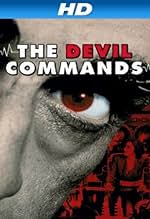
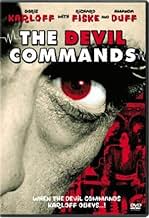
Ajouter une intrigue dans votre langueScientist becomes obsessed with the idea of communicating with his dead wife.Scientist becomes obsessed with the idea of communicating with his dead wife.Scientist becomes obsessed with the idea of communicating with his dead wife.
- Réalisation
- Scénaristes
- Vedettes




Ernie Adams
- Elam
- (uncredited)

Lester Allen
- Dr. Van Den
- (uncredited)

Wheaton Chambers
- Dr. Sanders
- (uncredited)
Earl Crawford
- Johnson
- (uncredited)
Harrison Greene
- Mr. Booth, Bakery Proprietor
- (uncredited)

Erwin Kalser
- Professor Kent
- (uncredited)

Eddie Kane
- Professor Walt
- (uncredited)
George McKay
- Station Agent
- (uncredited)
Al Rhein
- Truck Driver
- (uncredited)
6,11.6K
1
2
3
4
5
6
7
8
9
10
Avis en vedette
Not Bad, But The Book Is Sooooo Much Better
I must confess to a degree of disappointment after having watched "The Devil Commands" the other night, after several years of waiting to do so. The memory of its excellent source novel, William Sloane's "The Edge of Running Water" (1937), is still very much with me from several years ago, you see, and I'm afraid that the film does suffer in comparison. The book has sharply drawn characters, a well-detailed plot (a scientist attempting to communicate with his dead wife), great suspense and a very satisfying windup. The film, unfortunately, has none of these things in much abundance. Still, there ARE some good things to be said for it. Boris Karloff, as usual, is wonderful, as is Anne Revere in her role as his assistant. The effects are more than passable, and, at a mere 65 minutes, there is no unnecessary padding. Indeed, the film can be accused of being not fleshed out enough! Several things aren't explained; even Boris' fate is never clearly shown, unlike his character's amazing finish in the book. This is a story that is truly ripe for a remake, if done faithfully and by a team that respects the source material. Still, I can think of many more fruitless ways to spend an hour than by curling up with "The Devil Commands."
Rockin'-Out on Brain Waves
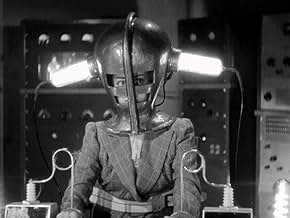
At last, Karloff has met his match. One glance from the steely-eyed Ann Revere (Mrs. Walters) is enough to freeze even Frankenstein. She doesn't need make-up—she's scary enough just walking onto the set. I'd love to see a stare-down between her and an icy Bette Davis. Anyway, the movie is occasionally atmospheric, especially the cliff house scenes. The plot doesn't make much sense—I guess that's why we get the voice-over narration. It's something about getting brain waves from the dead and turning them into talk. Apparently, that requires that Dr. Blair (Karloff) assemble a junk pile in his laboratory. On special occasions, the metal heaps sit around a table in diving helmets and sort of rock out on brain waves. Then there's the live person who puts on a helmet and sticks neon tubes in her ears. Apparently, that triggers an indoor wind, and then wispy ghost-like things appear. The wind doesn't bother them, but it sure musses-up Karloff's hair. It's one wild and crazy lab scene.
The cast and crew are an interesting bunch. Director Dmytryk was one of the blacklisted Hollywood Ten, who then decided to sing to the House committee, and so, went back to work. On the other hand, Revere never did sing and stayed blacklisted for a decade or so. There's also young Robert Fiske who plays Dr. Sayles. He has the distinction of being one of a handful of movie actors killed in action during WWII— don't they deserve some kind of Hollywood memorial. And between Dorothy Adams (Mrs. Marcy) and the equally familiar Ellen Corby, housekeeper roles stayed monopolized in Hollywood for about twenty years. Nothing special in this 50 or-so minutes, except for the goofy lab scenes. But something should be said for the great Karloff. Even in this routine programmer, he gives it his all, a spirited performance that almost makes the hocus-pocus believable. I hope there's a place in Hollywood heaven for great old pro's like him.
The cast and crew are an interesting bunch. Director Dmytryk was one of the blacklisted Hollywood Ten, who then decided to sing to the House committee, and so, went back to work. On the other hand, Revere never did sing and stayed blacklisted for a decade or so. There's also young Robert Fiske who plays Dr. Sayles. He has the distinction of being one of a handful of movie actors killed in action during WWII— don't they deserve some kind of Hollywood memorial. And between Dorothy Adams (Mrs. Marcy) and the equally familiar Ellen Corby, housekeeper roles stayed monopolized in Hollywood for about twenty years. Nothing special in this 50 or-so minutes, except for the goofy lab scenes. But something should be said for the great Karloff. Even in this routine programmer, he gives it his all, a spirited performance that almost makes the hocus-pocus believable. I hope there's a place in Hollywood heaven for great old pro's like him.
Don't open that door!
Corny and cliche'd as The Devil Commands may look to the superficial gaze, it's a powerful expression of the inextinguishable and far from trivial human wish to believe that death is not the end and that the dead we loved are not forever lost to us. Karloff starred in a whole sub-genre of films on this theme from the middle 1930s to the early 1940s (cf The Invisible Ray, Before I Hang, The Man They Could Not Hang, etc), invariably as a misunderstood scientific genius, embittered by tragedy or injustice, whose desire to conquer death clashes fatally with the prerogatives of the Almighty.
Whether one believes in an afterlife or not, it would be a coarsely reductionist mind that could consider the subject ridiculous. What gives these films (and this one in particular) their eerily modernist slant on the matter lies in the way they reflect the public's awe of science in the first half of the twentieth century, when astonishing developments such as radio and television (and that weird form of immortality, the motion picture), made it seem believable that technology might solve the supernatural as well as the physical mysteries. It is worth remembering in this context that the contemporary electrical wizards Thomas Edison and Nikola Tesla, classical Mad Scientists both, attempted to build machines with which to talk to the dead.
In this morbidly obsessive cinematic byway The Devil Commands stands out as one of the most insidiously poignant and nearly blasphemous films of its kind, sailing very close to the emotional and spiritual wind in its depiction of Karloff's bizarre attempts to communicate with his dead wife. As a mad-scientist entertainment it contains some of the most magnificently deranged laboratory scenes ever filmed, surpassed in this context only by James Whale's Frankenstein and Bride Of Frankenstein. I still succumb to its mournful fascination. And if your first viewing doesn't scare you half to death, you can't be more than half alive.
Whether one believes in an afterlife or not, it would be a coarsely reductionist mind that could consider the subject ridiculous. What gives these films (and this one in particular) their eerily modernist slant on the matter lies in the way they reflect the public's awe of science in the first half of the twentieth century, when astonishing developments such as radio and television (and that weird form of immortality, the motion picture), made it seem believable that technology might solve the supernatural as well as the physical mysteries. It is worth remembering in this context that the contemporary electrical wizards Thomas Edison and Nikola Tesla, classical Mad Scientists both, attempted to build machines with which to talk to the dead.
In this morbidly obsessive cinematic byway The Devil Commands stands out as one of the most insidiously poignant and nearly blasphemous films of its kind, sailing very close to the emotional and spiritual wind in its depiction of Karloff's bizarre attempts to communicate with his dead wife. As a mad-scientist entertainment it contains some of the most magnificently deranged laboratory scenes ever filmed, surpassed in this context only by James Whale's Frankenstein and Bride Of Frankenstein. I still succumb to its mournful fascination. And if your first viewing doesn't scare you half to death, you can't be more than half alive.
The Devil Commands (1941) **1/2
One of several "Mad Doctor" films Boris Karloff made for Columbia Pictures in the '40s and often considered one of the best of that group by many fans. It's not bad, but it's only a notch above average in my estimation. Here we have Karloff as a scientist who has discovered a device for reading people's brain waves and then becomes obsessed with the idea of trying to communicate with his recently deceased wife. He enlists the aid of a somewhat eccentric phony mystic (Anne Revere) who becomes the dominant force in the partnership and sets the course for some potentially disastrous events.
This movie was directed by Edward Dmytryk, so at least it enjoys some spirited dashes of mood and dreary lighting, which is one thing that elevates it just over the line of the ordinary. It's interesting to see long-time Three Stooges foil Kenneth MacDonald as a sheriff who suspects that strange goings-on are underfoot in Boris' mysterious house, and Anne Revere's stoic and power-hungry medium is an added benefit. Still, there's something which seems to be lacking here to keep this one from rising above "B" level. Karloff is quite good as the eager but harried scientist, emitting a range of different emotions during the course of the picture. **1/2 out of ****
This movie was directed by Edward Dmytryk, so at least it enjoys some spirited dashes of mood and dreary lighting, which is one thing that elevates it just over the line of the ordinary. It's interesting to see long-time Three Stooges foil Kenneth MacDonald as a sheriff who suspects that strange goings-on are underfoot in Boris' mysterious house, and Anne Revere's stoic and power-hungry medium is an added benefit. Still, there's something which seems to be lacking here to keep this one from rising above "B" level. Karloff is quite good as the eager but harried scientist, emitting a range of different emotions during the course of the picture. **1/2 out of ****
Ridiculous but Karloff saves it
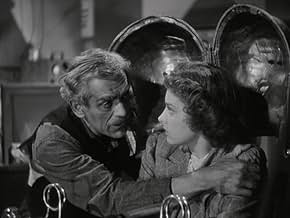
Kindly Dr. Revere (Boris Karloff) has found a way to record the brain waves of people. His loving wife is tragically killed in a car accident. Revere however gets a reading from his dead wife (he thinks) when alone in is lab. He becomes obsessed with trying to communicate with her beyond the grave. He ends up with a cruel conniving fake medium (Anne Revere) and some corpses borrowed from the nearby cemetery.
OK--the plot doesn't make a lick of sense. He does turn on the machine after his wife dies and he DOES get a message--but how can he know it's her? Why does he need to use other dead bodies to communicate with his wife? Why not dig up HER body and try it? Too many questions. The sets are threadbare (looks more like a PRC production than Columbia), talented character actress Revere gives out her worse performance, the silly narration doesn't work and it just completely derails at the end. Still Karloff is good (as always) and gives this junk a better performance than it deserves. He single handedly makes this an OK movie. It just isn't that scary. It does have a somewhat spooky scene where a maid is stuck in a room with a bunch of dead bodies but that's it. Minor but a must for Karloff fans.
OK--the plot doesn't make a lick of sense. He does turn on the machine after his wife dies and he DOES get a message--but how can he know it's her? Why does he need to use other dead bodies to communicate with his wife? Why not dig up HER body and try it? Too many questions. The sets are threadbare (looks more like a PRC production than Columbia), talented character actress Revere gives out her worse performance, the silly narration doesn't work and it just completely derails at the end. Still Karloff is good (as always) and gives this junk a better performance than it deserves. He single handedly makes this an OK movie. It just isn't that scary. It does have a somewhat spooky scene where a maid is stuck in a room with a bunch of dead bodies but that's it. Minor but a must for Karloff fans.


Le saviez-vous
- AnecdotesCompleted December 1940, released February 3, 1941.
- GaffesDr. Julian tells Mrs. Walters she had 10,000 volts pass through her body. Volts do not flow or pass, amps do.
- Citations
Dr. Julian Blair: Anne dear, your mother is not dead, not really. She's come back to me!
- ConnexionsFeatured in Hollywood and the Stars: Monsters We've Known and Loved (1964)
Meilleurs choix
Connectez-vous pour évaluer et surveiller les recommandations personnalisées
- How long is The Devil Commands?Propulsé par Alexa
Détails
- Durée
- 1h 5m(65 min)
- Couleur
- Rapport de forme
- 1.37 : 1
Contribuer à cette page
Suggérer une modification ou ajouter du contenu manquant