
Ajouter une intrigue dans votre langueWhen the composer of an opera about a swashbuckling, wenching highwayman meets his hero's real-life counterpart, he's disappointed with his lack of dash.When the composer of an opera about a swashbuckling, wenching highwayman meets his hero's real-life counterpart, he's disappointed with his lack of dash.When the composer of an opera about a swashbuckling, wenching highwayman meets his hero's real-life counterpart, he's disappointed with his lack of dash.
- Réalisation
- Scénaristes
- Vedettes

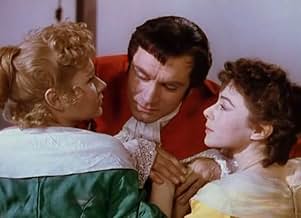
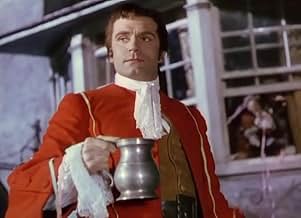


6,1433
1
2
3
4
5
6
7
8
9
10
Avis en vedette
Better than nothing
The Beggar's Opera has so much going for it. The author, John Gay placed it squarely in an underworld of thieves, whores, liars, drunkards, double-crossers, and corrupt officials. He gave them a witty voice, where moral values are reversed, and most importantly he gave them newly worded songs set to recent popular tunes.
The Beggar's Opera continues to be an important work, that has been raided by later writers; most importantly by Brecht who adapted its main elements as The Threepenny Opera; and also by writers such as Dennis Potter (Pennies From Heaven clearly borrows heavily from from The Beggar's Opera, down to the final twist).
This is a film that should work well as a film-of-the-stage, for there is always a sense that the characters are trapped in their little world, in each other's pocket, and all knowing each other's business. But Peter Brook tries to make the film more cinematic by opening the action out in places. Though this is understandable, it entails some unfortunate compromises. The attempt to inject some new life into this film, with primarily visual scenes and a bit of derring-do action, means that Brook is forced to cut the text severely in places, and the strength of the piece lies in the words Gay wrote, not in the pictures that Brook creates. The film works well where the original text survives and the characters are allowed to speak, but that happens rarely. And Brook also messes about with the twist-ending!
In brief, enough survives of the original to make it worth watching, if there's no better alternative.
The Beggar's Opera continues to be an important work, that has been raided by later writers; most importantly by Brecht who adapted its main elements as The Threepenny Opera; and also by writers such as Dennis Potter (Pennies From Heaven clearly borrows heavily from from The Beggar's Opera, down to the final twist).
This is a film that should work well as a film-of-the-stage, for there is always a sense that the characters are trapped in their little world, in each other's pocket, and all knowing each other's business. But Peter Brook tries to make the film more cinematic by opening the action out in places. Though this is understandable, it entails some unfortunate compromises. The attempt to inject some new life into this film, with primarily visual scenes and a bit of derring-do action, means that Brook is forced to cut the text severely in places, and the strength of the piece lies in the words Gay wrote, not in the pictures that Brook creates. The film works well where the original text survives and the characters are allowed to speak, but that happens rarely. And Brook also messes about with the twist-ending!
In brief, enough survives of the original to make it worth watching, if there's no better alternative.
Compenent Version of Classic Ballad Opera
While this is an adequate rendering of the famous John Gay mock opera, it suffers from having Olivier sing the entire role in his own untrained voice. After a while his vocalism grows wearisome, having a slight flat and dull quality to his tone.
Brook's direction is also lacking; in trying to open the action up on screen, it looks somewhat forced and off balance. This is still a good film, all things considered and the fact that it's a rare filming of this work.
So in the end we give it a grade of B, and hope a better version will subsequently be made.
Brook's direction is also lacking; in trying to open the action up on screen, it looks somewhat forced and off balance. This is still a good film, all things considered and the fact that it's a rare filming of this work.
So in the end we give it a grade of B, and hope a better version will subsequently be made.
The one Powell and Pressburger didn't make
The sad fact about "The Beggar's Opera" is that it wasn't directed by Powell and Pressburger. If this had been the case it would no doubt be lauded today as an eccentric masterpiece. It shared the same fate of critical disdain in its time as "Gone to Earth" and "The Elusive Pimpernel" but, unlike these, has still to await an appreciative resurrection. Could it be that it was made by the comparatively little known Peter Brook! And yet with its colourful visual flair and sometimes breathtaking sense of movement it seems right out of the same stable as "The Tales of Hoffmann" and "Oh Rosalinda!". A wonderfully imaginative shot of the landscape viewed from the scaffold gradually blacked out as the prisoner's blindfold is lowered over MacHeath's eyes is perhaps the best example of its inventiveness. For the musical purist it is inevitably something of a curiosity. A fine cast of contemporary singers including Adele Leigh, Jennifer Vyvyan and Edith Coates were assembled to dub the acting cast for the musical numbers, whereas the main role of MacHeath was sung by Laurence Oliver himself, his light baritone voice, although no match for the others, at least serviceable. But, as it works perfectly well, why quibble. (I have little time for those who criticised the "amateur" voices of Woody Allen's delicious musical "Everyone Says I Love You" as they so matched the characters and were not in the least, as has been suggested, unmusical). I watched "The Beggar's Opera" again the other day after a gap of over 50 years and found it just as refreshing. One of the reasons is that many of the tunes are terrific and not one of them goes on for too long. Generally I have to confess that I have little time for filmed musicals. I invariably want the songs to be got over as quickly as possible in order to get on with the action, which I know completely misses the point. With "The Beggar's Opera" I find the reverse to be true, just about resisting the temptation to fast-forward the dialogue to get to the next "tune". Sir Arthur Bliss did a wonderful job of arranging the music specially for the film version although it has to be admitted that the sound quality of the copy transmitted on Sky's Artsworld channel was often muddy and unclear. Would that the soundtrack could be remastered!
Satire of a Bawdy Age
Sir Laurence Olivier expressed a great deal of disappointment with the way The Beggar's Opera finally turned out. On reflection he probably would have done it as a straight dramatic play. Certainly the role of the swaggering outlaw Captain Macheath would seem to be a choice part.
Olivier had sung before on screen, in Fire Over England he warbled an old English ditty There Was a Spanish Lady Who Wooed an English Man and did very well by it in his portrayal of Michael Ingolby in that film. But the problem is that in Fire Over England he was the only one singing. Later on he did very well in The Entertainer as song and dance man Archie Rice. But in The Beggar's Opera his voice suffers by comparison to the trained voices that were dubbed for all the other players except Olivier and Stanley Holloway.
I guess producer Herbert Wilcox felt he couldn't dub voices as known as Olivier and Holloway. But Holloway was a musical performer so he didn't suffer by comparison.
The Beggar's Opera has been argued to be the first musical play done in the English language. John Gay wrote the book and lyrics and the music is taken from old English tunes and arranged by Johann Christoph Pepusch. It's a satire of the corrupt and bawdy age of Robert Walpole, King George I's Prime Minister and the first person to be actually called by that title.
The Age of Walpole began with the end of War of Spanish Succession and the death of Queen Anne and the Hanover succession secured. Robert Walpole had some very simple ideas on what was best for the United Kingdom. Everybody make money, eat, drink and be merry, secure good trade deals and keep out of war at all costs. You could buy anything during his time, including honor and justice. Merchant Peachum played by George Devine is a caricature of Walpole. A most greedy man who'll do anything for a pound.
Macheath knows the people he's dealing and he does it on their own terms. He gets arrested for rewards, he buys a reprieve. It really did work that way back in Walpole's time.
And he's romancing two women, Polly Peachum and Lucy Lockit although the women use him as much as he uses them. Lucy's dad is Stanley Holloway the jailkeeper who's not above a bribe or two from prisoners able to pay.
The Beggar's Opera got a Teutonic remake when Kurt Weill and Berthold Brecht did The Threepenny Opera in the last century and the immortal Mack the Knife comes from it.
Still if The Beggar's Opera was to be done in its original form, wouldn't it have been far better to have a group like the D'Oyly Carte Light Opera Company who do so well with Gilbert and Sullivan do this instead of straight players who have to be dubbed?
Olivier had sung before on screen, in Fire Over England he warbled an old English ditty There Was a Spanish Lady Who Wooed an English Man and did very well by it in his portrayal of Michael Ingolby in that film. But the problem is that in Fire Over England he was the only one singing. Later on he did very well in The Entertainer as song and dance man Archie Rice. But in The Beggar's Opera his voice suffers by comparison to the trained voices that were dubbed for all the other players except Olivier and Stanley Holloway.
I guess producer Herbert Wilcox felt he couldn't dub voices as known as Olivier and Holloway. But Holloway was a musical performer so he didn't suffer by comparison.
The Beggar's Opera has been argued to be the first musical play done in the English language. John Gay wrote the book and lyrics and the music is taken from old English tunes and arranged by Johann Christoph Pepusch. It's a satire of the corrupt and bawdy age of Robert Walpole, King George I's Prime Minister and the first person to be actually called by that title.
The Age of Walpole began with the end of War of Spanish Succession and the death of Queen Anne and the Hanover succession secured. Robert Walpole had some very simple ideas on what was best for the United Kingdom. Everybody make money, eat, drink and be merry, secure good trade deals and keep out of war at all costs. You could buy anything during his time, including honor and justice. Merchant Peachum played by George Devine is a caricature of Walpole. A most greedy man who'll do anything for a pound.
Macheath knows the people he's dealing and he does it on their own terms. He gets arrested for rewards, he buys a reprieve. It really did work that way back in Walpole's time.
And he's romancing two women, Polly Peachum and Lucy Lockit although the women use him as much as he uses them. Lucy's dad is Stanley Holloway the jailkeeper who's not above a bribe or two from prisoners able to pay.
The Beggar's Opera got a Teutonic remake when Kurt Weill and Berthold Brecht did The Threepenny Opera in the last century and the immortal Mack the Knife comes from it.
Still if The Beggar's Opera was to be done in its original form, wouldn't it have been far better to have a group like the D'Oyly Carte Light Opera Company who do so well with Gilbert and Sullivan do this instead of straight players who have to be dubbed?
Olivier the Highwayman
It was uncharacteristic of Peter Brook - whose next few films would become a byword for austere black & white - that his first as a director would be a rollicking Technicolor musical.
Olivier demonstrated that he was a good sport by providing his own voice; as he would also do later in 'The Entertainer'. As the man said it was not done well but one was impressed that it had been attempted in the first place.
Olivier demonstrated that he was a good sport by providing his own voice; as he would also do later in 'The Entertainer'. As the man said it was not done well but one was impressed that it had been attempted in the first place.


Le saviez-vous
- Anecdotes"The Beggar's Opera" is a ballad opera popular during the early eighteenth century, which used the music of popular folk songs, ballads and church hymns set to new lyrics to satirize social customs, mores, and especially Italian opera. It copied the three act Italian operatic format, rather than the then-custom of five acts.
- Citations
Captain MacHeath: [Hearing a woman singing] Women!... I love the sex!... and a man who loves money might as well be contented with one guinea... as I with one woman.
- Générique farfeluUnusually, the ghost vocalists for the non-singing actors were given billing in the end credits.
- ConnexionsFeatured in Carry on Forever: Episode #1.1 (2015)
Meilleurs choix
Connectez-vous pour évaluer et surveiller les recommandations personnalisées
Détails
- Date de sortie
- Pays d’origine
- Langue
- Aussi connu sous le nom de
- Die Bettleroper
- Lieux de tournage
- société de production
- Consultez plus de crédits d'entreprise sur IMDbPro
Box-office
- Budget
- 500 000 £ (estimation)
- Durée
- 1h 34m(94 min)
- Couleur
- Rapport de forme
- 1.37 : 1
Contribuer à cette page
Suggérer une modification ou ajouter du contenu manquant