ÉVALUATION IMDb
6,8/10
6,9 k
MA NOTE


Une téléphoniste se retrouve ivre et à la merci d'un goujat dans son appartement. Le lendemain matin, elle se réveille avec la gueule de bois et la terrible crainte d'avoir commis un meurtre... Tout lireUne téléphoniste se retrouve ivre et à la merci d'un goujat dans son appartement. Le lendemain matin, elle se réveille avec la gueule de bois et la terrible crainte d'avoir commis un meurtre.Une téléphoniste se retrouve ivre et à la merci d'un goujat dans son appartement. Le lendemain matin, elle se réveille avec la gueule de bois et la terrible crainte d'avoir commis un meurtre.
- Réalisation
- Scénaristes
- Vedettes





Fay Baker
- Switchboard Monitor
- (uncredited)

Robert Bice
- Policeman
- (uncredited)

Larry J. Blake
- Music Shop Clerk
- (uncredited)

Lela Bliss
- Miss Stanley
- (uncredited)

Gail Bonney
- Policewoman
- (uncredited)

Edward Clark
- News Stand Dealer
- (uncredited)
Papa John Creach
- Violinist
- (uncredited)
Mike Donovan
- Fingerprint Officer
- (uncredited)
6,86.8K
1
2
3
4
5
6
7
8
9
10
Avis en vedette
I Liked Gardenia More Than The Film's Director Did
The Blue Gardenia is the first of Fritz Lang's so-called "newspaper trilogy" (While The City Sleeps, and Beyond A Reasonable Doubt are the other two).
This one is my favorite of the three. It's ironic because Lang himself didn't care for the picture saying, "The story itself wasn't original and the acting wasn't engaging enough to elevate it past being a mild thriller."
I disagree with the master. Lang was coming off some personally turbulent years and was fed up with Hollywood. Perhaps he was not happy with the performance of Richard Conti, the newspaper reporter. Lang wanted Dana Andrews, who would go on to work on the next two pictures of the newspaper trilogy.
But, I think Anne Baxter is great as a jilted woman who impetuously goes out on a date with a wolf, played to perfection by Raymond Burr, and finds herself literally fighting off his sexual attack while in an inebriated state. She blacks out, awakens in her bed unaware of how she got there. Later, she learns Burr's character has been murdered and now finds herself on a journey to discover if she's a killer or not.
Lang's frustration with Hollywood's limitations were starting to show up with his lackluster camera movement (as compared to previous pictures). But, a movie made by a disillusioned Fritz Lang is still a must-watch.
This one is my favorite of the three. It's ironic because Lang himself didn't care for the picture saying, "The story itself wasn't original and the acting wasn't engaging enough to elevate it past being a mild thriller."
I disagree with the master. Lang was coming off some personally turbulent years and was fed up with Hollywood. Perhaps he was not happy with the performance of Richard Conti, the newspaper reporter. Lang wanted Dana Andrews, who would go on to work on the next two pictures of the newspaper trilogy.
But, I think Anne Baxter is great as a jilted woman who impetuously goes out on a date with a wolf, played to perfection by Raymond Burr, and finds herself literally fighting off his sexual attack while in an inebriated state. She blacks out, awakens in her bed unaware of how she got there. Later, she learns Burr's character has been murdered and now finds herself on a journey to discover if she's a killer or not.
Lang's frustration with Hollywood's limitations were starting to show up with his lackluster camera movement (as compared to previous pictures). But, a movie made by a disillusioned Fritz Lang is still a must-watch.
Fritz Lang directed this solid mystery thriller that has our complete attention from beginning to end
Norah Larkin (Anne Baxter) is a telephone operator who plans to spend her birthday evening alone with her boyfriend - or rather, with his photograph and a letter she just received from him. The real guy is 6000 miles away in Korea. While her two roommates - Crystal (Ann Sothern), a wisecracking divorcée and Sally (Jeff Donnell), a sweet girl with a taste for bloodthirsty mystery novels - are gone, Norah, wearing a black taffeta dress and sipping champagne, reads the letter and blanches. Her sweetheart has dumped her. She ends up spending the rest of her evening with Harry Prebble (Raymond Burr), a wolf who draws girls for a living and ruins them as a hobby. He takes her to the Blue Gardenia and they listen to Nat King Cole as he gets her very drunk on Polynesian pearl divers. The next morning she wakes up with a terrible hangover, but that's the best part. At work she learns of a murderess soon to be called the Blue Gardenia Girl. The label is invented by a newspaper columnist named Casey Mayo (Richard Conte), who hopes to find the femme fatale before the police. What worries Norah is that he and the police may both be looking for her.
Fritz Lang directed this solid mystery thriller that has our complete attention from beginning to end. A good script and good performances are accentuated by Fritz Lang's camera and his usual sharp eye for detail and way of creating mounting dread.
Fritz Lang directed this solid mystery thriller that has our complete attention from beginning to end. A good script and good performances are accentuated by Fritz Lang's camera and his usual sharp eye for detail and way of creating mounting dread.
the blue gardenia
One of Fritz Lang's lesser efforts this film is weighed down by a flat screenplay that gives the darkly great Richard Conte and the wonderfully sassy Ann Sothern not much to work with and a way too over the top performance by Anne Baxter that sounds as if Lang told her, "Whatever you did in "Eve", do the opposite". It does, however, feature properly moody cinematography by Nicholas Musuraka and one genuinely indelible scene, the one in the Great Early 50s Tiki Lounge with Baxter and Raymond Burr getting sloshed on tropical rum concoctions while the aging, Russian cigarette gal circulates and Nat King Cole, nattily attired (as usual,) with lay around necktie, croons the title song. Now that's noir! Give it a C plus.
PS...Appropriate that I saw this date rape flic on the day Cosby got sprung on a technicality.
PS...Appropriate that I saw this date rape flic on the day Cosby got sprung on a technicality.
Nostalgic Melodrama
Norah, a young, attractive woman (played by Anne Baxter), gets a letter from her overseas boyfriend, informing her that he has found a new love. At just the moment she realizes she has been rejected, the phone rings. It's a dinner invitation from a womanizer who thinks he is talking to one of Norah's two female roommates. Depressed and vulnerable, Norah impulsively accepts the invitation, on her own behalf. This is the setup for "The Blue Gardenia", set in the early 50s, a film with a good beginning and some really high-powered Hollywood talent.
The screenplay, with its contrived plot, and director Fritz Lang's ambivalent direction render a flawed production. The film's tone, expressed both in the B&W cinematography and in the music, tends to seesaw back and forth between romance and mystery. But, the film can still be enjoyable to viewers looking for a murder-mystery/romance combo that is not overly complex. The easy to follow plot moves along unencumbered by the confusion wrought by multi-layered plot gimmicks so common in today's films.
The film's ending is one for the books. In all the mystery films I have watched, I don't recall a murder investigation being wrapped up so easily as this one. It's way too neat and too tidy to be credible. The film's 88-minute run time leaves a lot of room for additional material. Expansion of the film's final Act could have provided a more realistic and satisfying ending.
I really liked seeing Raymond Burr and Ann Sothern. The film also sports some clever dialogue. With its interesting premise, "The Blue Gardenia", despite a flawed script, will likely appeal to viewers looking for a melodramatic film with a nostalgic setting, wherein the plot is straightforward. Viewers looking for a topnotch script and/or a complex storyline with lots of plot twists and subtlety will need to look elsewhere.
The screenplay, with its contrived plot, and director Fritz Lang's ambivalent direction render a flawed production. The film's tone, expressed both in the B&W cinematography and in the music, tends to seesaw back and forth between romance and mystery. But, the film can still be enjoyable to viewers looking for a murder-mystery/romance combo that is not overly complex. The easy to follow plot moves along unencumbered by the confusion wrought by multi-layered plot gimmicks so common in today's films.
The film's ending is one for the books. In all the mystery films I have watched, I don't recall a murder investigation being wrapped up so easily as this one. It's way too neat and too tidy to be credible. The film's 88-minute run time leaves a lot of room for additional material. Expansion of the film's final Act could have provided a more realistic and satisfying ending.
I really liked seeing Raymond Burr and Ann Sothern. The film also sports some clever dialogue. With its interesting premise, "The Blue Gardenia", despite a flawed script, will likely appeal to viewers looking for a melodramatic film with a nostalgic setting, wherein the plot is straightforward. Viewers looking for a topnotch script and/or a complex storyline with lots of plot twists and subtlety will need to look elsewhere.
Blue Gardenia, the flower of murder
A date with a ne'er do well named Harry Prebble (Raymond Burr of "Perry Mason" and "Ironsides" fame) leads a telephone operator into a web of deceit and murder in this 1940s-style (actually made in 1953) film-noir classic, "Blue Gardenia." Nora Larkin (Anne Baxter) gets a cruel birthday present in the form of a "Dear Jane" letter from her soldier boyfriend serving in Korea. Prebble, who draws for a living, "hits" on the telephone operators of a local company. He calls the apt. of 3 of the operators who live together in a flat. Nora Larkin answers and impulsively decides to accept Prebble's invitation to drinks and dinner at a Chinese restaurant nearby. The next thing Nora knows, she has a colossal hangover from too many "Polynesian Pearldiver" drinks and she learns her date was murdered. She doesn't remember killing him but she does recall trying to repel his sexual advances, grabbing a fireplace poker and shattering a mirror.
Assuming she did it, she because extremely testy and high strung; her 2 roommates - Crystal Carpenter (played so well by Ann Sothern) and Sally Ellis (Jeff Donnell) - try to figure out what's wrong. Finally, Crystal, a "party girl" figures it out.
An interesting plot twist is the addition of Casey Mayo (Richard Conte, who later went on to play Barzini in "The Godfather"), a hardboiled reporter for the Los Angeles Chronicle. He writes an open letter in the newspaper to the girl dubbed the "Blue Gardenia Killer" and Nora meets him at a local watering hole. She tells him it's a friend who committed the murder but Casey finds out later she is the one. But in the meantime, he has fallen in love with her and he and her roommates work to find the real killer which (unlike the OJ Simpson case) they do.
The real killer turns out to be a minor character and that was a disappointment. But Anne Baxter's portrayal as Nora, a complex character, and Ann Sothern's portrayal as the floozy with a heart of gold, make this a nice, decent little movie. I don't think I'd want to own a copy of this film but I'll watch it whenever it comes on because of the aforementioned performances and because I've always loved Raymond Burr, Nat "King" Cole and the song "Blue Gardenia."
Assuming she did it, she because extremely testy and high strung; her 2 roommates - Crystal Carpenter (played so well by Ann Sothern) and Sally Ellis (Jeff Donnell) - try to figure out what's wrong. Finally, Crystal, a "party girl" figures it out.
An interesting plot twist is the addition of Casey Mayo (Richard Conte, who later went on to play Barzini in "The Godfather"), a hardboiled reporter for the Los Angeles Chronicle. He writes an open letter in the newspaper to the girl dubbed the "Blue Gardenia Killer" and Nora meets him at a local watering hole. She tells him it's a friend who committed the murder but Casey finds out later she is the one. But in the meantime, he has fallen in love with her and he and her roommates work to find the real killer which (unlike the OJ Simpson case) they do.
The real killer turns out to be a minor character and that was a disappointment. But Anne Baxter's portrayal as Nora, a complex character, and Ann Sothern's portrayal as the floozy with a heart of gold, make this a nice, decent little movie. I don't think I'd want to own a copy of this film but I'll watch it whenever it comes on because of the aforementioned performances and because I've always loved Raymond Burr, Nat "King" Cole and the song "Blue Gardenia."


Le saviez-vous
- AnecdotesDirector Fritz Lang and cinematographer Nicholas Musuraca developed a revolutionary dolly for the camera that allowed for sustained tracking shots and intimate close-ups while shooting this film. Lang preferred the practice of tracking into a close-up shot of an actor as opposed to cutting to a close-up in editing. He believed the tracking close-up captured more of the actors' intimacy and emotions.
- GaffesPerhaps unaware that his hands on the keyboard are visible in the mirror behind him, Nat 'King' Cole plays a strikingly different piano arrangement of "Blue Gardenia" than the one heard.
- Citations
Sally Ellis: I didn't like Prebble when he was alive. But now that he's been murdered, that always makes a man so romantic.
- ConnexionsFeatured in Noir Alley: The Blue Gardenia (2017)
- Bandes originalesBlue Gardenia
Written by Bob Russell and Lester Lee
Performed by Nat 'King' Cole
Arranged by Nelson Riddle
[Nat King Cole performs the song at the Blue Gardenia during Norah and Harry's date, then the song is played frequently in the movie thereafter]
Meilleurs choix
Connectez-vous pour évaluer et surveiller les recommandations personnalisées
Détails
- Date de sortie
- Pays d’origine
- Langue
- Aussi connu sous le nom de
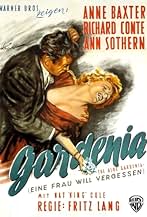
- Gardenia - Eine Frau will vergessen
- Lieux de tournage
- société de production
- Consultez plus de crédits d'entreprise sur IMDbPro
- Durée
- 1h 25m(85 min)
- Couleur
- Rapport de forme
- 1.37 : 1
Contribuer à cette page
Suggérer une modification ou ajouter du contenu manquant