ÉVALUATION IMDb
6,7/10
2,2 k
MA NOTE


Ajouter une intrigue dans votre langueAt the end of the Civil War, two friends return home to Colorado and one of them has changed and is violent and erratic.At the end of the Civil War, two friends return home to Colorado and one of them has changed and is violent and erratic.At the end of the Civil War, two friends return home to Colorado and one of them has changed and is violent and erratic.
- Réalisation
- Scénaristes
- Vedettes
- Prix
- 1 nomination au total


William 'Bill' Phillips
- York
- (as Wm. 'Bill' Phillips)

Stanley Andrews
- Roger MacDonald
- (uncredited)
Emile Avery
- Townsman
- (uncredited)
Walter Bacon
- Townsman
- (uncredited)

Walter Baldwin
- Tom Barton
- (uncredited)

Symona Boniface
- Matron
- (uncredited)

Chet Brandenburg
- Party Guest
- (uncredited)

James Bush
- Cpl. Dixon
- (uncredited)
Nora Bush
- Townswoman
- (uncredited)
Boyd Cabeen
- Townsman
- (uncredited)
6,72.1K
1
2
3
4
5
6
7
8
9
10
Avis en vedette
Running Roughshod Over Due Process
Back in the day William Holden and Glenn Ford both had a unique contractual arrangement with Columbia Pictures. When unknown Bill Holden was up for the lead in Golden Boy, Harry Cohn cast him in return for Paramount selling 50% of his services to Columbia. Holden served two studio masters at the time he was making The Man from Colorado and would for another decade.
Glenn Ford was Columbia's bread and butter leading man at the time and right after The Man From Colorado, Cohn sold half of Ford's contract to MGM and Ford also had two studio masters.
What it meant for these two was that all projects had to be cleared through both studios and that Holden and Ford if they did an outside loan out would also have to be cleared from both. Not that their respective studios didn't keep both these guys very busy.
Holden and Ford had done a well received western, Texas, for Columbia back in 1941. Texas was a rather lighthearted film about two cowboys turning to different sides of the law in post Civil War Texas, though it did feature the death of one of them.
The Man from Colorado is also a story about the activities of Union Army war veterans. But The Man from Colorado doesn't have any light moments whatsoever. It's pretty grim tale about one of them developing a real taste for sadism and killing as a result of the war.
Ford's the sadist here, it's one of the few villain parts he ever did and it works I think because he is so against type. He did very few parts like this, Lust for Gold is another, but his public wouldn't accept him in these roles.
Some of the town businessmen led by Ray Collins just look at the war record and decide Ford would make one fine federal judge. A real law and order type. They get a lot more than they bargain for.
In Texas Holden had the showier role of the young cowboy who take the outlaw route. Here however he's the best friend who stands by his former commanding officer even though he both sees the man has issues and Holden loses Ellen Drew to Ford. Holden takes the outlaw path after giving up his marshal's job when Ford starts running roughshod over due process.
The other really standout performance in this film is that of James Milliken who plays one of Ford's former soldiers who turns outlaw and in fact humiliates him in one of the few funny moments in The Man From Colorado. Ford conceives a burning hate for him that results in tragedy all around.
Ford and Holden were considering another joint project in 1981 when Holden died. I would like to have seen that one come to pass.
Try to see The Man From Colorado back to back with Texas.
Glenn Ford was Columbia's bread and butter leading man at the time and right after The Man From Colorado, Cohn sold half of Ford's contract to MGM and Ford also had two studio masters.
What it meant for these two was that all projects had to be cleared through both studios and that Holden and Ford if they did an outside loan out would also have to be cleared from both. Not that their respective studios didn't keep both these guys very busy.
Holden and Ford had done a well received western, Texas, for Columbia back in 1941. Texas was a rather lighthearted film about two cowboys turning to different sides of the law in post Civil War Texas, though it did feature the death of one of them.
The Man from Colorado is also a story about the activities of Union Army war veterans. But The Man from Colorado doesn't have any light moments whatsoever. It's pretty grim tale about one of them developing a real taste for sadism and killing as a result of the war.
Ford's the sadist here, it's one of the few villain parts he ever did and it works I think because he is so against type. He did very few parts like this, Lust for Gold is another, but his public wouldn't accept him in these roles.
Some of the town businessmen led by Ray Collins just look at the war record and decide Ford would make one fine federal judge. A real law and order type. They get a lot more than they bargain for.
In Texas Holden had the showier role of the young cowboy who take the outlaw route. Here however he's the best friend who stands by his former commanding officer even though he both sees the man has issues and Holden loses Ellen Drew to Ford. Holden takes the outlaw path after giving up his marshal's job when Ford starts running roughshod over due process.
The other really standout performance in this film is that of James Milliken who plays one of Ford's former soldiers who turns outlaw and in fact humiliates him in one of the few funny moments in The Man From Colorado. Ford conceives a burning hate for him that results in tragedy all around.
Ford and Holden were considering another joint project in 1981 when Holden died. I would like to have seen that one come to pass.
Try to see The Man From Colorado back to back with Texas.
A psychological western based on the mental anguishes of the post-Civil War era
"The Man From Colorado", filmed in 1948, portrays two men and how the trauma of the Civil War affected them, and those about them. Glenn Ford delivers a truly mesmerizing performance as a Civil War commander who is slowly being gripped by madness due to the violence of the War, while William Holden plays the part of a veteran of the same war, is able to cope with the aftermath, and yet, is unable to prevent his friend from sinking into degenerate madness.
After the war has ended, both men return to the same hometown to resume their lives. Ford is appointed as a federal judge of the territory, and he, in turn, names Holden as federal marshal. Ultimately, Ford's character sinks deeper into violence and glaring errors in carrying out justice, and Holden has to try and stop his former friend.
Don't let the age of the film deceive you, this movie does pack a message that can be applied today. An 8/10 viewing mark
After the war has ended, both men return to the same hometown to resume their lives. Ford is appointed as a federal judge of the territory, and he, in turn, names Holden as federal marshal. Ultimately, Ford's character sinks deeper into violence and glaring errors in carrying out justice, and Holden has to try and stop his former friend.
Don't let the age of the film deceive you, this movie does pack a message that can be applied today. An 8/10 viewing mark
Avoids Cliché
Best friends Owen and Del, along with local men, are mustered out of the Union army at Civil War's end. Trouble is Big Ed has grabbed the men's gold-bearing land while the men were gone, and now, as a judge, Owen has to enforce the law in Big Ed's favor. This splits the community into warring factions.
Gritty, character-driven western. We know at outset that Owen (Ford) is a flawed character when his Union detachment shells surrendering Johnny rebs. In fact, Owen hides his killer instinct behind an uptight rendering of authority, whether as a colonel or as a federal judge. Ford plays the authoritarian part so grimly (count the smiles—I stopped at zero), it's hard to see how the charming Caroline would be attracted to him. Nonetheless, the interplay between best-friends Ford and Holden is involving and forms the story's core. Alliances between the various factions are sometimes hard to keep up with, but are more unpredictable than usual. And I especially like that final maneuvering around the bridge that I didn't see coming.
Columbia Studios popped for a lot of extras, along with fine special effects, especially when the burning wall comes down. Funny, though, how mountainous Colorado looks like greater LA. Too bad Columbia didn't pop for sending the crew at least to Lone Pine and the Southern Sierras. All in all, it's a very different kind of horse opera that avoids the usual clichés, with Ford at his absolute grimmest. Clearly, however, he and Holden are on their way up the Hollywood ladder.
Gritty, character-driven western. We know at outset that Owen (Ford) is a flawed character when his Union detachment shells surrendering Johnny rebs. In fact, Owen hides his killer instinct behind an uptight rendering of authority, whether as a colonel or as a federal judge. Ford plays the authoritarian part so grimly (count the smiles—I stopped at zero), it's hard to see how the charming Caroline would be attracted to him. Nonetheless, the interplay between best-friends Ford and Holden is involving and forms the story's core. Alliances between the various factions are sometimes hard to keep up with, but are more unpredictable than usual. And I especially like that final maneuvering around the bridge that I didn't see coming.
Columbia Studios popped for a lot of extras, along with fine special effects, especially when the burning wall comes down. Funny, though, how mountainous Colorado looks like greater LA. Too bad Columbia didn't pop for sending the crew at least to Lone Pine and the Southern Sierras. All in all, it's a very different kind of horse opera that avoids the usual clichés, with Ford at his absolute grimmest. Clearly, however, he and Holden are on their way up the Hollywood ladder.
Perfectly cast action packed Western
Ford and Holden worked together more than once, and they took turns playing "good cop bad cop" as the saying goes. In their case more "good Westerner bad Westerner". In this one, it's clear early that Ford is the bad guy. It was perfect casting. Ford and Holden are ex Civil War officers who become the law in a mining town. With usual poetic film license, the men from their unit live in that very town, and left mining claims while fighting in the war. While they were gone, a mine baron took advantage of a loophole to steal their claims. As the new judge, Ford complies with the letter of the law. We get a very complex and real look at the psychological influence of power, and interpretation of the law. Ford delivers his sadistic power hungry official with realism. He doesn't foam at the mouth when he performs his sadistic acts. Instead, he acts reluctant, as if he's chilled by violence. Then, after taking more and more power in his hands, he loses control of everything when he loses control of his wife, who remains faithful to him despite her respect and possible love for William Holden's character. Ford's character is very much like a Shakespearean king descending into madness and mayhem.
War can do strange things to a man.
The end of the Civil War is nigh and one last pocket of Confederate resistance is holed up at Jacob's Gorge. Knowing their time is up they hoist the white flag in surrender. Union Colonel Owen Devereaux sees the white flag but orders the attack anyway. Returning home with his friend and colleague, Capt. Del Stewart, Devereaux grows ever more erratic by the day, his friends, his loves and all who cross him, are sure to pay if they can't rein in his madness.
Starring Glenn Ford as Devereaux and William Holden as Stewart, directed by Henry Levin, The Man from Colorado, from a story by Borden Chase, is an intriguing psychological Western. The story follows the theme of a man ravaged by war and his inability to let go of the anger and mistrust gnawing away at him. Perfectly essayed by Ford as Devereaux (great to see him donning some bad guy boots), the film is rather grim in context. Light on action (no bad thing here at all) it's with the dialogue driven characters that Levin's film really triumphs. Having both become lawmen, it would have been easy for all to just play out a standard oater as the two friends are driven apart by not only their different levels of sanity (Holden's Stewart is an excellent counter point to Ford's blood thirst), but also the love of a good woman (Ellen Drew's petite Caroline Emmet). However, Chase's story has other elements to keep it from ever being formulaic. There's a deep political thread involving power and those entrusted with it, while the treatment of returning soldiers is firmly given prominence. Here the "boys" return after 3 years of being knee deep in blood and bone, to find that their claims are no longer valid. Snaffled by a greedy corporate type, thus as the "boys" look to the law for help?...
As a story it has substance of depth, how nice to also find that there are smart technical aspects to harness the screenplay. The Simi Valley location work is fabulous, most appealing. William E. Snyder's cinematography work is top draw, arguably his best work in the Western genre. It's fair to say that even a "c" grade Western can look nice if given a good transfer, but when the Technicolor print is good, you can tell the difference big time, and this piece is first rate. The dusty orange and browns of the scenery fabulously envelopes the blue uniforms, while the green and gold glow lamps are vivid and shine bright as if extra characters in the piece. Even Ford's greying temples have a classy sheen to them, almost belying his characters anger. All Western fans simply must hone into High Definition TV because although we always knew how fabulous these pictures looked, now it's another dimension of rewards unbound.
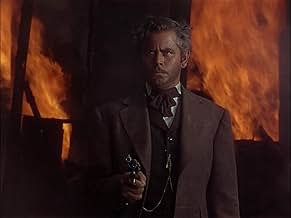
As the finale comes in a blaze of fire (welcome to hell!), The Man from Colorado has achieved the two essential Western requirements if it wants to be taken seriously - one is that it looks gorgeous, the other is that it has strong thematics to drive it forward - this has both. Hooray! 8/10
Starring Glenn Ford as Devereaux and William Holden as Stewart, directed by Henry Levin, The Man from Colorado, from a story by Borden Chase, is an intriguing psychological Western. The story follows the theme of a man ravaged by war and his inability to let go of the anger and mistrust gnawing away at him. Perfectly essayed by Ford as Devereaux (great to see him donning some bad guy boots), the film is rather grim in context. Light on action (no bad thing here at all) it's with the dialogue driven characters that Levin's film really triumphs. Having both become lawmen, it would have been easy for all to just play out a standard oater as the two friends are driven apart by not only their different levels of sanity (Holden's Stewart is an excellent counter point to Ford's blood thirst), but also the love of a good woman (Ellen Drew's petite Caroline Emmet). However, Chase's story has other elements to keep it from ever being formulaic. There's a deep political thread involving power and those entrusted with it, while the treatment of returning soldiers is firmly given prominence. Here the "boys" return after 3 years of being knee deep in blood and bone, to find that their claims are no longer valid. Snaffled by a greedy corporate type, thus as the "boys" look to the law for help?...
As a story it has substance of depth, how nice to also find that there are smart technical aspects to harness the screenplay. The Simi Valley location work is fabulous, most appealing. William E. Snyder's cinematography work is top draw, arguably his best work in the Western genre. It's fair to say that even a "c" grade Western can look nice if given a good transfer, but when the Technicolor print is good, you can tell the difference big time, and this piece is first rate. The dusty orange and browns of the scenery fabulously envelopes the blue uniforms, while the green and gold glow lamps are vivid and shine bright as if extra characters in the piece. Even Ford's greying temples have a classy sheen to them, almost belying his characters anger. All Western fans simply must hone into High Definition TV because although we always knew how fabulous these pictures looked, now it's another dimension of rewards unbound.
As the finale comes in a blaze of fire (welcome to hell!), The Man from Colorado has achieved the two essential Western requirements if it wants to be taken seriously - one is that it looks gorgeous, the other is that it has strong thematics to drive it forward - this has both. Hooray! 8/10


Le saviez-vous
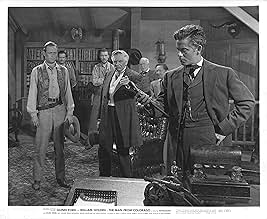
- AnecdotesColumbia Pictures spent quite a bit on The Man in Colorado. At one point, the crew dynamited the side of a 1500-foot mountain in California's San Fernando Valley in order to create a deep gorge as called for by the script. And the western town they constructed was one of the largest location sets ever built by Columbia up to that time. During filming of a massive fire scene at the end, however, the set caught fire uncontrollably, and Holden and Ford tried to actually fight the fire until firemen could arrive. "Dad came away coated in black soot, with burns to his arms and hands," Ford's son Peter later wrote.
- GaffesMany of the men are wearing trousers with belt loops and belts. Belt loops were not added to men's trousers until the 20th century.
- Citations
Owen Devereaux: [voiceover as he writes in his diary] I killed a hundred men today. I didn't want to. I couldn't help myself. What's wrong with me? I'm afraid... afraid I'm going crazy.
- Générique farfeluOpening credits are listed in the pages of a book being turned by a hand.
- ConnexionsFeatured in La levée des tomahawks (1952)
- Bandes originalesWhen Johnny Comes Marching Home
(uncredited)
Written by Louis Lambert (pseudonym for Patrick Sarsfield Gilmore)
Played at the homecoming
Meilleurs choix
Connectez-vous pour évaluer et surveiller les recommandations personnalisées
- How long is The Man from Colorado?Propulsé par Alexa
Détails
- Date de sortie
- Pays d’origine
- Langue
- Aussi connu sous le nom de
- The Man from Colorado
- Lieux de tournage
- société de production
- Consultez plus de crédits d'entreprise sur IMDbPro
Box-office
- Budget
- 1 000 000 $ US (estimation)
- Durée
- 1h 40m(100 min)
- Couleur
- Rapport de forme
- 1.37 : 1
Contribuer à cette page
Suggérer une modification ou ajouter du contenu manquant