ÉVALUATION IMDb
6,6/10
1,7 k
MA NOTE


Ajouter une intrigue dans votre langueWhile his wife is urging him to quit the force, a Los Angeles homicide detective hunts for the killer responsible for the murder of his ex-partner, who might have been on the take with local... Tout lireWhile his wife is urging him to quit the force, a Los Angeles homicide detective hunts for the killer responsible for the murder of his ex-partner, who might have been on the take with local bookies.While his wife is urging him to quit the force, a Los Angeles homicide detective hunts for the killer responsible for the murder of his ex-partner, who might have been on the take with local bookies.
- Réalisation
- Scénaristes
- Vedettes
- Prix
- 1 nomination au total



Gloria DeHaven
- Lili
- (as Gloria De Haven)


Bette Arlen
- Girl with Sleeper
- (uncredited)
6,61.6K
1
2
3
4
5
6
7
8
9
10
Avis en vedette
Above average police-procedural noir shows MGM's skittish touch
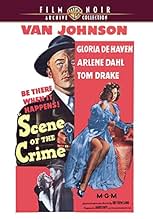
An off-duty Los Angeles police detective is shot and killed one night with an unexplained thousand dollars found in his pocket. It falls to his former partner (Van Johnson) to track down his killers and try to exonerate him. Scene of the Crime, which tells the story, stays a police procedural with a few twists and touches that raise it a notch or two above the routine.
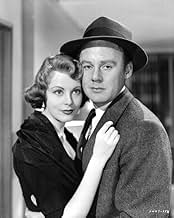
First of all, Johnson's wife (Arlene Dahl) has fallen prey to the dissatisfactions common to her lot. She's tired of their evenings, in and out, being ruined by yet another summons to duty (`Whenever the telephone rings, it cuts me,' she cries); she tired of rolling his dice rigged to come up seven, a ritual that supposedly bids him luck.
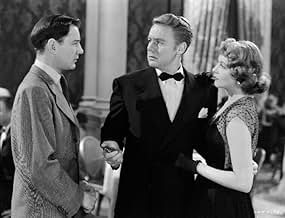
On the job, he has his burdens, too. His new partner (John McIntyre) is getting on in years and his sight is failing. And under Johnson's wing is nestled rookie cop Tom Drake, learning the ropes. Outside the office there's an abrasive police reporter (Donald Woods) chasing the corruption angle; there's also the network of low-lifes who serve, if the pressure is right, as stoolies - most vivid of them is the young Norman Lloyd.
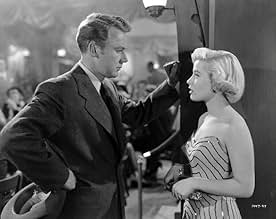
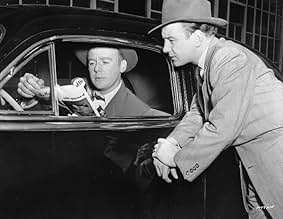
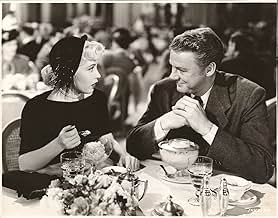
Word filters up that the killing was the work of a couple of downstate `lobos' who have been knocking over bookie operations. Going undercover, Johnson starts romancing a stripper one of them used to date (Gloria De Haven, in the movie's sharpest performance). Even though he's working her, he finds his emotions in play - and even though it turns out that she's working him, too, she has no emotions.
Under Roy Rowland's direction, Scene of the Crime keeps its plotting straightforward, though with some uncharacteristic bursts of violence. The movie's studio, Metro-Goldwyn-Mayer, was celebrated for its lavish color musicals, not for the unsentimental style of film noir. That probably accounts for the final shot's being a reconciliatory kiss, in hopes that such a sweet image might expunge all the urban squalor that went before it. Luckily, it doesn't.
First of all, Johnson's wife (Arlene Dahl) has fallen prey to the dissatisfactions common to her lot. She's tired of their evenings, in and out, being ruined by yet another summons to duty (`Whenever the telephone rings, it cuts me,' she cries); she tired of rolling his dice rigged to come up seven, a ritual that supposedly bids him luck.
On the job, he has his burdens, too. His new partner (John McIntyre) is getting on in years and his sight is failing. And under Johnson's wing is nestled rookie cop Tom Drake, learning the ropes. Outside the office there's an abrasive police reporter (Donald Woods) chasing the corruption angle; there's also the network of low-lifes who serve, if the pressure is right, as stoolies - most vivid of them is the young Norman Lloyd.
Word filters up that the killing was the work of a couple of downstate `lobos' who have been knocking over bookie operations. Going undercover, Johnson starts romancing a stripper one of them used to date (Gloria De Haven, in the movie's sharpest performance). Even though he's working her, he finds his emotions in play - and even though it turns out that she's working him, too, she has no emotions.
Under Roy Rowland's direction, Scene of the Crime keeps its plotting straightforward, though with some uncharacteristic bursts of violence. The movie's studio, Metro-Goldwyn-Mayer, was celebrated for its lavish color musicals, not for the unsentimental style of film noir. That probably accounts for the final shot's being a reconciliatory kiss, in hopes that such a sweet image might expunge all the urban squalor that went before it. Luckily, it doesn't.
Life's pretty gritty in the city
Detective Van Johnson's romantic evening out with wife Arlene Dahl is over before it's begun, when a harrowing telephone call informs him that former partner Monigan has lit his pipe for the last time, prior to being gunned down outside an illegal bookies, with $1000 in his pocket.
Accompanied by short sighted veteran, John McIntire and rookie, Tom Drake, Johnson is left to investigate a murder case tainted by allegations of police corruption. All except wacky informant, Norman Lloyd close ranks and a prolonged, arduous manhunt lies ahead.
With Arlene Dahl quaking in her high heels every time Johnson packs a rod and hits the streets, gripped by the possibility that the next time she sees him, he might be lying on a slab, the movie embarks upon a parallel route into the realms of domestic drama seen from Dahl's vantage point, illustrating the emotionally draining experience of being a cop's wife. Such is her devotion, that returning home in the small hours, with lipstick on his collar, after a 'romantic' encounter with gangster's moll and prize trollop Gloria De Haven, draws the polar opposite response to the Connie Francis treatment.
Serious soul searching starts, however, with the reappearance of ex lover, suave, debonair Tom Helmore, still carrying a torch of colossal proportions. Dahl is suddenly, painfully alerted to the safe, secure, stable and extremely prosperous life that she might have had.
'Scene of the Crime' is not a classic film noir, but as it steams along its flinty course towards the tensely violent finale, it successfully paints a contrasting picture between Johnson's unglamorous world of crime'n'grime and Dahl's no less sacrificial, contemplative, disquieting perspective on marriage to a high ranking police officer.
Accompanied by short sighted veteran, John McIntire and rookie, Tom Drake, Johnson is left to investigate a murder case tainted by allegations of police corruption. All except wacky informant, Norman Lloyd close ranks and a prolonged, arduous manhunt lies ahead.
With Arlene Dahl quaking in her high heels every time Johnson packs a rod and hits the streets, gripped by the possibility that the next time she sees him, he might be lying on a slab, the movie embarks upon a parallel route into the realms of domestic drama seen from Dahl's vantage point, illustrating the emotionally draining experience of being a cop's wife. Such is her devotion, that returning home in the small hours, with lipstick on his collar, after a 'romantic' encounter with gangster's moll and prize trollop Gloria De Haven, draws the polar opposite response to the Connie Francis treatment.
Serious soul searching starts, however, with the reappearance of ex lover, suave, debonair Tom Helmore, still carrying a torch of colossal proportions. Dahl is suddenly, painfully alerted to the safe, secure, stable and extremely prosperous life that she might have had.
'Scene of the Crime' is not a classic film noir, but as it steams along its flinty course towards the tensely violent finale, it successfully paints a contrasting picture between Johnson's unglamorous world of crime'n'grime and Dahl's no less sacrificial, contemplative, disquieting perspective on marriage to a high ranking police officer.
Doesn't Gel
I guess the lesson here is that you can take the crime drama out of MGM, but you can't take MGM out of the crime drama. With noirish location shots, the new Dore Schary regime changed the usual MGM look somewhat, yet the movie still boasts a string of stars and star power for which the studio was known. The trouble is that working Van Johnson, Arlene Dahl, Tom Drake, Gloria DeHaven, Donald Woods, and a string of "name" supporting players into the screenplay with sufficient screen time for each overstretches the results. Despite some effective moments (the hotel room fistfight, the fright screams from the burning car), the movie suffers from too much flab for overall effect. For example, the two rather lengthy scenes with Norrie Lorfield (Tom Helmore), the rival for Conovan's (Johnson) wife, are simply a needless distraction from the main plot, and work to dilute the overall effect. In fact, the entire marital subplot should have been dropped or at least minimized, but it seems that the studio was not satisfied with the kind of fast, efficient little crime drama that RKO, for one, routinely turned out.
I'm tempted to say that just as movie spectaculars and historical epics depend on big budgets for optimal effect, crime dramas and noirs depend on the tight disciplining constraints of small ones. That way, production values don't interfere with the story line. Here it appears that MGM's celebrated production values over-produced the number of feature players, which, in turn, multiplied the various subplots, or vice-versa. In either case, it's too bad the script didn't eliminate a few of these in favor of giving Norman Lloyd's truly memorable character, Sleeper, more screen time. He's the kind of unique character that could have transformed this otherwise forgettable exercise into a memorable one.
I'm tempted to say that just as movie spectaculars and historical epics depend on big budgets for optimal effect, crime dramas and noirs depend on the tight disciplining constraints of small ones. That way, production values don't interfere with the story line. Here it appears that MGM's celebrated production values over-produced the number of feature players, which, in turn, multiplied the various subplots, or vice-versa. In either case, it's too bad the script didn't eliminate a few of these in favor of giving Norman Lloyd's truly memorable character, Sleeper, more screen time. He's the kind of unique character that could have transformed this otherwise forgettable exercise into a memorable one.
A Cop Killing In Los Angeles
Van Johnson plays it a lot rougher than usual when cast as a hardboiled police detective in Scene Of The Crime. He's got reason to be hard in this case. A fellow detective has been murdered, shot down in the mean streets of Los Angeles. The victim had a thousand dollars in his pocket and may have been doing some off duty guard duty for some bookmakers. Which would make the cop and incidentally Van's friend a crooked cop.
Which among other things is what Captain Leon Ames wants Van to find out as well as bring in the killer. What Van and his squad uncover is a gang of crooks who are robbing these illegal gambling establishments, be they bookmaking parlors, dice games, poker games, whatever.
This case is the main concern of this film, but Johnson has a whole lot of other things on his plate. A partner, John McIntire, who is slowing up with age, a young detective Tom Drake who is learning the ropes as fast as Van can teach him, and his wife Arlene Dahl who would like very much for her husband to get out of the cop business.
Two other performances really stand out in this film. First Gloria DeHaven as singer/gangster girl friend who's definitely the most hardboiled character in the film. Her reasons for her actions tread into adult areas that the Code frowned on, but are still implied. Secondly Norman Lloyd you will not forget as one of Van's stool pigeons who might just be missing a whole suit in his deck of cards. Lloyd will definitely make your skin crawl.
Scene Of The Crime is a good cop drama, atypical for MGM at that time, but they would soon be doing more of these.
Which among other things is what Captain Leon Ames wants Van to find out as well as bring in the killer. What Van and his squad uncover is a gang of crooks who are robbing these illegal gambling establishments, be they bookmaking parlors, dice games, poker games, whatever.
This case is the main concern of this film, but Johnson has a whole lot of other things on his plate. A partner, John McIntire, who is slowing up with age, a young detective Tom Drake who is learning the ropes as fast as Van can teach him, and his wife Arlene Dahl who would like very much for her husband to get out of the cop business.
Two other performances really stand out in this film. First Gloria DeHaven as singer/gangster girl friend who's definitely the most hardboiled character in the film. Her reasons for her actions tread into adult areas that the Code frowned on, but are still implied. Secondly Norman Lloyd you will not forget as one of Van's stool pigeons who might just be missing a whole suit in his deck of cards. Lloyd will definitely make your skin crawl.
Scene Of The Crime is a good cop drama, atypical for MGM at that time, but they would soon be doing more of these.
From the nitty-gritty side of M-G-M...compact and well-written
Two veteran Los Angeles police detectives and a well-meaning rookie set out to find the killer of an off-duty fellow officer who may have been on the take. This is an L.A. filled with dangerous broads, bookie joints, ex-bootleggers in on a new racket, and cops in natty suits and broad-billed hats. The pulpy, slangy dialogue is fun at times, as are the performances from Van Johnson and Gloria DeHaven (playing a chanteuse "with a figure like champagne and a heart like the cork"). Other, later crime-dramas would quickly up the ante on such a scenario, but this one is a fine example of the compact policer. M-G-M was downsizing their budgets at the time and trying their hand at different types of films--which provided the perfect opportunity for matinée idols like Johnson to stretch their acting muscles. The results here are not exactly noir, but more from an overtly-ordinary, overtly-jaded mold, with everyday people going about their business and getting the job done. If it isn't exciting, at least it's highly competent. **1/2 from ****


Le saviez-vous
- AnecdotesThis film has many actors cast against previous types. Van Johnson had appeared in light comedies and musicals, making him a teen idol at the time. His versatility, proven in this film, would lead to his role in Bastogne (1949). Gloria DeHaven has previously been cast as sweet, innocent girls, but here she is a stripper and gun moll. Gorgeous Arlene Dahl, formerly a high-paid covergirl before marrying Mike, spurns the glamorous life and tries hard to accept the role the stay-at-home wife of a cop (whom she is desperately in love with, and daily fears losing).
- GaffesWhen Detective Piper introduces the young man that sold the .38 S&W revolver to the cop killer to detective Conovan the man says he sold the gun to a man in a bar. Conovan then assails the man over his getting a lousy eighty bucks for the gun that killed his former partner - lousy in what became of the gun, not the price, easily twice what the gun was worth. But at no time did the man or Piper mention getting that amount for the gun. It appears Piper had already reported in by phone, perhaps via CC, as Conovan did not register the least surprise at him appearing at the headquarters with the former gun owner in tow. And Conovan acted as though he already was familiar with the gist of the pickup, and was on edge and ready to talk hostilely to the young man, even threaten unlawful activities toward him.
- Citations
Sleeper: Naturally, I know you know I know somethin'.
Mike Conovan: I know you know I know you know somethin'.
- ConnexionsFeatured in Some of the Best: Twenty-Five Years of Motion Picture Leadership (1949)
- Bandes originalesI'M A GOODY-GOODY GIRL
(uncredited)
Music by André Previn
Lyrics by William Katz
Sung (with partial striptease) by Jean Carter
Meilleurs choix
Connectez-vous pour évaluer et surveiller les recommandations personnalisées
- How long is Scene of the Crime?Propulsé par Alexa
Détails
- Date de sortie
- Pays d’origine
- Langue
- Aussi connu sous le nom de
- La ciudad del crimen
- Lieux de tournage
- 259 E. 5th Street, Los Angeles, Californie, États-Unis(site of Hippo's Coffee Pot)
- société de production
- Consultez plus de crédits d'entreprise sur IMDbPro
Box-office
- Budget
- 761 000 $ US (estimation)
- Durée
- 1h 34m(94 min)
- Couleur
- Rapport de forme
- 1.37 : 1
Contribuer à cette page
Suggérer une modification ou ajouter du contenu manquant