

Ajouter une intrigue dans votre langueAfter World War II, a Highland Regiment's acting Commanding Officer, who rose from the ranks, is replaced by a peace-time Oxford-educated Commanding Officer, leading to a dramatic conflict b... Tout lireAfter World War II, a Highland Regiment's acting Commanding Officer, who rose from the ranks, is replaced by a peace-time Oxford-educated Commanding Officer, leading to a dramatic conflict between the two.After World War II, a Highland Regiment's acting Commanding Officer, who rose from the ranks, is replaced by a peace-time Oxford-educated Commanding Officer, leading to a dramatic conflict between the two.
- Réalisation
- Scénariste
- Vedettes
- Nommé pour 1 oscar
- 2 victoires et 7 nominations au total


Avis en vedette
A truly excellent movie
A few details about "Tunes of Glory"
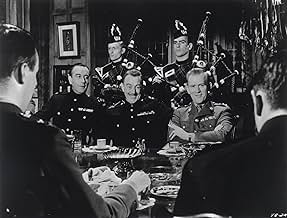
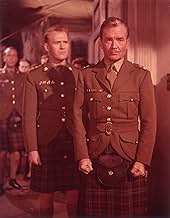
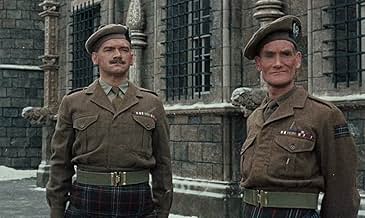
The more I watch this film, the more I appreciate the wealth of detailed characterization it contains. On Barrow's first meeting with the officers of the regiment, as he is introduced to the rotund Major "Dusty" Miller, note John Mills' quick downward glance of disapproval at the Major's corpulent gut. In the following scene, where Jock Sinclair offers Barrow a whiskey, Barrow courteously replies that whiskey does not agree with him, to Jock's dismay. We later learn that Barrow is emotionally unstable, has problems controlling his rage, and that his family life has broken up. Could alcoholism be an issue, explaining his aversion to whiskey? While Guinness and Mills are justly praised, I find the performance by Dennis Price as Major Charlie Scott to be very interesting as well. Bringing to mind Ralph Richardson, he exudes an oily, genteel but detached sort of upper-crust English manner that Colonel Sinclair gleefully mocks ("old boy, old boy, old boy"). When RSM Riddick (Percy Herbert, distractingly bringing to mind Michael Palin in appearance and exaggerated military manner) tries to officially express the doubts of those in his own strata in the military hierarchy about the prosecution of Jock Sinclair, Barrow's first reaction is curiously bemused and sarcastic ("you astonish me"). Barrow subsequently snaps into martinet mode and brusquely dismisses Riddick's petition. His initial bemusement, though, is telling in that his instinct is not to take this man, from a lower level of the social and military hierarchy, seriously at all, treating him almost as an unruly child who needs be put in his place. Having seen power struggles, personality clashes, and class divisions like this in my work experience, I see that this all rings true. As foreign, exotic, and strange as the setting, characters, and language are to an American like me, the themes of this story are so universal that they can be immediately appreciated by almost anyone who's experienced life to some degree.
As for the language, it's a delight to finally have a DVD with English subtitles to clarify some of the spoken lines. The picture, by the way, is excellent on the new DVD, except for the intermittent appearance of a dark streak down the right side of the screen near the end of the film. I would have thought this could be fixed with digital restoration, but the cost of that might have been prohibitive, and though a little distracting, it really doesn't spoil my enjoyment. I think it's fitting that there are no negative reviews here thus far.
What fine reviews
I would take issue with the reviewer who said that the Mills character would never have been given command. Clearly he had been highly educated, had a long and distinguished career in a headquarters job following a traumatic time as a POW of the Japanese. He would have at least earned some kind of moral right at the end of his career and in peacetime to be given the job that he believed he really wanted and might have thought to have been among friends. He would most likely have been highly respected owed favours and been able to pull strings. Had Jock Sinclair (Guinness) - unashamedly uneducated, rough and proud to have been educated in Barlinnie jail, Glasgow and deeply popular with his men not been the officer he replaced, most likely Colonel Barrow would have made a success of it. The whole entirely believable tragedy came about through the grotesque mischance that with these so different characters, one had to wrest command - and respect of the men - from the other. Colonel Barrow's fragility was only exposed when he tried to impose his English "civilising" ways on the one person whose whole being rejected them. Bad enough if it had been simply about class, here it was a battle for the Scottish soul. These deeper levels of conflict deriving from earlier historical intra-Scottish battles was suggested by one reviewer. The film tells a story which perhaps could have been set in almost any country with a strong military tradition - France. Germany, Japan etc rather like its near name-sake "Paths of Glory" by Stanley Kubrick set in WW1 France. Here though the central conflict presumably had very deep roots in Scottish ethnic and tribal history of clan wars, of Highlanders vs Lowlanders even of those supposed English-loving "traitors" who "sold" Scotland to "a parcel of rogues" (The English) in 1707. It may well be that for Sinclair, the entirely Anglicised Colonel Barrow (gin-drinking, aloof, distant and without a hint of a Scottish accent) represented exactly that kind of treacherous pseudo-Scot.
One reviewer describes it as "pure John Ford" leaving it unclear if he is suggesting that it was similar or derivative. With art in general, its lower and by definition least original forms ape others. This film does not ape any other - as already said the intensity of the conflict derives not just from class but from old old historical grievances between two intimately close nations. In "Old" Europe grievances and rivalries ran long and deep.
Just a rather sad footnote. One reviewer mentioned similarities to earlier John Ford/John Wayne movies. The entire John Wayne archive is to be seen on a continuously circulating basis on two of Britain's five national television channels State broadcaster the BBC and so-called public service broadcaster Channel 4. Yet in contrast Tunes of Glory has rarely been shown. It reappeared 2 years ago but in a poor quality print on a remote satellite channel which plays mainly public domain material. Many of Britain's fine vigorous quality films of the 1960s have never been shown at all on British television until a few months ago when again a very minor satellite channel started showing them: Otley, The Hireling, The Reckoning and others. I did not see them originally and it was revelation seeing the bold acting and directing talent which existed then and how sad is the current decline into the Lock Stock etc formulaic gangster stuff. Very curious indeed that great British films are not shown on the supposed British public service channels and it is left to small satellite channels Movies4Men and Simply Movies to show them. Very curious indeed. Public service broadcasting not in the service of the public.
The art of acting
Double Oscar Winners
The book is a slim volume, but is fast moving and full of character. Set in provincial Scotland, the flavour of the film is as strong as the novel (by James Kennaway who also wrote the screenplay) but the characterisation by the actors builds on and then surpasses the script. I note that neither of the actors is Scottish and this amazes me. Maybe I should seek advice from a Scot on this matter.
We never leave the barracks or the quiet army town and so learn only by rumour how Jock Sinclair, on some blasted field at the centre of El Alamein saved his regiment and turned the battle. Half the officers and men were dead, the cause lost, yet his spirit and the force of his will brought him a battlefield promotion to acting colonel. The Regiment is what he lives for.
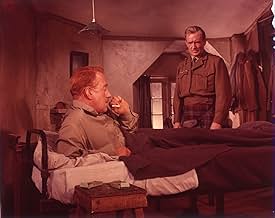
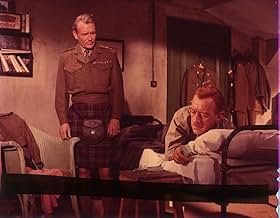
Several years later, in peacetime, the army catches up with its paperwork and sends a proper officer to take back the reins. Basil Barrow arrives unexpectedly from a desk job and Sandhurst. His assignment is to organise and civilise the men, long gone wild under Jock's supervision. John Mills plays the rather impotent lonely Barrow as an accentless and educated man. There are "dark rumours" amongst the men that he may be English.
The clash between the two men commences immediately on their meeting and ends in scenes of mourning and redemption.
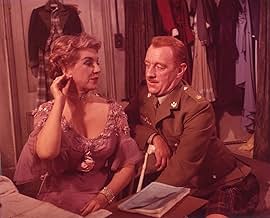
This is an actors film. There are few effects and much of the action is centred on one or the other of Guinness or Mills. Sinclair is a piper, this gives him an almost spiritual air and his feel for music (the Tunes of Glory) is the first area of contention between the two Colonels. When Jock leads his men in a wild and unruly reel with arms flailing and much shouting and yipping at a society ball the ensuing fit from the uptight and conservative Mills is wonderful. He trembles and shakes and we do likewise.
The film builds and builds to a finale full of Tunes of Glory and we come to an understanding about both men, as they come to understand each other.


Le saviez-vous
- AnecdotesSir Alec Guinness was offered the role of Lieutenant Colonel Barrow, but asked for the role of Major Sinclair instead. He then suggested Sir John Mills for the other role.
- GaffesPipe Major MacLean is never shown with a set of bagpipes. In particular, he is a mere observer at band practice. A pipe major is not only the leader of the band but also its chief instructor, and it is unthinkable that he would not play an active role in all practices.
- Citations
Major Jock Sinclair, D.S.O., M.M.: We're on a first name basis in this regiment. Your first name is Derek. My first name is Major.
- ConnexionsFeatured in Film Extra: Alec Guiness (1973)
Meilleurs choix
- How long is Tunes of Glory?Propulsé par Alexa
Détails
- Date de sortie
- Pays d’origine
- Langue
- Aussi connu sous le nom de
- Fanfare slave
- Lieux de tournage
- Stirling Castle, Stirling, Écosse, Royaume-Uni(establishing shots)
- sociétés de production
- Consultez plus de crédits d'entreprise sur IMDbPro
- Durée
- 1h 47m(107 min)
- Couleur
- Rapport de forme
- 1.66 : 1