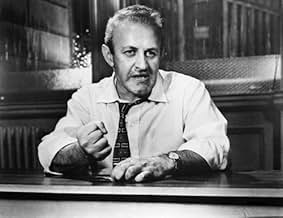
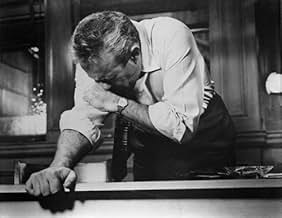
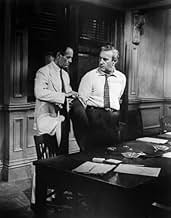
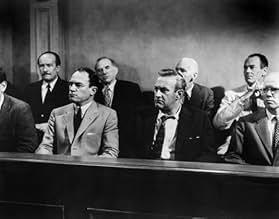
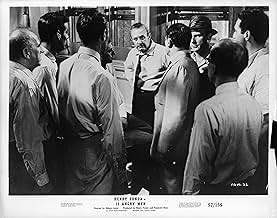
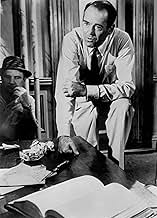
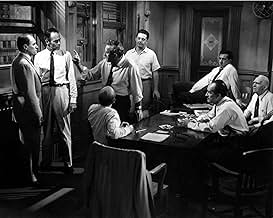
Un jury réfractaire tente d'empêcher une erreur judiciaire en forçant les autres jurys à réexaminer les preuves.Un jury réfractaire tente d'empêcher une erreur judiciaire en forçant les autres jurys à réexaminer les preuves.Un jury réfractaire tente d'empêcher une erreur judiciaire en forçant les autres jurys à réexaminer les preuves.
- Réalisation
- Scénariste
- Vedettes
- Nommé pour 3 oscars
- 16 victoires et 12 nominations au total
Tom Gorman
- Stenographer
- (uncredited)
James Kelly
- Guard
- (uncredited)
Billy Nelson
- Court Clerk
- (uncredited)
John Savoca
- The Accused
- (uncredited)
Walter Stocker
- Man Waiting for Elevator
- (uncredited)
9,0961K
1
2
3
4
5
6
7
8
9
10
Sommaire
Reviewers say '12 Angry Men' is acclaimed for its deep exploration of justice, prejudice, and reasonable doubt. The film is lauded for its strong ensemble cast, especially Henry Fonda's performance, and Sidney Lumet's impactful direction. Central themes include human nature, the justice system, and dialogue's power. Critics praise its engaging character interactions and moral dilemmas. Despite minor criticisms about character development and pacing, it is widely regarded as a timeless, relevant classic.
Avis en vedette
2 thumbs up!
I saw this movie 3 or 4 times, and each time, I remain speechless in front of such a masterpiece. An unforgettable acting game with poignant plot twists. Awesome!
I find this movie guilty of being a masterpiece.
Shot in real time, this story of a jury trying to decide whether a young man is innocent or guilty never lets the viewer's attention go. Henry Fonda plays Juror #8, who is convinced the entire time that the defendant is innocent, while everyone else has already called him guilty. Throughout the movie, we not only get to hear everyone's opinions on the matter, but also every possibility of the verdict. With "12 Angry Men", Sidney Lumet brought to the screen the same kind of "closing in" feeling that he brought to movies like "Network". In the end, the issue is not whether the defendant is innocent or guilty; the important point is the process by which the jurors reached their decision. This may be THE perfect movie.
What a Character-Study Is Meant to Be.
Intense courtroom drama which has 12 very different people, all males, struggling with a murder case involving a young Puerto Rican boy that seems cut-and-dried. However, juror Henry Fonda does not believe it to be as sure-fire as it appears. He votes not guilty and what follows is a chain of events that will test the views, beliefs and thoughts of the other 11 members. Fonda is great, but Lee J. Cobb steals every scene (and that is not easy to do in a film like this). Ed Begley, Martin Balsam, Jack Warden, Jack Klugman, Joseph Sweeney, E.G. Marshall and John Fiedler are among the other individuals caught in a situation that is much more difficult than it appears on the surface. An excellent character-study that should be studied and embraced by all present and future film-makers. 5 stars out of 5.
Flawless
Oh Boy Oh Boy, it Took me Seven years to Rewatch This Masterpiece, Damn why don't they make em like this Anymore.
No Dissonance
This film deserves to be on anyone's list of top films. My problem is that it is so perfect, so seamlessly polished, it is hard to appreciate the individual excellences.
The acting is top notch. I believe that monologue acting is quite a bit simpler than real reactive ensemble acting. Most of what we see today is monologues pretending to be conversations. But in this film, we have utter mastery of throwing emotions. Once the air becomes filled with human essence, it is hard to not get soaked ourselves as the camera moves through the thick atmosphere. Yes, there are slight differences in how each actor projects (Fonda internally, Balsam completely on his skin...) but the ensemble presents one vision to the audience.
The writing is snappy too. You can tell it was worked and worked and worried, going through several generations. It is easy to be mesmerized by this writing and acting, and miss the rare accomplishment of the camera-work. This camera is so fluid, you forget you are in one room. It moves from being a human observer, to being omniscient, to being a target. It is smart enough to seldom center on the element of most importance, so expands the field to all men.
This is very hard. Very hard, to make the camera human. So much easier to do what we see today -- acknowledge the machinery and jigger with it. Do we have a filmmaker today who could do this?
Ted's Evaluation -- 4 of 3: Every cineliterate person should experience this.
The acting is top notch. I believe that monologue acting is quite a bit simpler than real reactive ensemble acting. Most of what we see today is monologues pretending to be conversations. But in this film, we have utter mastery of throwing emotions. Once the air becomes filled with human essence, it is hard to not get soaked ourselves as the camera moves through the thick atmosphere. Yes, there are slight differences in how each actor projects (Fonda internally, Balsam completely on his skin...) but the ensemble presents one vision to the audience.
The writing is snappy too. You can tell it was worked and worked and worried, going through several generations. It is easy to be mesmerized by this writing and acting, and miss the rare accomplishment of the camera-work. This camera is so fluid, you forget you are in one room. It moves from being a human observer, to being omniscient, to being a target. It is smart enough to seldom center on the element of most importance, so expands the field to all men.
This is very hard. Very hard, to make the camera human. So much easier to do what we see today -- acknowledge the machinery and jigger with it. Do we have a filmmaker today who could do this?
Ted's Evaluation -- 4 of 3: Every cineliterate person should experience this.
Le saviez-vous
- AnecdotesDirector Sidney Lumet had the actors all stay in the same room for several hours on end and do their lines over and over without filming them. This was to give them a real taste of what it would be like to be cooped up in a room with the same people.
- GaffesWithin the last half hour of the movie, the clock on the wall in the jury room can be seen indicating 6:15. Several minutes later, E.G. Marshall states that it is "a quarter after six". Several minutes after that, the wall clock is seen again, but still shows 6:15. Still later, when Lee J. Cobb leans over the table after he tears up the snapshot from his wallet, his watch can be seen indicating 5:10.
- Citations
Juror #8: Let me ask you this: Do you really think the boy'd shout out a thing like that so the whole neighborhood could hear him? I don't think so - he's much too bright for that.
Juror #10: Bright? He's a common ignorant slob. He don't even speak good English.
Juror #11: [who has a foreign accent] He *doesn't* speak good English.
- Générique farfeluAt the end of the film, the actors are billed in order of their juror numbers; thus Henry Fonda, although the star of the film, appears 8th.
- Autres versionsThe United Artists logo is plastered with black and white versions of the MGM/UA Communications Co./1987 United Artists logo in the 1990 VHS, and 1994 variant in the DVD. But in the 2008 DVD and some TV prints, it featured the colorized opening and closing MGM logos.
- ConnexionsEdited into Voskovec & Werich - paralelní osudy (2012)
Meilleurs choix
Connectez-vous pour évaluer et surveiller les recommandations personnalisées
Everything New on Prime Video in December
Your guide to all the new movies and shows streaming on Prime Video in the US this month.
Détails
- Date de sortie
- Pays d’origine
- Langue
- Aussi connu sous le nom de
- 12 Angry Men
- Lieux de tournage
- société de production
- Consultez plus de crédits d'entreprise sur IMDbPro
Box-office
- Budget
- 350 000 $ US (estimation)
- Brut – à l'échelle mondiale
- 2 945 $ US
- Durée
- 1h 36m(96 min)
- Couleur
- Mixage
- Rapport de forme
- 1.85 : 1
Contribuer à cette page
Suggérer une modification ou ajouter du contenu manquant