ÉVALUATION IMDb
7,6/10
5,9 k
MA NOTE

Ajouter une intrigue dans votre langueA man wanders aimlessly away from his town, away from the woman he loves, emotionally and socially inactive.A man wanders aimlessly away from his town, away from the woman he loves, emotionally and socially inactive.A man wanders aimlessly away from his town, away from the woman he loves, emotionally and socially inactive.
- Réalisation
- Scénaristes
- Vedettes
- Prix
- 3 victoires et 2 nominations au total



Gabriella Pallotta
- Edera, her sister
- (as Gabriella Pallotti)


Jacqueline Jones
- Andreina
- (as Lyn Shaw)


Pietro Corvelatti
- Fisherman
- (uncredited)

Elli Parvo
- Donna Matilda
- (uncredited)
7,65.8K
1
2
3
4
5
6
7
8
9
10
Avis en vedette
alienation and the modern man
Known as "The Outcry" in the U.S. A wonderful if disturbing film about alienation and modern society. Not for those who like bouncy, happy films.
The great though relatively forgotten American actor Steve Cochran is near perfect as the worker who finds he cannot communicate, with those he loves, and so begins a downward spiral towards a state of mental disintegration. What is interesting are the Marxist and Freudian overtones that Antonioni puts on the character. The protagonist as the result of his economic position in a capitalist society ( he only has his labour to sell) is uprooted from his community and therefore alienated from his environment, and so becomes alienated from those he loves. The harder he tries the more he withdraws until he perceives he can suffer no more.
Cochran always was very good at playing "heavies" or "playboys", and here he manages to bring both to his underdog character who is strong, brutish and handsome. At the same time he manages to convey the loneliness and vulnerability the character lives through showing that those attributes are not enough to survive.
Antonioni directs with a sure hand a picture of a successful, postwar, industrial Italy where everything is not as easy as it seems. Needless to say the film is in black and white and photographed in grainy neo realist style. The landscapes, in true Antonioni fashion, are bleak, and the loneliness and isolation from others is reflected in the distance between buildings. The leisured pacing, adds to the feeling that life drags on without change.
Antonioni's characters normally, as his films L'eclisse and Red Desert, as with fellow Italian directors Fellini and De Sica during the same period, usually have uncertain futures, as if there is a hidden side to Italy's postwar economic miracle. Here, it's as if the protagonist has a manifest destiny from which there is no redemption.
The great though relatively forgotten American actor Steve Cochran is near perfect as the worker who finds he cannot communicate, with those he loves, and so begins a downward spiral towards a state of mental disintegration. What is interesting are the Marxist and Freudian overtones that Antonioni puts on the character. The protagonist as the result of his economic position in a capitalist society ( he only has his labour to sell) is uprooted from his community and therefore alienated from his environment, and so becomes alienated from those he loves. The harder he tries the more he withdraws until he perceives he can suffer no more.
Cochran always was very good at playing "heavies" or "playboys", and here he manages to bring both to his underdog character who is strong, brutish and handsome. At the same time he manages to convey the loneliness and vulnerability the character lives through showing that those attributes are not enough to survive.
Antonioni directs with a sure hand a picture of a successful, postwar, industrial Italy where everything is not as easy as it seems. Needless to say the film is in black and white and photographed in grainy neo realist style. The landscapes, in true Antonioni fashion, are bleak, and the loneliness and isolation from others is reflected in the distance between buildings. The leisured pacing, adds to the feeling that life drags on without change.
Antonioni's characters normally, as his films L'eclisse and Red Desert, as with fellow Italian directors Fellini and De Sica during the same period, usually have uncertain futures, as if there is a hidden side to Italy's postwar economic miracle. Here, it's as if the protagonist has a manifest destiny from which there is no redemption.
Echo of Winterreise
Other reviews to the contrary, if you found Le Notte or L'Eclisse lacked sufficient plot, I doubt you'll enjoy Il Grido. However, unlike later Antonioni, the focus here is not on fear of commitment & loss of passion, but on a classic spurned lover. Like L'Eclisse, Il Grido begins with breakup, magnificently acted & powerfully filmed; we feel each shudder of pain. In fact, both films' power rests on us sharing this experience, second by second, nerve-end by nerve-end. Note Irma's efforts to hold to the fabric of order & routine to keep a lid on Aldo's fury & the careful portrayal of Aldo's frustrations.
Il Grido's opening builds to a very public & final breakup. It initiates Aldo's journey away from Irma & home. I kept thinking of Schubert's song cycle, Winterreise. In both, after rejection the protagonist's world ceases to hold together. Only here the descent isn't into winter but into fog, industrial sprawl, & ever more spartan existence. Even the piano which accompanies Aldo reminded me of lieder.
The opening's not quite picturesque scenery may suggest nurturing home values. Unlike couples in other Antonioni classics, Aldo & Irma have a daughter, & to Aldo their lives seemed fulfilled. The almost picturesque is soon replaced by encroaching industrial sounds & images. Several times we see trees felled as an old order is being swept away. At film's end, the whole town is slated for demolition, & we are asked to contemplate the relation between the Winterreise-like main text of lost love & this subtext of industrial sprawl & oppressive, intrusive government. No clear connection is given, but as in later Antonioni, the images work their effect as much on our subconscious as on our intellect; whether we can verbalize our thoughts or not, we feel this rupture with earlier values & social structures. For me, Il Grido is a more honest film than L'Avventura. If it lacks a bit of the elegant, refined photo compositions of Antonioni's trilogy, it rests on the same detailed, carefully structured cinematography.
Il Grido's opening builds to a very public & final breakup. It initiates Aldo's journey away from Irma & home. I kept thinking of Schubert's song cycle, Winterreise. In both, after rejection the protagonist's world ceases to hold together. Only here the descent isn't into winter but into fog, industrial sprawl, & ever more spartan existence. Even the piano which accompanies Aldo reminded me of lieder.
The opening's not quite picturesque scenery may suggest nurturing home values. Unlike couples in other Antonioni classics, Aldo & Irma have a daughter, & to Aldo their lives seemed fulfilled. The almost picturesque is soon replaced by encroaching industrial sounds & images. Several times we see trees felled as an old order is being swept away. At film's end, the whole town is slated for demolition, & we are asked to contemplate the relation between the Winterreise-like main text of lost love & this subtext of industrial sprawl & oppressive, intrusive government. No clear connection is given, but as in later Antonioni, the images work their effect as much on our subconscious as on our intellect; whether we can verbalize our thoughts or not, we feel this rupture with earlier values & social structures. For me, Il Grido is a more honest film than L'Avventura. If it lacks a bit of the elegant, refined photo compositions of Antonioni's trilogy, it rests on the same detailed, carefully structured cinematography.
Depressing and slow but still quite good.
Some folks watching "Il Grido" might be surprised to see some Americans in this Italian film. In the 1950s and 60s, quite a few Italian directors (such as Antonioni and Fellini) cast Americans and had them dubbed into Italian. Most were second and third tier actors at the time (such as Steve Cochran, Richard Basehart and Anthony Quinn) but later even some big name stars performed in the Italian films (such as Burt Lancaster). I think the reason they did this was to attempt to increase the marketability of the movies outside of Italy--and these stars would help.
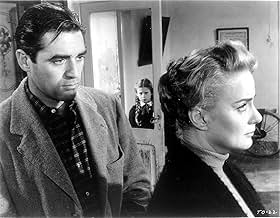
The film begins with Irma (Alida Valli) learning that her husband is dead. He apparently has been gone for many years and the interim she's been living with Aldo (Steve Cochran). They even have a child together. Here's the odd part, however, now that she knows she's a widow, she tells Aldo to leave! He is not at all happy and eventually he disappears along with his daughter. For the rest of the film, Aldo and his daughter move from town to town. However, Aldo has difficulty connecting with other women and he rejects opportunity after opportunity for relationships. Instead, he remains socially isolated and depressed.
Overall, you'll probably find this film a bit slow and depressing. While this is usually a big turn-off, it actually works here. Director Antonioni wants to create a depressing portrait of a lost man and does it quite well. The simple piano score sure helps with this. Not a film for everyone but exceptionally well made.
By the way, at one point in the film, you see folks saying they caught a couple porcupines and were going to eat them. These actually were hedgehogs--you never would hold porcupines the way they did nor do I think you'd eat them! This is simply a mistranslation.
The film begins with Irma (Alida Valli) learning that her husband is dead. He apparently has been gone for many years and the interim she's been living with Aldo (Steve Cochran). They even have a child together. Here's the odd part, however, now that she knows she's a widow, she tells Aldo to leave! He is not at all happy and eventually he disappears along with his daughter. For the rest of the film, Aldo and his daughter move from town to town. However, Aldo has difficulty connecting with other women and he rejects opportunity after opportunity for relationships. Instead, he remains socially isolated and depressed.
Overall, you'll probably find this film a bit slow and depressing. While this is usually a big turn-off, it actually works here. Director Antonioni wants to create a depressing portrait of a lost man and does it quite well. The simple piano score sure helps with this. Not a film for everyone but exceptionally well made.
By the way, at one point in the film, you see folks saying they caught a couple porcupines and were going to eat them. These actually were hedgehogs--you never would hold porcupines the way they did nor do I think you'd eat them! This is simply a mistranslation.
Emptiness and Search
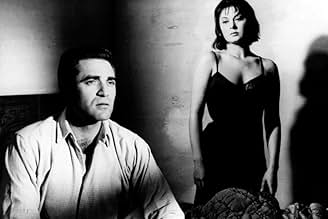
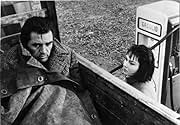
After living seven years with the mechanic Aldo (Steve Cochran), having a daughter with him, the simple woman Irma (Alida Valli) is informed that her absent husband had just died in Sydney. She becomes upset when Aldo proposes to marry her and she tells him that she is going to leave him. Unable to explain how much he loves her, Aldo takes their daughter Rosina (Mirna Girardi) and travels with her, meeting different women in different places, trying to establish a new relationship and fill the emptiness of his sentimental life. He visits his former lover Elvia (Betsy Blair); he meets and lives with the widow Virginia (Dorian Gray), who owns a gas station; he lives with the prostitute Andreina (Lynn Shaw). But these relationships never complete the needy Aldo.
Michelangelo Antoniani is the filmmaker of the troubled relationships and "Il Grido" is a depressive story of a worker seeking a woman to fulfill the emptiness of his sentimental life after his seven year mate breaks their marriage. Without possessions, he needs to work to survive with his daughter while trying to live with another woman, in a sad and tragic story. My vote is eight.
Title (Brazil): "O Grito" ("The Cry")
Michelangelo Antoniani is the filmmaker of the troubled relationships and "Il Grido" is a depressive story of a worker seeking a woman to fulfill the emptiness of his sentimental life after his seven year mate breaks their marriage. Without possessions, he needs to work to survive with his daughter while trying to live with another woman, in a sad and tragic story. My vote is eight.
Title (Brazil): "O Grito" ("The Cry")
Aldo's way
Aldo's way takes him through the northern Italian region he knew in his youth. Gianni di Venanzo's photography is superb, capturing the bleak atmosphere of small towns: houses run down, cheap gas stations, a school in the middle of nowhere. There is nobody like Antonioni for portraying empty spaces leading nowhere.
Aldo is as confused a character as one can find in European cinema. His life with Irma is over-she doesn't love him anymore-but he insists on moving on with his daughter. Elvia and her sex pot sister Edera offer no shelter to this man, who can't afford to bring up a child. He gets lucky, it seems with Virginia and her crazy dad at the gas station, but still he manages to alienate her. The last stop is a rundown shack with a prostitute. The four actresses--Alida Valli, Betsy Blair, Dorian Grey and Lyn Shaw--all play well. Steve Cochran at least has the advantage of a sturdy build even if his acting skills are limited.
If Il grido is not as fine as L'avventura or Le amiche from the early period, it is still very good work.
Aldo is as confused a character as one can find in European cinema. His life with Irma is over-she doesn't love him anymore-but he insists on moving on with his daughter. Elvia and her sex pot sister Edera offer no shelter to this man, who can't afford to bring up a child. He gets lucky, it seems with Virginia and her crazy dad at the gas station, but still he manages to alienate her. The last stop is a rundown shack with a prostitute. The four actresses--Alida Valli, Betsy Blair, Dorian Grey and Lyn Shaw--all play well. Steve Cochran at least has the advantage of a sturdy build even if his acting skills are limited.
If Il grido is not as fine as L'avventura or Le amiche from the early period, it is still very good work.


Le saviez-vous
- AnecdotesMichelangelo Antonioni's first collaboration with his future muse and lover, Monica Vitti. Although Vitti doesn't physically appear in the film, she dubbed the Italian lines for Dorian Gray.
- GaffesToutes les informations contiennent des divulgâcheurs
- ConnexionsFeatured in Cinéma Paradiso (1988)
Meilleurs choix
Connectez-vous pour évaluer et surveiller les recommandations personnalisées
- How long is Il Grido?Propulsé par Alexa
Détails
Box-office
- Brut – États-Unis et Canada
- 16 549 $ US
- Fin de semaine d'ouverture – États-Unis et Canada
- 6 536 $ US
- 10 nov. 2024
- Brut – à l'échelle mondiale
- 17 413 $ US
- Durée
- 1h 56m(116 min)
- Couleur
Contribuer à cette page
Suggérer une modification ou ajouter du contenu manquant