

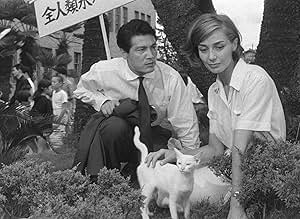
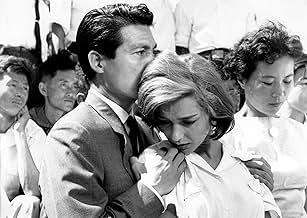
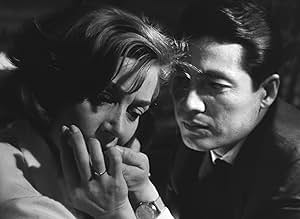
Une actrice française qui tourne un film contre la guerre à Hiroshima a une aventure avec un architecte japonais marié au cours de laquelle ils échangent leurs points de vue différents sur l... Tout lireUne actrice française qui tourne un film contre la guerre à Hiroshima a une aventure avec un architecte japonais marié au cours de laquelle ils échangent leurs points de vue différents sur la guerre.Une actrice française qui tourne un film contre la guerre à Hiroshima a une aventure avec un architecte japonais marié au cours de laquelle ils échangent leurs points de vue différents sur la guerre.
- Réalisation
- Scénariste
- Vedettes
- Nommé pour 1 oscar
- 7 victoires et 7 nominations au total



7,838.7K
1
2
3
4
5
6
7
8
9
10
Avis en vedette
Persistence of Memory
"Hiroshima mon amour" (1959) is an extraordinary tale of two people, a French actress and a Japanese architect - a survivor of the blast at Hiroshima. They meet in Hiroshima fifteen years after August 6, 1945 and become lovers when she came there to working on an antiwar film. They both are hunted by the memories of war and what it does to human's lives and souls. Together they live their tragic past and uncertain present in a complex series of fantasies and nightmares, flashes of memory and persistence of it. The black-and-white images by Sasha Vierney and Mikio Takhashi, especially the opening montage of bodies intertwined are unforgettable and the power of subject matter is undeniable. My only problem is the film's Oscar nominated screenplay. It works perfectly for the most of the film but then it begins to move in circles making the last 20 minutes or so go on forever.
Deep, beautiful, devastating, extremely personal cinema
In my previous paper I said that À bout de souffle was an extremely complicated movie. Well, if we compare it to Resnais' Hiroshima, mon amour, it just seems to be a skilled aesthetic exercise. I think Resnais takes a further step in modern cinema intermingling influences from surrealism, modernism and the New Wave of French cinema: intimate topics, deep and changing characters, oneirism, unclear limits between reality and mind. His movie is a skilled masterpiece that really needs to be seen twice since its symbolism and action are extremely interwoven. Personally, I felt somewhat frustrated the first time I saw it. Indeed, I find that Resnais style in this film is too extreme in some ways. He twists action and mixes reality with memories in a way that makes the spectator lose his/her way once and again. On top of that, most usually action is extremely slow -quite the contrary of his colleague Godard- and takes are extremely long. Truffaut did shoot this kind of scenes, but his were also agile, attractive. Resnais is slow, exasperating, boring. We must think however that Hiroshima mon amour is a literary film, a long shot poem. The script is a literary work of art by Marguerite Duras. Indeed, dialogs are like lines in a poem, rhythmically broken, slow, as if they were declaimed instead of simply said. Resnais complements this poetry inserting strongly lyric scenes of the Japanese people and the city of Hiroshima and playing around with meaningful light, as we will see later. In my opinion, the main topic of this film is memories and how a forgotten dark past can shape our present and determine our future. Basically, the film tells the story of a woman who has gone through a painful experience in his youth: she loved a German soldier during the occupation of Nevers, her hometown in France. This caused despise from her family and her community. This is a story that she has not told ever before. But an affair with a Japanese man while she shoots a film in Hiroshima will wake up her memories. The Japanese man recalls her of her first love; let us remember for instance, when she remembers the German man hand when she sees the Japanese's -both of them have a similar hair style and color. At some point in the film, the Japanese will grow more interested in her life in Nevers -he thinks the key to win her love is there- and this will unleash harsh flashbacks in the French woman's memories. She has never told anyone: as she talks out, articulates her memories -while they are at the bar- she will experience very strong feelings. We cannot differentiate what she was feeling at the moment of the story or what she is feeling now, what is a fact and what is a memory. I find very interesting the scene in which they sit together at the bar: at some point she takes the Japanese man for her old love. She begins talking to him as if he was so. Her memories take her over and she talks what she feels, what she remembers. Light effects are magical: she is drowned in brightness while the Japanese man stays in the dark. She talks and talks and Resnais inserts the necessary flashback images. The Japanese at that moment acts as the voice of her own memory: he asks her once and again. Until a point when she suffers so dramatically that the Japanese man, the real one, slaps her in her face to wake her up. Now we find a sharp kind of awakening. While she talked everything was silent. Now, everything sound as what it is: a bar with people chattering and frogs in the dark stream outside. There are four main elements in the film that spin around the life of the French girl, whose name we do not know. Two cities: Nevers and Hiroshima. And two men: the German soldier and the Japanese man. There is a whole system of connections between these four elements in the center of which is her. Resnais uses the powerful image of Hiroshima, the sadness of the place and grief of the people to identify the sadness and grief of the Frecn girl at Nevers. On the other side, the Japanese man reminds her of the German soldier. There is not an exact parallelism between the two cities or the two men, but connections can be made. We must remember the images of the streets in Hiroshima and the images of Nevers -la Place de la République, the churches-, flowing at the same time. The beautiful but empty Loire, the dead fields of Hiroshima. Although we can see some parallelism between the two cities, Resnais ends up the film with a scene in which this relationship seems to be much stronger. 'Toi, ton nom est Hiroshima. - Et toi, ton nom est Nevers, en France'. However, I cannot figure out what is the exact relationship between the two cities: maybe a comparison between grief in the memory and actual grief in the present day. Whatever way it might be, Resnais leaves for us a cryptic, dark ending that we would have to figure out the best we can depending on the elements he has given us in the film.
10RunPepe
A complex view of humans and how they cope when their worlds become tragic
This film has been compared to "Citizen Kane," not because of the story itself, but the way it is told, and through innovative artistic devices. The screenplay is highly poetic even when describing destruction, death, and madness. Several jump cuts in time occur with voice-over, and, at the beginning, voice-over during a montage of frightening images from the aftermath of the Hiroshima bombing and the bodies of the two lovers in bed. The characters represent different cities; the Japanese man, Hiroshima, the French woman, a city in France, Nevers (was this intentional?), but the latter might as well represent any outside nation. While "Hiroshima," even after being destroyed by an "ally" of France, falls in love with her and wants her to stay, despite his claims that she can never know what the bombing was really like, yet leaving this in the past without forgetting, "France" is hung up on a dead Nazi soldier whom she had loved, and became an outcast because of it. What the soldier really seems to represent is not the Nazis, but rather a real, true love that transcended nationalities and associations. France's past is personal and fears forgetting it, while Hiroshima's is communal and, while not wanting to forget, also wants to move ahead. For this reason Hiroshima keeps trying to convince France to stay so that they can be in love, but France is too preoccupied with its own personal ghost that it cannot share, which is why it is a major breakthrough for her when she tells her tragic story for the first time to anyone, Hiroshima. Hiroshima's past tragedy being communal is shared and it wants to share with the rest of the world. France's tragedy is personal and is only beginning to be shared. It takes the entire film before the two characters can get to a beginning of something more than their differences and likenesses of tragedy and loss in the past, and this beginning is who they really are, in the present, two people reborn from these tragedies.
A Poem
It's nearly impossible to talk about "Hiroshima, Mon Amour" in the same language I use to talk about other films. Even people used to international cinema may find themselves somewhat boggled by this visual tone poem. It's beautiful, and it leaves a distinct impression, but it does so in the way that a striking and unexpected image would, not in the way that an accessible film narrative would. Therefore, it interests without ever fully engaging.
To say that Resnais' film has something in common with silent cinema would be misleading, because sound certainly matters. But the movie definitely feels like a piece of non-verbal cinema, where sensation matters more than cognition.
A movie I probably need to see again to truly appreciate.
Grade: A
To say that Resnais' film has something in common with silent cinema would be misleading, because sound certainly matters. But the movie definitely feels like a piece of non-verbal cinema, where sensation matters more than cognition.
A movie I probably need to see again to truly appreciate.
Grade: A
A beautiful piece of film making that sets itself apart from other new wave films
The comparison between heart break and the Hiroshima bombing is beautiful. The film is about the pain of memories forgotten and remembered. Just as the pain of lost love will be forgotten so too have the horrors of Hiroshima. The scars will always be there but that feeling of pain and isolation as the world celebrates while you mourn will be lost in the past. Lui is helping to rebuild Hiroshima as an architect and Elle has fled Nevers, the place of her love affair with a German soldier. The film represents Frech New Wave in it's reaction against the Hollywood style. The plot is reminiscent of Brief Encounter and Casablanca (they even go to a bar called Casablanca at one point) but the films style is vastly different. Action will jump in time while conversation remains the same, the story jumps around chronologically and we are often unsure of where precisely in time we are. The reason it sets itself apart from other new ave films is it's use of style. Jump cuts and screwing with the chronology are not used because they can be but for a purpose. The chronology is off because the scenes are memories acting like real memories and flowing randomly. The cuts help accentuate how little time these two lovers have with each other before they will be parted. An excellent film well-deserved of it's excellent reputation.


Le saviez-vous
- AnecdotesThis film pioneered the use of jump cutting to and from a flashback, and of very brief flashbacks to suggest obtrusive memories.
- GaffesWhen Elle leaves the hotel to go the set, she is wearing a nurse's uniform with a headscarf and carrying a black handbag. When Lui meets her on the set, she is now wearing a skirt and blouse and still has the headscarf. When they leave the set, the headscarf is left behind. When they get to Lui's house, she now has a white jacket.
- ConnexionsEdited into Histoire(s) du cinéma: Le contrôle de l'univers (1999)
Meilleurs choix
Connectez-vous pour évaluer et surveiller les recommandations personnalisées
- How long is Hiroshima Mon Amour?Propulsé par Alexa
Détails
- Date de sortie
- Pays d’origine
- Langues
- Aussi connu sous le nom de
- Hiroshima Mon Amour
- Lieux de tournage
- Nevers, Nièvre, France(street scenes, river banks)
- sociétés de production
- Consultez plus de crédits d'entreprise sur IMDbPro
Box-office
- Brut – États-Unis et Canada
- 96 439 $ US
- Fin de semaine d'ouverture – États-Unis et Canada
- 18 494 $ US
- 19 oct. 2014
- Brut – à l'échelle mondiale
- 139 947 $ US
- Durée
- 1h 30m(90 min)
- Couleur
- Mixage
- Rapport de forme
- 1.37 : 1
Contribuer à cette page
Suggérer une modification ou ajouter du contenu manquant