ÉVALUATION IMDb
6,9/10
18 k
MA NOTE

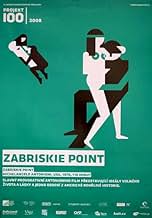
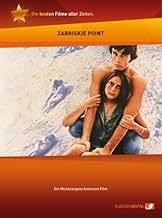
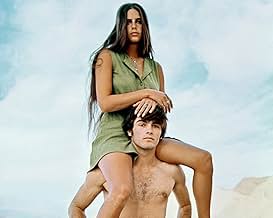
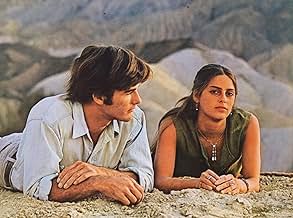
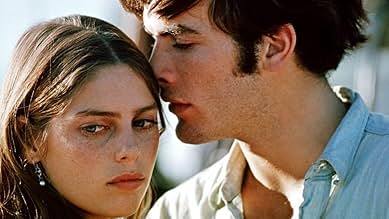
Deux parfaits inconnus font connaissance: lui rêveur et elle jeune étudiante hippie, ils se lancent dans une romance effrénée, faisant l'amour sur le sol poussiéreux de Zabriskie Point.Deux parfaits inconnus font connaissance: lui rêveur et elle jeune étudiante hippie, ils se lancent dans une romance effrénée, faisant l'amour sur le sol poussiéreux de Zabriskie Point.Deux parfaits inconnus font connaissance: lui rêveur et elle jeune étudiante hippie, ils se lancent dans une romance effrénée, faisant l'amour sur le sol poussiéreux de Zabriskie Point.
- Réalisation
- Scénaristes
- Vedettes
- Prix
- 1 victoire et 1 nomination au total





Martin Abrahams
- Radical student
- (uncredited)
Michael L. Davis
- Police lieutenant on loudspeaker
- (uncredited)
Lee Duncan
- Highway patrolman
- (uncredited)

George Dunn
- Airport mechanic
- (uncredited)
Dennis Falt
- University student
- (uncredited)

Harrison Ford
- Arrested student
- (uncredited)
Jim Goldrup
- College student
- (uncredited)

Norman Grabowski
- Man in Deli
- (uncredited)

Bill Hickman
- Gun store owner
- (uncredited)
- …

Kenner G. Kemp
- Departing Plane Passenger
- (uncredited)
Peter Lake
- Documentary cameraman
- (uncredited)
6,917.9K
1
2
3
4
5
6
7
8
9
10
Avis en vedette
California dreaming
I was told it was one of those "either you love it or you hate it" movies. Well, I loved it. Obvious hippie-era, dated and easy symbolism and all. So, I probably have no taste at all when it comes to Antonioni, but this and La Notte (made exactly a decade earlier) are my favourites among his movies so far. Made two years before I was born, Zabriskie Point was supposed to have been Michelangelo's great American epic. But apparently, it turned out to be a flop. I really can't see why. Before watching it I'd read that it was rather boring, so I braced myself for a very slow movie - though I love me a slow movie. For my taste, Zabriskie didn't have a tedious minute in it. While watching it, I made a mental note of how European it was on the director's part to make such frequent use of advertisement billboards in almost every urban scene, enormous billboards dwarfing any human form in sight. This recurrent visual element is obviously there to underline the way that consumerism crushes the individual in American society. But then I watched L'Eclisse straight afterwards, which is set in Rome in the early 60s, and noticed that Antonioni often included billboards in it as well. After all, the masterful use of landscapes, architecture and inanimate objects in each frame with or without human beings is an Antonioni trademark this is precisely the way that he evokes his characters' psychological states, with more or less understated power and great visual impact. He is virtually unsurpassed in this skill.
Zabriskie Point starred two very appealing leads that should have become big stars of the 70s, but never did. Mark Frechette, whom I'd already seen in Francesco Rosi's fine WWI-set movie Uomini Contro, had a very tragic life and died aged just 27. According to his biography page, he donated his $60,000 earnings from Zabriskie to a commune. Mark's co-star Daria Halprin, apparently also Dennis Hopper's wife later on, has the stunning, natural beauty and appeal of a young Ornella Muti one of those luminous beauties that don't need a shred of make-up to turn heads. Like Frechette, she has only graced a couple of obscure movies and has never become a star, but at least she didn't die tragically. Most notably, Zabriskie Point contains one of the most original sex scenes ever filmed - one that brings home a sense of youthful playfulness like few I've seen - as well as a powerfully cathartic ending. It may be the most banal sequence ever filmed as far as its symbolism goes, but I can't see how anyone can deny its beauty and wonderful sense of emotional release. Never has an explosion looked so good, and so poetic. It seems to be an explosion that restores order rather than bringing chaos.
Zabriskie Point starred two very appealing leads that should have become big stars of the 70s, but never did. Mark Frechette, whom I'd already seen in Francesco Rosi's fine WWI-set movie Uomini Contro, had a very tragic life and died aged just 27. According to his biography page, he donated his $60,000 earnings from Zabriskie to a commune. Mark's co-star Daria Halprin, apparently also Dennis Hopper's wife later on, has the stunning, natural beauty and appeal of a young Ornella Muti one of those luminous beauties that don't need a shred of make-up to turn heads. Like Frechette, she has only graced a couple of obscure movies and has never become a star, but at least she didn't die tragically. Most notably, Zabriskie Point contains one of the most original sex scenes ever filmed - one that brings home a sense of youthful playfulness like few I've seen - as well as a powerfully cathartic ending. It may be the most banal sequence ever filmed as far as its symbolism goes, but I can't see how anyone can deny its beauty and wonderful sense of emotional release. Never has an explosion looked so good, and so poetic. It seems to be an explosion that restores order rather than bringing chaos.
Has its merits but essentially bland
I must admit, it's been (around) 2 years since I last saw Zabriskie Point...
For some reason it's never totally left my conscience yet generally for all the wrong reasons. While the cinematography is certainly impressive throughout I found that the whole ordeal just dragged, and dragged...and dragged, literally to the point of tedium. In the first instance then, Zabriskie Point is clearly suffering from pace, or lack of. The 'desert' or 'love' scene being a prime example of this - it's not art; it's not even vaguely artistic - but mundane and self indulgent. The gorgeous and sweltering locales of the desert are what's worth noting here; not two young protagonists who appear to share little, if no, connection.
In that respect it would seem that most people's opinions of Zabriskie Point are either deeply 'for' it or very much 'against' it. Were the 60s really like this?! Zabriskie Point seems to linger on too many stereotypes and while films such as Easy Rider managed to successful capture the ambience of counter-culture 1960s America Zabriskie Point falls just a bit short. Antonioni certainly knows how to lay-on some thick anti-establishment slurs but it's just so blatantly obvious and very hard to believe. On the plus side, the documentary-esque footage at the start of the film does help to give off a very 'real' vibe and is duly convincing. The acting, or lack of, is apt to an extent but hardly noteworthy. This is the frustrating element - it just seems to try so hard and has now gained a small reputation of being somewhat of a 'cult classic' but it's not justified. For those who try to read what they want to read into a film for the sake of art or intellect; those who subsequently look for hidden meanings that aren't there - maybe try this. If I wanted to do that I'd happily watch El Topo - not that I would ever compare the two.
Oh, did I mention Pink Floyd contributed to the soundtrack perhaps one of the only serious redeeming qualities here. Thanks Dave and Roger.
6/10
For some reason it's never totally left my conscience yet generally for all the wrong reasons. While the cinematography is certainly impressive throughout I found that the whole ordeal just dragged, and dragged...and dragged, literally to the point of tedium. In the first instance then, Zabriskie Point is clearly suffering from pace, or lack of. The 'desert' or 'love' scene being a prime example of this - it's not art; it's not even vaguely artistic - but mundane and self indulgent. The gorgeous and sweltering locales of the desert are what's worth noting here; not two young protagonists who appear to share little, if no, connection.
In that respect it would seem that most people's opinions of Zabriskie Point are either deeply 'for' it or very much 'against' it. Were the 60s really like this?! Zabriskie Point seems to linger on too many stereotypes and while films such as Easy Rider managed to successful capture the ambience of counter-culture 1960s America Zabriskie Point falls just a bit short. Antonioni certainly knows how to lay-on some thick anti-establishment slurs but it's just so blatantly obvious and very hard to believe. On the plus side, the documentary-esque footage at the start of the film does help to give off a very 'real' vibe and is duly convincing. The acting, or lack of, is apt to an extent but hardly noteworthy. This is the frustrating element - it just seems to try so hard and has now gained a small reputation of being somewhat of a 'cult classic' but it's not justified. For those who try to read what they want to read into a film for the sake of art or intellect; those who subsequently look for hidden meanings that aren't there - maybe try this. If I wanted to do that I'd happily watch El Topo - not that I would ever compare the two.
Oh, did I mention Pink Floyd contributed to the soundtrack perhaps one of the only serious redeeming qualities here. Thanks Dave and Roger.
6/10
An Italian in California: a technical masterpiece with sub-par substance
There aren't too many times when I see a film and go, "huh, what?", but this was one of them. Maybe after seeing Zabriskie Point I felt much the same way Woody Allen felt after seeing 2001- he only liked the film after seeing it three times over a two year period, realizing the filmmaker was ahead of him in what was going on. Michelangelo Antonioni, in one of his few tries at making films inside of the US (after Red Desert, he did Blow-Up, this film, China, and The Passenger, all filmed outside his native Italy), I could sense he almost tried to learn about the ways of the country through his own mastery of the medium. The results show that he doesn't lack the means to present images, feelings, tones, colors, sounds, and a visual representation of this era. "A director's job is to see", Antonioni once stated. Whatever that means, he doesn't disappoint for the admirer of his post-fifties work (I say post-fifties since I've yet to see any of his films from before L'Avventura).
What he does lack is a point, at least the kind of point that he could bring in Blow-Up and The Eclipse. You get the feeling of what is around these characters, what the themes are bringing forth to their consciousness, however in this case the characters and the actors don't bring much conviction or purpose. Antonioni, coming from the school of hard-knocks, neo-realistic film-making, does do what he can with his mostly non-professional cast (those who look most like real actors are subjugated to the roles of the corporate characters), but the two stars Mark Frechette and Daria Halprin seem as if Antonioni's under-directing them. Perhaps that was the point. The story's split into three acts, thankfully not too confusing, as Mark escapes his existence around the boiling, dangerous campus life going on in the circa late 60's LA area, and Daria is sent out from LA to drive to Phoenix for some business meeting. They meet by chance as Mark's plane (how does he know how to drive, maybe a little background info there?) and Daria's car meet up, and they spend some time together in an existential kind of groove out in the desert. Aside from a stylistically mesmerizing if bizarre sex scene, much of this act isn't terribly interesting.
The two leads are fair enough to look at, but what exactly draws them to each other outside of curiosity? The ideas that come forth (in part from a screenplay co-written by Sam Shepard) aren't too revealing, except for one brief instant where drugs vs. reality is brought up. Then the film heads towards the third act, as Mark decides to do the right thing, under disastrous circumstances, and Daria arrives at her boss' place, only to be in full disillusionment (not taking into account the infamous last five minutes or so of the film). Although the film took its time telling its story, I didn't have as much of a problem with that as I did that the story only engages a certain kind of viewer. I understand and empathize with the feelings and doubts and fears as well as the self-confidence of the "anti-establishment", but maybe Antonioni isn't entirely fully aware of it himself. In some scenes he as director and editor (and the often astounding cinematography by Alfio Contini) find the scenery and backgrounds more enlightening and fixating than the people in the foreground. Not to say the technical side of Zabriskie Point isn't involving to a degree (this may make some feel drowsy, as Antonioni is probably far greater as a documentary filmmaker as he is a theatrical director like say Francis Ford Coppola is).
The deserts, skies, city, and even the faces in close-ups are filmed with the eye of a filmmaker in love with the art of getting things in the frame, bringing us in. The soundtrack is equally compelling, with a master stroke including a sweet Rolling Stones song at one point, and then a crushing, surreal Pink Floyd song (re-titled from 'Careful with that Axe Eugene, one of their best pre-Dark Side) in the explosion sequence. If only the performances weren't so one-sided I might find this to be on par with Blow-Up or The Eclipse. It's an unconventional stroke of genius on one hand, and on the other a boring take on what was the hippie/radical movement of the late 60's. But hey, what may be boring for an American such as myself born in the eighties may not be to others outside the US, such as say, Italy. And it does ask to not be discarded right away after one viewing.
What he does lack is a point, at least the kind of point that he could bring in Blow-Up and The Eclipse. You get the feeling of what is around these characters, what the themes are bringing forth to their consciousness, however in this case the characters and the actors don't bring much conviction or purpose. Antonioni, coming from the school of hard-knocks, neo-realistic film-making, does do what he can with his mostly non-professional cast (those who look most like real actors are subjugated to the roles of the corporate characters), but the two stars Mark Frechette and Daria Halprin seem as if Antonioni's under-directing them. Perhaps that was the point. The story's split into three acts, thankfully not too confusing, as Mark escapes his existence around the boiling, dangerous campus life going on in the circa late 60's LA area, and Daria is sent out from LA to drive to Phoenix for some business meeting. They meet by chance as Mark's plane (how does he know how to drive, maybe a little background info there?) and Daria's car meet up, and they spend some time together in an existential kind of groove out in the desert. Aside from a stylistically mesmerizing if bizarre sex scene, much of this act isn't terribly interesting.
The two leads are fair enough to look at, but what exactly draws them to each other outside of curiosity? The ideas that come forth (in part from a screenplay co-written by Sam Shepard) aren't too revealing, except for one brief instant where drugs vs. reality is brought up. Then the film heads towards the third act, as Mark decides to do the right thing, under disastrous circumstances, and Daria arrives at her boss' place, only to be in full disillusionment (not taking into account the infamous last five minutes or so of the film). Although the film took its time telling its story, I didn't have as much of a problem with that as I did that the story only engages a certain kind of viewer. I understand and empathize with the feelings and doubts and fears as well as the self-confidence of the "anti-establishment", but maybe Antonioni isn't entirely fully aware of it himself. In some scenes he as director and editor (and the often astounding cinematography by Alfio Contini) find the scenery and backgrounds more enlightening and fixating than the people in the foreground. Not to say the technical side of Zabriskie Point isn't involving to a degree (this may make some feel drowsy, as Antonioni is probably far greater as a documentary filmmaker as he is a theatrical director like say Francis Ford Coppola is).
The deserts, skies, city, and even the faces in close-ups are filmed with the eye of a filmmaker in love with the art of getting things in the frame, bringing us in. The soundtrack is equally compelling, with a master stroke including a sweet Rolling Stones song at one point, and then a crushing, surreal Pink Floyd song (re-titled from 'Careful with that Axe Eugene, one of their best pre-Dark Side) in the explosion sequence. If only the performances weren't so one-sided I might find this to be on par with Blow-Up or The Eclipse. It's an unconventional stroke of genius on one hand, and on the other a boring take on what was the hippie/radical movement of the late 60's. But hey, what may be boring for an American such as myself born in the eighties may not be to others outside the US, such as say, Italy. And it does ask to not be discarded right away after one viewing.
A hippie's pretentious odyssey through "decadent", capitalist America.
Antonioni, by making this film, had assumed the role of Papa Smurf to all the little long-haired, American, radical student-Smurfs. He had taken them under the guiding protection of his European communist wings, showing appreciation and support for their confused American ways. (These Smurfs are red and wear blue, not the other way around.) The radical Smurfs were happy to get the guidance of a wise old man with gray hair who regularly preys to the God of all long-haired Smurfs, Lenin the Communist - another wise old man whose beard made the Smurfs take him even more seriously, for it symbolized something wise, though they did not quite know why they regarded the beard to have this kind of deep effect on them. Castro, another wise bearded man, has often profited from this confusion and exuded magical powers with his beard over his naive overseas admirers. (Not to mention Che Guevara: that beard has a certain je-ne-sais-pas-quoi about it, makes one want to immediately embrace Marx and his lovely, pacifistic teachings
) The film starts with a muddled meeting of radically stupid radical students, who engage in dialogues that truly redefine the word "confused". As confused as a blind-folded dog falling of a high-story building into a bottomless pit. Suddenly, the movie's "hero" (well, Antonioni's hero) rises up and says something to his pathetic left-wing peers and then leaves, hoping that this display of "mega-coolness" will improve his James Dean image and vastly increase his chances of getting laid with the best "chicks" in the next mass hippie orgy. Eventually he gets into trouble with cops (i.e. pigs) at a rally, and spends the movie under the blue American capitalist skies, looking for freedom
Or something like that.
Antonioni's predictable assault on capitalism is not only intellectually hollow, but has (or had) nothing new to offer; it's just the same old trigger-happy one-dimensional cops, businessmen discussing business deals (and what's wrong with that, isn't that how Antonioni's movies get made?), and endless shots of TV commercials and billboards advertising the oh-so morally decadent products for the abhorrent, selfish, and greedy right-wing rabble-population who thinks of no one but themselves, their families, their work, and their children.
Papa Smurf Antonioni, just like his long-haired Smurfs and Smurfettes of the late 60s, failed to notice the most obvious and vital aspect about their silly movement: they were allowed to have their laughable meetings and express their anti-establishment opinions freely within that very establishment, whereas the students in those countries whose left-wing systems they admired, did not (and still do not). By far the greatest irony about the hippies - and Antonioni, naturally, failed to realize this as well (his judgment being clouded by cocaine-snorting and an excessive intake of LSD) - is that hippies were (are) the garbage-residue of capitalism. This is an incredible irony. Only in a successfully-functioning capitalist system can you find that species called "hippie"; a spoiled, ungrateful, and selfish bunch of middle and upper-middle class losers.
The film itself seems to go on forever. Antonioni takes his sweet time with getting on with it, while including overlong scenes of pointlessness, with a high dullness factor. His attempts at symbolism are annoying and trite. His statements are highly dubious, at best. This film is Antonioni's way of saying that violent revolution is the solution. And this is what we get from an old, saturated, filthy-rich, fat film-maker who lives in villas and dines in the best French and Italian restaurants.
I don't remember seeing any major Western movie about the Tiananmen massacre of thousands of students in China. But when one Western student gets shot for waving Che Guevara's face into all our faces, we get ten major films about it at once. I suppose this means that a Chinese life is worth a thousand times less than a Western one at least to the left-wing hypocrites who infest movies.
If you're a Marxist neo-hippy and disliked this awful review, please klick "NO" below.
Antonioni's predictable assault on capitalism is not only intellectually hollow, but has (or had) nothing new to offer; it's just the same old trigger-happy one-dimensional cops, businessmen discussing business deals (and what's wrong with that, isn't that how Antonioni's movies get made?), and endless shots of TV commercials and billboards advertising the oh-so morally decadent products for the abhorrent, selfish, and greedy right-wing rabble-population who thinks of no one but themselves, their families, their work, and their children.
Papa Smurf Antonioni, just like his long-haired Smurfs and Smurfettes of the late 60s, failed to notice the most obvious and vital aspect about their silly movement: they were allowed to have their laughable meetings and express their anti-establishment opinions freely within that very establishment, whereas the students in those countries whose left-wing systems they admired, did not (and still do not). By far the greatest irony about the hippies - and Antonioni, naturally, failed to realize this as well (his judgment being clouded by cocaine-snorting and an excessive intake of LSD) - is that hippies were (are) the garbage-residue of capitalism. This is an incredible irony. Only in a successfully-functioning capitalist system can you find that species called "hippie"; a spoiled, ungrateful, and selfish bunch of middle and upper-middle class losers.
The film itself seems to go on forever. Antonioni takes his sweet time with getting on with it, while including overlong scenes of pointlessness, with a high dullness factor. His attempts at symbolism are annoying and trite. His statements are highly dubious, at best. This film is Antonioni's way of saying that violent revolution is the solution. And this is what we get from an old, saturated, filthy-rich, fat film-maker who lives in villas and dines in the best French and Italian restaurants.
I don't remember seeing any major Western movie about the Tiananmen massacre of thousands of students in China. But when one Western student gets shot for waving Che Guevara's face into all our faces, we get ten major films about it at once. I suppose this means that a Chinese life is worth a thousand times less than a Western one at least to the left-wing hypocrites who infest movies.
If you're a Marxist neo-hippy and disliked this awful review, please klick "NO" below.
A Rare Treat
About two hundred members of a Cleveland, Ohio USA film society, named Cinematheque, gathered on August 19, 2000 to view a pristine Cinemascope print of Michelangelo Antonioni's 1970 film, "Zabriskie Point." Cinematheque Director John Ewing, who does a superlative job of obtaining the finest prints for his series, shared with the audience beforehand that this print was specially flown over from Italy for this one showing only.
The audience was held spellbound as the film unfolded its artisty on the huge panoramic screen. Watching this superb print, shown the way Antonioni intended, made one aware that this is indeed a modern art work. It was all the more fitting that the series is housed in the Cleveland Insititue of Art in University Circle.
Antonioni's compositions are created for the Cinemascope landscape. His beautiful balancing of images, striking use of colors, sweeping choreographic movements, all are the work of a genuine artist, using the screen as his canvas.
At last the audience could understand "Zabriskie Point." As its narrative unfolded, it became obvious that this work is not about story per se, but rather an artist's impressionistic rendering of fleeting images of his subject. The setting of some of the more turbulent activities of the sixties provides only a dramatic motor for the artist's sweeping collage.
Antonioni is not bound by conventional narrative standards, and can pause at any point to creatively embroider an event with grandiose embellishments. The audience willingly went with the flow of his remarkable imagination, as his huge images on the massive canvas held one in rapt attention. While the audience may have been only tangentially involved in character relationships, it realized the theme here is human aleination, the director's recurring theme.
It was also realized that no print any smaller or of lesser quality than this original one in Cinemascope can do justice to this particular rendering. The audience was therefore all the more appreciative of viewing "Zabriskie Point" in its original, breathtaking format, and broke into thunderous applause at the end.
The audience was held spellbound as the film unfolded its artisty on the huge panoramic screen. Watching this superb print, shown the way Antonioni intended, made one aware that this is indeed a modern art work. It was all the more fitting that the series is housed in the Cleveland Insititue of Art in University Circle.
Antonioni's compositions are created for the Cinemascope landscape. His beautiful balancing of images, striking use of colors, sweeping choreographic movements, all are the work of a genuine artist, using the screen as his canvas.
At last the audience could understand "Zabriskie Point." As its narrative unfolded, it became obvious that this work is not about story per se, but rather an artist's impressionistic rendering of fleeting images of his subject. The setting of some of the more turbulent activities of the sixties provides only a dramatic motor for the artist's sweeping collage.
Antonioni is not bound by conventional narrative standards, and can pause at any point to creatively embroider an event with grandiose embellishments. The audience willingly went with the flow of his remarkable imagination, as his huge images on the massive canvas held one in rapt attention. While the audience may have been only tangentially involved in character relationships, it realized the theme here is human aleination, the director's recurring theme.
It was also realized that no print any smaller or of lesser quality than this original one in Cinemascope can do justice to this particular rendering. The audience was therefore all the more appreciative of viewing "Zabriskie Point" in its original, breathtaking format, and broke into thunderous applause at the end.


Le saviez-vous
- AnecdotesAntonioni met with Jim Morrison during early production to ask for a musical contribution to the soundtrack. Morrison and the Doors provided "L'America" which Antonioni then rejected.
- GaffesZabriskie Point, in Death Valley National Park (California, USA) is not actually the lowest-elevation point in the United States. That would be Badwater Basin, at a depth of 282 feet below sea level, which is also located in Death Valley National Park about 20 miles away.
- Citations
[booking a protester]
Cop: Occupation?
William S. Polit, protester: Associate professor of history.
Cop: That's too long, Bill. I'll just put down clerk.
- Autres versionsIn the original version, the song that's playing when Daria drives away at the very end and over the closing "End" title card is a Roy Orbison song, but in the 1984 MGM/UA Home Video version it's a continuation of the Pink Floyd song. The 1991 MGM/UA Home Video version restores the Orbison song.
- ConnexionsEdited into Histoire(s) du cinéma: La monnaie de l'absolu (1999)
Meilleurs choix
Connectez-vous pour évaluer et surveiller les recommandations personnalisées
- How long is Zabriskie Point?Propulsé par Alexa
Détails
Box-office
- Budget
- 7 000 000 $ US (estimation)
- Brut – à l'échelle mondiale
- 84 879 $ US
- Durée
- 1h 53m(113 min)
- Mixage
- Rapport de forme
- 2.35 : 1
Contribuer à cette page
Suggérer une modification ou ajouter du contenu manquant