

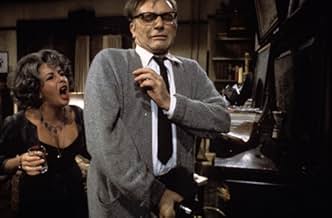
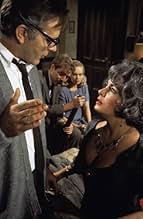
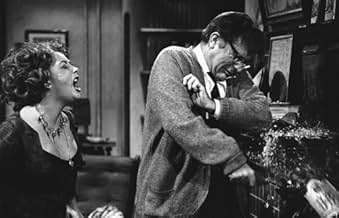
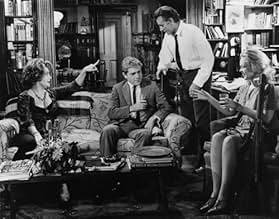
Un couple amer et vieillissant, l'alcool aidant, se sert d'un jeune couple pour alimenter l'angoisse et la douleur émotionnelle qu'ils ressentent l'un envers l'autre.Un couple amer et vieillissant, l'alcool aidant, se sert d'un jeune couple pour alimenter l'angoisse et la douleur émotionnelle qu'ils ressentent l'un envers l'autre.Un couple amer et vieillissant, l'alcool aidant, se sert d'un jeune couple pour alimenter l'angoisse et la douleur émotionnelle qu'ils ressentent l'un envers l'autre.
- Réalisation
- Scénaristes
- Vedettes
- A remporté 5 oscars
- 22 victoires et 26 nominations au total


8,083.4K
1
2
3
4
5
6
7
8
9
10
Avis en vedette
10Rathko
Perfect Movie-making
An undisputed classic that chronicles every appalling moment of a drunken night in hell as middle-aged George and Martha tear each other, and their guest, to pieces.
Elizabeth Taylor proves categorically that she was a truly great actress. Her Oscar-winning performance as the psychologically tormented Martha is one of the greatest performances in the history of cinema. Taylor's imperceptible shifting from sadism to tenderness, from bullying condescension to exhausted vulnerability, is a masterclass in character building. Martha is a truly monstrous character, and yet Taylor is able to imbue her with sympathy, allowing you brief glimpses of the warm and lovable woman she could have been.
Richard Burton is equally magnificent as George; an ageing, failing college professor whose initial meekness gives way to a raging torment all of his own. His verbal sparring with Taylor, like two pit-bulls in the ring of an endless and bloody dogfight, has become legendary. Every word drips with malice and contempt, every sentence is designed to cut the deepest wound. At times, it becomes painful to watch, but like true train-wreck television, you cannot drag yourself away from the inevitably terrible conclusion.
Quite possibly, this is as close to perfect as movies can get; beautifully written dialogue, deeply complex characters, an evolving and suspenseful storyline, beautiful photography, and a wonderfully understated score by Alex North. Nominated for 13 Academy Awards in 1967, but lost out to A Man for All Seasons and Born Free to win only 5.
"Who's Afraid of Virginia Woolf?" "I am."
Elizabeth Taylor proves categorically that she was a truly great actress. Her Oscar-winning performance as the psychologically tormented Martha is one of the greatest performances in the history of cinema. Taylor's imperceptible shifting from sadism to tenderness, from bullying condescension to exhausted vulnerability, is a masterclass in character building. Martha is a truly monstrous character, and yet Taylor is able to imbue her with sympathy, allowing you brief glimpses of the warm and lovable woman she could have been.
Richard Burton is equally magnificent as George; an ageing, failing college professor whose initial meekness gives way to a raging torment all of his own. His verbal sparring with Taylor, like two pit-bulls in the ring of an endless and bloody dogfight, has become legendary. Every word drips with malice and contempt, every sentence is designed to cut the deepest wound. At times, it becomes painful to watch, but like true train-wreck television, you cannot drag yourself away from the inevitably terrible conclusion.
Quite possibly, this is as close to perfect as movies can get; beautifully written dialogue, deeply complex characters, an evolving and suspenseful storyline, beautiful photography, and a wonderfully understated score by Alex North. Nominated for 13 Academy Awards in 1967, but lost out to A Man for All Seasons and Born Free to win only 5.
"Who's Afraid of Virginia Woolf?" "I am."
"...total war..."
WHOS's AFRAID OF VIRGINIA WOOLF? is a drama film with the elements of black comedy, that on the violent and honest way indicates marital frustration and psyche, through the alcoholism, aging, cynicism and sterility. A dangerous double game becomes more intense and urgency with environmental changes. Simply, we are going through an intimate experience, which is seasoned with an excellent acting. The problem occurs in the moment, when we realize, how much is this experience, as a matter of fact, sincere and painful.
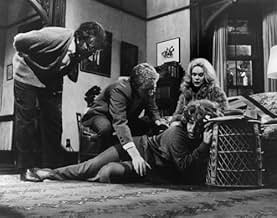
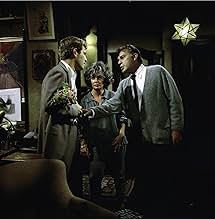
George, an associate history professor at a small New England college, and Martha, the daughter of the university president, live in an unstable and violent marriage. After they return home drunk from a party, Martha reveals she has invited a young married couple, whom she'd met at the party, for a drink. Their guests are Nick, a biology professor, and his wife, Honey. The hosts are engaged in a cruel verbal duel. The younger couple is first embarrassed and later enmeshed. After an evening of a sadistic, perversely hilarious and dangerous clashes", a painful truth comes to the light.
Mr. Nichols keeping his camera close, so that, violent emotions, defeats and cramps on the faces of the actors come to the fore. The direction is excellent, because it is very difficult to draw the line between passion borders and boundaries of a nervous breakdown. The characters are lost in a futile and desperate struggle, which celebrates a kind of demonic love in an attempt to save a bad marriage.
The characterization is excellent and fully corresponds with sharp dialogues and gloomy atmosphere.
Elizabeth Taylor as Martha is definitely a major figure in this film with her acceptance of gray hair and her use of profanity. It is difficult to accept that such a beautiful face hides a violent and so crazed but again, fragile and deeply wounded character. Richard Burton as George is worthy as a her counterweight. He is not a victim, he is the husband who is tired of everything, while he tries to put all the things in the right place. The couple has offered an excellent performance.
George Segal as Nick is a young man who moves between confusion, arrogance and dominance in their relations. Sandy Dennis as Honey is his bland wife. She is not up to this unscrupulous game.
This is a brutal clash between unhappy spouses who move the boundaries of inhumanity, while they skillfully flee from the truth.
George, an associate history professor at a small New England college, and Martha, the daughter of the university president, live in an unstable and violent marriage. After they return home drunk from a party, Martha reveals she has invited a young married couple, whom she'd met at the party, for a drink. Their guests are Nick, a biology professor, and his wife, Honey. The hosts are engaged in a cruel verbal duel. The younger couple is first embarrassed and later enmeshed. After an evening of a sadistic, perversely hilarious and dangerous clashes", a painful truth comes to the light.
Mr. Nichols keeping his camera close, so that, violent emotions, defeats and cramps on the faces of the actors come to the fore. The direction is excellent, because it is very difficult to draw the line between passion borders and boundaries of a nervous breakdown. The characters are lost in a futile and desperate struggle, which celebrates a kind of demonic love in an attempt to save a bad marriage.
The characterization is excellent and fully corresponds with sharp dialogues and gloomy atmosphere.
Elizabeth Taylor as Martha is definitely a major figure in this film with her acceptance of gray hair and her use of profanity. It is difficult to accept that such a beautiful face hides a violent and so crazed but again, fragile and deeply wounded character. Richard Burton as George is worthy as a her counterweight. He is not a victim, he is the husband who is tired of everything, while he tries to put all the things in the right place. The couple has offered an excellent performance.
George Segal as Nick is a young man who moves between confusion, arrogance and dominance in their relations. Sandy Dennis as Honey is his bland wife. She is not up to this unscrupulous game.
This is a brutal clash between unhappy spouses who move the boundaries of inhumanity, while they skillfully flee from the truth.
Still powerful, harrowing view of the "Anti-Ozzie and Harriet"
This is still an exceptional film from the 1960s. Though some of the epithets are obviously softening much stronger words, the language is frank and brutal, Martha's bludgeoning body-blows balanced by George's icepick thrusts. Edward Lehman's respectful screenplay gently opens up Edward Albee's one-set play while keeping a certain claustrophobic atmosphere. Mike Nichols' first directing effort is stunning in its lack of artifice; rarely do you feel that the director has done much more than turn on the camera and watch four actors, all at the top of their game, tear into their roles. George Segal's work in this movie is criminally underrated, but his reactive work as studly, ultimately disappointing Nick should be mandatory study by all young actors. Sandy Dennis' fluttery turn as mousy, wifey Honey is powerful also; a lot more is going on than you might think. Richard Burton is staggering as George ("Georgie Porgie Put-upon Pie"), and his performance demonstrates the magic that he could bring to a worthy role. Elizabeth Taylor's work here still astounds. The physical transformation she undertook to become aging harpy Martha is amazing enough, but her performance seems to channel a hurricane's force and fury. By turns hilarious, maddening and then, at the end, exhausted and defeated yet again, Taylor demonstrates acting, particularly film acting, at its best. The film is by no means easy or "Hollywood" in feel-- the audience is as exhausted as the characters at the end. But this was a bracing, necessary antidote to the impossible ideal of marriage usually portrayed in the movies. A towering film.
Best acting you'll ever see
Who's afraid of Virgina Wolf? contains what I would call the most outstanding old school actor/audience experience I'ver ever seen. This movie is 131 minutes long and only contains 5 actors, on of which hardly gets any screen time and the two leading characters played by the famous couple Richard Burton and Elizabeth Taylor are on screen almost the whole time. Also this movie only contains a couple of locations so the whole project depends almost entirely on these two actors superb performance. The two of them fight almost the entire movie and it never gets boring for a second. Well, I gave this movie ten stars..... definitely a classic must see if you're interested in acting.
One of the greatest
Simply put, this is one of my favourite films of all time. Great acting, great writing and great camerawork make this close to cinematic perfection. Liz Taylor and Richard Burton give the performances of their lives. Sandy Dennis also shines in an early-ish role. It's a dramatic film, but the wicked humour that permeates the film is absolutely devastating, and I mean that in the best possible way. Many moments in the film I find myself laughing only to think, "Should I be laughing at this." Certainly the film is loaded with uncomfortable moments, enhanced by the camerawork replete with uneasy close-ups. Most of all, this film shows how a lot can be accomplished with just a little: a cast of four and minimal scenery changes. "Who's Afraid Of Virginia Woolf" has become an absolute icon of American cinema. If you haven't seen it, what are you waiting for?


Le saviez-vous
- AnecdotesThis became the first movie in Academy Awards history since La Ruée vers l'Ouest (1931) to be nominated for every Academy Award category in which it was eligible, including Best Adapted Screenplay (Ernest Lehman), Director (Mike Nichols), all of the acting categories (Richard Burton, Dame Elizabeth Taylor, George Segal and Sandy Dennis) and Picture of the Year (Ernest Lehman).
- GaffesThe four characters stop at a bar after the first soiree at George's house. It is clearly after 2:00 a.m., since the time was stated during the first segment. No bars, however, would have been open after 1 or 2 a.m. in the New England states, where the film is set.
- ConnexionsEdited from The Letter (1940)
- Bandes originalesWho's Afraid of Virginia Woolf?
(to the tune of "Here We Go Round the Mulberry Bush")
Traditional English melody
Original lyrics ("Who's Afraid of the Big Bad Wolf?") by Frank Churchill and Ann Ronell; modified by Edward Albee
Performed by Elizabeth Taylor
Meilleurs choix
Connectez-vous pour évaluer et surveiller les recommandations personnalisées
Détails
- Date de sortie
- Pays d’origine
- Langues
- Aussi connu sous le nom de
- Who's Afraid of Virginia Woolf?
- Lieux de tournage
- Cambridge, Massachusetts, États-Unis(location)
- sociétés de production
- Consultez plus de crédits d'entreprise sur IMDbPro
Box-office
- Budget
- 7 500 000 $ US (estimation)
- Brut – États-Unis et Canada
- 28 000 000 $ US
- Brut – à l'échelle mondiale
- 28 007 258 $ US
- Durée
- 2h 11m(131 min)
- Couleur
- Mixage
- Rapport de forme
- 1.85 : 1
Contribuer à cette page
Suggérer une modification ou ajouter du contenu manquant